

Most financial advisors assume prospecting is a numbers game. Call more people, send more emails, and the clients will come. That's the misconception that keeps too many advisors stuck in low-conversion cycles. What is advisor prospecting explained properly? It's a disciplined, trust-building process that combines the right timing, compliant communication, and smart use of technology to connect with prospects when they're actually ready to act. This article breaks down what prospecting in finance really means, which techniques move the needle, and how to build a system that generates consistent growth.
Table of Contents
- Key Takeaways
- What advisor prospecting explained actually means
- The timing-first approach to prospecting
- Practical advisor prospecting techniques and tools
- Compliance in advisor prospecting in 2026
- Building a repeatable prospecting system
- My honest take on what actually works
- How Mastermindadvisormarketing helps you prospect better
- FAQ
Key Takeaways
| Point | Details |
|---|---|
| Timing drives conversions | Reaching prospects during life or wealth events produces far higher conversion rates than fixed outreach schedules. |
| Compliance is non-negotiable | SEC marketing rule enforcement in 2026 targets testimonials, endorsements, and performance claims with real consequences. |
| Referrals need structure | Nearly half of advisors say referrals deliver the best ROI, yet most lack a formal program to generate them consistently. |
| AI enhances, not replaces | AI tools improve lead quality and efficiency, but the human relationship is still what closes new clients. |
| Systems beat sporadic effort | A repeatable prospecting system built around event tracking, CRM data, and regular cadence outperforms ad hoc outreach every time. |
What advisor prospecting explained actually means
The industry term for this practice is simply prospecting. In financial services, it refers to the systematic process of identifying, qualifying, and initiating contact with potential clients. What is advisor prospecting explained in plain terms? It's how you fill your pipeline before someone becomes a client.
Here's where most advisors go wrong. They treat prospecting and marketing as interchangeable. They're not. Marketing creates awareness and attracts interest. Prospecting is the active, deliberate pursuit of a specific person or group who fits your ideal client profile. Marketing brings people into your orbit. Prospecting is what you do once they're there, or when you decide to go find them directly.
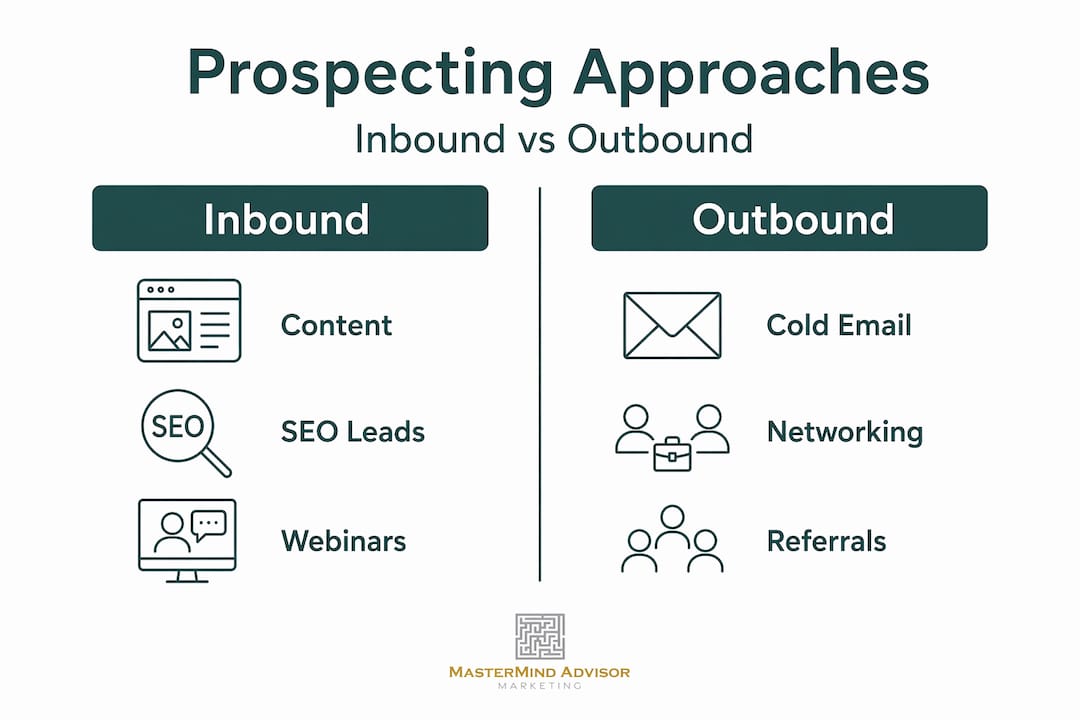
Prospecting in finance has two primary modes:
- Outbound prospecting: You initiate contact. Cold calls, direct mail, targeted emails, LinkedIn outreach, seminar invitations. You choose the prospect and make the first move.
- Inbound prospecting: The prospect shows interest first, through your content, website, referral, or event, and you follow up with a deliberate engagement process.
Neither mode works well in isolation. Outbound without inbound is exhausting and inefficient. Inbound without outbound is passive and slow. The strongest advisors run both tracks simultaneously, using each to feed the other.
The deeper purpose of prospecting is not lead generation. It's relationship initiation. You're not trying to sell a product on the first touch. You're trying to earn enough trust that a conversation about financial planning feels natural and welcome. That reframe changes everything about how you approach it.
The timing-first approach to prospecting
Here is the single biggest insight separating top-performing advisors from everyone else. Warm leads convert at significantly higher rates when advisors reach out during active decision windows triggered by financial or life events. Not when you decide to reach out. When they are in motion.
Think about what opens a genuine decision window for a prospect:
- A job change or executive role transition
- The sale of a business or partial liquidity event
- An inheritance or death in the family
- A real estate transaction, especially a primary residence purchase or sale
- A divorce or remarriage
- Retirement or the approach of retirement age
- A child reaching college enrollment age
Each of these moments forces a person to think about money differently. Their existing arrangements may no longer fit. They have questions. They're open to guidance. Outreach during these windows lands completely differently than a cold email in the middle of a Tuesday with no context.
The flip side is equally true. Outbound prospecting underperforms when it's disconnected from any triggering event, no matter how polished the message. You can have perfect personalization, a strong offer, and a great track record, and still get ignored if the prospect has no reason to act right now.

This is why warm introductions are so powerful. A referral from someone a prospect already trusts isn't just a warm lead. It's a timed introduction. The act of being referred often coincides with a conversation about money, which means the prospect is already in a receptive state when you call.
Pro Tip: Set up Google Alerts, LinkedIn job change notifications, or a tool like Aidentified for your top prospect segments. When a wealth event triggers, your outreach arrives at exactly the right moment instead of being lost in the noise.
Common mistakes advisors make with timing: they reach out once during an event window and give up when they don't hear back. They miss the fact that conversion requires persistent multi-touch engagement, not a single perfect message. One touch is curiosity. Five touches over relevant time intervals is relationship building.
Practical advisor prospecting techniques and tools
Advisor prospecting techniques fall into two broad categories: those that rely on direct human effort and those that use technology to scale and qualify that effort. The best prospecting strategies for advisors use both.
| Technique | Best for | Key consideration |
|---|---|---|
| Cold outreach (phone/email) | Reaching untapped segments quickly | Close rates are very low without follow-up cadence |
| Content marketing (blogs, podcasts, videos) | Building authority and inbound flow | Consistency over months, not weeks |
| Referral programs | Highest-quality leads with built-in trust | 52% of advisors lack formal systems |
| Educational seminars and events | Engaging qualified prospects in person | Requires proper compliance review of materials |
| AI-assisted lead tools | Scaling outreach and qualifying leads faster | AI improves quality, but human follow-through is irreplaceable |
A few things worth unpacking here. Content marketing, specifically podcasts, has become one of the more underutilized tools in advisor client acquisition. A well-produced financial advisor podcast positions you as a trusted authority before you ever speak directly with a prospect. They arrive at your first conversation already familiar with how you think.
On referrals: 48% of financial professionals say networking and referrals produce the highest ROI of any prospecting channel. Yet most advisory firms treat referrals as something that happens to them rather than something they actively generate. A formal referral program with scripts, timing triggers, and thank-you protocols turns an occasional windfall into a repeatable pipeline source.
CRM management is where all of this comes together. Your CRM isn't just a contact database. It's a prospecting engine when you configure it to log wealth events, track outreach dates, and flag follow-up windows. Tracking event types and outreach timing in your CRM creates a feedback loop that shows you which events and follow-up sequences actually produce clients.
Pro Tip: When building your referral process, script three specific moments to ask for introductions: after a positive account review, after you solve an unexpected problem, and after a client mentions that a friend or family member is going through a wealth event.
Compliance in advisor prospecting in 2026
Advisor marketing explained without covering compliance is like explaining driving without mentioning traffic laws. Compliance isn't separate from your prospecting strategy. It is part of it.
SEC marketing rule enforcement in 2026 focuses heavily on three areas: client testimonials, endorsements, and performance advertising. If you're using any of these in your prospecting materials, you need to know the rules in detail. Here's what the SEC requires and where advisors typically run into trouble:
- Testimonials and endorsements must include clear, prominent disclosures about whether the reviewer is a current client, whether they were compensated, and any material conflicts of interest.
- Performance claims in prospecting materials must meet strict presentation standards, including showing gross and net returns and comparing against an appropriate benchmark.
- Documentation and due diligence are not optional. Regulators expect advisors to have records showing they reviewed third-party content, verified its accuracy, and confirmed it meets the rule's requirements.
- Retroactive compliance does not work. Trying to add disclosures after the fact exposes advisors to heightened scrutiny. Embedding compliance controls into daily workflows from the start is what winning firms do.
- Social media prospecting falls under the same rules. A LinkedIn post featuring a client's success story is a testimonial under the marketing rule, full stop.
Advisors who get this right don't just avoid regulatory headaches. They build trust. A prospect who sees that your marketing is transparent, specific, and honest about limitations is far more likely to trust you with their money than one who sees vague success stories with no context. Compliant client testimonials can be one of your most powerful prospecting tools when used correctly.
Building a repeatable prospecting system
Understanding best practices for advisor prospecting means nothing without a system that runs whether you're inspired or not. Here's how to build one:
- Build a tiered prospect database. Segment prospects by fit score, event status, and relationship stage. Tier 1 prospects with active wealth events get weekly touches. Tier 3 prospects stay on a quarterly nurture sequence.
- Log every wealth event. When you hear that a prospect sold their business, changed jobs, or listed their home, log it immediately with a date. That date becomes the anchor for your outreach cadence.
- Develop a multi-touch sequence for each event type. A business sale event might trigger a seven-touch sequence over 30 days: an email, a call, a LinkedIn message, a personal note, a second call, an article share, and an invitation to an event.
- Automate the repeatable parts. Email scheduling, CRM reminders, and lead scoring can all run on autopilot. What cannot be automated is the actual relationship conversation. Protect your time for that.
- Measure and refine. Review your pipeline monthly. Which event types converted? Which outreach sequences had the highest response rates? Let data-driven prospecting optimization guide your quarterly adjustments.
Pro Tip: Set a hard rule: every prospect who hits a known wealth event gets a personal outreach within 72 hours, no exceptions. Speed signals attentiveness, and attentiveness is what separates advisors who win mandates from those who lose them to the advisor who called first.
Building your digital presence matters here too. Prospects who receive your outreach will look you up online before they respond. A strong, consistent digital footprint reinforces the trust your prospecting is trying to build.
My honest take on what actually works
I've seen advisors with meticulous scripts and premium data tools who struggled to add five clients a year. I've also seen advisors with a simple legal pad and a phone who grew by 20% annually. The difference was never the tools. It was whether they had a genuine reason to call and whether they called when it actually mattered.
The timing-first model changed how I view everything in prospecting. Before it, outreach felt like throwing darts in a dark room. After it, every call had a reason, a context, and a natural opening. That shift isn't just strategic. It changes how you feel about prospecting because you're no longer interrupting people. You're showing up when they need someone.
Where I see advisors consistently underestimate themselves is in compliance. Most treat it as a legal burden. The firms I respect most treat it as a marketing advantage. Being the advisor whose materials are transparent, documented, and specific builds a kind of credibility that no amount of ad spend can buy.
Technology is real, and AI tools are genuinely useful for identifying prospects and personalizing at scale. But I'd caution anyone against letting the tools do too much. The relationship is the product in this business. Blending digital tools with human engagement is the model. Not one or the other.
— Josh
How Mastermindadvisormarketing helps you prospect better
If you've read this far, you already understand prospecting better than most advisors working today. The next step is putting it into practice with the right support behind you.
Mastermindadvisormarketing works exclusively with independent financial advisors to build prospecting and marketing systems that are compliant, effective, and built for growth. From managing compliant client testimonials to building your digital presence, creating educational content, and structuring referral programs, the team at Mastermind Advisor has the tools and experience to turn everything you learned here into a real pipeline. Explore the full range of advisor marketing services and find out which solution fits where you are right now.
FAQ
What is advisor prospecting in simple terms?
Advisor prospecting is the active process of identifying, qualifying, and reaching out to potential clients with the goal of building relationships that lead to new business. It combines outbound outreach, inbound follow-up, and relationship development into a structured growth system.
Why does timing matter so much in advisor prospecting?
Prospects convert at significantly higher rates when advisors reach them during active financial or life events like a job change, business sale, or inheritance. Outreach outside these windows, regardless of quality, rarely produces the same results.
What are the best prospecting techniques for financial advisors?
The highest-performing advisors combine referral programs, educational seminars, content marketing, and targeted outreach tied to life events. 48% of advisors report referrals and networking deliver the strongest return on investment.
How does the SEC marketing rule affect advisor prospecting?
The SEC marketing rule requires clear disclosures for testimonials, endorsements, and performance claims in any prospecting materials. Compliance-ready workflows built from the start reduce regulatory risk and strengthen client trust.
Can AI replace human relationship-building in prospecting?
No. AI tools improve lead quality and outreach efficiency, but they cannot replace the human connection that converts a prospect into a client. The best approach uses AI for identification and personalization while keeping the advisor at the center of every relationship conversation.