
Advisors need a compliance-first, five-stage review workflow, submission, routing, review and edit tracking, approval, and archiving that produces timestamped approvals and exportable audit logs. Every step should carry an SLA, pre-approved disclosure templates, and role-based routing gates. Mastermind Advisor Marketing builds this exact structure into its turnkey system for independent advisors.
TL;DR:
- A formal five-stage compliance review workflow ensures all marketing assets are properly submitted with metadata, routed based on risk, and documented with timestamps.
- Role-based gates, pre-approved templates, and SLA enforcement help streamline review times, reducing bottlenecks and ensuring audit readiness.
- Centralized archiving with immutable records and detailed approval logs are essential for regulatory examinations and audit compliance.
- Using a compliance-first content architecture minimizes review cycles by reusing templates and only escalating high-risk content, speeding time to market.
- Incorporating automated submission metadata, standardized workflows, and proper retention policies helps firms avoid common pitfalls flagged during SEC and FINRA audits.
Table of Contents
- What Does a Compliance Review Workflow For Advisors Look Like?
- How Do You Put This Workflow to Work Inside Your Firm?
- What Tools Actually Create an Audit-Ready Trail?
- What Should Your Compliance Export Actually Include?
- Why a Compliance-First Workflow Speeds Up Marketing, Not Just Audits
- How Mastermind Advisor Marketing Builds This Workflow for You
- Sources
What Does a Compliance Review Workflow For Advisors Look Like?
A real compliance review workflow has five distinct stages, and skipping any one of them is what shows up as a deficiency in an exam. The SEC's Marketing Rule requires that advertising be fair, balanced, and not misleading, and it ties directly to the recordkeeping duties under Rule 204-2. That connection between the content rule and the records rule is the whole reason this workflow needs to exist as a formal system rather than a set of habits.
- Submission. Every asset enters the system with metadata attached: channel (email, social, webinar slide), audience segment, campaign name, and the source for any factual or performance claim. Without this metadata, reviewers are guessing at context, and guesswork is what slows everything down.
- Routing. Content gets assigned by type and risk. A market commentary post with no performance numbers might go to one reviewer; a webinar deck with a return chart needs a second set of eyes trained on performance disclosure rules.
- Review and edit tracking. Comments, redlines, and version changes get logged with immutable timestamps. Nobody edits a document and loses the trail of who changed what and when.
- Approval. The approver's entry needs to show who approved it, the exact date and time, and the policy rationale, meaning which section of the firm's marketing policy or which disclosure template justified the sign-off.
- Archiving and audit reporting. The final asset, its full version history, and the approval record get stored somewhere searchable and exportable on demand.
Regulators are watching this closely. The SEC's Division of Examinations flagged missing formal pre-approval workflows and the absence of centralized review records as recurring deficiencies among advisers in 2024. The same guidance notes that firms with a defined process typically turn reviews around in a few business days depending on complexity, a benchmark worth building your own SLAs around. Anything that routinely takes longer usually points to a bottleneck in routing or an approver who's become a single point of failure.
How Do You Put This Workflow to Work Inside Your Firm?
The biggest operational shift is moving compliance earlier. Instead of submitting a finished blog post or webinar deck for a yes/no verdict, submit the brief or outline first. Compliance can flag a problematic claim before anyone spends three hours writing around it.
From there, build the infrastructure that makes the five-stage model run on autopilot:
- Create topic buckets: retirement income, market volatility commentary, fee transparency; and pre-approve a template for each so compliance reviews the pattern once, not every instance.
- Build a disclosure library so writers pull an approved disclosure instead of drafting new language every time.
- Set SLAs by risk tier. Low-risk educational content might get a 24-hour turnaround; a performance-related webinar slide might need 3 to 5 business days for a full review.
- Decide where reviews run in parallel (legal and compliance reviewing simultaneously) versus sequential (compliance must sign off before design touches it).
- Attach required metadata at submission, campaign, audience, claim sources, and enforce a hard rule: nothing publishes without a completed approval record.
- Define what counts as a "material edit" after approval. A typo fix is different from swapping in a new performance chart, and the second one needs to go back through review.
Contently's research on compliance-first content architecture describes this as a maturity curve, firms move from ad hoc reviews to documented processes to fully systematized, compliance-first pipelines, and the firms at that top level report far less back-and-forth because the friction gets designed out early.
Pro Tip: Route by risk tier, not by content type alone. A "low risk" newsletter that suddenly includes a specific return figure should automatically escalate to the same review tier as your webinar decks, even if newsletters normally move fast.
What Tools Actually Create an Audit-Ready Trail?
Five tool categories do the real work here: your CRM, a compliance-routing layer, an archiving system, a scheduler or publisher, and a disclosure library. The mistake most firms make is assuming their CRM alone can carry compliance weight.
- CRM as the source of record for contacts and campaigns, feeding a separate compliance interface rather than trying to be that interface.
- A compliance-routing layer that captures metadata and locks approvals, so nothing publishes until the gate opens. Smart RIA's analysis of ad-review failures makes the point directly: a CRM tracks relationships, not review status, and firms that treat it as their compliance system are the ones getting caught flat during exams.
- An archiving system with immutable timestamps and exportable logs, built for e-discovery requests, not just internal reference.
- A scheduler/publisher tied to the approval gate, so a "publish" button simply doesn't exist until sign-off is logged.
- A disclosure library with version control, so every approved disclosure has a retrievable history.
When evaluating any platform, ask directly: Does it offer API access for integration with your existing CRM? Can it export full retention records on demand? Does it support role-based user permissions? Third-party guidance on running an effective marketing asset review covers the documentation habits worth building into any tool you choose.
What Should Your Compliance Export Actually Include?
When an examiner asks for your marketing records, they typically want five things: the final asset itself, the full approval log, complete version history, the source behind any disclosure used, and the first and last dates that asset ran.
Retention periods matter here, and they differ by regulator. Rule 204-2 requires investment advisers to keep these records for five years, while FINRA sets a three-year minimum for broker-dealer records. The safest approach is to start the retention clock at the moment of first publication, not at approval, since that's the date examiners will actually ask about.
Your minimum export field set should include:
- Content ID and campaign name
- Channel and audience segment
- Submitter and every reviewer involved
- Timestamps for submission, review, and approval
- The specific policy rationale cited for approval
- First-use and last-use dates
The Division of Examinations has repeatedly flagged the same pitfalls: informal review chains buried in email threads, missing documentation behind performance claims, and disclosures that were technically present but inadequate for the claim they accompanied. None of those are complicated fixes. They're just the predictable result of never building a formal system in the first place.
Why a Compliance-First Workflow Speeds Up Marketing, Not Just Audits
Many advisors view compliance review as slowing marketing. However, a workflow built around the five stages above, with topic buckets and pre-approved templates doing the heavy lifting, can reduce the volume of content needing deep review. Compliance ends up spending its attention on the genuinely risky claims instead of re-litigating the same disclosure language every week.
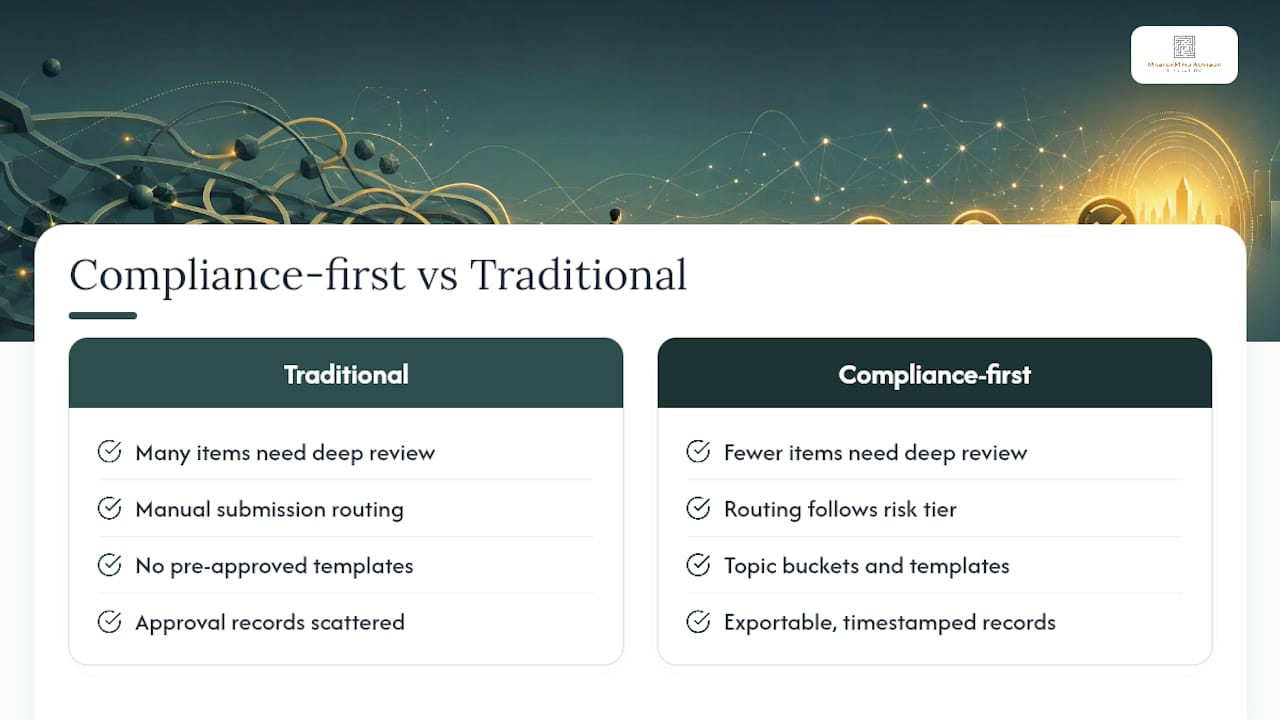
Mastermind Advisor Marketing operationalizes this model for the advisors it works with: submission metadata gets captured automatically, routing follows risk tier, and every approval lands in an exportable, timestamped record from day one. The outcome advisors care about isn't just a cleaner exam file. It's shorter review cycles, a reusable content library that doesn't need to be rebuilt every campaign, and lead flow that doesn't stall out waiting on compliance sign-off.
None of this replaces your firm's own compliance judgment. It just gives that judgment a system built to hold up when someone asks to see the receipts.
— Josh
How Mastermind Advisor Marketing Builds This Workflow for You
Mastermind Advisor Marketing gets your firm to market faster than a traditional agency because the compliance workflow is already built into the deliverables, not bolted on after the fact. You're not paying a separate vendor to review what another vendor produced.
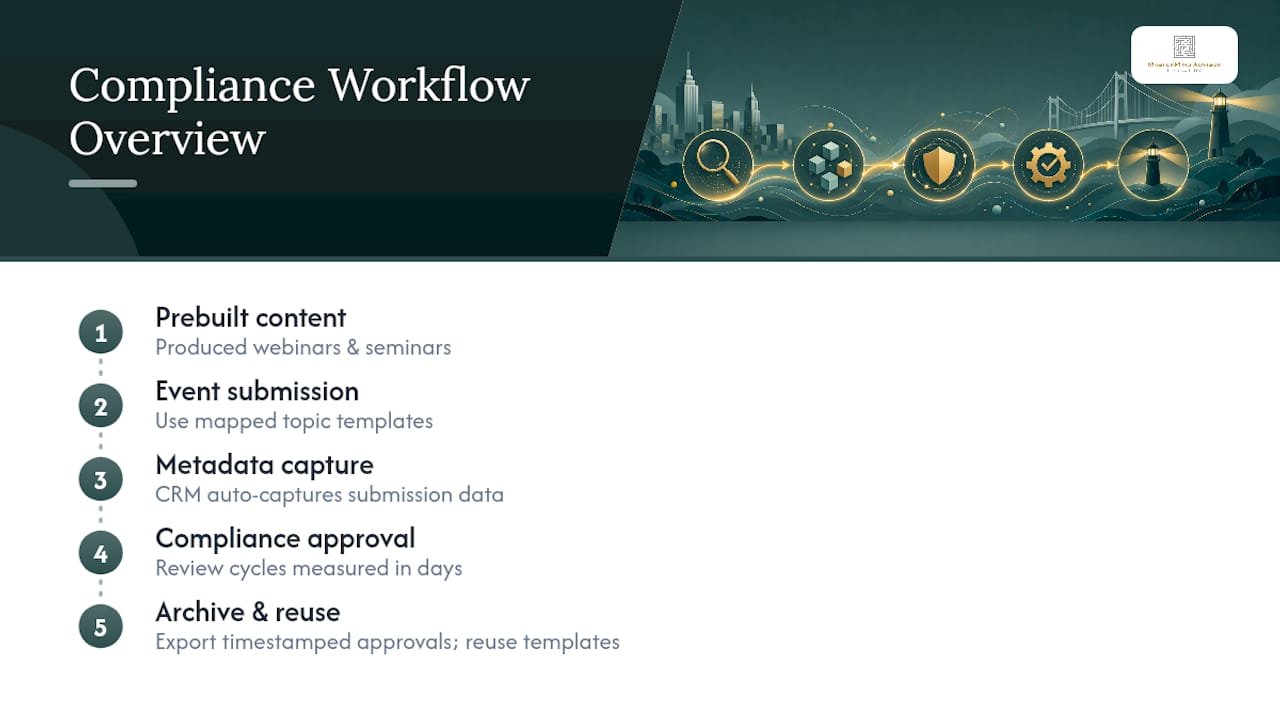
The system includes fully produced webinars and seminars, a library of pre-approved content templates mapped to your topic buckets, CRM integration that captures submission metadata automatically, and archiving that exports timestamped approval records on demand. That means audit-ready files without extra staff hours, review cycles measured in days instead of weeks, and a growing template library your team reuses instead of rebuilding from scratch every quarter.
If you're ready to see what a compliance-approved seminar program looks like in practice, start with how to host the best seminars and see how the workflow maps onto a live event from submission to archiving.
Sources
For the regulatory backbone, keep the SEC's Marketing Rule compliance guide and FINRA's social media guidance close at hand. Pair those with Mastermind Advisor Marketing's own compliance marketing checklist and its breakdown of fiduciary marketing risk tiers for building routing rules that match your firm's actual risk profile.
This article is general information, not a substitute for advice from a qualified financial advisor. Consult a qualified financial professional about your own circumstances before acting on anything here.
- SEC — Investment Adviser marketing: Small business compliance guide
- FINRA — Social media: key topics and guidance