

Writing a financial advisor bio is the process of crafting a clear, credible, and engaging personal introduction that highlights your expertise and builds trust with prospective clients. Your bio is often the first thing a prospect reads before deciding whether to call you. A weak bio loses that prospect in seconds. A strong one positions you as the obvious choice before you ever speak a word.
What to include when you write a financial advisor bio
A professional bio follows a four-part format: who you are, what you specifically do, proof backing your claims, and where you are headed or a call to action. That structure applies directly to financial advisor profiles. Think of it as the skeleton every bio needs before you add personality and specificity.
Here is what each component looks like in practice:
- Who you are: Your full name, title, and firm affiliation. "Sarah Chen, CFP, Senior Wealth Advisor at Meridian Financial Group" tells a prospect everything they need to orient themselves in the first sentence.
- What you do: Specific services and your niche. "I specialize in retirement income planning for federal employees" is far stronger than "I help clients with their finances."
- Proof: Credentials, certifications, years of experience, client outcomes, and awards. Quantifiable achievements and named credentials make a bio memorable and credible. "Managed over $120M in client assets" beats "extensive experience."
- Personal touch: A sentence on your values, your professional philosophy, or what drives you. Clients hire people they trust, and trust requires a human element.
- Compliance: Every claim must meet FINRA and CFP Board standards. CFP Board ethical competency and accurate representation in bios directly protect your certification and public trust.
Pro Tip: Treat your bio as conversion copy. Separate your narrative section from your credentials section. This makes compliance reviews faster and lets your compliance officer approve changes without rewriting the whole document.
How to tailor your advisor bio across different platforms

A single bio does not fit every context. Your website bio, your LinkedIn summary, your conference speaker introduction, and your email signature all serve different purposes and attract different levels of attention.
The most practical approach is the bio bank method: write a comprehensive third-person master bio of up to 350 words, then cut it down to shorter versions and convert to first person for LinkedIn and social platforms. This saves time and keeps your messaging consistent across every channel.
| Platform | Recommended length | Voice | Key focus |
|---|---|---|---|
| Website "About" page | 200 to 350 words | Third person | Full credentials, story, and call to action |
| LinkedIn summary | 100 to 200 words | First person | Niche, value proposition, and connection invite |
| Conference speaker bio | 75 to 100 words | Third person | Credentials and topic authority |
| Email signature | 25 to 50 words | Third person | Title, firm, and one key credential |
| Social media profiles | 50 to 80 words | First person | Personality and niche |
Consistent credential naming and service language across all platforms reduces confusion for prospective clients and strengthens your discoverability in search results. If your website calls you a "Retirement Income Specialist" but your LinkedIn says "Financial Planner," prospects notice the inconsistency and trust drops.
Your bio should also integrate your elevator pitch. An effective elevator pitch is 10 to 30 seconds and follows the template: "I help [audience] worried about [problem] so they can [specific outcome]." That sentence belongs near the top of every bio version. It answers the prospect's first question before they ask it.
Step-by-step process to write or update your bio
Follow this workflow whether you are writing your first bio or refreshing one that has not been updated in three years.
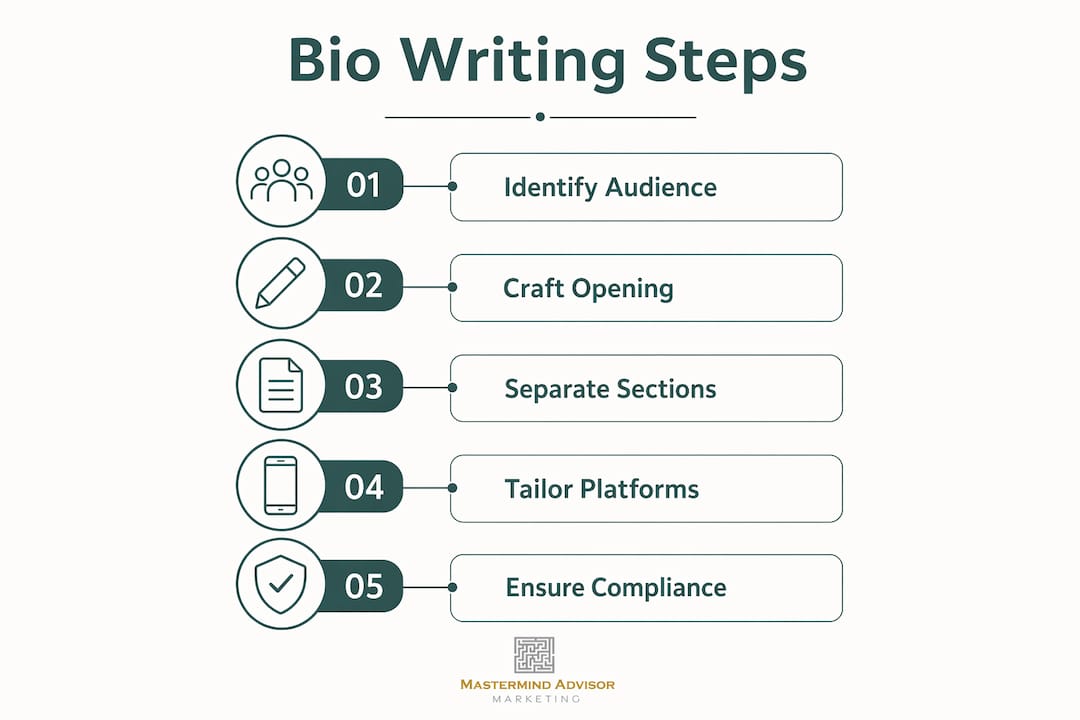
- Gather your raw material. List every credential, certification, award, firm affiliation, years of experience, and notable client outcome. Include your CFP, CFA, ChFC, or any other designation with the correct official capitalization.
- Define your ideal client. A retirement planning specialist writing for federal employees uses different language than an advisor targeting small business owners. Your bio should speak directly to one person, not everyone.
- Draft your anchor opening line. Combine your name, title, firm, and specialty into one sentence. "Michael Torres, CFP, helps federal employees at Torres Wealth Advisors turn their FERS pension into a tax-efficient retirement income plan."
- Add proof points with numbers. Replace adjectives with data. "Over 18 years of practice" and "guided 200+ clients through retirement transitions" are specific. "Experienced and dedicated" are not.
- Close with a forward-looking statement or call to action. "Michael is currently accepting new clients in the Washington D.C. metro area" tells prospects exactly what to do next.
- Edit for clarity and compliance. Remove filler, focus on measurable results, and write like a real person. Run the draft through Grammarly or Hemingway Editor for readability. Then have your compliance officer review it against FINRA Rule 2210 before publishing.
- Create platform-specific versions. Cut the master bio to the lengths in the table above. Convert third person to first person for LinkedIn. Add SEO keywords to your website version using on-page optimization principles from resources like Big Fin SEO.
Pro Tip: Schedule a bio review every six months. Credentials change, client niches shift, and regulatory guidance updates. A stale bio is a missed opportunity every single day it sits unchanged.
Common mistakes and compliance pitfalls to avoid
Most bio errors fall into two categories: marketing overreach and regulatory blind spots. Both carry real consequences.
- Misleading performance claims: Never include projected returns or imply guaranteed outcomes. Misleading claims in bios can result in fines exceeding $850,000, as demonstrated in a 2024 enforcement case involving unapproved influencer posts with misleading content.
- Overstated credentials: Only list designations you currently hold. Listing a lapsed certification is a compliance violation, not a minor oversight.
- Vague superlatives: Phrases like "top advisor" or "industry leader" require substantiation. If you cannot cite the award or ranking, remove the claim.
- Unsupervised social media bios: Written supervisory procedures must cover all communication channels, including social media profiles where your bio appears. A bio posted on Instagram without compliance review is still subject to Rule 2210.
- Missing disclaimers: If your bio references past performance or specific client outcomes, a disclaimer is required.
"FINRA Rule 2210 requires financial advisor communications, including bios used in marketing, to be fair, balanced, and not misleading. Claims and credentials must be supported; no unqualified performance projections are permitted." FINRA Rule 2210
Balancing compliance requirements and marketing effectiveness is the defining challenge of financial advisor bio writing. The advisors who solve it write bios that are both legally sound and genuinely persuasive. That combination is rarer than it should be.
You can also strengthen your credibility by incorporating client testimonials compliantly into your broader marketing materials, which reinforces the proof points in your bio.
Key takeaways
A compelling financial advisor bio requires a clear four-part structure, platform-specific versions, and full compliance with FINRA Rule 2210 to convert prospects into clients.
| Point | Details |
|---|---|
| Use the four-part structure | Open with who you are, what you do, proof points, and a call to action. |
| Build a bio bank | Write one master third-person bio, then cut and adapt versions for each platform. |
| Integrate your elevator pitch | Place your "I help [audience] with [problem] to achieve [outcome]" sentence near the top of every version. |
| Stay compliant | All claims must meet FINRA Rule 2210 standards; have compliance review every version before publishing. |
| Audit regularly | Update your bio every six months to reflect new credentials, client niches, and regulatory changes. |
Why most advisor bios fail before the first sentence
I have reviewed hundreds of financial advisor bios over the years, and the pattern is almost always the same. The advisor opens with something like "John Smith has been serving clients for over 20 years with a commitment to excellence." That sentence says nothing. It signals nothing. And it wastes the only moment when a prospect is genuinely paying attention.
The advisors with the strongest bios treat the opening line as the only line that matters. Everything else is evidence. If your first sentence does not name your niche and your client outcome, you are already losing the prospect to someone who does.
Here is the part most bio advice skips: specificity is not just a marketing tactic. It is a compliance strategy. When you say "I help federal employees maximize their FERS pension income," that is a specific, verifiable claim. When you say "I help clients achieve financial freedom," that is a vague promise that invites regulatory scrutiny and tells prospects nothing useful.
The advisors I have seen grow their practices fastest are the ones who treat their bio as a living document, not a one-time task. They update it when they earn a new credential, when they shift their niche, and when they get a new result worth citing. They also build their bio into every platform consistently, so a prospect who finds them on LinkedIn, then visits their website, then reads their speaker bio at a conference all encounters the same clear identity. That consistency builds trust faster than any single piece of content can.
If you want to go deeper on crafting short, high-impact introductions that feed directly into your bio content, the frameworks in this advisor podcast guide are worth your time.
— Josh
How Mastermindadvisormarketing helps you build a stronger advisor brand
Your bio is one piece of a larger marketing system. Writing it well matters, but placing it in front of the right prospects at the right moment is what actually generates leads.

Mastermindadvisormarketing builds turnkey marketing systems specifically for independent financial advisors. From compliant bio writing and branding to custom webinars, automated email follow-ups, and CRM integration, the platform handles the marketing infrastructure so you can focus on clients. Advisors who work with Mastermind Advisor report stronger lead pipelines and a clearer, more consistent brand identity across every channel. If your bio is ready but your broader marketing system is not, that is the next problem worth solving.
FAQ
What is a financial advisor bio?
A financial advisor bio is a professional introduction that states who you are, what you specialize in, your credentials, and the value you provide to clients. It appears on your website, LinkedIn, conference materials, and email signature.
How long should a financial advisor bio be?
Bio length depends on the platform. Website bios run 200 to 350 words, LinkedIn summaries 100 to 200 words, and email signatures 25 to 50 words. A bio bank of platform-specific versions keeps all versions consistent.
Does FINRA regulate financial advisor bios?
Yes. FINRA Rule 2210 requires all advisor communications, including bios used in marketing, to be fair, balanced, and not misleading. Unverified performance claims and overstated credentials can result in significant fines.
Should I write my bio in first or third person?
Write your master bio in third person, then convert it to first person for LinkedIn and social platforms. Third person reads more authoritatively on websites and in conference programs, while first person feels more personal on social media.
How often should I update my financial advisor bio?
Review and update your bio at least every six months. Changes in credentials, client niche, firm affiliation, or regulatory guidance all require a bio update and a fresh compliance review before republishing.