

When you’re evaluating a financial advisor, you don’t start with their brochure. You start with what other clients say about them. That instinct is backed by data: 92% of B2B buyers consult testimonials before making a purchase decision. Yet most advisors treat testimonials as an afterthought rather than a core part of their credibility strategy. The role of client testimonials advisors rely on has shifted dramatically. Today, they function as trust infrastructure, compliance obligations, and lead generation tools all at once. This article breaks down exactly how they work and how to use them well.
Table of Contents
Key Takeaways
| Point | Details |
|---|---|
| Testimonials drive decisions | 92% of B2B buyers read testimonials before choosing a service provider, making them central to advisor selection. |
| Compliance is non-negotiable | The SEC marketing rule requires disclosure and documented collection workflows before advisors can publish testimonials. |
| Format matters significantly | Video testimonials outperform written ones in trust and message retention, making format choice a strategic decision. |
| Systematic collection wins | Ad hoc testimonial requests produce inconsistent results; automated post-meeting outreach builds volume and compliance. |
| Testimonials reflect service quality | Strong testimonials are a byproduct of intentional client experiences, not just good marketing copy. |
The role of client testimonials in financial advisory
Trust is the core product every financial advisor sells. Before a prospect hands over their retirement savings or investment portfolio, they need to believe you are competent, honest, and genuinely invested in their outcome. Formal credentials help. Awards help. But nothing closes the trust gap faster than hearing directly from someone who has already walked that path with you.
The psychology behind this is straightforward. When people face uncertain decisions, they look to others who have been in the same position. A prospective client researching advisors is not just looking for qualifications. They are looking for evidence that someone like them trusted this advisor and came out better for it. That is the social proof mechanism at work, and it is one of the most reliable drivers of human decision-making.
Here is what makes the importance of client testimonials particularly high in financial services:
-
Intangibility of the service. Unlike buying a product, you cannot test-drive financial advice. Testimonials substitute for that direct experience.
-
High stakes. Financial decisions carry real consequences. Clients need more reassurance than they would for a lower-stakes purchase.
-
Emotional weight. Money is tied to security, family, and the future. Testimonials that speak to those emotional dimensions carry far more weight than any marketing claim.
Conversion rates increase by 34% on pages that feature testimonials, and product pages with reviews see a 58% conversion lift. Those numbers translate directly to advisory websites and landing pages. When a prospective client reads that another investor felt heard, supported through a market downturn, or helped to retire two years early, they are not just reading a review. They are imagining their own future with that advisor.
Format also matters more than most advisors realize. Video testimonials outperform written formats in effectiveness because they combine audio and visual cues that written text simply cannot replicate. Tone of voice, facial expression, and genuine emotion all register in ways that a paragraph of text never will. Adding a client photo to a written testimonial increases its perceived credibility by 35%, which is a meaningful lift even before you move to full video.
“Real client stories outperform generic marketing claims because they speak to the reader’s actual fears and aspirations, not the advisor’s self-image.”
Compliance and ethical considerations
The 2021 SEC marketing rule changed the game for financial advisors who want to use testimonials. Before that rule, many registered investment advisors were effectively prohibited from publishing client testimonials at all. The updated rule allows them, but with specific requirements that cannot be ignored.
The SEC marketing rule mandates disclosure and prohibits cherry-picking. You cannot selectively publish only glowing reviews while suppressing negative ones. You must disclose whether the person giving the testimonial is a current client, whether they were compensated, and any material conflicts of interest. These disclosures need to appear clearly alongside the testimonial itself, not buried in footnotes.
Here is a practical compliance checklist every advisor should work through before publishing testimonials:
-
Document your collection process. You need a clear record showing that testimonials were requested from a representative sample of clients, not just your happiest ones.
-
Obtain written consent. Clients must agree to have their words, name, and any identifying information used in your marketing.
-
Include required disclosures. Compensation, client status, and conflicts of interest must all be disclosed clearly.
-
Review state-level regulations. Many advisors remain cautious because state-level rules can layer additional requirements on top of federal ones.
-
Avoid specific investment performance claims. A testimonial that implies guaranteed returns or exceptional results creates regulatory exposure.
-
Protect client privacy. Using detailed personal financial information or photos without explicit consent creates both legal and ethical problems.
Compliance success requires systematic workflows and documentation for testimonial collection. Ad hoc requests, where you ask a client informally after a great meeting, do not produce the paper trail regulators expect. You need a repeatable process that applies consistently across your client base.
Pro Tip: Set up an automated post-meeting email that goes out 48 hours after every annual review. This creates a consistent, documented outreach history and dramatically increases your testimonial volume without requiring manual effort.
Building a systematic testimonial program
Most advisors who struggle with testimonials have the same problem: they treat the ask as awkward. It feels like requesting a favor, and that discomfort leads to inconsistency. Reframing the request changes everything. When you invite a client to share their experience, you are not asking for a favor. You are giving them the opportunity to tell their own story and potentially help someone else in a similar situation.

That reframe matters because it shifts the dynamic from extraction to collaboration. Clients who feel like partners in the process give better testimonials and give them more willingly.
Here is how to build a program that actually works:
-
Time your requests strategically. The best moments are right after a client milestone: a successful retirement transition, a portfolio rebalancing that outperformed expectations, or a financial plan that helped them buy their first home.
-
Use multiple formats. Written testimonials are easiest to collect. Video interviews require more coordination but produce stronger results. Case studies go even deeper and work well for complex planning scenarios.
-
Showcase diversity. Your testimonials should reflect the range of clients you serve. If every testimonial is from a 60-year-old retiree and you want to attract younger investors, that gap will show.
-
Integrate testimonials across channels. Your website homepage, service pages, email follow-ups, and social media profiles all benefit from well-placed client stories.
-
Refresh regularly. A testimonial from 2019 signals that nothing noteworthy has happened since. Set a calendar reminder to collect new testimonials at least twice a year.
Testimonials have become a competitive necessity for AI discovery and lead qualification, requiring ongoing management rather than one-time collection. Search algorithms increasingly reward profiles with recent, authentic reviews. That means your testimonial program is not just a marketing asset. It is part of your discoverability strategy.
Pro Tip: When asking for a video testimonial, send clients three specific questions in advance rather than asking them to “say a few words.” Specific prompts produce specific, credible answers that are far more useful than vague praise.
How testimonials shape long-term client relationships
The marketing value of testimonials is obvious. What gets less attention is how the testimonial process itself strengthens the advisor-client relationship. When a client articulates what you have done for them, they are also reinforcing their own commitment to the relationship. That articulation creates emotional ownership.
Advisory teams that intentionally design client experiences build emotional connections that testimonials naturally reflect. The testimonial is not the goal. It is the evidence that the goal was achieved. Advisors who receive strong, specific testimonials are almost always advisors who have been consistently present during their clients’ most significant life moments.
Consider what a testimonial looks like when it is grounded in a real relationship:
| Generic testimonial | Relationship-grounded testimonial |
|---|---|
| “Great advisor, very knowledgeable.” | “When my husband passed, Sarah helped me understand our finances for the first time.” |
| “Helped me grow my portfolio.” | “After losing my job, David helped me restructure our plan so we didn’t have to touch retirement savings.” |
| “Very professional and responsive.” | “She called me personally during the market crash in 2020 before I could even panic.” |
The difference is specificity and emotion. Relationship-grounded testimonials also serve an internal function. They tell you, as the advisor, what your clients actually value. That feedback loop is one of the most underused benefits of client feedback in the industry. If ten clients mention that you helped them feel calm during volatility, that is not just a marketing message. It is a signal about where your real competitive advantage lies.
Using social proof in follow-up communications adds trust and relevance, improving response rates by up to 15%. That means testimonials embedded in prospect nurture sequences and post-meeting follow-ups do measurable work beyond your website.
Testimonials vs. other social proof formats
Testimonials are one tool in a larger social proof toolkit. Understanding how they compare to other formats helps you build a more effective overall strategy.
| Social proof type | Strengths | Limitations |
|---|---|---|
| Client testimonials | Personal, emotional, specific | Require compliance documentation |
| Third-party reviews | Independent credibility | Less control over content or timing |
| Awards and certifications | Institutional authority | Impersonal; clients may not recognize the issuing body |
| Case studies | Deep specificity and context | Time-intensive to produce; clients may decline |
| Endorsements | Borrowed authority from known figures | Compliance scrutiny; perceived as paid |
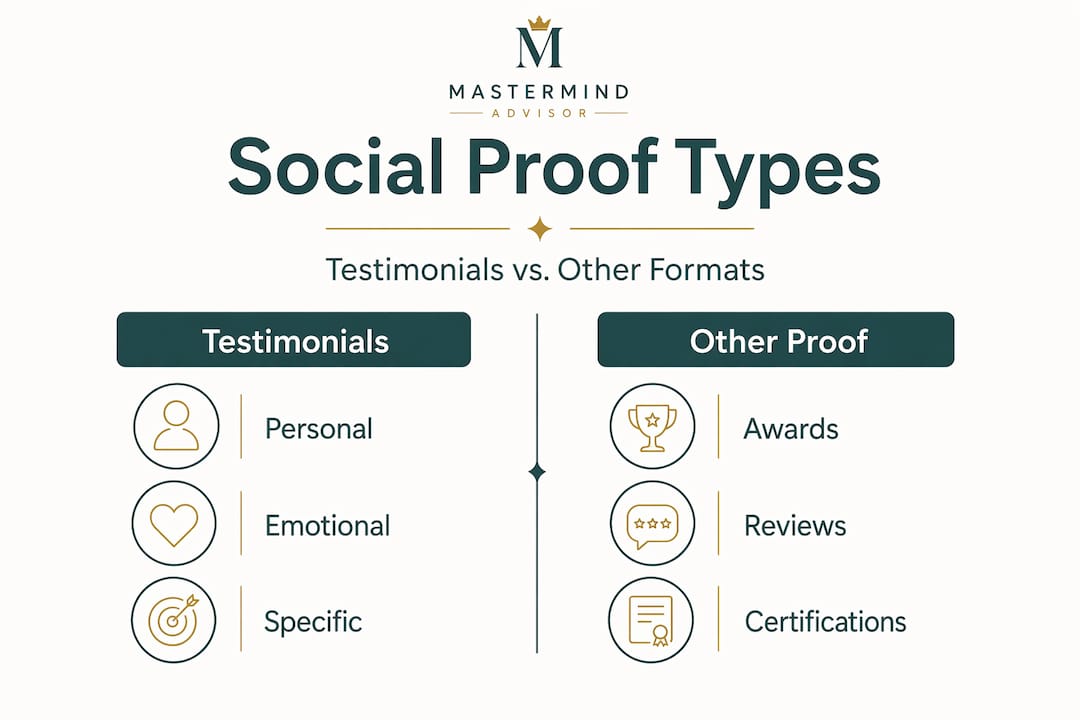
The most effective advisor marketing programs use a mix. Testimonials provide the emotional resonance. Awards and certifications provide institutional credibility. Case studies provide depth for complex prospects who want to see your thinking in action. Third-party reviews provide independence that your own website cannot replicate.
The compliance nuances vary across these formats. Endorsements from compensated third parties carry the heaviest disclosure requirements. Organic third-party reviews on platforms like Google require less documentation but still need to be monitored for accuracy and fairness. The impact of reviews on advisory services is real whether you manage them actively or not. The question is whether you are shaping that impact or leaving it to chance.
My take on where most advisors get this wrong
I’ve worked with enough independent advisors to see the same pattern repeat. They know testimonials matter. They intend to collect them. And then six months go by and they have three testimonials on their website, two of which are from 2021.
The problem is not motivation. It is infrastructure. Advisors who treat testimonial collection as a task they will get to eventually will always be outcompeted by advisors who have built it into their workflow. I’ve seen advisors with modest practices and strong testimonial programs consistently outperform larger firms in lead conversion because prospects feel an immediate sense of trust before the first call.
What I’ve also learned is that the advisors who get the best testimonials are not necessarily the ones with the best performance numbers. They are the ones who show up consistently, communicate clearly, and make clients feel genuinely cared for. The testimonial is just the proof. If your testimonials are thin or generic, that is worth examining honestly. It might be a collection problem. It might also be a client experience problem.
The long-term payoff of maintaining a real testimonial program goes well beyond marketing. It creates a documented record of your impact, a feedback system for your practice, and a trust signal that works for you around the clock.
— Josh
Build a testimonial program that actually works
If this article has made one thing clear, it is that testimonials are not a nice-to-have. They are a core part of how prospects evaluate advisors and how clients stay connected to the value you deliver.
At Mastermindadvisormarketing, we build compliant testimonial programs specifically for independent financial advisors. That means compliance-first collection workflows, multi-format display, automated outreach sequences, and integration across your digital presence. We handle the infrastructure so you can focus on the client relationships that generate the testimonials in the first place. If you are ready to turn your client satisfaction into a marketing asset that works, explore what we offer and see how we support advisor growth from the ground up.
FAQ
Why do client testimonials matter for financial advisors?
Client testimonials provide social proof that helps prospects trust an advisor before the first meeting. Research shows that 92% of buyers consult testimonials before making decisions, making them one of the most influential factors in advisor selection.
Are financial advisors allowed to use client testimonials?
Yes, under the 2021 SEC marketing rule, registered investment advisors can use client testimonials with proper disclosures and documented collection processes. State-level regulations may add additional requirements, so advisors should review both federal and state rules before publishing.
What makes a financial advisor testimonial credible?
Specificity, emotion, and authenticity. Testimonials that reference a real situation, a life transition, or a specific outcome carry far more weight than generic praise. Adding a client photo increases credibility by 35%, and video formats outperform written ones in trust and engagement.
How often should advisors collect new testimonials?
At minimum twice a year, ideally after significant client milestones like retirement transitions or major financial planning events. Automated post-meeting outreach improves both volume and compliance documentation consistency.
How do testimonials differ from online reviews for advisors?
Testimonials are solicited, curated, and published directly by the advisor with required disclosures. Online reviews are independent and posted on third-party platforms. Both contribute to an advisor’s credibility, but testimonials give you more control over context, format, and placement within your marketing.