

A professional website is the single most powerful trust-building tool an independent financial advisor owns. Before a prospective client shares their net worth, tax situation, or retirement fears with you, they will search your name online. What they find, or fail to find, determines whether they book a call or move on to someone else. This is why independent advisors need a website that goes beyond a digital business card. It must communicate credentials, advisory philosophy, fee transparency, and regulatory standing in a way that converts a cautious stranger into a confident prospect.
Why independent advisors need a website built on trust signals
An independent advisor's website is the first point of contact for clients who are hesitant to share sensitive financial information with someone they have never met. According to trust signal research, prospects specifically search for FCA registration, professional qualifications, social proof, and transparent fees before they engage with any advisor. That behavior tells you exactly what your website must deliver.
Trust signals are not decorative. They are functional conversion tools. When a prospective client lands on your homepage and immediately sees your regulatory status, your credentials, and a clear explanation of how you charge, their anxiety drops. That drop in anxiety is what moves them from browsing to booking.
Here are the trust signals your website must communicate clearly:
- Regulatory status. Display your FCA registration number or SEC registration prominently. Clients want to verify you are legitimate before they share a single financial detail.
- Professional qualifications. CFP, CFA, ChFC, and continuing education credentials signal that you are current, serious, and accountable to a professional standard.
- Transparent fee structure. Fee-only, fee-based, AUM percentage, or flat retainer. State it plainly. Ambiguity about money destroys trust faster than almost anything else.
- Compliant social proof. Client outcome statements and testimonials, used within financial promotions rules, demonstrate real-world results without overpromising.
- Advisory approach. A clear explanation of your investment philosophy and planning process tells prospects what working with you actually looks like.
The placement of these elements matters as much as their presence. Proof elements near CTAs reduce perceived risk at the exact moment a visitor is deciding whether to act. Burying your credentials in a footer or an "About" page that nobody reads is a conversion failure waiting to happen.
Pro Tip: Place your regulatory registration number and primary credential directly on your homepage hero section, not just your bio page. Visitors who see compliance signals within the first scroll are significantly more likely to complete a contact form.
How compliance regulations affect your website content
The SEC's Marketing Rule reshaped what independent advisors can and cannot publish on their websites. Testimonials and endorsements are now permitted, but they come with strict disclosure requirements that many advisors are failing to meet. A 2025/2026 SEC Risk Alert found that missing disclosures and weak policy implementation are the most common compliance failures on advisor websites. Updating your written policies is not enough. You must actually implement them.
The FCA's Consumer Duty standard takes this further. It mandates fairness and transparency embedded into the substance of your communications, not just appended as disclaimers. That means your website content must genuinely serve the client's understanding, not just technically satisfy a checklist.
Here is a practical compliance framework for your website:
- Audit every testimonial and endorsement. Each one must include a disclosure stating whether the reviewer is a current client, whether compensation was provided, and that past results do not guarantee future outcomes.
- Review all d/b/a microsites. If you operate under a trade name or maintain a secondary domain, compliance controls apply across all domains, not just your primary website. Many advisors miss this entirely.
- Document your oversight process. The SEC expects you to show that someone reviewed and approved website content before publication, with a record of that review.
- Update policies and then verify implementation. The most common failure identified in the SEC Risk Alert is firms that updated policies but failed implementation. A policy document sitting in a drawer does not protect you.
- Review social media profiles as extensions of your website. LinkedIn, X, and Facebook pages that reference your advisory services fall under the same marketing rule obligations.
Pro Tip: Schedule a quarterly website compliance review on your calendar the same way you schedule client reviews. Regulations evolve, and a page that was compliant in January may not be compliant in October.
What website design and SEO strategies actually work for advisors
A website that no one finds is a liability, not an asset. Independent advisor local SEO is the discipline that puts your practice in front of people searching for financial guidance in your geographic area. Google Business Profile optimization, location-specific service pages, and locally relevant content are the foundation of any independent advisor local SEO checklist worth following.

The top SEO tools for independent advisors include Google Search Console for tracking search performance, Semrush or Ahrefs for keyword research and competitor analysis, and BrightLocal for managing local citations and reviews. These tools give you data on what your prospective clients are actually searching for, which is far more useful than guessing.
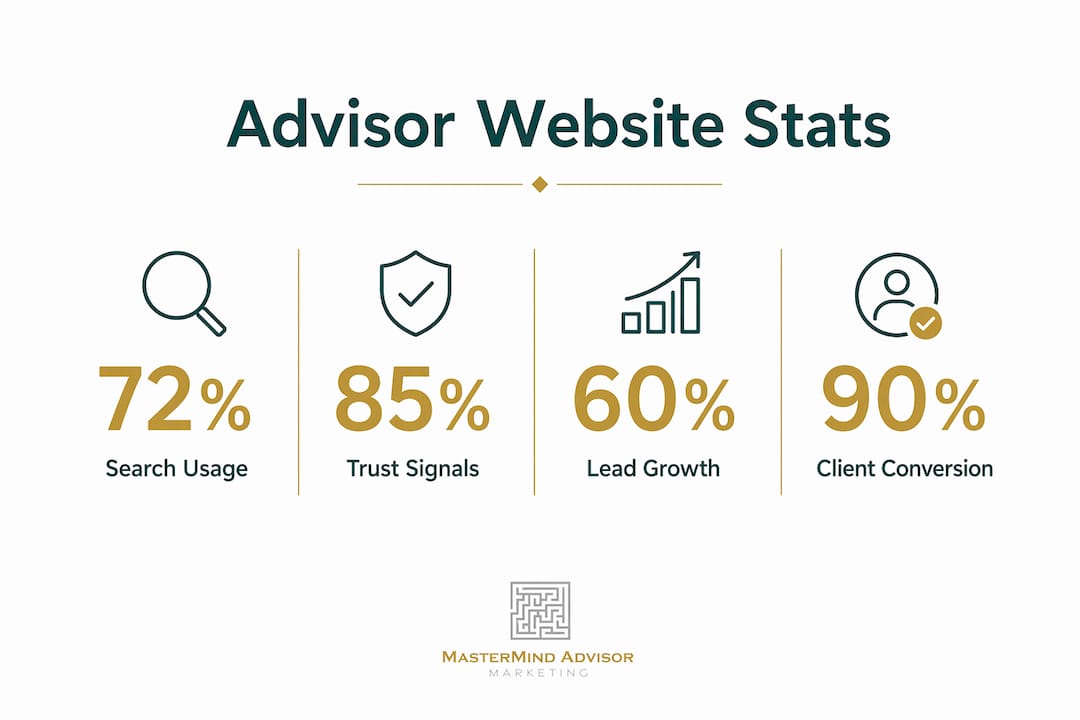
AI search platforms like Perplexity and ChatGPT are now a meaningful source of client discovery. FAQ content and authentic testimonials are the two content formats that AI search engines cite most frequently when answering questions about financial advisors. This means your FAQ page is no longer just a user experience feature. It is an AI citation target.
Here is a comparison of content strategies by their impact on both traditional SEO and AI search visibility:
| Content type | Traditional SEO impact | AI search visibility |
|---|---|---|
| FAQ pages | High (featured snippets) | Very high (direct citation source) |
| Client testimonials | Moderate (review signals) | High (authentic social proof) |
| Service location pages | Very high (local rankings) | Moderate |
| Blog articles with transcripts | High (long-tail keywords) | High (detailed answer source) |
| Podcast episode pages | Moderate | High (conversational content) |
The practical takeaway is that adapting content for AI search requires the same qualities that build human trust: specific answers, real credentials, and verifiable outcomes. The advisors who write for both audiences simultaneously will own the most valuable digital real estate in their markets.
Pro Tip: Add a dedicated FAQ page with at least 10 questions your prospective clients actually ask during discovery calls. Write answers in plain language, under 100 words each. This format feeds both Google's featured snippets and AI citation engines.
How a website compares to other client acquisition methods
Referrals remain the dominant source of new clients for most independent advisors. A website does not replace referrals. It multiplies them. When a referred prospect receives your name, the first thing they do is search for you online. A weak or absent web presence causes referral conversions to drop, because the prospect cannot independently verify what their friend told them about you.
High-net-worth clients prefer advisors who combine independence with institutional support. A well-designed website communicates both qualities simultaneously. It shows that you operate with the flexibility of an independent practice while maintaining the professional infrastructure of a credible institution.
Seminars, podcasts, and social media all generate awareness. A website converts that awareness into appointments. Without a destination that captures and qualifies leads, every other marketing channel leaks. Your financial advisor podcast drives listeners to your website. Your seminar attendees verify your credentials on your website before they sign an engagement letter. Your LinkedIn posts send traffic to your website for the deeper conversation.
The benefits of online presence for independent advisors extend beyond lead generation. A website scales your practice beyond geography. It works at 2 a.m. when a prospective client in a different time zone is researching their options. It answers the same questions your team would otherwise spend hours addressing on the phone. That is the kind of leverage that referrals alone cannot provide.
Key takeaways
An independent advisor's website is a trust infrastructure that converts cautious prospects into clients by communicating compliance, credentials, and value before the first conversation.
| Point | Details |
|---|---|
| Trust signals drive conversions | Place credentials, regulatory status, and fees on your homepage, not buried in secondary pages. |
| Compliance applies everywhere | SEC Marketing Rule obligations cover all domains, microsites, and social profiles, not just your main website. |
| AI search rewards FAQ content | FAQ pages and authentic testimonials are the formats AI platforms cite most when answering advisor queries. |
| Websites multiply referrals | Referred prospects verify your credibility online before converting, making your website a referral conversion tool. |
| Local SEO is non-negotiable | Tools like Google Search Console, Semrush, and BrightLocal are the foundation of any advisor's local search strategy. |
The uncomfortable truth about advisor websites I've learned over the years
Most independent advisors I work with underestimate how much their website is doing, or failing to do, before the first conversation ever happens. The advisors who treat their website as a passive brochure consistently lose prospects to competitors whose sites communicate confidence and specificity. The advisors who treat it as an active sales tool, one that answers objections, proves credentials, and guides visitors toward a clear next step, consistently convert at higher rates.
The compliance piece is where I see the most avoidable damage. Advisors spend real money on website design and then publish testimonials without proper disclosures, or maintain a d/b/a microsite that has never been reviewed against their marketing policies. The SEC is not looking for perfection. It is looking for documented intent and consistent implementation. A simple quarterly review process catches most issues before they become exam findings.
The AI search shift is real and it is accelerating. I have watched advisors who invested in detailed FAQ pages and podcast transcripts start appearing in Perplexity and ChatGPT answers for local financial planning queries. That is free, compounding visibility that no paid ad can replicate. The advisors who build for AI citation now will have a structural advantage in three years that will be very difficult for late movers to close.
— Josh
How Mastermindadvisormarketing helps you build a website that actually converts

Building a website that balances trust, compliance, and conversion is not a one-time project. It requires a system. Mastermindadvisor.com provides independent financial advisors with a turnkey marketing platform that includes website strategy, content development, and automated client engagement tools built specifically for your regulatory environment. From compliant testimonial frameworks to podcast production that feeds your website with AI-ready content, Mastermindadvisormarketing handles the marketing infrastructure so you can focus on serving clients. If you are ready to turn your digital presence into your most productive business development asset, start with the 2024 marketing preview to see exactly what a high-performing advisor marketing system looks like.
FAQ
Why do independent advisors need a website?
An independent advisor's website reduces client uncertainty by communicating credentials, regulatory status, fees, and advisory approach before the first conversation. Without it, referred prospects cannot independently verify your credibility, and cold prospects move on to advisors they can research online.
What trust signals must a financial advisor website include?
The most critical trust signals are regulatory registration, professional qualifications such as CFP or CFA, a transparent fee structure, and compliant client testimonials. Placement near decision points on the page increases conversion rates significantly.
How does the SEC Marketing Rule affect advisor website content?
The SEC Marketing Rule requires that testimonials and endorsements include specific disclosures about client status, compensation, and past performance limitations. The most common compliance failure is updating written policies without actually implementing them across all web properties.
What are the top SEO tools for independent advisors?
Google Search Console, Semrush, Ahrefs, and BrightLocal are the primary tools for independent advisor local SEO. They cover keyword research, search performance tracking, and local citation management, which are the three pillars of advisor search visibility.
How does a website support client acquisition beyond referrals?
A website converts referral traffic by giving prospects a place to verify what they heard about you. It also scales your practice by generating organic search leads, capturing seminar and podcast audiences, and answering qualification questions automatically, reducing the time your team spends on early-stage prospect education.