

Financial services digital marketing is the strategic use of SEO, content, paid advertising, email, and AI-powered personalization to attract, convert, and retain financial clients while meeting regulatory compliance requirements. The shift from referral-dependent growth to digital discovery has made this multi-channel discipline non-negotiable for independent advisors, banks, credit unions, and fintech firms alike. Platforms like LinkedIn Ads, Google Search, and automated email systems now drive the majority of qualified prospect interactions. Regulatory bodies including FINRA and the SEC set the compliance boundaries within which every campaign must operate. Mastering this system means building trust at scale without sacrificing your license or reputation.
What are the essential digital marketing channels for financial services?
Digital marketing for finance works best as an integrated system where each channel serves a distinct role rather than competing for budget. No single tactic wins alone. The combination of organic visibility, paid pipeline, and relationship nurturing creates compounding returns over time.
SEO builds the foundation. Google classifies financial content as YMYL (Your Money or Your Life), meaning it applies its strictest quality standards. Finance content requires named, credentialed authors, explicit sourcing for every claim, and regular updates to maintain search rankings. An advisor whose website lacks author bios and sourced content will consistently lose ground to competitors who treat SEO as a trust signal, not just a traffic tactic. For credit unions and community banks, SEO for financial organizations focuses heavily on local search intent and product-specific landing pages.

Paid advertising delivers immediate pipeline. Finance keywords are among the most expensive in Google Ads, with 5.1% average conversion rates for paid search in the sector. That conversion rate is meaningful because it reflects bottom-funnel intent. LinkedIn Ads dominates B2B financial marketing because its targeting by job title, company size, and industry matches how financial professionals identify qualified prospects.
Email marketing remains the highest-ROI channel for relationship nurturing. Lifecycle automation sequences that deliver market commentary, planning guides, and event invitations keep prospects engaged across the 6-plus month sales cycles typical in financial services. Email best practices for 2026 emphasize segmentation by life stage and financial trigger rather than generic broadcast campaigns.
Social media in financial services serves education and credibility, not entertainment. LinkedIn, YouTube, and Facebook each attract different segments of the financial audience. Short-form video explaining tax changes or retirement planning concepts consistently outperforms promotional posts in both reach and engagement.
AI-powered personalization now shapes how prospects experience your digital presence. Dynamic website content, predictive email sequencing, and answer engine optimization for tools like ChatGPT and Perplexity are becoming standard components of financial marketing strategies.
- SEO: sustainable organic visibility with 9 to 12 month compounding returns
- Paid search and LinkedIn Ads: immediate bottom-funnel lead generation
- Email automation: lifecycle nurturing across long sales cycles
- Social media: credibility building through educational content
- AI personalization: dynamic experiences that match prospect intent
Pro Tip: SEO impact grows significantly between months 9 and 12, with full transformation taking 12 to 18 months. Budget for both paid ads and SEO simultaneously so you generate leads now while building long-term organic equity.
How do regulatory and compliance requirements affect financial marketing?
Compliance is not a constraint on financial services digital marketing. It is the foundation that makes every campaign credible. Advisors who treat compliance as a checklist rather than a strategic asset consistently produce weaker marketing because they avoid the specificity that builds trust.
The SEC Marketing Rule governs investment adviser advertising across all digital channels including websites, email, and social media. It requires factual accuracy, substantiation of all performance claims, and retention of marketing materials for five years with two years kept readily accessible. Testimonials and endorsements are now permitted under the rule, but they require specific disclosures about compensation and conflicts of interest. Many advisors either avoid testimonials entirely out of caution or use them without proper disclosure, both of which represent missed opportunities or compliance exposure.
FINRA Rule 2210 governs broker-dealer communications and mandates review, approval, and retention of all retail communications, including social media posts that reach more than 25 retail investors within 30 days. New member firms must pre-file retail communications for their first year of operation. This means every LinkedIn post, every email campaign, and every paid ad must pass through a documented review process before publication.
Compliance failures happen most frequently in digital channels including websites, social media, and influencer marketing. The SEC's risk alerts consistently identify these areas as under-supervised. Building a content-to-controls workflow, where every approved piece of marketing is stored with its exact approved copy and substantiation documentation, protects against audit exposure and speeds up future campaign approvals.
Here is a practical compliance workflow for digital marketing campaigns:
- Draft marketing content with your compliance officer involved from the first outline, not the final review.
- Document the substantiation for every factual claim, statistic, and performance reference before submission.
- Obtain written pre-approval and log the approval date, reviewer name, and version number.
- Publish only the exact approved copy. Any edit after approval requires a new review cycle.
- Archive the approved copy, all supporting documentation, and distribution records for the required retention period.
- Schedule quarterly audits of live digital content to catch outdated claims or unapproved edits.
Pro Tip: Marketing claims in finance must be substantiated and balanced, especially for testimonials, endorsements, and third-party ratings. Build a compliance sign-off template that includes a substantiation field for every factual claim before any content goes live.
How to measure and optimize digital marketing performance in finance
Vanity metrics destroy financial marketing budgets. Page views and social media followers tell you nothing about whether your campaigns are generating funded clients. The shift to revenue-linked measurement is the single biggest performance lever available to most financial marketing teams.
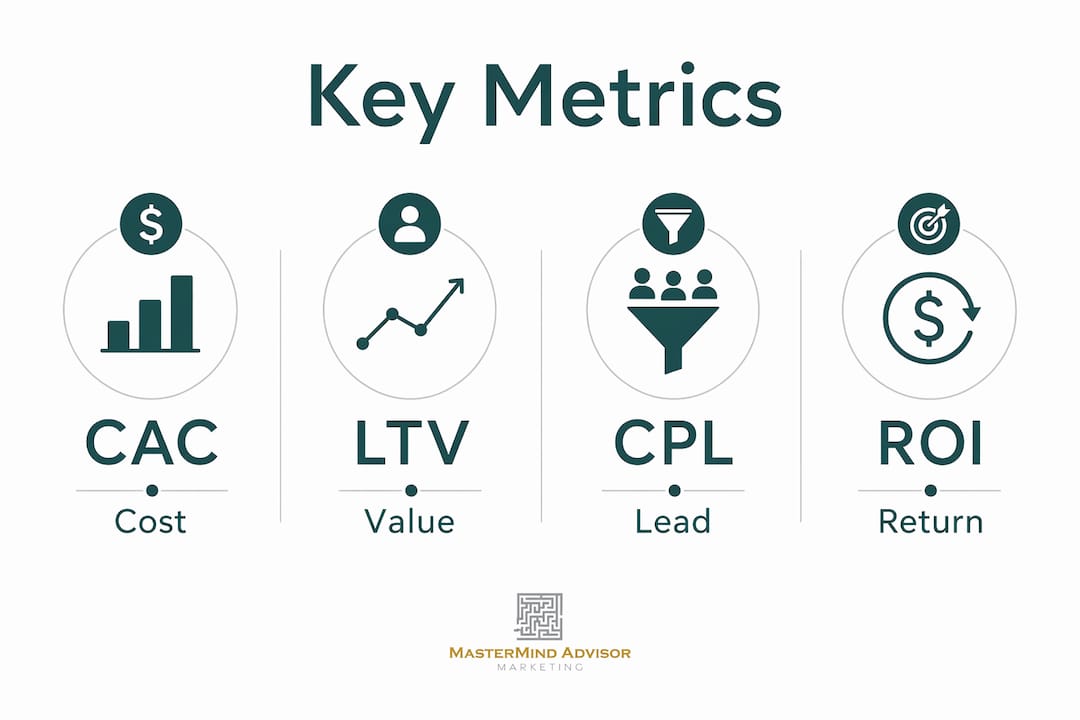
Fintech marketing pipelines require measurement of customer acquisition cost (CAC), lifetime value (LTV), and channel-level contribution to avoid misleading optimizations. A campaign that generates 500 leads at $10 each but converts none into funded accounts is worse than a campaign that generates 20 leads at $200 each with a 40% close rate. The math is obvious, but most financial marketers still optimize for lead volume rather than lead quality.
Micro-conversions matter in long sales cycles. Guide downloads and webinar attendance are meaningful pipeline indicators when connected to downstream revenue outcomes. A prospect who downloads your retirement planning guide, attends a webinar, and then books a consultation has a fundamentally different close probability than someone who fills out a contact form from a cold ad. Tracking these sequences requires a CRM that connects marketing touchpoints to client outcomes.
| Metric | What it measures | Why it matters |
|---|---|---|
| Customer Acquisition Cost (CAC) | Total marketing spend divided by new clients acquired | Reveals true cost efficiency across channels |
| Lifetime Value (LTV) | Projected revenue from a client over the relationship | Justifies higher CAC for high-value client segments |
| Cost Per Lead (CPL) | Spend divided by leads generated | Useful for channel comparison, not standalone optimization |
| Micro-conversion rate | Downloads, webinar registrations, calculator uses | Predicts pipeline health before final conversion |
| Organic traffic growth | Month-over-month SEO-driven sessions | Tracks long-term content and SEO investment returns |
Attribution in financial services is genuinely difficult because prospects interact with multiple channels over months before converting. Multi-touch attribution models that assign partial credit to each interaction give a more accurate picture than last-click attribution, which systematically over-credits paid search and under-credits content and email.
What content marketing strategies build trust with financial clients?
Fintech customer acquisition costs run 3 to 7 times higher than e-commerce, and the primary reason is trust deficit. Financial decisions are high-stakes and emotionally loaded. Content marketing is the most cost-effective tool for closing that trust gap before a prospect ever speaks to an advisor.
Content must map to funnel stages with precision. Awareness content answers broad questions: "How much should I have saved by 50?" or "What happens to my 401(k) if I change jobs?" Consideration content compares options and explains trade-offs: fee-only versus commission-based advisors, Roth versus traditional IRA. Decision content removes final objections: client success stories, advisor credentials, process explanations, and clear next steps.
The most effective content formats for financial services include:
- Long-form educational guides (2,000-plus words) targeting specific YMYL search queries with named authors and cited sources
- Market commentary videos that demonstrate expertise and keep existing clients engaged between meetings
- Anonymized case studies that show real outcomes without violating client privacy or compliance rules
- Comparison articles that help prospects evaluate options, positioning your firm as the objective expert
- Webinars and seminars that convert engaged prospects into booked consultations at significantly higher rates than passive content
Client testimonials, when used correctly, are among the most persuasive content assets available. The SEC Marketing Rule now permits them with proper disclosures. Using testimonials strategically means selecting stories that reflect the specific outcomes your ideal clients want, not just generic praise. A financial advisor bio that leads with credentials, specialization, and client outcomes converts significantly better than one that reads like a resume.
E-E-A-T signals (Experience, Expertise, Authoritativeness, Trustworthiness) determine whether Google ranks your content or buries it. Every piece of content should carry a named author with credentials, a publication date, a last-updated date, and explicit sourcing for any statistics or claims. These are not optional SEO tactics. They are the minimum standard Google applies to financial content.
Key takeaways
Financial services digital marketing succeeds when SEO, paid advertising, email nurturing, compliant content, and revenue-linked measurement operate as one integrated system rather than isolated tactics.
| Point | Details |
|---|---|
| Compliance is a foundation, not a filter | Build SEC and FINRA requirements into campaign workflows from the first draft, not the final review. |
| Measure revenue-linked metrics | Track CAC, LTV, and micro-conversions rather than leads and page views to optimize for funded clients. |
| SEO requires E-E-A-T signals | Named authors, credentials, and sourced claims are mandatory for financial content to rank on Google. |
| Content must map to funnel stages | Awareness, consideration, and decision content serve different prospect needs and require different formats. |
| Paid and organic channels complement each other | Paid ads generate immediate pipeline while SEO builds compounding returns over 12 to 18 months. |
Why compliance and creativity are not opposites in financial marketing
I have worked with enough financial advisors to know that the compliance conversation usually goes one of two ways. Either the advisor treats every marketing idea as a legal liability and produces content so cautious it says nothing, or they push campaigns live without proper review and spend the next quarter cleaning up the fallout.
Neither approach works. The advisors who consistently outperform their peers treat compliance as a creative constraint that sharpens their message. When you cannot make vague performance claims, you are forced to be specific about the real value you deliver. When you cannot use unsubstantiated testimonials, you build a process for collecting and disclosing them properly, which makes the testimonials far more credible to prospects.
The other pattern I see consistently is advisors who underestimate how long financial marketing takes to produce results. Treating financial marketing like SaaS growth, expecting rapid conversion from cold traffic, leads to budget exhaustion and abandonment before the strategy has time to work. The advisors who build sustainable practices invest in education-led content, nurture sequences, and webinars that convert warm audiences rather than chasing cold leads with aggressive paid campaigns.
My honest recommendation is to start with your content infrastructure: a credentialed website, a compliance-approved content calendar, and an email nurture sequence mapped to your client journey. Paid advertising amplifies what is already working. It does not fix what is broken. If your website does not convert warm referrals, it will not convert cold ad traffic either. Independent advisors need a website that functions as a 24-hour trust-building asset before any paid channel makes sense.
The firms winning in financial services digital marketing right now are not the ones with the biggest ad budgets. They are the ones with the clearest positioning, the most credible content, and the most disciplined measurement.
— Josh
How Mastermindadvisormarketing can accelerate your digital marketing results
Independent financial advisors face a specific challenge: building a credible, compliant digital presence while running a practice full-time. Generic marketing agencies do not understand FINRA Rule 2210, SEC recordkeeping requirements, or the trust dynamics of financial client relationships.

Mastermindadvisormarketing builds turnkey marketing systems designed exclusively for financial advisors, including custom CRMs, automated email follow-ups, and compliance-aware content strategies. The platform's seminar and webinar programs convert warm audiences into booked consultations at rates that cold digital advertising cannot match. If you want a marketing system built around your practice's specific goals, explore the full range of advisor marketing services and see what a purpose-built approach delivers.
FAQ
What is financial services digital marketing?
Financial services digital marketing is the use of SEO, content, paid advertising, email, and social media to attract and convert financial clients while complying with regulatory frameworks like FINRA and the SEC Marketing Rule.
How does compliance affect digital marketing for financial advisors?
FINRA Rule 2210 requires review and retention of all retail communications, and the SEC Marketing Rule mandates factual accuracy and five-year recordkeeping for all marketing materials including websites and social media.
What KPIs should financial marketers track?
Financial marketers should prioritize customer acquisition cost (CAC), lifetime value (LTV), cost per lead (CPL), and micro-conversion rates like webinar attendance and guide downloads rather than vanity metrics like page views.
How long does SEO take to produce results for financial services firms?
SEO for financial services produces significant gains between months 9 and 12, with full transformation typically taking 12 to 18 months. Paid advertising should run simultaneously to generate leads during the organic growth period.
What content types work best for financial services marketing?
Long-form educational guides, market commentary videos, anonymized case studies, and compliance-approved client testimonials consistently outperform promotional content by building the trust required for high-stakes financial decisions.