
Run three sequences, not one: an education ladder for cold leads, an objection-resolution track for prospects who stall, and a readiness reactor for anyone showing buying signals. Compliance is the constraint that shapes every template and approval step, not an afterthought. Pilot this with your warmest 50 prospects over 90 days, tied to CRM triggers, before rolling it firmwide.
TL;DR:
- Segment prospects into three sequences: education for cold leads, objection resolution for stalled prospects, and readiness for high-intent behaviors, to improve conversion rates.
- Compliance requires all email templates to be pre-approved, documented, and stored, with strict recordkeeping of approvals, send lists, and revisions for SEC and FINRA rules.
- CRM systems must support versioning, approval workflows, behavioral triggers, and archiving to automate compliant outreach and avoid exam issues.
- An effective nurture sequence spans 8 to 12 touches over 90 to 120 days, with tailored content and triggers that adapt based on prospect engagement.
- Running a 50-prospect pilot first ensures cadence and compliance issues are addressed before full-scale deployment, reducing risk and increasing success.
Table of Contents
- Which nurture sequences actually convert prospects into meetings?
- What compliance rules govern advisor email templates?
- What does your CRM need to support compliant automation?
- How do you build a sequence that actually moves prospects to a meeting?
- Which metrics tell you if the sequence is actually working?
- What we've seen work across advisor nurture rollouts
- How do you handle unsubscribes without losing compliance ground?
- The gap between nurture theory and what actually gets prospects to book
- Ready to launch a compliant nurture sequence without building it yourself?
- Sources
Which nurture sequences actually convert prospects into meetings?
Most advisors run one generic drip and wonder why it stalls. The prospects who convert fastest get routed into one of three distinct sequences based on where they stand, not blasted with the same five emails everyone else gets.
The education ladder targets cold leads: people who downloaded a guide or attended a seminar but haven't engaged since. It builds trust with content that has nothing to sell, just teaches. Objection-resolution sequences target prospects who opened emails, maybe booked a call, then went quiet. These address the specific friction point, whether it's fee anxiety, distrust of advisors generally, or "I want to think about it." The readiness reactor is a short, fast track triggered by high-intent behavior: someone using your retirement calculator twice in a week, or registering for a webinar and then rewatching the recording.
Matching content to each sequence matters as much as the segmentation logic itself:
- Education ladder: short explainer videos, a downloadable checklist, a webinar invite
- Objection-resolution: case study addressing a specific concern, a comparison one-pager, a short testimonial-style story (compliance permitting)
- Readiness reactor: direct meeting-booking link, a personalized note referencing their specific behavior, a case study matched to their apparent need
Segment by lead source first, then by behavior. A referral gets less education and more credibility content. A cold webinar lead gets the full ladder before you ever mention a meeting.
What compliance rules govern advisor email templates?
Every recurring email template counts as an advertisement under the SEC's marketing rule, which means it needs review before it ever reaches a prospect's inbox. That rule expanded the definition of advertisement significantly and imposed disclosure and presentation requirements on testimonials, endorsements, and performance claims that didn't exist under the old framework.
Three things trip advisors up constantly:
- Testimonials and endorsements: allowed now, but only with clear disclosures about compensation and conflicts, plus documented consent from the person quoted.
- Performance claims: any number describing returns or outcomes needs substantiation on file, and vague superlatives ("best in the region") invite scrutiny without data behind them.
- Approval before use: FINRA Rule 2210 requires a qualified principal to approve retail communications before they go out, and that approval has to be documented, not just verbally agreed.
Compliance Callout: SEC staff guidance stresses that written compliance policies must be reviewed whenever a firm transitions to the amended marketing rule, and those policies need to stay accessible, not buried in a drawer.
Recordkeeping isn't optional. Archive every send list, every approval signature, and the full copy of every version sent, including subject lines. Retention periods follow your firm's books-and-records schedule, and "we'll pull it from the email server if the SEC asks" is not a retention policy an examiner will accept.
What does your CRM need to support compliant automation?
A generic email tool wasn't built for exams. Before you scale a nurture sequence past a handful of prospects, your CRM and automation stack need specific capabilities baked in, not bolted on later.
Look for:
- Template versioning so every edit is tracked, timestamped, and tied to who approved it
- Approval workflow that routes new templates to a designated principal before activation, with a digital signoff logged
- Send-list archival capturing exactly who received which version and when
- Behavioral-trigger support for actions like email opens, link clicks, webinar signups, and inactivity windows
- Branching logic that can route a prospect into a different sequence based on those triggers, not just delay the next email
The integration pattern that works: CRM captures the behavior, an automation engine executes the branching logic, and everything feeds into an archive or journal system that a compliance officer can pull up instantly. Automated first-pass reviewers that flag potential Rule 206(4)-1 issues before a human ever sees the draft cut review time without removing the human judgment call.
Pro Tip: Set a change-management rule now: no template goes live without a dated approval record, even for a one-word subject-line tweak. Examiners look for gaps in the paper trail more than they look for perfect copy.
How do you build a sequence that actually moves prospects to a meeting?
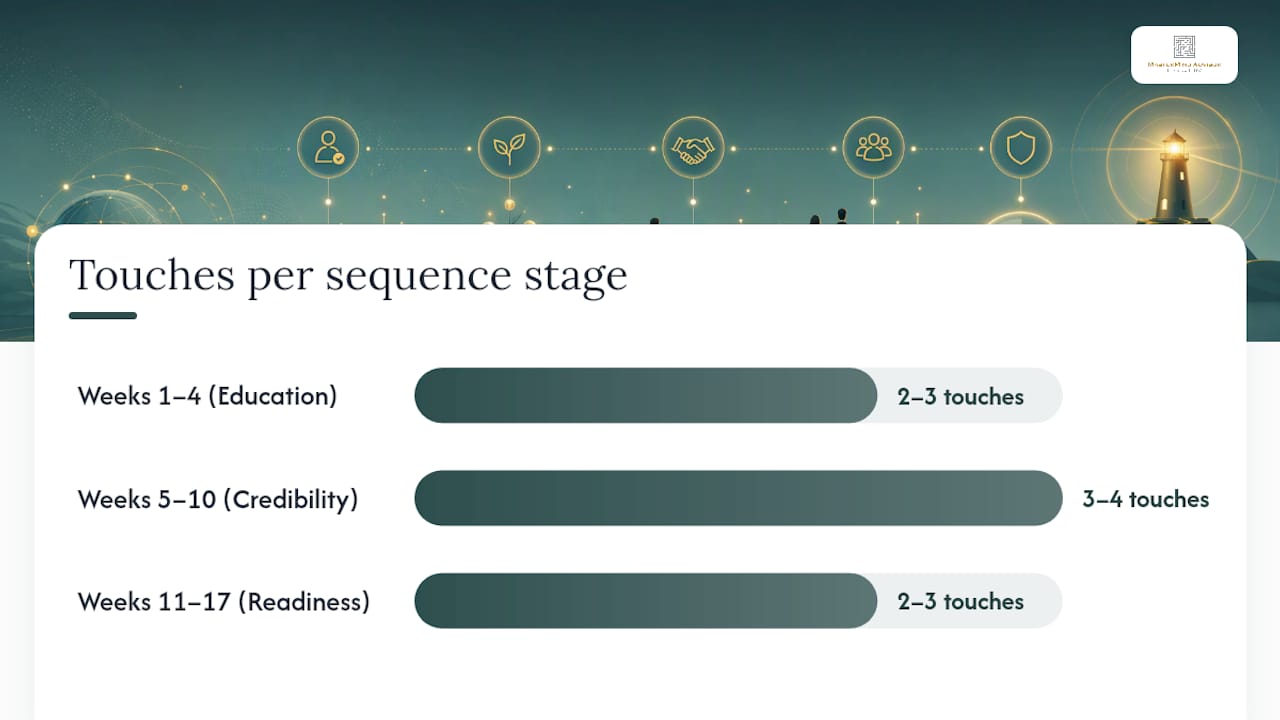
The sequence length and cadence matter more than most advisors assume. Practitioner data shows automated nurturing correlates with roughly 25% higher conversion when the primary sequence runs 8 to 12 touches over 90 to 120 days, not the six-email drip most advisors default to.
Structure it in three stages:
- Weeks 1 to 4 (education): two to three touches establishing credibility and value, no pitch, just useful content.
- Weeks 5 to 10 (credibility and engagement): three to four touches mixing case studies, a webinar invite, and one direct but low-pressure check-in.
- Weeks 11 to 17 (readiness push): two to three touches offering a specific next step, a portfolio review, a calculator tool, or a short call.
That ratio keeps the sequence from feeling like a sales pitch dressed up as a newsletter.
Branching triggers decide what happens next:
- Opens but doesn't click: send a shorter, more direct follow-up
- Clicks through: move into the credibility stage early
- Registers for a webinar: shift immediately into the readiness reactor
- Goes inactive for 21+ days: drop into a reengagement track with lighter-touch content
Sample subject-line prompts by stage: education ("Three questions to ask before your next 401(k) rollover"), credibility ("How one client restructured a $2M portfolio after a layoff"), readiness ("15 minutes to check if your retirement plan still fits"). Keep CTAs to one action per email. Two links competing for a click usually means neither gets clicked.
Which metrics tell you if the sequence is actually working?
Three numbers matter more than everything else combined: prospect-to-meeting rate, time-to-meeting, and meeting-to-client rate. Track those weekly, not quarterly.
- Prospect→meeting: target a reasonable prospect-to-meeting rate for a well-segmented sequence
- Meeting→client: target a strong meeting-to-client rate once someone actually sits down with you
- Secondary signals: open rate, click rate, and webinar attendance help diagnose why the primary numbers move, but don't optimize for them directly
Run A/B tests on one variable at a time, cadence or CTA phrasing, never both. A simple dashboard tracking these three metrics against a rolling 90-day baseline beats a 20-tab spreadsheet nobody opens.
What we've seen work across advisor nurture rollouts
Across Mastermind Advisor Marketing deployments, the lift shows up fastest when advisors resist over-automating the readiness stage. Behavioral triggers get someone to raise their hand. A human voice closes the meeting.
The traps repeat: skipping the pilot phase, letting templates go live without documented approval, and treating every prospect the same regardless of lead source. Advisors who run a warmest-50 pilot before firmwide launch catch cadence problems early, without risking their full pipeline on an unproven sequence.
How do you handle unsubscribes without losing compliance ground?
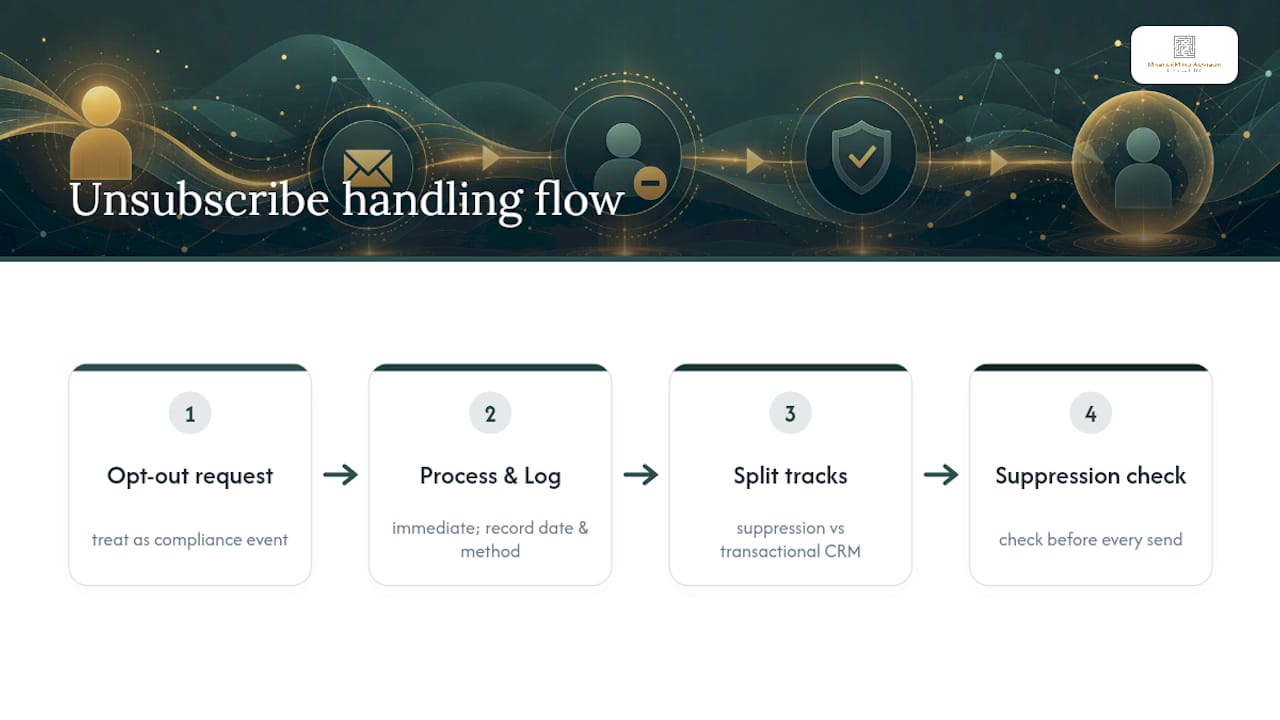
An unsubscribe request isn't just an inbox preference. It's a compliance event that needs the same documentation discipline as a template approval.
Process every opt-out within the timeframe your email platform enforces, typically immediate for CAN-SPAM compliance, and log the date and method of the request. If a prospect unsubscribes from marketing emails but you still owe them a transactional message (a scheduled meeting confirmation, for example), separate those tracks in your CRM so a legitimate transactional email doesn't get suppressed or, worse, a marketing email doesn't slip through to someone who opted out.
List health depends on treating unsubscribes as data, not noise. A high opt-out rate on a specific sequence stage usually means the content mismatched the prospect's readiness level, not that email marketing itself failed. Review unsubscribe patterns quarterly: if your objection-resolution track sheds people at a higher rate than the education ladder, the content is probably too sales-forward too early.
Keep a suppression list separate from your active CRM records, and make sure your automation engine checks it before every send, not just at list import. Reactivating a prospect who opted out, even accidentally, creates a compliance problem and a trust problem in the same email. Document your opt-out handling process in writing, the same way you document template approvals, because an examiner reviewing your marketing practices will ask how you manage it, not just whether you do.
The gap between nurture theory and what actually gets prospects to book
Most advice on this topic treats nurture sequences like a content problem: write better emails, add more touches, personalize the subject line. That misses the real lever. The sequences that convert aren't the ones with the cleverest copy. They're the ones built around behavioral triggers that catch a prospect at the exact moment they're ready, and a compliance process tight enough that nobody has to slow down to double-check whether a template is safe to send.
The conventional advice also underrates how much time compliance friction actually costs. Advisors lose weeks rewriting templates after the fact instead of building the approval workflow first. Fix the process before you write the fiftieth email.
Prioritize this in order: get your CRM and archive system compliant first, then run the 50-prospect pilot, then scale. Skipping straight to volume is the single most common mistake we see.
— Josh
Ready to launch a compliant nurture sequence without building it yourself?
Building this in-house means someone on your team learns marketing automation, compliance documentation, and behavioral trigger logic, on top of their actual job. Mastermind Advisor Marketing built a turnkey system specifically so independent advisors skip that learning curve entirely.
The system includes customized lead-generation webinars, a compliance-friendly content library already structured around SEC and FINRA requirements, automated email drip campaigns with built-in approval workflows, and a custom CRM that handles the archival and audit trail examiners expect. Instead of assembling template versioning, branching logic, and a compliance review gate from scratch, you get a system already built around the three-sequence approach that converts, with the recordkeeping already handled.
If you're ready to see how a done-for-you nurture system would look for your practice, visit the Mastermind Advisor Marketing site to request a strategy walkthrough and see a sample sequence built for advisors in your specialty.
Sources
- SEC final rule IA-5653 (Marketing rule)
- FINRA Rule 2210 guidance
- Financial Advisor Lead Nurturing: 25% More Conversions (2026) | US Tech Automations