

Direct mail marketing for financial advisors is defined as a targeted, physical outreach strategy that builds the trust required to convert prospects into long-term clients. No digital channel replicates the credibility of a well-designed letter arriving at a prospect's home. The role of direct mail financial advisors play in their marketing mix goes far beyond lead generation. It creates a foundation for the kind of trust that financial decisions demand, supports client retention through consistent touchpoints, and integrates with CRM systems and digital retargeting to form a complete, measurable marketing engine.
Why direct mail builds trust better than digital channels
Physical mail signals permanence and professionalism in a way that a Facebook ad simply cannot. When a prospect receives a letter from a financial advisor, it communicates that the advisor invested real resources to reach them. That signal matters enormously in a category where trust is the primary purchase criterion.
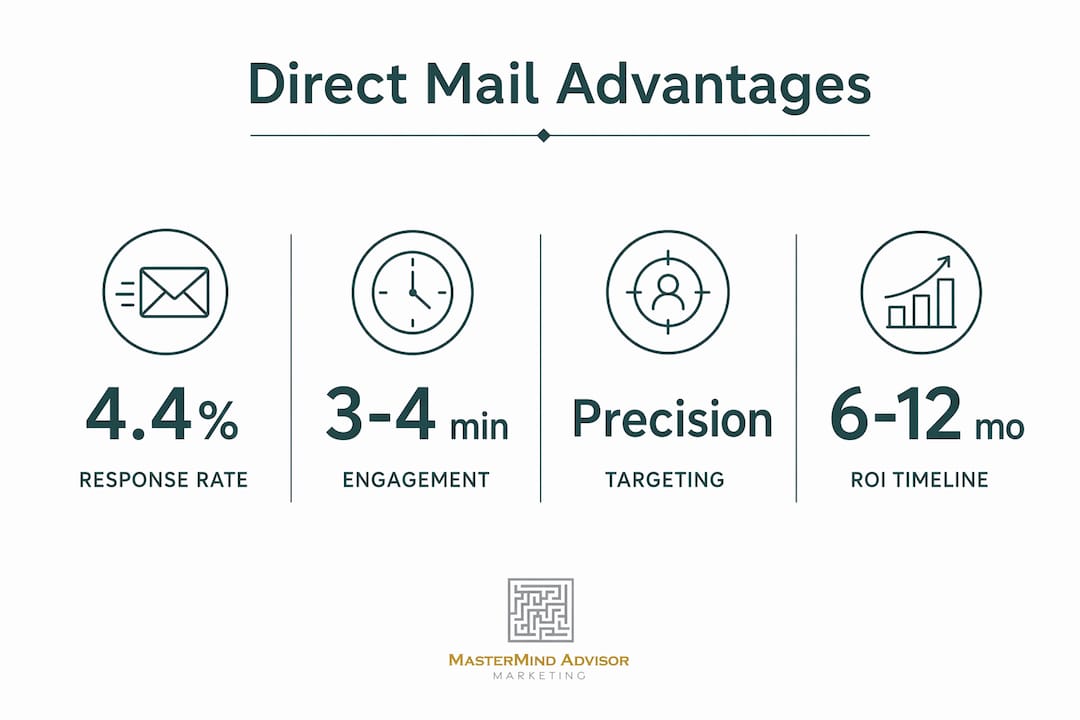
The engagement numbers confirm this. Recipients spend 3 to 4 minutes engaging with physical mail pieces. Compare that to the average digital display ad, which earns less than two seconds of attention. For financial advisors explaining retirement income strategies or estate planning options, those extra minutes are the difference between a prospect who understands your value and one who scrolls past.
Digital saturation compounds the problem for advisors relying solely on online channels. Inboxes are crowded, social feeds are noisy, and privacy regulations increasingly restrict targeting precision. Direct mail uniquely meets the trust threshold required in financial services by delivering professionally designed, physical communication that digital ads cannot replicate. This is not a nostalgic preference. It is a measurable behavioral reality.
Compliance also favors direct mail. Financial advisors operate under FINRA and SEC guidelines that require careful review of marketing materials. The structured, pre-approved nature of direct mail campaigns aligns naturally with these requirements. Advisors can submit pieces for compliance review before mailing, something that is far harder to manage with real-time digital advertising.
"A well-structured direct mail program balances educational offers and consultative invitations, avoiding aggressive sales language to align with industry compliance and buyer psychology." — McCarthy and King Marketing
How does hyper-targeting improve direct mail results for advisors?
Mass mailings to generic zip codes are a waste of budget. The advisors who see the strongest returns from direct mail marketing for advisors use data filters that match their ideal client profile with precision.
Filtering by loan-to-value ratios, home equity, and life-stage events significantly drives financial direct mail campaign success. A prospect with high home equity and a child approaching college age is a fundamentally different conversation than a recent homebuyer with minimal investable assets. Targeting tools available through data providers let you filter by income level, professional milestones like business formation, credit indicators, and new mover status.
Here is how broad targeting compares to precision targeting in practice:
| Targeting approach | Typical response rate | Cost per acquisition |
|---|---|---|
| Broad geographic mailing | 1 to 2% | High, due to low relevance |
| Hyper-targeted by life stage and equity | Exceeds industry average 4.4% | Significantly lower |
The table above illustrates why precision pays. When your list matches your ideal client profile, fewer pieces generate more appointments. That is the core economics of effective direct mail campaigns for financial advisors.
Life-stage triggers are particularly powerful. Retirees who recently rolled over a 401(k), business owners who just filed incorporation documents, and households that recently received an inheritance are all high-intent prospects. Data-driven mailing lists built around these triggers improve both engagement and regulatory adherence by keeping messaging relevant to the recipient's actual financial situation.
Pro Tip: Request a data count from your list provider before purchasing. Ask specifically for filters on net worth, home equity, and age range. A list of 2,000 precisely matched prospects will outperform a list of 10,000 generic names every time.
How do financial advisors integrate direct mail with CRM and digital systems?
Direct mail works best as the front end of a multi-touch contact strategy, not as a standalone tactic. The physical piece creates awareness and credibility. The follow-up digital touchpoints reinforce the message and move the prospect toward a conversation.
Integrating direct mail with CRM systems enables personalized follow-up, marketing automation, and multi-touch lead nurturing that improves conversion rates. Here is a practical workflow that top-performing advisors use:
- Mail a targeted letter or postcard to a filtered prospect list.
- Upload the same mailing list to Facebook and Google for digital retargeting ads that reinforce your message.
- When a prospect visits your dedicated landing page, your CRM captures their information and triggers an automated email sequence.
- A follow-up call or second mail piece goes out within 30 days based on CRM activity data.
- Non-responders enter a multi-drop mail program that sends 3 to 4 mailings over 6 to 12 months, building brand frequency and catching prospects at different decision points.
This sequence matters because financial decisions rarely happen on the first contact. Direct mail ROI should be measured with a 6 to 12 month attribution window because client lifetime value is high and decisions take time. Advisors who abandon a campaign after one mailing and no immediate response are measuring the wrong outcome at the wrong time.
Dedicated landing pages with unique phone numbers or QR codes let you track exactly which mail pieces generated responses. This data feeds back into your CRM, improving list quality and message testing over time.

Pro Tip: Use a separate phone number or URL for each mail campaign. This gives you clean attribution data and lets you compare response rates across different offers, formats, and list segments without guessing.
What direct mail formats and messages work best for financial advisors?
Format selection depends on the goal of the campaign and the sensitivity of the message. Each format serves a distinct purpose in direct mail strategies for advisors.
- Letters remain the preferred format for sensitive communications. Financial direct mail letters enhance credibility through their privacy and formal tone, making them ideal for retirement planning outreach or estate planning introductions.
- Postcards work well for seminar invitations, market update announcements, and brand awareness campaigns where brevity is an asset.
- Self-mailers fold into their own envelope and work for mid-length educational content like planning checklists or tax season reminders.
- Brochures suit situations where you need to explain credentials, services, and differentiators in detail, typically for warm prospects already familiar with your name.
Messaging tone is as important as format. The most effective copy leads with an educational offer or a low-pressure invitation, not a sales pitch. Phrases like "complimentary retirement income review" or "no-cost Social Security optimization analysis" lower the perceived risk of responding. Aggressive language like "call now" or "limited time offer" conflicts with the trust-based nature of financial advising and can trigger compliance flags.
| Campaign goal | Recommended format | Messaging approach |
|---|---|---|
| Seminar invitation | Postcard or letter | Event details, credentials, low-pressure RSVP |
| Retirement planning outreach | Letter | Educational offer, personalized salutation |
| Client market update | Self-mailer or newsletter | Data, insights, advisor commentary |
| Brand awareness | Postcard | Clean design, single clear message |
A well-structured direct mail program avoids aggressive sales language and instead positions the advisor as a credible resource. This approach respects both the buyer's psychology and the compliance requirements that govern financial marketing.
How does direct mail support client retention and referrals?
Prospecting gets most of the attention in direct mail discussions, but the retention and referral applications are where many advisors find their highest return on investment.
Quarterly in-market updates and planning checklists sent via direct mail help maintain client relationships and generate more referrals than digital-only campaigns. A physical piece sitting on a client's desk or kitchen counter is a persistent brand impression. An email gets deleted. A well-designed newsletter gets passed to a friend or family member who asks, "Who is your advisor?"
Effective retention mail programs share several characteristics:
- Personalized salutations and references to the client's specific life stage or recent milestones
- Market commentary that positions the advisor as informed and proactive
- Subtle referral program mentions that make it easy for clients to share the advisor's contact information
- Consistent quarterly or semi-annual cadence that signals reliability without overwhelming the client
Physical quarterly mailers are more effective than emails alone in retaining clients and generating referrals due to their tangible, personal nature. Clients who receive regular physical communication from their advisor report higher satisfaction and are more likely to introduce their advisor to others. You can read more about structuring this kind of program in this overview of referral program benefits for financial advisors.
Pro Tip: Include a "know someone who could benefit?" line with a simple reply card or QR code in every client newsletter. Make the referral action frictionless and you will see it happen more often.
Key takeaways
Direct mail for financial advisors works because it builds trust through physical presence, precision targeting, and consistent multi-touch follow-up that digital channels alone cannot achieve.
| Point | Details |
|---|---|
| Trust advantage | Physical mail earns 3 to 4 minutes of engagement, far exceeding digital ad attention spans. |
| Hyper-targeting drives ROI | Filtering by home equity, life stage, and income level pushes response rates above the 4.4% industry average. |
| CRM integration multiplies results | Pairing direct mail with automated follow-up and digital retargeting creates a measurable multi-touch funnel. |
| Format matches message | Letters suit sensitive outreach; postcards work for invitations; self-mailers fit educational content. |
| Retention and referrals | Quarterly physical mailers outperform email-only campaigns in client satisfaction and referral generation. |
Why I think advisors underestimate direct mail's long game
Most advisors I see try direct mail once, send a single postcard to a broad list, and declare it ineffective after 30 days. That is not a fair test of the channel. It is a test of impatience.
The advisors who build real practices with direct mail treat it as a 12-month investment, not a one-time experiment. They use precision-targeted lists built around specific life events. They integrate every mailing into a CRM workflow that triggers digital follow-up automatically. And they measure success in appointments booked and clients acquired over a full year, not response cards returned in week one.
The trust dynamics in financial advising are unlike almost any other service category. A prospect may receive your letter, hold onto it for four months, and then call you the week after a market correction rattles their confidence. Direct mail pieces extend the decision timeline because the physical piece stays in the home, creating multiple engagement opportunities that a digital ad cannot replicate. That is the channel's real power, and it requires patience to capture.
For advisors new to this approach, I recommend starting with advisor prospecting fundamentals before building your first campaign. Understanding the full prospecting funnel makes direct mail far more effective because you know exactly what role each piece plays in moving a prospect toward a conversation.
— Josh
How Mastermindadvisormarketing helps you build direct mail campaigns that convert
Mastermindadvisormarketing is built specifically for independent financial advisors who want a marketing system that does the heavy lifting without requiring a full-time marketing team.
The platform combines data-driven list targeting, compliance-ready creative, CRM integration, and automated digital follow-up into one turnkey system. If you want to run seminar campaigns that convert direct mail prospects into booked attendees, the seminar hosting guide is a strong starting point. For advisors ready to build a full marketing engine, Mastermind Advisor offers the tools, templates, and support to make direct mail a predictable, measurable growth channel for your practice.
FAQ
What is the role of direct mail for financial advisors?
Direct mail for financial advisors serves as a trust-building prospecting and retention tool that delivers personalized, physical communication to targeted prospects and clients. It supports lead generation, seminar invitations, client retention, and referral generation within a compliant marketing framework.
How do financial advisors use direct mail effectively?
Effective use combines hyper-targeted mailing lists filtered by home equity, income, and life-stage triggers with CRM-driven follow-up and digital retargeting. Multi-drop programs sending 3 to 4 pieces over 6 to 12 months consistently outperform single-mailing campaigns.
What response rate should financial advisors expect from direct mail?
The financial services industry average response rate is 4.4%, but hyper-targeted campaigns using life-stage and financial data filters regularly exceed this benchmark. Broad geographic mailings typically fall below 2%.
How long does it take to see ROI from direct mail campaigns?
Financial advisor direct mail ROI should be measured over a 6 to 12 month window because high-value clients take time to make decisions. Advisors who evaluate campaigns after 30 days consistently underestimate the channel's actual return.
What direct mail formats work best for financial advisors?
Letters are preferred for sensitive, high-trust communications like retirement planning outreach. Postcards suit seminar invitations and market updates. Self-mailers work well for educational content like planning checklists or tax season reminders.