

The webinar topics that fill seats fastest cover a narrow, urgent question with a clear next step: RMD deadlines, Social Security claiming ages, tax-loss harvesting before December 31. Below you'll find categorized topic lists, audience-specific titles ready to copy, a six-point checklist for vetting your own ideas, and the promotion basics that get people to actually show up.
TL;DR:
- Webinars focused on urgent deadlines like RMDs and Social Security claiming tend to attract the most registrations, especially if their titles highlight specific risks or outcomes.
- Topics with a clear, actionable takeaway and timeliness, such as tax moves before year-end or strategies for managing inflation impacts, outperform generic themes.
- Promoting webinars through a consistent schedule, targeting optimal days and times, and reinforcing invitations via email and partners significantly increases attendance.
- On-demand webinars work best for evergreen content like budgeting or financial literacy, while live formats are ideal for personal disclosures and complex Q&A sessions.
- Using audience-specific, precisely phrased titles and vetting ideas through a six-point checklist improves the chances of filling the room with qualified prospects.
Table of Contents
- Financial Webinar Topics by Category
- Ready-to-Use Webinar Titles by Audience
- Choosing Topics That Actually Drive Registrations
- Timing, Format, and Promotion That Fill the Room
- How Mastermind Advisor Supports Topic Planning
- Personal Finance Basics Worth Their Own Session
- Financial Literacy Sessions for True Beginners
- Talking About Economic Trends Without Sounding Like the News
- Behavioral Finance: Why People Sabotage Their Own Plans
- Insurance Planning Topics That Round Out the Series
- What Actually Separates a Good Topic From a Great One
- A Done-for-You Path if Topic Planning Isn't Your Bottleneck, Time Is
- Sources
- FAQ
Financial Webinar Topics by Category
Most advisors default to "retirement planning 101" because it feels safe. It also feels generic, and generic topics don't convert. The webinars that pull real registrations pick a category, then narrow it to something specific enough that a prospect thinks "that's my exact situation."
High-performing advisor webinar topics tend to cluster around a handful of categories that consistently drive registrations, according to Onimod Global's guide to webinar marketing for financial advisors. Here's how those categories break down with example session themes:
- Retirement and retirement income: required minimum distributions (RMDs), Social Security claiming strategies, Medicare basics for people approaching 65.
- Tax planning: year-end tax moves, tax-efficient withdrawal sequencing, tax implications of RSUs or cryptocurrency gains.
- Estate and legacy planning: wills versus trusts, lifetime gifting strategies, charitable giving basics.
- Investments and markets: market outlook sessions, managing volatility without panic-selling, portfolio rebalancing mechanics.
- Protection and fraud prevention: common scams targeting retirees, cybersecurity for personal finances, what to do after identity theft.
- Life-stage topics: college savings and financial aid, caring for aging parents, tax and retirement planning for small-business owners.
Notice the pattern: each theme answers a question someone is already asking themselves, usually triggered by a deadline, a life event, or a headline they saw last week. That's not an accident. Institutional webinar calendars that run year-round tend to mix exactly this blend of life-event and technical content, covering everything from homebuying and health care costs in retirement to fraud prevention, because that mix is what keeps registration numbers steady across a full year instead of spiking once and going quiet.
Ready-to-Use Webinar Titles by Audience
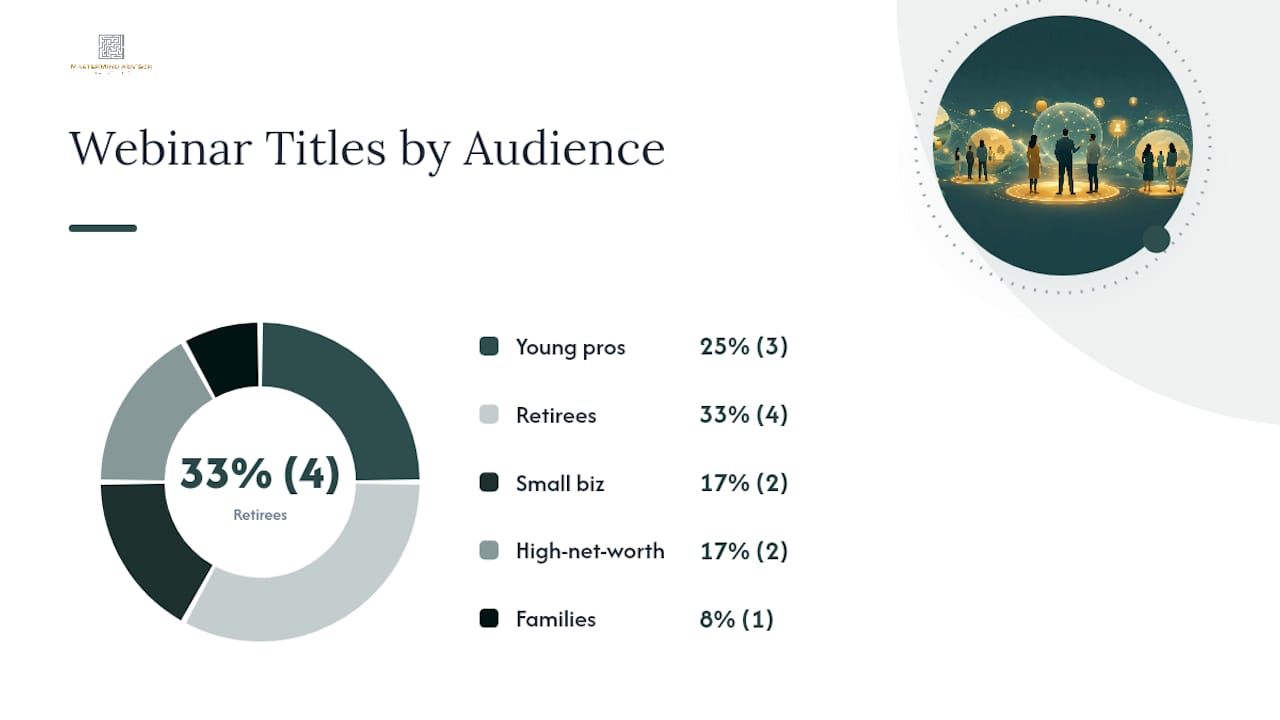
A topic category is a starting point. A title is what actually gets clicked. Specific, audience-focused titles with a clear takeaway consistently outperform vague ones, based on Docupace's research on webinar hosting, so every title below pairs a hook with the outcome an attendee walks away with.
For young professionals:
- "Your First $100K: A Simple Framework for Saving and Investing in Your 20s and 30s" (live, with a Q&A on employer 401(k) matches)
- "Student Loans vs. Investing: Which Should You Prioritize First?" (on-demand friendly)
- "Equity Compensation 101: What to Do With Your RSUs and Stock Options"
For retirees and near-retirees: 4. "The Social Security Decision: Why Your Claiming Age Could Cost You $100,000" 5. "RMDs Explained: What Happens to Your Retirement Accounts After 73" 6. "Medicare Without the Confusion: Parts A, B, D, and Supplement Plans Compared" 7. "Longevity Planning for Women: Why Your Retirement Math Looks Different" (best live, given the sensitive personal questions it tends to draw)
For small-business owners: 8. "Exit Ready: Building a Business Succession Plan Before You Need One" 9. "Retirement Plans for the Self-Employed: SEP IRA, Solo 401(k), or Defined Benefit?"
For high-net-worth households: 10. "Beyond the Will: Advanced Estate Strategies for Multi-Generational Wealth" 11. "Concentrated Stock Positions: Managing Risk Without Triggering a Tax Bill"
For families and caregivers: 12. "The Sandwich Generation: Paying for College and Caring for Aging Parents at the Same Time"
Keep the language compliance-safe: describe frameworks and considerations, not guaranteed outcomes. "A framework for evaluating your options" clears review far more easily than "the strategy that will maximize your Social Security check." Live formats work better for anything involving personal financial disclosure or complex Q&A, like Social Security or estate planning. On-demand suits foundational, evergreen content like budgeting or RSU basics, where attendees mostly want facts at their own pace.
Choosing Topics That Actually Drive Registrations
Picking a topic because it sounds important is how you end up with a half-empty webinar room. Picking one because it scores well against a short set of criteria is how you fill it.
Run every candidate topic through six checks before you commit a date to it:
- Audience fit: does this match a question your specific list is actually asking right now?
- Timeliness: is there a deadline, headline, or season attached (tax season, RMD deadlines, market news)?
- Searchable phrasing: would someone type this exact phrase into Google?
- Clear takeaway: can you state, in one sentence, what attendees will be able to do afterward?
- Compliance neutrality: does the title avoid performance promises or guaranteed outcomes?
- Measurability: can you track registrations, attendance, and follow-up conversions for this specific topic?
A topic that scores well on five of six is workable. One that scores well on two or three needs a rewrite, not a promotion budget.
Pro Tip: Before you build a full webinar deck, drop a one-question poll on social media or a one-line survey in your email signature asking "Which topic interests you more: RMDs or Roth conversions?" A topic that can't win a two-way poll usually won't win a registration page either.
Advisors running a full webinar series, rather than one-off events, tend to build deeper relationships with attendees over time, according to Bedrock's guide to marketing webinar series for independent advisors. Compliance review of every script and slide deck remains critical throughout, regardless of format.
Timing, Format, and Promotion That Fill the Room
A great topic with poor promotion still draws an empty room. Live sessions of 30 to 45 minutes hit the sweet spot for financial content. Long enough to cover substance, short enough that people don't drop off halfway through. On-demand versions work well as a second life for evergreen topics like budgeting basics or RSU explainers.
Tuesday through Thursday, late morning or early evening, tends to outperform Mondays and Fridays for financial webinars. Start promotion three to four weeks out, with best practices from USA Financial recommending a steady email cadence plus partner or referral-source amplification rather than a single blast.
- Send invitation, reminder, and "starting soon" emails on a fixed cadence, not all at once.
- Use live polls, a dedicated Q&A block, and occasionally a guest speaker to keep engagement high.
- Close with one clear call to action, like booking a follow-up call or downloading a related guide, and follow up with both attendees and no-shows within 48 hours.
A content calendar built around your webinar dates keeps promotional emails, social posts, and blog teasers synced instead of scrambled together the week before.
How Mastermind Advisor Supports Topic Planning
Mastermind Advisor works with independent financial advisors on the full webinar lifecycle: topic ideation matched to a practice's actual client base, full production, and CRM-integrated follow-up sequences that keep attendees warm after the session ends. For deeper implementation steps, see the advisor webinar strategy guide and lead-generation playbook.
Personal Finance Basics Worth Their Own Session
Budgeting, saving, and debt management sound like beginner material, but they consistently rank among the most requested webinar topics across age groups, not just for new investors. A 45-minute session on the debt avalanche versus debt snowball method, for instance, pulls in people who've never attended a financial webinar in their life. That's the appeal: no one feels intimidated walking into a session about paying down credit cards.
The strongest budgeting webinars skip generic advice like "track your spending" and instead walk through a specific method: zero-based budgeting, the 50/30/20 rule, or a sinking-funds approach for irregular expenses like car repairs and holidays. Saving topics work best paired with a concrete number or milestone: building a three- to six-month emergency fund, saving for a first home down payment, or automating transfers so saving happens before spending does.
Debt management deserves its own standalone slot, separate from budgeting. A session titled "Credit Card Debt: A Realistic Payoff Plan for 2026" draws a different, often more urgent audience than one titled "Household Budgeting Basics." Splitting them lets you speak more directly to each group's actual pain point instead of diluting the message across a single broad session.
These basics also function as excellent top-of-funnel webinars. Someone who shows up to learn about debt payoff today may be your retirement-planning client in five years.
Financial Literacy Sessions for True Beginners
Financial literacy webinars aren't the same as personal finance basics. Literacy content teaches the underlying concepts (what a credit score actually measures, how compound interest works, what the difference is between a Roth and traditional IRA) rather than an action plan. Beginners need the vocabulary before they need the strategy.
A session like "Money Terms Nobody Explains: Credit Scores, APR, and Compound Interest Decoded" performs well precisely because it names the confusion out loud. Adults frequently avoid financial content because they're embarrassed not to already know the basics. A webinar that treats that gap as normal, rather than assuming baseline knowledge, earns trust fast.
Younger audiences and first-generation savers respond particularly well to literacy programming. Community and institutional financial education series commonly build entire calendars around foundational money management topics tailored to specific groups, according to a financial literacy series run for college staff and community members. That same model, targeted programming for a defined group rather than a generic audience, works just as well for an independent advisory practice building its own literacy track.
Keep these sessions short, visual, and light on jargon. A 30-minute format with heavy use of simple charts (how $100 a month grows over 20 years, for example) tends to land better than a dense slide deck full of definitions.
Talking About Economic Trends Without Sounding Like the News
Attendees don't need another webinar that just recaps headlines. They need help translating inflation numbers, interest rate moves, or a volatile jobs report into what it means for their own budget, portfolio, or retirement timeline. That translation is the actual value.
A session on interest rate changes, for example, should walk through concrete effects: what a rate move does to mortgage refinancing decisions, savings account yields, and bond fund pricing, not just recite the current rate. Inflation webinars land better when they cover practical countermeasures like adjusting a retirement withdrawal rate or renegotiating fixed expenses, rather than simply explaining what inflation is.
Timing matters here more than in almost any other category. A webinar on "What the Latest Fed Decision Means for Your Portfolio" scheduled within a week or two of an actual rate announcement will outperform the same content run in a quiet news month. Build a short list of recurring economic-trend topics, then keep them ready to deploy quickly when the news cycle creates demand.
Behavioral Finance: Why People Sabotage Their Own Plans
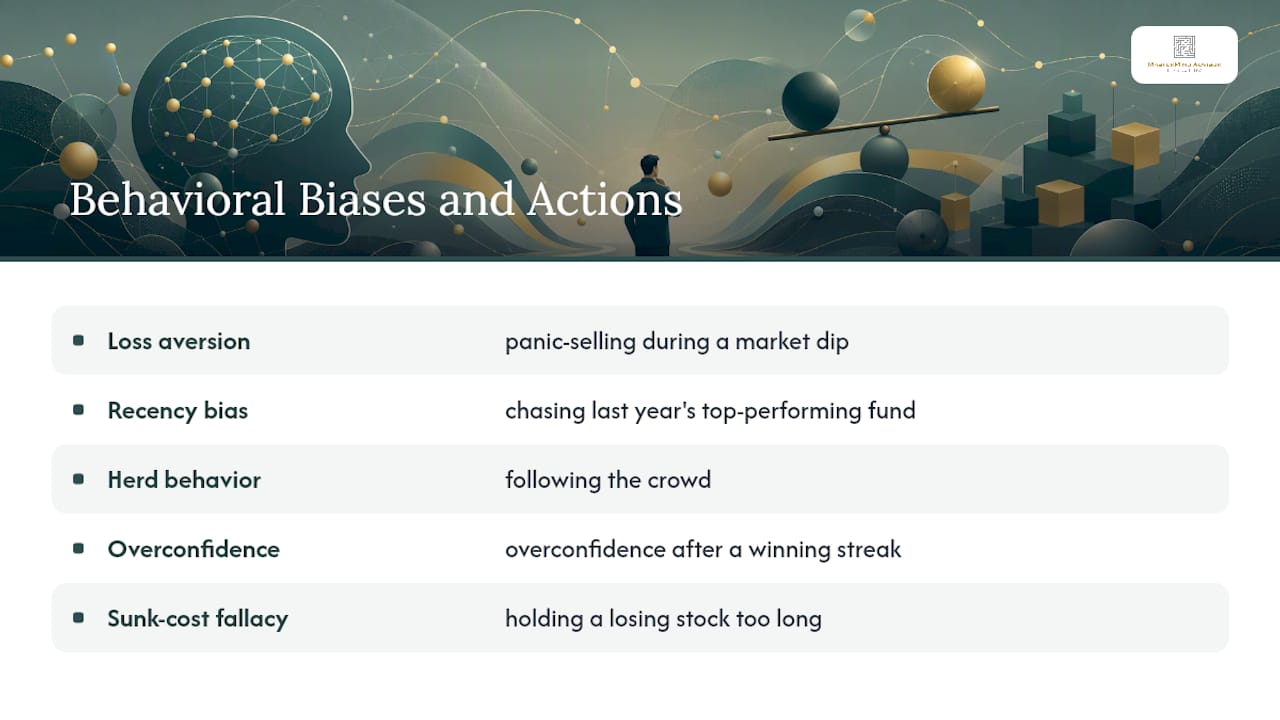
Investors rarely lose money because they lacked information. They lose money, or leave it on the table, because of predictable psychological patterns: loss aversion, recency bias, herd behavior, and overconfidence after a winning streak. Behavioral finance webinars name these patterns directly, and attendees usually recognize themselves within the first five minutes.
A session titled "Why Smart People Make Bad Investment Decisions" or "The Behavioral Traps That Cost Investors the Most" tends to draw strong engagement because it's not accusatory. It's diagnostic. Cover specific biases attendees can actually spot in their own recent decisions: panic-selling during a market dip (loss aversion), chasing last year's top-performing fund (recency bias), or holding a losing stock too long because selling would "make the loss real" (the sunk cost fallacy).
These topics work particularly well as a bridge between a market-volatility session and a portfolio-review conversation. Once someone understands why they're prone to a particular mistake, they're far more open to a structured plan that removes the decision from their hands, like automatic rebalancing or a written investment policy statement.
Insurance Planning Topics That Round Out the Series
Insurance rarely gets top billing in a webinar calendar, yet gaps in life, disability, and long-term care coverage cause some of the most expensive financial surprises a household will ever face. A standalone session gives this topic the attention it needs instead of a rushed mention inside a broader retirement talk.
Life insurance sessions work best framed around a specific life event: a new baby, a mortgage, or a business partnership that depends on one person's income. Disability insurance deserves more airtime than it usually gets. Working-age adults are statistically far more likely to face a disability that stops their income than to die during their working years, yet disability coverage is one of the most commonly skipped policies. A session like "The Insurance Gap Most People Don't Know They Have" addresses this directly.
Long-term care planning pairs naturally with your retirement and estate content. A session on "Paying for Long-Term Care: Insurance, Self-Funding, and Medicaid Planning" fits well as the final entry in a retirement-focused webinar series, since it's the topic people are most likely to postpone until it's urgent.
What Actually Separates a Good Topic From a Great One
The conventional advice says pick topics your audience "cares about." That's not wrong, it's just incomplete. Almost everyone cares about retirement, taxes, and market performance in the abstract. The topics that actually convert are the ones that narrow that broad interest into a specific, timely decision someone needs to make in the next few weeks.
Here's what gets underrated: the title matters almost as much as the content behind it. Two advisors can deliver the identical RMD presentation, and the one titled "RMD Deadlines: What Happens If You Miss One" will out-register the one titled "Understanding Required Minimum Distributions" by a wide margin, because one names a fear and one names a topic.
What I'd prioritize first, if I were building a calendar from scratch: pick one urgent, deadline-driven topic (tax season, RMDs, open enrollment) and one evergreen, low-intimidation topic (budgeting, financial literacy basics) and alternate between them. The urgent ones bring in warm, ready-to-act prospects. The evergreen ones build your list for the long game. Most advisors only run the first kind, then wonder why their pipeline dries up between tax seasons.
— Josh
A Done-for-You Path if Topic Planning Isn't Your Bottleneck, Time Is
This service is designed for advisors who know their audience but lack the time to write, produce, and promote a webinar series every quarter. Instead of building slide decks and chasing email sequences between client meetings, it offers topic strategy matched to a practice's client base, full seminar and webinar production for live or virtual formats, a compliance-friendly content library, and automated follow-up integrated with CRM systems.
That last piece is where most advisor-run webinars quietly lose leads: a great session followed by no structured follow-up. Automated email drip campaigns can continue engagement immediately after the webinar ends, ensuring attendees are contacted without additional effort from the advisor. If you want to see how the webinar follow-up sequence works in practice, or how a full seminar program comes together from seminar planning through the final client conversation, start with a look at Mastermind Advisor and book a call to map out your next topic calendar.
This article is general information, not a substitute for advice from a qualified financial advisor. Consult a qualified financial professional about your own circumstances before acting on anything here.
Sources
- Webinar Marketing for Financial Advisors: A Complete Guide
- 7 Steps to Webinar Hosting Success
- 25 Webinar Best Practices for Financial Advisors
FAQ
What Are Some Popular Topics for Finance Webinars?
Retirement income planning, Social Security claiming strategies, tax-efficient withdrawal planning, RMDs, estate planning, and market volatility management consistently rank among the highest-performing categories for advisor webinars.
What Are the Top Financial Topics for a General Audience?
Beyond retirement and tax planning, budgeting methods, debt payoff strategies, insurance gaps (especially disability coverage), behavioral finance biases, and current economic trends like interest rate changes draw strong general-audience interest.
What Are Good Topics for a Financial Seminar?
Seminar-friendly topics tend to be broader and more introductory than a single-issue webinar, covering areas like retirement basics, estate planning fundamentals, and tax-efficient strategies, often expanded into longer lists of adaptable titles advisors can customize for their own seminar programs.
What Makes a Webinar Topic Successful?
A successful topic answers one narrow, timely question and gives attendees a clear next step, rather than covering broad theory with no specific action attached.
How Often Should I Run Financial Webinars?
A series format, run monthly or quarterly around a consistent theme, tends to build deeper attendee relationships and generate more qualified leads than scattered one-off events, according to Bedrock's webinar series guide.