

Financial webinars are the most cost-efficient lead generation channel available to independent advisors today, producing qualified prospects at roughly $72 per lead compared to $800 or more per lead at trade shows. To generate leads through financial webinars effectively, you need three things working together: a compliance-reviewed content structure, a registration funnel that captures behavioral data, and a segmented follow-up sequence that fires within 24 hours. Platforms like Zoom Webinars, GoTo Webinar, and ON24 each support the compliance and CRM integration requirements that registered investment advisors and independent financial professionals face. When you add CE credit incentives, expert co-hosts, and automated email nurturing, the webinar becomes far more than a one-time event. It becomes a repeatable client acquisition engine.
What are the essential tools and compliance requirements for financial webinars?
The technology stack for financial webinar lead generation is straightforward, but the compliance layer is where most advisors cut corners and pay for it later. Your hosting platform must support cloud recording for archival purposes, allow registration gating, and integrate with a CRM like Salesforce, HubSpot, or Redtail Technology. These are not optional features. They are the foundation of a defensible compliance record.
On the compliance side, keep language strategy-first and avoid product pitches outside appropriate regulatory contexts. Every slide deck and script should pass a compliance review before the event goes live. Use neutral, educational framing throughout. Disclosures belong at the start and end of every session, not buried in footnotes.
For lead capture, keep your registration form to two fields: name and email. Every additional field reduces completion rates. After registration, behavioral scoring begins. Track who attends live versus watches the replay, who clicks mid-session CTAs, and who submits questions. These signals separate high-intent prospects from passive viewers.
Effective lead magnets for financial webinars include retirement income checklists, Social Security timing guides, and tax-efficient withdrawal worksheets. These assets give prospects a reason to register and a reason to stay engaged after the session ends.
| Tool Category | Recommended Options |
|---|---|
| Webinar hosting | Zoom Webinars, GoTo Webinar, ON24 |
| CRM integration | Salesforce, HubSpot, Redtail Technology |
| Email automation | ActiveCampaign, Mailchimp, Constant Contact |
| Lead magnets | Retirement checklists, tax guides, Social Security worksheets |
| Compliance review | Internal CCO review, RegEd, Smarsh archival |
Pro Tip: Record every webinar and store it with your compliance team before repurposing it as on-demand content. Regulators treat recorded webinars the same as live ones.
How do you design and promote webinars to attract high-quality financial leads?
The best financial webinar ideas target a specific life event or financial decision, not a broad topic. "Retirement Income Planning for Ages 55 to 65" outperforms "Financial Planning 101" every time because it speaks directly to a prospect's current situation. Pre-retirees and affluent investors in their late fifties are the highest-converting demographic for most independent advisors, and they respond to specificity.

Structure your sessions at 30 to 45 minutes with a live Q&A at the end. Longer sessions lose attendees at the 40-minute mark. The Q&A is not just engagement. It is a live lead scoring event where the questions asked reveal intent, urgency, and asset level.
Promotion is where most advisors underinvest. A strong promotion plan for financial education webinars includes:
- An SEO-optimized landing page with a single registration CTA and social proof (advisor credentials, past attendee counts, or testimonials)
- LinkedIn paid ads targeting by job title, age bracket, and zip code
- Email campaigns to your existing list with a referral incentive
- A Google search campaign targeting terms like "retirement income planning webinar" or "Social Security strategy seminar"
- CE credit incentives for sessions targeting other financial professionals, such as CPAs or estate attorneys who can refer clients
Expert co-hosts add credibility that solo advisors cannot manufacture alone. A CPA, estate attorney, or Medicare specialist sharing the stage signals depth and objectivity to prospects who are evaluating whether to trust you with their retirement assets.
Pro Tip: Schedule webinars on Tuesday or Wednesday evenings between 6:30 and 8:00 PM local time. Pre-retirees are home, not commuting, and not yet in weekend mode.
What are the best practices for executing the webinar and capturing leads?
Execution is where the lead generation strategy either compounds or collapses. Interactive webinar formats with live polls and mid-session CTAs produce marketing-qualified lead rates of approximately 38%, compared to 19% for passive slide presentations. That gap represents real pipeline.
Follow this sequence during the live session:
- Open with a poll question tied to the topic (example: "How confident are you that your retirement income will last 30 years?"). This establishes engagement and gives you segmentation data immediately.
- At the 15-minute mark, drop a CTA to download the companion guide. Track who clicks.
- At the 25-minute mark, introduce the single next step: a complimentary 30-minute retirement income review. Frame it as the natural continuation of what you just taught, not a sales call.
- During Q&A, answer questions publicly but note the names of attendees who ask specific, personal questions. These are your highest-priority follow-up calls.
- Close with a clear, single instruction: "Click the link in the chat to schedule your review before Friday."
| Attendee behavior | Lead score signal | Follow-up priority |
|---|---|---|
| Attended full session + asked question | Very high intent | Call within 2 hours |
| Attended full session + clicked CTA | High intent | Call within 24 hours |
| Attended partial session | Medium intent | Email sequence Day 1 |
| Registered, did not attend | Low intent | Replay email + nurture |
Pro Tip: Send the replay link only to non-attendees. Attendees who already watched live should receive a personalized follow-up email, not a generic broadcast.
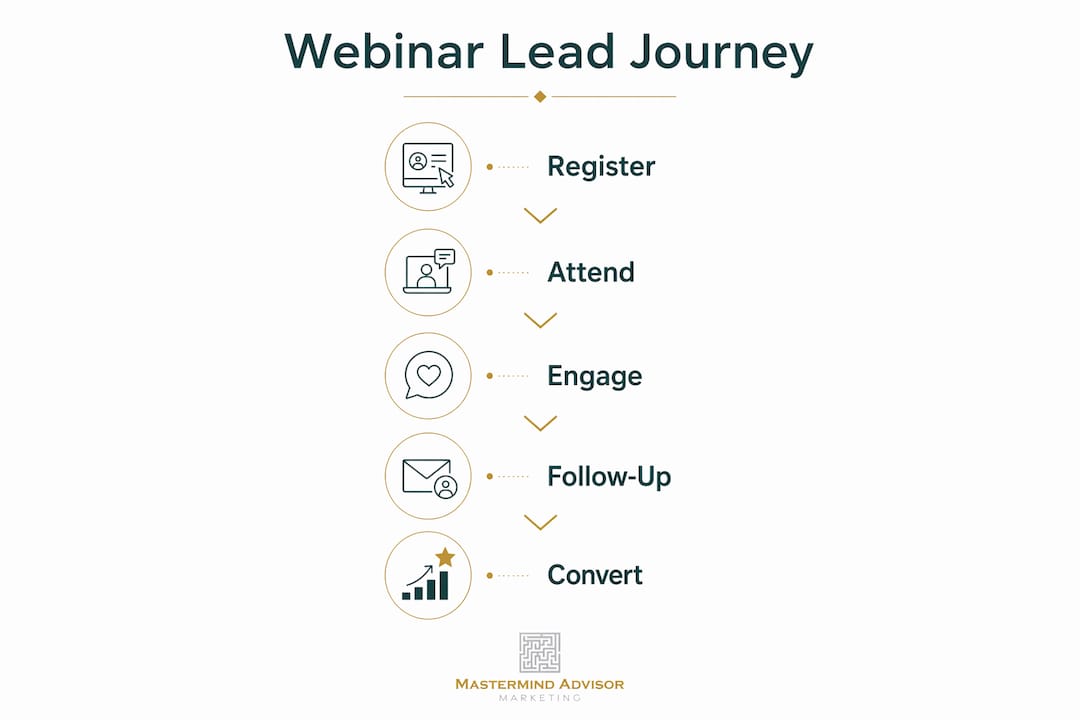
How do you convert webinar leads into clients with timely follow-up?
73% of event leads go cold within 72 hours without timely follow-up. That statistic defines the entire post-webinar strategy. The first 24 hours capture the majority of total conversions, which means your follow-up system must be automated and segmented before the webinar even starts.
Here is the follow-up sequence that converts:
- Within 1 hour of session end: Send a personalized thank-you email to all attendees with the downloadable guide and a single scheduling link.
- Within 24 hours: Call every attendee who clicked the CTA or asked a question. Reference their specific question by name. This is not a cold call. It is a warm continuation.
- Day 2 to Day 3: Send a second email to non-responders with a case study or client success story relevant to the webinar topic.
- Day 5 to Day 7: Final follow-up email with a soft deadline on the complimentary review offer.
- Day 14 and beyond: Move unresponsive leads into a long-term nurture sequence through your CRM.
Segmentation is the difference between a 5% conversion rate and a 20% one. Behavioral signals like poll answers, CTA clicks, and questions asked can trigger routing within hours, putting your highest-intent leads in front of you before they talk to anyone else. Use LinkedIn to connect with attendees the morning after the event. A connection request with a short personal note referencing the webinar topic has a high acceptance rate and keeps you visible.
Compliance applies to follow-up too. Avoid specific product recommendations in written follow-up unless you are operating under a formal advisory agreement. Keep the framing educational and focused on the next conversation, not the next transaction.
What common mistakes kill webinar lead generation results?
Most advisors who struggle to generate leads from financial webinars make the same six mistakes. Recognizing them is faster than learning them through lost pipeline.
- Running sessions longer than 45 minutes. Attention drops sharply after 40 minutes. A tight, focused session with a clear next step outperforms a comprehensive lecture every time.
- Skipping compliance review. One unsupported performance claim or an implied product recommendation can trigger a regulatory inquiry. Every script needs a compliance sign-off.
- Sending a single broadcast follow-up to all attendees. A prospect who asked three questions during Q&A and a prospect who registered but never showed up are not the same lead. Treat them differently.
- Waiting more than 48 hours to follow up. Only 9.6% of prospects take a month or more to decide. The rest are deciding now, and slow follow-up hands them to the next advisor who calls.
- Ignoring engagement data. Poll responses, CTA clicks, and attendance duration are lead scoring inputs. Advisors who ignore this data leave their best leads in a generic nurture queue.
- Hosting one-off webinars. A single event builds no momentum. A monthly or quarterly series builds a reputation, an audience, and a compounding lead pipeline.
Pro Tip: Build a seminar calendar at least 90 days in advance. Prospects who miss one session will register for the next if they know it is coming.
Key takeaways
Financial webinars generate qualified leads at a fraction of the cost of traditional channels, but only when compliance, behavioral scoring, and rapid follow-up work as a single system.
| Point | Details |
|---|---|
| Cost advantage is real | Webinars average $72 per qualified lead versus $800 or more at trade shows. |
| Compliance is non-negotiable | Every script needs CCO review; keep language educational and strategy-first. |
| Interactive formats double MQL rates | Live polls and mid-session CTAs produce 38% MQL rates versus 19% for passive sessions. |
| 72-hour follow-up window is critical | 73% of leads go cold without contact in the first 72 hours post-event. |
| Segmentation drives conversion | Score leads by behavior and prioritize calls to attendees who asked questions or clicked CTAs. |
Why webinars have become my primary recommendation for financial advisors
I have watched advisors spend $5,000 on a single dinner seminar and walk away with two appointments. I have also watched advisors run a 40-minute webinar on Social Security timing and book eight discovery calls the next morning. The difference is not the topic or the advisor's credentials. It is the system behind the event.
The shift I see in 2026 is that affluent prospects treat webinars as a gateway to a one-on-one consultation. They are not attending to learn everything about retirement income. They are attending to decide whether you are worth an hour of their time. That reframes the entire webinar design. Your job is not to teach. Your job is to earn the follow-up call.
The advisors who get this right do two things consistently. They run webinars on a schedule, not on a whim. And they treat the 24 hours after the event as the most important marketing activity of the month. The webinar is the trust-building event. The follow-up call is where the client relationship actually starts.
Compliance trends are also tightening around digital content in 2026. Regulators are paying closer attention to recorded webinars, replay distribution, and email follow-up language. Advisors who build compliance review into their webinar workflow from the start will not scramble when an audit arrives. Those who treat it as an afterthought will.
If you are not yet running a recurring webinar series, the advisor prospecting frameworks that work for in-person seminars translate directly to the digital format. Start with one topic, one audience segment, and one clear next step. Build from there.
— Josh
How Mastermindadvisormarketing supports your webinar lead generation
Mastermindadvisormarketing builds the entire webinar system for independent financial advisors so you are not piecing together platforms, scripts, and follow-up sequences on your own. The turnkey approach covers compliance-ready content, CRM integration, and automated email follow-up sequences that fire based on attendee behavior, not a generic broadcast schedule.
If you are ready to run webinars that actually fill your calendar with qualified appointments, start with the seminar hosting guide at Mastermindadvisormarketing. It covers topic selection, promotion, and post-event follow-up in a format built specifically for financial advisors. For a broader view of how webinars fit into your digital lead generation strategy, the 2026 growth guide is the right next step. Visit Mastermind Advisor to explore the full system.
FAQ
How much does it cost to generate leads through financial webinars?
Webinars average approximately $72 per qualified lead, making them significantly more cost-efficient than search ads at $92 per lead or trade shows at $800 or more per lead.
What are the best financial webinar ideas for attracting pre-retirees?
Topics tied to specific decisions, such as Social Security timing, retirement income sequencing, or tax-efficient withdrawal strategies, consistently outperform broad financial planning topics for the 55 to 65 age bracket.
How quickly should financial advisors follow up after a webinar?
Follow-up calls and emails should go out within 24 hours of the session ending. Research shows 73% of event leads go cold within 72 hours without contact.
Do financial webinars require compliance review?
Yes. Every script, slide deck, and follow-up email must pass a compliance review. Regulators treat recorded webinars the same as live presentations, and product-pitch framing outside appropriate advisory contexts creates regulatory exposure.
How do CE credits help attract webinar attendees?
Offering CE credits, such as CFP or CFA continuing education units, gives financial professionals a concrete reason to register and attend. This tactic also positions the host advisor as a credible educator within the professional community.