

Digital leads for financial advisors are prospects generated online through targeted marketing tactics that meet financial industry compliance standards while maximizing client acquisition efficiency. The industry term for this practice is digital lead generation, and it covers every channel from SEO and paid search to social media and AI-powered answer engines. Advisors who treat these channels as a unified system, rather than isolated experiments, consistently outperform peers who rely on referrals alone. This guide breaks down exactly which channels work, how to use them compliantly, and what separates advisors who fill their calendars from those who struggle to get a single inquiry.
What are the proven digital lead generation channels for financial advisors?
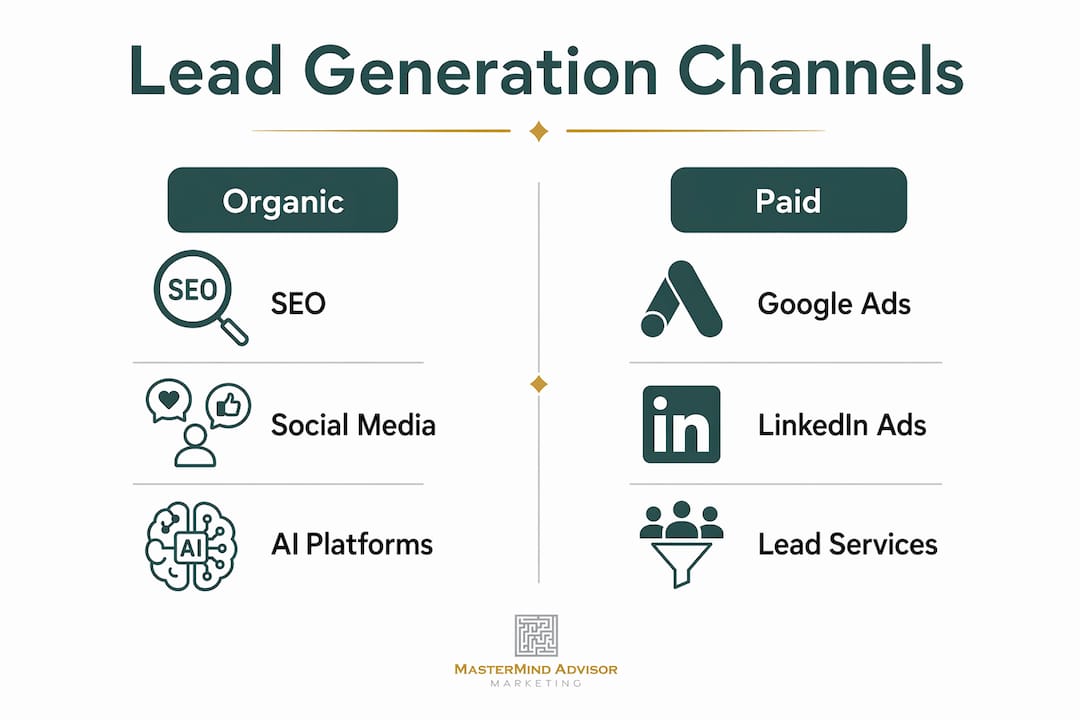
The most effective digital lead generation channels for financial advisors are SEO, social media, paid advertising, AI answer engine optimization, and professional lead services. Each channel serves a different stage of the client journey, and the advisors who grow fastest use at least three simultaneously.
Search engine optimization remains the highest-ROI long-term channel. Financial content falls under Google's Your Money or Your Life (YMYL) policy, which means Google holds it to a higher standard than lifestyle content. Life-event SEO targets high-intent queries like "what to do with a 401k after leaving a job" and produces warmer leads than generic city-based keywords like "financial advisor Chicago." The specificity of the query signals where the prospect is in their decision process.

AI answer engines are a fast-growing channel that most advisors have not yet claimed. Platforms like ChatGPT, Perplexity, and Google's AI Overviews now handle 28% of financial comparison queries, meaning nearly one in three prospects researching advisors online never clicks a traditional search result. Advisors who structure their content to appear in these answers gain visibility their competitors cannot buy.
Social media generates leads through consistent engagement rather than one-off posts. LinkedIn and Facebook receive the largest share of advisor social media budgets, with Instagram and TikTok gaining ground among younger client segments. The platform you prioritize should match the demographic you want to attract.
Paid advertising delivers immediate lead flow but requires precision. Financial keywords on Google can cost $50 to $80 per click, which makes broad campaigns expensive and inefficient. Tightly themed ad groups built around bottom-funnel keywords protect your budget.
Professional lead services offer a shortcut to qualified meetings. These services typically deliver 5 to 20 pre-qualified meetings monthly, giving advisors a predictable pipeline while their organic channels mature.
| Channel | Best for | Time to results |
|---|---|---|
| SEO and life-event content | Long-term, high-intent organic leads | 3 to 12 months |
| AI answer engine optimization | Emerging visibility in AI-driven searches | 2 to 6 months |
| LinkedIn and Facebook | Professional networking and referral amplification | 1 to 3 months |
| Paid search (Google Ads) | Immediate bottom-funnel lead flow | Days to weeks |
| Lead generation services | Pre-qualified meetings on demand | Immediate |
How can financial advisors leverage AI and compliance-friendly SEO to boost lead quality?
Answer Engine Optimization (AEO) is the practice of structuring content so that AI platforms like ChatGPT, Perplexity, and Google's AI Overviews cite your firm when answering financial questions. With AI platforms capturing 28% of financial comparison queries, ignoring AEO means surrendering a significant share of high-intent research traffic to advisors who have already optimized for it.
The foundation of AEO is the same as strong SEO: genuine E-E-A-T signals (Experience, Expertise, Authoritativeness, and Trustworthiness). Google and AI platforms both reward content written by named experts with verifiable credentials. An article bylined by a CFP with a linked bio, published on a site with proper disclosures, ranks higher and gets cited more often than anonymous content, regardless of keyword density.
Structured data and schema markup are the technical layer that makes AEO work. FAQ schema, HowTo schema, and Article schema tell AI crawlers exactly what your content answers, making it easier for them to surface your response to a matching query. Adding these to your lead generation landing pages is one of the highest-leverage technical improvements an advisor's site can make.
Compliance and clarity are not opposites. Writing must balance precise compliance language with a human, personal voice to build client trust. A disclaimer at the bottom of a page does not make the rest of the content robotic. Advisors who write in plain language, explain concepts through real scenarios, and then add required disclosures consistently outperform those who let legal review strip all personality from their content.
Pro Tip: Build a master disclaimer library with pre-approved language for common topics like retirement planning, tax strategy, and investment risk. Paste from this library rather than writing new disclosures each time, which cuts compliance review time and keeps your messaging consistent.
What role does social media marketing play in generating digital leads for financial advisors?
Social media is the fastest channel for building the kind of familiarity that converts a cold prospect into a booked meeting. Advisors who post approximately 35 times per month consistently acquire more clients than those who post sporadically. That frequency sounds high, but it breaks down to roughly eight posts per week across platforms, which is achievable with a content calendar and a few hours of batch creation.
Platform selection matters more than total posting volume. Here is how to think about each channel:
- LinkedIn is the primary platform for advisors targeting business owners, executives, and professionals. Long-form posts about tax strategy, succession planning, and retirement income perform well here because the audience actively seeks professional development content.
- Facebook reaches the 45-plus demographic that holds the largest share of investable assets. Event promotion, educational videos, and community group participation all generate leads on Facebook at a lower cost per engagement than paid ads.
- Instagram works for advisors building a personal brand with younger accumulators. Short educational reels, behind-the-scenes content, and milestone posts (client success stories with permission) build the kind of trust that converts over time.
- TikTok is the fastest-growing channel for reaching millennials and Gen Z clients. Advisors who explain concepts like Roth conversions or I-bonds in 60-second videos routinely attract prospects who would never respond to a cold email.
Content ideas that consistently drive engagement include educational explainer videos on timely tax topics, personal stories about why you became an advisor, invitations to upcoming webinars or seminars, and quick myth-busting posts about common financial misconceptions. The goal is not to go viral. The goal is to stay visible to the 200 to 500 people in your target market who follow you, so that when they are ready to hire an advisor, you are the first name they think of.
Pro Tip: Repurpose every piece of long-form content into at least five social posts. A 1,000-word blog post becomes a LinkedIn article, three short-form tips, a question post, and a video script. This multiplies your output without multiplying your workload.
How do paid digital advertising and lead generation services complement organic lead strategies?
Paid advertising and lead services solve the one problem organic channels cannot: speed. SEO and social media compound over time, but they rarely produce a full calendar in the first 90 days. Paid channels fill that gap while your organic presence builds.
Google Ads for financial advisors requires a different setup than most industries. Because financial keywords cost $50 to $80 per click, broad match campaigns burn through budget without producing qualified leads. The advisors who get positive ROI from paid search use tightly themed ad groups, each built around a single service and a specific life event. "Retirement income planning for federal employees" converts at a far higher rate than "financial advisor near me" and costs less per qualified click.
LinkedIn Ads give advisors a targeting capability no other platform matches. You can serve ads specifically to people with titles like "VP of Operations" or "Practice Owner" within a defined geography, with a minimum net worth filter applied. The cost per lead is higher than Google, but the quality of the prospect is often better for advisors targeting business owners and executives.
Professional lead generation services offer a third option worth serious consideration. These services pre-qualify prospects based on investable assets and stated interest before booking a meeting on your calendar. The average yield of 5 to 20 qualified meetings per month gives advisors a predictable baseline of new business conversations, which is especially valuable during slow referral periods.
The most effective approach combines all three. Paid search captures high-intent prospects actively searching for an advisor. LinkedIn Ads build awareness among your ideal client profile. Lead services fill the calendar with pre-qualified meetings. Together, they create a lead flow that does not depend on any single channel.
| Method | Average cost | Lead quality | Speed |
|---|---|---|---|
| Google Ads (financial keywords) | $50 to $80 per click | Medium, intent-based | Immediate |
| LinkedIn Ads | Higher CPL, lower volume | High, demographic-targeted | 1 to 2 weeks |
| Lead generation services | Per-meeting fee | High, pre-qualified | Immediate |
What best practices ensure compliance and trust while maximizing digital leads?
Compliance is not a barrier to effective digital marketing. It is a trust signal. Advisors who display proper disclosures, cite sources, and use named expert bylines consistently convert at higher rates than those who publish generic content without attribution.
The most practical compliance tool is the pre-built page template. Templates with embedded disclaimers and disclosures reduce legal review time and speed up content deployment. Instead of routing every new blog post through a full compliance review, advisors can use approved templates for common content types and reserve full review for novel topics or specific investment recommendations.
Trust signals extend beyond legal disclosures. Client testimonials, third-party awards, professional certifications displayed prominently, and links to regulatory profiles (like FINRA BrokerCheck or the SEC's Investment Adviser Public Disclosure database) all tell a prospect that you are a real, vetted professional. Client testimonial examples that speak to specific outcomes, like "helped me understand my pension options before retirement," outperform generic praise in conversion rate.
The average wealth management client journey spans 6 to 18 months, which means most leads will not convert on first contact. An automated email nurture sequence that delivers relevant content over that window keeps your firm top of mind without requiring manual follow-up. This is where a purpose-built CRM for financial advisors pays for itself. The combination of compliance-aware content and consistent follow-up is what separates advisors who close 30% of their leads from those who close 10%.
Pro Tip: Build a two-tier content review process. Tier one covers templated content that uses pre-approved language and only needs a quick check before publishing. Tier two covers original analysis or specific investment commentary and requires full compliance review. This keeps your publishing cadence high without cutting corners on regulatory requirements.
Key takeaways
Generating consistent digital leads for financial advisors requires combining SEO, AI visibility, social media, paid advertising, and compliance-aware content into a single, coordinated system rather than treating each channel as a standalone tactic.
| Point | Details |
|---|---|
| AI visibility is non-negotiable | AI platforms handle 28% of financial queries, so AEO must be part of every advisor's content strategy. |
| Social media frequency drives results | Advisors posting around 35 times monthly consistently acquire more clients than those who post sporadically. |
| Paid channels need precision targeting | Financial keywords cost $50 to $80 per click, making tightly themed ad groups a financial necessity, not a preference. |
| Compliance accelerates trust | Pre-built templates with embedded disclosures speed up publishing and signal credibility to prospects. |
| Long sales cycles require nurture systems | With client journeys lasting 6 to 18 months, automated follow-up is the difference between a lost lead and a closed client. |
Why most advisors are leaving digital leads on the table
After working with independent advisors across dozens of markets, the pattern I see most often is not a lack of effort. It is a lack of integration. An advisor will invest in a great website but post on LinkedIn only when they remember to. Or they will run Google Ads for three months, see mediocre results from a poorly structured campaign, and conclude that paid search does not work for financial advisors. It does work. The setup just has to match the economics of the industry.
The advisors I have seen grow fastest treat digital marketing as a system, not a collection of tactics. They publish compliant content consistently, they show up on social media with a real point of view, and they use paid channels to accelerate what organic is already building. They also invest early in AI visibility, because the advisors who get cited by ChatGPT and Perplexity today will have a compounding advantage over those who wait.
The compliance concern is real, but it is also frequently overstated as a reason not to market. The advisors who use pre-built templates, named bylines, and structured review processes publish more content, not less, than those who treat every post as a legal liability. Digital marketing amplifies relationship-building. It does not replace it. The goal is to show up online in a way that makes a prospect feel like they already know you before they ever book a call.
— Josh
How Mastermindadvisormarketing helps advisors build a real lead pipeline
If the strategies in this guide feel like a lot to build from scratch, that is exactly the problem Mastermindadvisormarketing was designed to solve. The platform gives independent financial advisors a turnkey marketing system that includes compliant content strategies, custom CRMs, automated email follow-up sequences, and webinar and seminar hosting resources, all built specifically for the compliance and client acquisition realities of financial advisory.

Advisors who want to convert digital interest into in-person relationships can also use Mastermindadvisormarketing's seminar hosting resources to run events that turn online leads into booked appointments. The system is built for advisors who want to grow without hiring a full marketing team or starting from zero.
FAQ
What are digital leads for financial advisors?
Digital leads for financial advisors are prospective clients who express interest in your services through an online channel, such as a website form, social media inquiry, paid ad click, or AI-driven referral. They differ from referrals in that they require a structured digital marketing system to generate consistently.
How many leads can a financial advisor expect from digital marketing?
Results vary by channel and investment level. Professional lead generation services typically deliver 5 to 20 pre-qualified meetings per month, while SEO and social media build toward a larger volume of inbound inquiries over 3 to 12 months.
Which social media platform is best for financial advisor lead generation?
LinkedIn and Facebook receive the largest share of advisor social media budgets and produce the most consistent leads. LinkedIn targets professionals and business owners, while Facebook reaches the 45-plus demographic that holds the majority of investable assets.
How do financial advisors stay compliant while marketing digitally?
Pre-built page templates with embedded disclaimers, named expert bylines, and a two-tier content review process allow advisors to publish frequently while meeting regulatory requirements. Compliance delays drop significantly when templated content handles routine topics.
Does AI search affect how financial advisors generate leads online?
Yes. AI platforms now handle 28% of financial comparison queries, meaning a growing share of prospects research advisors through ChatGPT or Perplexity rather than traditional search. Advisors who use Answer Engine Optimization and structured data are more likely to appear in those AI-generated responses.