

Lead generation landing pages are standalone web pages built to convert visitors into qualified leads by presenting a single, focused offer and removing every distraction that might pull a prospect away. For independent financial advisors, these pages are not optional extras. They are the front door of your digital practice, and how you design them determines whether a prospect books a consultation or clicks away forever. High-converting B2B lead capture pages achieve around a 10% conversion rate, a benchmark that separates advisors who grow their books from those who stall. This guide covers the components, tools, and step-by-step process to build pages that actually perform.
What makes lead generation landing pages convert for financial advisors?
Dedicated landing pages outperform generic website pages because they serve one conversion goal and eliminate competing navigation. A financial advisor's homepage might link to your bio, your blog, your services, and your contact form. A landing page does exactly one thing: it captures a lead. That focus is the entire point.
Headlines and value propositions that speak to real concerns
Your headline is the first and often only sentence a prospect reads before deciding to stay or leave. It must name a specific outcome the visitor wants. "Retire with Confidence: Get Your Free Income Gap Analysis" outperforms "Welcome to Our Financial Planning Services" by a wide margin because it speaks to a fear and offers a resolution in the same breath.

The subheadline carries the proof. Use it to state your credentials, your method, or the number of clients you have helped. Specificity builds credibility faster than any design element.
Trust signals that financial advisors can deploy immediately
Personal credibility including headshots, credentials, and client results boosts trust and encourages lead submissions. For advisors, this means placing a professional photo above the fold, listing your CFP, CFA, or ChFC designation near your name, and including one or two short client testimonials that describe a concrete outcome. The role of client testimonials in building advisor authority is well documented. A quote that says "John helped me understand exactly how much I needed to retire comfortably" does more work than a generic five-star rating.
Compliance note: always confirm that testimonials meet SEC and FINRA guidelines before publishing. The rules changed in 2021, and most advisors now have more flexibility than they realize.
Form design and call-to-action placement
Keep your initial form to three fields maximum: name, email, and one qualifying question such as investable assets or retirement timeline. Progressive profiling reduces friction and gathers richer lead data by breaking the capture process into stages rather than front-loading every question at once. Think of it as onboarding, not interrogation.
Your call-to-action button should name the reward, not the action. "Get My Free Retirement Checkup" converts better than "Submit." Place it above the fold and repeat it after any long content block.
Pro Tip: Remove your site navigation entirely from landing pages. Every menu link is an exit ramp. Advisors who strip navigation from their lead gen pages consistently see higher form completion rates.
How to connect landing pages to your CRM and automate lead routing
Building a page that looks great is only half the job. Connecting lead capture forms to a CRM with lead enrichment and workflow automation is what separates a landing page that generates contacts from one that generates clients.
Here is a practical setup sequence for independent advisors:
- Choose your form tool and CRM. Platforms like HubSpot, Redtail, or Wealthbox accept form submissions via native integrations or Zapier. Pick one and commit to it before you build the page.
- Map your fields. Every form field must map to a CRM property. If you ask for "investable assets," that answer needs to land in a field your team can filter and act on.
- Set up automated lead enrichment. Tools like ZoomInfo or Clearbit append firmographic and demographic data to a new contact record the moment a form is submitted. This gives you a fuller picture before the first call.
- Define lead routing rules. If you work with a junior advisor or a scheduling assistant, route high-asset leads directly to your calendar and lower-tier leads to a nurture sequence. Lead routing and SLA follow-ups are the operational backbone of any serious lead generation system.
- Set a speed-to-lead SLA. Research consistently shows that response time within five minutes dramatically increases contact rates. Build an automated email or text confirmation that fires the moment a form is submitted, so the prospect knows you received their information.
| Metric | What to track | Why it matters |
|---|---|---|
| Conversion rate | Form submissions divided by page visits | Baseline performance indicator |
| Form abandonment rate | Visitors who start but do not complete the form | Signals friction in your form design |
| Lead quality score | CRM-assigned score based on asset level and intent | Prioritizes your follow-up time |
| Speed-to-lead time | Minutes between submission and first contact | Directly impacts contact and close rates |
Pro Tip: Use a tool like Calendly embedded directly on your thank-you page. After a prospect submits the form, redirect them to a page where they can book a call immediately. This single step can double your booked consultation rate.
What can AI-powered conversational landing pages do for advisors?
Static landing pages present information and wait. Conversational landing pages engage visitors with a real-time dialog that adapts based on their answers. The difference in outcome is significant.
Quiz-based and conversational landing pages generate 2 to 3 times higher conversion rates and produce richer lead qualification data than static forms. For a financial advisor, this means a prospect who answers five adaptive questions about their retirement timeline, current savings, and biggest financial concern arrives in your CRM pre-qualified, not just identified.
Conversational landing pages automate qualification and enrich lead data to reduce unproductive outreach and increase lead relevance. Instead of calling every form submission to ask basic discovery questions, you walk into the first conversation already knowing what the prospect needs.
Here is how the two formats compare:
| Feature | Static landing page | AI conversational page |
|---|---|---|
| Lead qualification | Manual, post-submission | Automated, during interaction |
| Data richness | Name, email, one field | Full discovery profile |
| Visitor engagement | Passive reading | Active dialog |
| Bad-fit filtering | None | Automatic disqualification |
| Setup complexity | Low | Moderate |
Tools like WarmPage make this accessible. WarmPage starts at $49 per month and automates qualification through adaptive conversational flows. That price point puts AI-powered lead qualification within reach for solo advisors who previously assumed this technology was reserved for enterprise firms.
The practical use case for advisors: build a conversational page around a specific offer such as a "Retirement Readiness Score" or a "Social Security Timing Analysis." The tool walks the visitor through five to seven questions, delivers a personalized result, and captures the lead at the moment of highest engagement. Offering value before requesting contact information significantly increases form completion. Advisors using this model report that the leads who come through are not just more numerous. They are more serious.
How to build and test a lead gen landing page step by step
Building an effective lead gen landing page follows a repeatable process. Skipping steps is where most advisors lose conversion momentum.
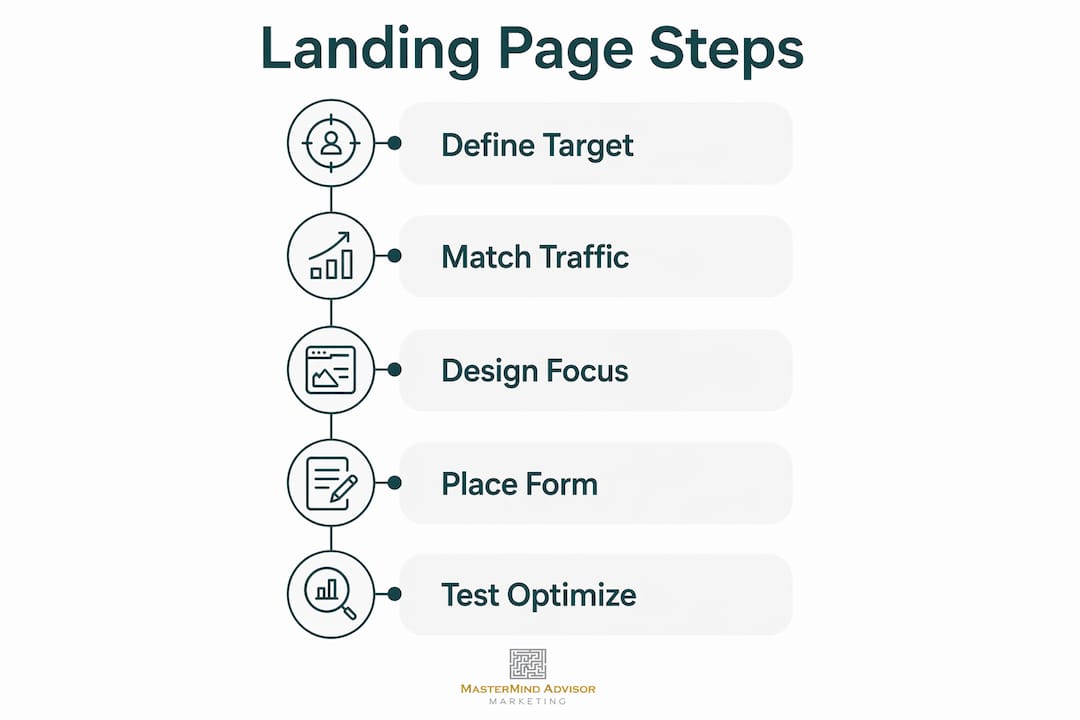
Step 1: Define your ideal client profile and offer. Before you write a single word, know exactly who you are targeting and what you are offering them. A page targeting pre-retirees aged 55 to 65 with a free Social Security optimization guide will outperform a generic "contact us" page every time. Advisor prospecting fundamentals start with this specificity.
Step 2: Match your page to your traffic source. A prospect who clicks a Facebook ad expecting a retirement income guide should land on a page that mirrors that exact promise. Message mismatch is the single most common reason for high bounce rates on advisor landing pages.
Step 3: Design for one action. Remove navigation, sidebars, and any link that does not lead to your form or call-to-action. Every element on the page should push the visitor toward one decision.
Step 4: Place your form strategically. Offering value first before requesting contact details reduces abandonment. If you are using a lead magnet like a guide or assessment, show a preview or summary before the form appears. The visitor should feel they are already receiving something before they give you their email.
Step 5: Test one variable at a time. Run A/B tests on your headline first, then your call-to-action button text, then your form length. Testing multiple elements simultaneously makes it impossible to know what drove the change. Use tools like Google Optimize or the built-in testing features in Unbounce or Leadpages.
Common mistakes to avoid:
- Using your firm's logo as the headline instead of a benefit statement
- Asking for phone number on the first form when email alone would suffice
- Sending paid traffic to your homepage instead of a dedicated page
- Forgetting to set up a confirmation email that fires immediately after submission
- Never reviewing form abandonment data to identify where prospects drop off
Landing pages should be treated as living experiments, with messaging and design continuously refined based on real visitor behavior. The advisors who grow their practices fastest treat every page as a hypothesis, not a finished product.
Key takeaways
High-converting lead generation landing pages for financial advisors require focused offers, trust-based design, CRM integration, and continuous testing to turn visitors into qualified prospects.
| Point | Details |
|---|---|
| Dedicated pages outperform homepages | Remove navigation and focus on one offer to maximize form completions. |
| Trust signals drive advisor conversions | Use professional photos, credentials, and compliant client testimonials above the fold. |
| CRM integration is non-negotiable | Connect every form to your CRM with automated routing and a speed-to-lead SLA. |
| Conversational pages qualify leads automatically | AI tools like WarmPage deliver 2 to 3 times higher conversion rates than static forms. |
| Test continuously and iterate | Treat every page as a hypothesis and run structured A/B tests on headlines and CTAs first. |
What I have learned from watching advisors build these pages
Most advisors I have worked with make the same mistake at the start: they build a landing page that looks like a brochure. It is polished, professional, and completely ineffective. The page talks about the firm instead of talking to the prospect.
The advisors who see real results do something counterintuitive. They make the page feel almost uncomfortably specific. One advisor I know built a page targeting widows and widowers navigating inherited IRAs. The headline was blunt: "Inherited an IRA and Not Sure What to Do Next?" The form completion rate was nearly double his previous general-audience page. Specificity is not exclusionary. It is magnetic to the right person.
I also think the industry underestimates how much the follow-up process affects perceived page performance. An advisor can have a technically sound page with a 9% conversion rate, but if the leads sit in a CRM for 48 hours before anyone contacts them, the page gets blamed for poor results. The page did its job. The process failed. Fixing your speed-to-lead time often produces a bigger revenue impact than any design change.
On AI conversational tools: I am genuinely enthusiastic about what they can do for solo advisors, but I would caution against letting the technology replace the human warmth that makes financial advisory relationships work. Use conversational flows to qualify and educate. Use a real human voice in the follow-up. That combination is hard to beat.
Finally, treat your landing page as a living marketing experiment, not a one-time project. The advisors who review their page data monthly and make small, deliberate changes consistently outperform those who build once and move on.
— Josh
How Mastermindadvisormarketing helps advisors build pages that convert

Mastermindadvisormarketing builds and manages lead generation systems designed exclusively for independent financial advisors. That means landing pages connected to a custom CRM, automated email follow-up sequences, and offer strategies built around what actually moves prospects to act. Whether you want to host a seminar that feeds into a follow-up landing page or need a full digital lead capture system, the platform handles the technical and creative work so you can focus on client relationships. If you are ready to stop sending traffic to a homepage and start converting it, explore what Mastermindadvisor offers for financial professionals like you.
FAQ
What is a good conversion rate for a financial advisor landing page?
B2B lead generation landing pages benchmark at approximately 10% conversion rate. Financial advisor pages targeting a specific offer and audience segment can reach or exceed this when trust signals and form design are optimized.
How many fields should a financial advisor's lead capture form have?
Start with three fields: name, email, and one qualifying question. Progressive profiling allows you to gather additional data across multiple interactions rather than front-loading every question, which reduces abandonment.
Do I need a separate landing page for each marketing campaign?
Yes. Each traffic source and offer should have its own dedicated page to maintain message alignment. Sending a Facebook ad click to a generic homepage is one of the most common and costly mistakes in lead generation for advisors.
What lead magnets work best for financial advisor landing pages?
Specific, outcome-focused offers perform best. Retirement income gap analyses, Social Security timing guides, and tax efficiency assessments consistently outperform generic newsletters because they address a concrete concern the prospect already has.
Are AI conversational landing pages worth the investment for solo advisors?
For most solo advisors, yes. Tools like WarmPage start at $49 per month and automate the discovery process, delivering pre-qualified leads with richer context than a standard form. The time saved on unproductive discovery calls typically justifies the cost within the first month.