
FINRA requires every communication with the public to be fair, balanced, and not misleading under Rule 2210. Retail communications generally need principal pre-approval before first use, certain categories must be filed with FINRA (often within 10 business days), and firms must retain records for at least three years. Get the classification wrong, and everything downstream, approval, filing, retention, breaks with it.
TL;DR:
- Firms should classify all communications carefully, distinguishing between correspondence, retail communications, and institutional content to ensure proper approval and filing processes.
- Retail communications require approval from a licensed principal before first use and must be filed with FINRA within 10 business days for certain product categories, especially during a firm's first year.
- Recordkeeping must include the final published content, approval records, and metadata, retained for at least three years, with digital content screenshots recommended to prevent link rot.
- Digital posts and social media are treated as retail communications once shared with more than 25 investors in 30 days, requiring pre-approval and careful content management to avoid violations.
- Common violations involve material omissions, entity confusion, misleading performance claims, and exaggerated language, which can trigger enforcement actions if uncorrected.
Table of Contents
- What Does FINRA Rule 2210 Actually Require?
- How Do You Classify a Communication Correctly?
- Who Has To Approve Marketing Materials Before They Go Out?
- When Do You Need To File With FINRA, and How Fast?
- What Records Do You Have To Keep, and For How Long?
- How Do FINRA Advertising Rules Apply to Social Media and Digital Ads?
- What Are the Most Common FINRA Advertising Violations?
- What Should a Compliance Workflow for Advertising Look Like?
- How Does the AREF Filing Process Actually Work?
- What Happens During a FINRA Spot Check or Enforcement Action?
- What Counts as a Misleading Performance Claim?
- What Are the Rules on Testimonials and Endorsements?
- How Do FINRA and SEC Rules Interact on Advertising?
- Have There Been Recent Changes to Rule 2210?
- How Do You Build an Ongoing Monitoring Program That Actually Works?
- Where Can You Find Primary FINRA and SEC Guidance?
- Speed Versus Compliance Isn't Actually a Trade-Off
- A Marketing System Built Around These Exact Rules
- Sources
What Does FINRA Rule 2210 Actually Require?
Rule 2210 is the backbone of broker-dealer advertising compliance. It sets the standard that every piece of marketing material, from a tombstone ad to a TikTok clip, has to meet: fair, balanced, and not misleading. That phrase sounds soft until an examiner applies it to your landing page copy.
The rule doesn't operate in isolation. It sits alongside SEC rules governing investment adviser marketing, MSRB rules for municipal securities communications, and SIPC disclosure expectations for account protection claims. A firm dually registered as a broker-dealer and investment adviser has to satisfy FINRA's content standards and the SEC's marketing rule at the same time, and the two frameworks don't always use identical language for the same idea.
Three content principles drive most of the rule's practical application:
- Material facts can't be omitted. Leaving out a fee, a risk factor, or a liquidity restriction because it complicates the pitch is the single most common way firms run afoul of the rule.
- Risk disclosure has to be proportionate to the claim. A communication that touts upside without giving risk equal visual and substantive weight fails the "balanced" test even if every individual sentence is technically true.
- Exaggerated or promissory language is prohibited outright. Words like "guaranteed," "risk-free," or "can't lose" get flagged almost automatically, regardless of context.
FINRA's own guidance stresses that balanced disclosure means giving an investor enough information to form a sound judgment, not just appending a disclaimer at the bottom of the page. That distinction shows up constantly in exam findings, and it's worth internalizing before you build a single template. When in doubt, the interpretive notes attached to Rule 2210 in FINRA's rulebook and the SEC's eCFR entries on investment adviser advertising are the two places to check first, not a competitor's marketing page or a LinkedIn post from someone who "used to work in compliance."
How Do You Classify a Communication Correctly?
Every piece of content a firm produces falls into one of three buckets, and the bucket determines the entire compliance path that follows. Misclassifying a document is the fastest way to end up out of compliance without realizing it.
- Correspondence covers communications, including electronic ones, sent to 25 or fewer retail investors within a 30-calendar-day period. Think one-to-one emails or a small distribution list.
- Retail communications are anything distributed or made available to more than 25 retail investors within that same 30-day window. Once you cross that threshold, you're in retail territory, whether it's a mass email, a public webpage, or a widely shared social post.
- Institutional communications go exclusively to institutional investors and carry lighter procedural requirements, though the fair-and-balanced standard still applies.
The 25-investor line sounds simple until you hit an edge case. A webinar with attendee-driven whiteboarding, for instance, gets treated differently depending on whether the content is pre-produced (retail communication, if broadly distributed) or generated live by participants in real time. FINRA's guidance on this ties the classification to distribution method and expected audience size, not just headcount. Forwarded material creates a similar wrinkle: if an advisor forwards a firm-approved piece to a dozen prospects, it's likely still correspondence, but if that same piece gets reposted publicly, it just became a retail communication with none of the original approval trail attached to the new distribution.
Pro Tip: Build a one-page decision tree for your marketing team that answers three questions before anything goes out: who's receiving this, how many people, and over what time window. That single document prevents more classification errors than any amount of after-the-fact training.
Who Has To Approve Marketing Materials Before They Go Out?
Retail communications generally require approval from a registered principal before first use. That principal typically holds a Series 24 (General Securities Principal) or Series 26 (Investment Company and Variable Contracts Products Principal) license, depending on the product line the communication touches. This isn't a formality. It's a substantive review of content, context, and audience.
- Identify the right principal for the product category. A Series 26-only principal shouldn't be signing off on structured product materials outside that scope.
- Document the approval with specifics, not just a checkbox: date of approval, first-use date, and the exact version reviewed.
- Confirm the communication matches what was approved. Marketing teams sometimes tweak copy after sign-off, which quietly voids the approval.
- Route anything ambiguous back to the principal, rather than defaulting to "close enough."
Post-use review is the exception, not the default, and it only applies to communications a firm's written supervisory procedures explicitly identify as qualifying, usually narrow categories like certain correspondence or previously-approved template variations with minimal changes. Written procedures need to spell out exactly which categories get this treatment and why.
When examiners show up, they don't ask you to explain your process verbally. They ask for the audit trail: who approved it, when, what version, and where the record lives. If that trail has gaps, no amount of verbal reassurance closes them.
Pro Tip: Keep approval metadata in a structured field, not buried in an email thread. A spreadsheet row with approver name, registration type, approval date, and first-use date takes thirty seconds to produce during an exam. Reconstructing it from Outlook takes days.
When Do You Need To File With FINRA, and How Fast?
Not every retail communication needs to be filed. But when a filing obligation applies, the clock starts the moment the material goes live, and missing it is one of the more avoidable compliance failures a firm can commit.
Communications that commonly trigger a filing requirement include:
- Materials promoting registered investment companies (mutual funds, closed-end funds, and similar products)
- Structured product communications
- Communications concerning security futures
- Retail communications from firms in their first year of FINRA membership
New member firms face a stricter standard: during the first year, they must file certain retail communications at least 10 business days before first use, not after. That's a pre-use filing requirement, and it catches new broker-dealers off guard more often than any other timing rule.
For established firms, the more common pattern is a post-use filing window: certain retail communications, particularly those tied to registered investment companies and structured products, must be filed with FINRA's Advertising Regulation Department within 10 business days of first use.
Before publishing anything, run it through a simple filing checklist: Does the product category appear on FINRA's list of communications requiring filing? Is the firm within its first year of membership? Has a substantially similar piece already been filed and cleared? If any answer points toward "yes, this needs to go to FINRA," build the filing into your production timeline rather than treating it as an afterthought once the content is already scheduled to launch.
What Records Do You Have To Keep, and For How Long?
Firms must retain records of retail communications for at least three years from the date of last use, with the first two years kept somewhere easily accessible, not archived in a system that takes a week to query.
The retention requirement isn't limited to the final approved copy. Examiners typically expect to see the approval documentation itself: who signed off, the date, and the version history showing what changed between drafts. For digital content, that means capturing the exact rendering as it appeared publicly, screenshots with metadata, not just a text transcript or a link to a page that may have since changed or disappeared.
- Retain the final published version exactly as the public saw it.
- Preserve approval records: approver name, registration category, and timestamps.
- Capture digital appearances with metadata (date, platform, audience settings), not just archived URLs.
- Keep a version history showing edits between draft and final approval.
- Store records where they can be retrieved within hours, not days, during the first two years.
Pro Tip: A link rot problem is a retention problem. If your evidence for a social post is a URL and that platform later removes or edits the post, you've lost your record. Screenshot at time of publication, every time, and store it alongside the approval metadata.
How Do FINRA Advertising Rules Apply to Social Media and Digital Ads?
FINRA treats a social media post as a retail communication once it's distributed or made available to more than 25 retail investors within a 30-day period, which in practice covers nearly any public post on a firm or advisor account. That triggers the same approval and retention obligations as a printed brochure, just on a platform built for speed, not review cycles.
This is where the gap between marketing's instincts and compliance's requirements shows up most sharply. A marketing team wants to post the same day an idea lands. A principal needs time to review. The tension between publishing speed and pre-use approval is one of the most cited sources of friction in digital compliance programs.
- Treat any public-facing post, paid ad, or landing page as a retail communication by default, and route it for approval before it's live.
- Use hyperlinks carefully: linking out to required disclosures doesn't relieve the primary communication of its own fair-and-balanced obligations. The linked page has to be similarly compliant, and the link itself can't be the only place a critical risk disclosure appears.
- Build a pre-approved messaging bank: a library of principal-cleared phrases, disclosures, and post templates that marketing can pull from without triggering a fresh review cycle every time.
- Identify narrow, written-procedure-defined categories eligible for post-use review, and keep that list short and specific.
A well-built content library solves more of this friction than any amount of after-the-fact scrambling. It's also exactly the kind of infrastructure that separates firms with clean exam histories from firms that treat every post as a one-off improvisation.
What Are the Most Common FINRA Advertising Violations?
Exam findings tend to cluster around a small number of repeat offenders, and knowing them in advance is the cheapest compliance insurance available.
- Omitted material facts. Leaving out a fee structure, a surrender charge, or a performance caveat because it complicates the narrative.
- Improper entity identification. Firms frequently blur the line between a broker-dealer and a non-broker-dealer affiliate by using identical branding across both, leaving investors unclear about which legal entity is actually responsible for the product or advice.
- Misleading performance claims. Cherry-picked time periods, unannotated hypothetical returns, or performance figures presented without required disclosures about fees and volatility.
- Exaggerated or promissory language. Anything implying guaranteed outcomes, even implicitly through phrasing like "steady growth you can count on."
FINRA's 2021 examination and risk monitoring report specifically flags entity identification as a recurring, remediable problem, one that firms fix by simply separating branding and clearly disclosing which entity stands behind a given communication.
When an examiner flags a problem, the response typically falls somewhere on a spectrum: informal revision requests, instructions to cease use immediately, or, in more serious or repeated cases, a referral to FINRA Enforcement. The severity usually tracks how material the omission was and whether it looks like a pattern rather than a one-off drafting mistake.
The fastest remediation path is having a designated point person who can pull the flagged communication, its approval record, and its distribution history within the same business day. Firms that scramble to reconstruct that history after the fact turn a fixable finding into a drawn-out one.
What Should a Compliance Workflow for Advertising Look Like?
A workflow that exists only in someone's head isn't a workflow. It's a liability waiting for that person to be on vacation when a filing deadline hits.
- Intake and classification. Every piece of proposed content gets logged with its intended audience size, distribution channel, and product category before drafting even begins.
- Routing. Based on classification, route to the correctly licensed principal (Series 24 or Series 26, depending on product scope).
- Approval capture. Record approver name, registration type, date of approval, and the specific version reviewed.
- Filing check. Cross-reference against the list of communication types requiring FINRA filing, and confirm the timing (pre-use for new members, within 10 business days for triggering categories).
- Publication and archiving. Capture the exact live rendering, with metadata, at the moment of first use.
- Version tracking. Log any post-publication edits and whether they require re-approval.
Template fields worth building into whatever system you use: approver name and registration number, date of approval, first-use date, distribution channel, audience size estimate, and a version history log that timestamps every edit after initial sign-off.
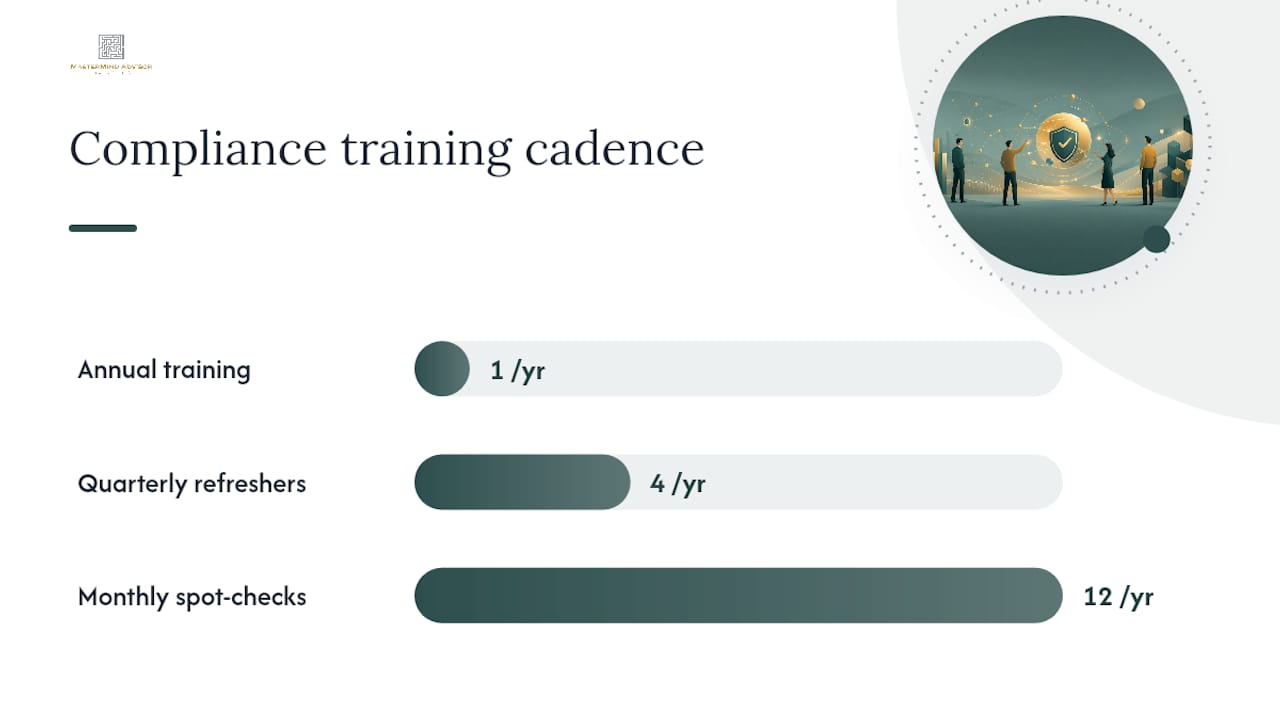
Training cadence matters more than most firms budget for. A single annual training session doesn't hold up against a marketing team publishing weekly. Quarterly refreshers, paired with spot-check audits of a sample of published communications each month, catch drift before an examiner does. Running a regular cross-functional review, along the lines of the structured monthly strategy review process some marketing consultancies use, gives compliance and marketing a standing forum to reconcile speed with sign-off requirements instead of negotiating it ad hoc every time a deadline looms.
Prioritize audit attention by risk: performance claims and structured product materials first, general educational content last. Not every piece of content carries the same exposure, and treating a client newsletter with the same scrutiny as a performance-heavy pitch deck wastes review capacity you'll need elsewhere.
Pro Tip: Assign a risk tier to every content category up front, high, medium, low, so your principal's review time goes where it actually matters instead of getting spread evenly across everything in the queue.
An internal compliance marketing checklist built around these steps turns a vague sense of "we should probably review this" into a repeatable process new hires can follow without reinventing it each time.
How Does the AREF Filing Process Actually Work?
FINRA's Advertising Regulation Electronic Filing system (AREF) is the portal through which firms submit communications for review. Reviewers check submitted material against Rule 2210's content standards and issue a written review letter noting any required revisions.
- Submit through AREF with the correct filing category selected; misclassifying the filing type slows the review.
- Expect a written review letter back from FINRA staff, which may request specific edits before the communication can continue running or, if already live, before further distribution.
- Use the Revised Communication Pilot Program to upload revisions when staff previously flagged issues, and request a letter confirming the revised version is now consistent with applicable standards.
- Budget for filing fees, which vary by communication type and firm size category, and factor in that a single campaign with multiple variants may trigger multiple filing fees.
- Track review letter turnaround times internally; they affect how far in advance a campaign needs to enter the filing pipeline.
The AREF review letter is the single most important operational document in this whole process. It's the paper trail that shows a firm engaged with the review process in good faith, which matters enormously if a later question arises about whether a communication was properly vetted.
What Happens During a FINRA Spot Check or Enforcement Action?
Spot checks aren't random in the way people assume. They often follow patterns: a spike in a firm's social media activity, a new product line with heavy marketing spend, or a tip tied to investor complaints. When FINRA's Advertising Regulation Department initiates a review, the typical ask is straightforward: the communication as published, the approval record behind it, and evidence of the distribution list or audience.
Remediation pathways scale with severity. Minor issues usually resolve with a revision request and a cease-use instruction until the fix is made. More serious or repeated problems can trigger informal disciplinary action, and the most egregious cases, particularly ones involving material omissions or misleading performance data, can get referred to FINRA Enforcement for formal action.
The firms that come through a spot check cleanly are the ones that can produce a complete evidence package within a day: the approval trail, the filing record if one applied, and the exact version history. Running a rapid internal review the moment a request comes in, rather than waiting to see how serious it is, consistently shortens the whole process.
What Counts as a Misleading Performance Claim?
Performance advertising sits at the top of FINRA's risk list because a small wording choice can turn an accurate number into a misleading impression. A return figure presented without its corresponding time period, benchmark, or fee drag violates the fair-and-balanced standard even when the number itself is technically correct.
Common violations include cherry-picked date ranges that flatter a strategy's worst-performing period, hypothetical or back-tested returns presented without clear labeling as hypothetical, and performance comparisons against a benchmark that isn't actually comparable in risk or composition. Annualized returns without the underlying time horizon disclosed are another repeat offender; a strong one-month annualized figure looks very different from a genuine multi-year track record, and burying that distinction is exactly the kind of omission examiners flag.
The safer standard: any performance claim needs its time period, whether it's gross or net of fees, the relevant benchmark if a comparison is implied, and a statement that past performance doesn't guarantee future results. None of that is optional decoration. It's the difference between a communication that survives a filing review and one that comes back with mandatory revisions.
What Are the Rules on Testimonials and Endorsements?
Testimonials and endorsements are permitted under FINRA's framework, but they carry disclosure obligations that a lot of firms underestimate. If compensation changed hands, that has to be disclosed. If the endorser has a material conflict of interest, tied to the firm, a product, or an incentive structure, that also needs disclosure.
A testimonial can't imply that the experience described is typical or representative unless the firm can support that claim, and it can't be used to make an implicit performance promise ("this strategy changed my retirement") without the same fair-and-balanced scrutiny applied to any other performance-adjacent statement. This overlaps directly with the SEC's marketing rule, which governs testimonial and endorsement disclosures for investment advisers specifically, meaning dually registered firms need to satisfy both frameworks simultaneously, not just the more lenient of the two.
The practical fix is a standard disclosure template attached to every testimonial before it goes anywhere public: compensation status, material relationship, and a plain statement that individual results vary.
How Do FINRA and SEC Rules Interact on Advertising?
FINRA rules and SEC rules aren't redundant, they cover overlapping ground from different angles, and firms operating under both need a process that satisfies the stricter of the two on any given point.
Rule 2210 governs broker-dealer communications specifically. The SEC's marketing rule governs investment adviser advertising, with its own testimonial, endorsement, and performance presentation standards. A dually registered or hybrid firm has to run every communication through both lenses, because a piece that clears FINRA's fair-and-balanced standard might still fall short of a specific SEC disclosure requirement for adviser-side content, or the reverse.
MSRB rules add a third layer for municipal securities communications specifically, and SIPC-related claims about account protection carry their own accuracy requirements since misstating SIPC coverage limits is its own distinct violation. The practical takeaway: build your compliance checklist around the most restrictive applicable standard for each communication type, rather than assuming FINRA clearance automatically satisfies SEC or MSRB obligations.
Have There Been Recent Changes to Rule 2210?
FINRA periodically updates guidance and interpretive notes attached to Rule 2210 as digital communication channels evolve, particularly around social media, influencer-style content, and interactive webinar formats. The core three-part standard, fair, balanced, not misleading, hasn't changed, but how it applies to newer formats keeps getting clarified through FAQs and notices rather than through wholesale rule rewrites.
The practical implication for compliance teams: don't assume last year's approved template automatically covers this year's format. A firm that built its social media approval process around static image posts needs to revisit that process before greenlighting video content, live-streamed webinars, or interactive chat features, since each carries its own classification and archiving questions. Checking FINRA's Advertising Regulation overview page periodically, rather than relying on a policy written once and never revisited, is the only reliable way to stay current as interpretive guidance shifts.
How Do You Build an Ongoing Monitoring Program That Actually Works?
A monitoring program that only activates when a new communication launches misses the bigger risk: content that was compliant when published but has since gone stale, outdated performance figures, expired disclosures, or a product that's no longer offered but still lives on an old landing page.
Set a recurring audit cadence, monthly for high-risk categories like performance-heavy content, quarterly for lower-risk evergreen material. Sample a percentage of live communications each cycle and re-verify that disclosures, performance data, and entity identification are still accurate. Pay particular attention to social media accounts, since posts accumulate over time and a profile's older content rarely gets revisited unless something forces the issue.
Pair the audit with a feedback loop back to the approval workflow: if an audit finds a recurring problem, whether it's a template that keeps producing entity identification issues or a performance disclosure that's consistently incomplete, fix the template, not just the individual instance. That's the difference between a monitoring program that catches the same mistake repeatedly and one that actually reduces future findings.
Where Can You Find Primary FINRA and SEC Guidance?
- FINRA Rule 2210 full text: the rule itself, including definitions of communication categories and content standards.
- Advertising Regulation overview: FINRA's plain-language explanation of fair, balanced, and not misleading.
- What and when to file: filing triggers and timelines, including the 10-business-day rule.
- Advertising Regulation FAQs: interpretive answers on retention, approval, and classification edge cases.
- Sec: SEC marketing rule text and related guidance for dually registered firms.
Consult the rule text and FAQs directly before finalizing internal policy. Secondhand summaries, including this one, are a starting point, not a substitute.
Speed Versus Compliance Isn't Actually a Trade-Off
Most firms treat marketing velocity and compliance rigor as opposing forces, something you trade off against each other depending on how aggressive the growth targets are that quarter. That framing is backwards, and it's the reason so many compliance programs feel like a bottleneck instead of infrastructure.
The firms that move fastest without exam findings aren't the ones with the laxest review process. They're the ones that pushed the compliance work upstream, into pre-approved message banks, cleared templates, and content libraries built with disclosure language baked in from the start, so the review at publication time is a quick confirmation, not a first read. Content sprints and compliance gates aren't in tension when the gate is checking a pre-cleared template against minor edits, rather than reviewing a completely new piece of copy from scratch every single time.
The real skill isn't writing faster or reviewing faster. It's designing the system so most content never needs a full first-time review at all, and escalating only the genuinely novel pieces, a new product line, a first-time testimonial, a new performance claim, to the slower, more deliberate path. A compliance-aware content library does exactly that kind of upstream work, and it's worth building one before the next campaign deadline forces a shortcut nobody wants to take.
— Josh
A Marketing System Built Around These Exact Rules
A compliant marketing system exists because most advisors don't have a compliance department big enough to build the infrastructure this article just walked through, pre-approved templates, a classification workflow, a content library with disclosures baked in. Our system gives independent advisors and advisory firms webinars, seminars, and a content library designed around approval and retention patterns Rule 2210 requires, paired with automated email drip campaigns and CRM tools.

Instead of building your own approval workflow from scratch, or hoping a generic marketing agency understands why "guaranteed returns" can't appear in a headline, you get a system where the marketing content is already built with these standards in mind. If you're ready to see how a compliance-aware marketing system fits your practice, request a demo of the Mastermind Advisor system and walk through how it maps to your firm's existing review process.