
The SEC marketing rule, formally Rule 206(4)-1, merges the old advertising and cash solicitation rules into one principles-based standard for registered investment advisers. Under it, you can use testimonials, third-party ratings, and performance results in your marketing, but only if you meet specific disclosure, oversight, and recordkeeping conditions. The rule took effect May 4, 2021, with a compliance date of November 4, 2022, so if your policies still reflect the old framework, you're already out of date.
TL;DR:
- Marketers must classify all communication channels as advertisements or non-ads based on the two-prong test to ensure proper compliance and controls.
- All marketing content must meet seven anti-fraud standards, including accuracy, full disclosure, and avoiding misleading claims, with thorough documentation.
- Paid promoters require written agreements, clear disclosures, oversight, and disqualification checks, even with small payments under $1,000.
- Performance presentations must include both gross and net figures with consistent periods and methodology, and any extracts or prior firm results need proper context.
- Digital and social media marketing now face the same rigorous review and recordkeeping requirements as traditional advertising, emphasizing transparency and documented approval.
Table of Contents
- What Counts as an Advertisement Under the SEC Marketing Rule?
- The Seven General Prohibitions That Apply to Every Advertisement
- Testimonials, Endorsements, and Promoters: The Rules You Can't Skip
- How Should Advisers Present Investment Performance?
- What Disclosures Do Third-Party Ratings Require?
- Recordkeeping and Form ADV: What Changed
- A Step-by-Step Compliance Checklist You Can Start Today
- Where to Find Ongoing SEC Guidance on the Marketing Rule
- How Do You Calculate and Present Standardized Performance?
- How the Marketing Rule Changes Digital and Social Media Advertising
- Old Advertising Rule vs. the Modern Marketing Rule
- Handling Forward-Looking Statements and Projections
- Building a Compliance-First Marketing Program
- How Mastermind Advisor Marketing Supports Compliant Adviser Growth
- Sources
What Counts as an Advertisement Under the SEC Marketing Rule?
The rule uses a two-prong definition of "advertisement," and getting this classification right is the first job for any compliance officer. Miss it, and every downstream control (disclosure language, recordkeeping, sign-off workflow) gets built on the wrong foundation.
The first prong covers any direct or indirect communication that offers your advisory services to prospective clients or offers new services to existing clients. The second prong covers testimonials and endorsements for which you compensate someone, along with third-party ratings you use in your materials. IA-5653 walks through why the SEC drew the line this way, and it matters because the two prongs trigger different obligations.
Channels that typically fall under the rule include:
- Your firm's website and landing pages
- Email campaigns sent to more than one recipient
- Social media posts, whether organic or paid
- Public seminars, webinars, and podcasts
- Any slide deck or brochure used with more than one prospect
One-on-one communications are generally excluded from the first prong. The exception that trips people up: if that one-on-one conversation includes a compensated testimonial or hypothetical performance figures, it can still get pulled into the rule's scope. A private call where you promise a referral fee for a client's endorsement, for instance, counts even though it's a single conversation.
The Seven General Prohibitions That Apply to Every Advertisement
Every piece of adviser marketing, regardless of format or audience, has to clear seven baseline tests. The SEC's compliance guide frames these as anti-fraud guardrails, and they apply whether you're running a paid social campaign or handing out a one-page fact sheet.
- No untrue statements of material fact. Fact-check every claim before it goes live; keep source documents attached.
- No omission of material facts that makes a statement misleading. Ask what a reasonable prospect would need to know to avoid a false impression.
- No statements that are unfair or unbalanced. Pair every benefit claim with relevant risk language.
- No claims implying SEC approval or endorsement. Never suggest registration equals a government stamp of quality.
- No claims lacking a reasonable basis. Keep the substantiation on file, ready to produce on demand.
- No inconsistent or misleading performance time periods. Standardize the periods you report across materials.
- No otherwise materially misleading content. This catch-all covers anything the first six miss.
Document your reasoning for each claim as you build it. That habit alone will save you during an exam.
Testimonials, Endorsements, and Promoters: The Rules You Can't Skip
Testimonials and endorsements are allowed, but the rule attaches real conditions to both. If you're paying anyone, including affiliates, to promote your firm, that person is a "promoter," and specific disclosure and contract requirements kick in.
Required disclosures include whether the person is a client, whether they were compensated, and the material conflicts that compensation creates. These disclosures need to be clear and prominent, not buried in fine print at the bottom of a page. The SEC's compliance guide also requires:
- A written agreement with most promoters, describing the scope of activities and compensation
- Adviser oversight of the promoter's statements, not just a one-time sign-off
- A disqualification check to confirm the promoter has no disqualifying legal or disciplinary history
There's a de minimis exemption: promoters paid $1,000 or less over a trailing 12 months generally fall outside the written-agreement requirement, though disclosure obligations still apply. Before you activate any paid endorsement arrangement, run a disqualification check and keep the results on file. For a deeper look at how testimonial mechanics play out in practice, see our breakdown of client testimonials for financial advisors.
Pro Tip: Build your promoter disqualification check into onboarding, not into your annual compliance review. A promoter who becomes disqualified mid year and keeps posting is a problem you want to catch in weeks, not months.
How Should Advisers Present Investment Performance?
Performance advertising is where the marketing rule gets the most technical, and it's also where enforcement attention concentrates. The baseline rule: if you show gross performance, you generally have to show net performance with at least equal prominence, and both figures need to cover the same time period using the same methodology.
Extracts, meaning a slice of a larger portfolio's performance, are allowed but only with guardrails. Staff guidance says that when you present an extract, you should show the total portfolio's gross and net performance with at least equal prominence, in a way that lets a reader actually compare the two. Skip that comparison, and the extract risks being materially misleading on its own.
A few other performance rules worth building into your review checklist:
- Predecessor performance (results generated at a prior firm) is permissible only when the personnel and strategy are substantially similar to what you offer now
- Interim performance for a partial year can be shown briefly after year end under specific staff conditions, but it's not a standing exception
- Hypothetical performance carries its own separate disclosure obligations, especially when shown to retail prospects
This is the section of the rule most likely to generate an exam finding, so keep your calculation worksheets alongside every performance chart you publish.
What Disclosures Do Third-Party Ratings Require?
Ratings and awards can appear in your marketing, but only with disclosures that let a prospect judge how much weight to give them. You need to disclose the date of the rating, the entity that issued it, the methodology used, and any compensation you paid to be considered or included.
Before you use any award badge, confirm you understand exactly what the rating measured. A "Top Adviser" list based on assets under management tells a prospect something very different from one based on client satisfaction surveys, and your marketing shouldn't blur that line.
Keep a file for every rating you display containing:
- The methodology document or summary from the rating provider
- Any payment records tied to participation or licensing the badge
- The date range the rating covers, so you retire outdated badges on schedule
Recordkeeping and Form ADV: What Changed
Rule 204-2 now requires you to keep copies of every advertisement, along with the records that substantiate the claims inside them. That includes performance calculation worksheets, promoter agreements, and the underlying documentation for any testimonial or rating you display.
Form ADV also picked up new questions tied to the marketing rule. You now have to disclose whether you use testimonials, endorsements, third-party ratings, or performance results in your marketing, and update those answers as your practices change. The amended Form ADV items exist specifically so examiners can cross-reference your disclosures against what they find in your marketing files.
Practical retention list:
- Every advertisement, in its final published form, with the date it went live
- Substantiation files for every material claim, cross-referenced to the ad
- Promoter agreements and disqualification check results
- A record of your Form ADV updates whenever marketing practices change
A workable rule of thumb: if an examiner could ask "prove it," you should be able to pull the file in minutes, not days. For more on how ADV disclosures interact with your broader marketing plan, see our guide to the role of ADV in advisor marketing.
A Step-by-Step Compliance Checklist You Can Start Today
Turning the rule into daily practice comes down to four moves, done in sequence and revisited quarterly.
- Inventory every communication channel you use and run the two-prong test against each one. Website, email, social, seminars, and one-on-one materials with performance data all need a classification decision on file.
- Rewrite your written policies and procedures to reflect principles-based oversight rather than rigid checklists. Your policy should describe how you review, approve, and monitor marketing content, not just list prohibited words.
- Update your promoter contracts and disclosures, build an approval workflow for anything a compensated third party posts about you, and revise your Form ADV items to match current practice.
- Train your team and schedule periodic testing. Pull a sample of live advertisements every quarter and check them against the seven prohibitions and your own substantiation files.
For a more detailed workflow you can adapt directly, our independent advisor compliance marketing checklist breaks each step into assignable tasks.
Pro Tip: Assign one person, not a committee, to own final sign-off on marketing content. Diffuse responsibility is the single most common reason a stale disclosure survives three campaign cycles before anyone catches it.
Where to Find Ongoing SEC Guidance on the Marketing Rule
The rule is principles-based by design, which means the SEC fills in the gaps through staff guidance rather than new regulations. The Division of Investment Management's marketing compliance FAQs are the primary place to check, and they get updated as new questions surface from the adviser community.
These FAQs reflect staff views, not binding rule text, but examiners reference them constantly. Notable clarifications so far cover how to handle interim performance briefly after year end and how to present extracts without misleading a reader. Watch for:
- New FAQ entries addressing edge cases in testimonial disclosure
- Risk alerts flagging examiner focus on performance substantiation and promoter oversight
- Any updates to the two-prong definition's application to newer channels like short-form video
If your firm faces a genuinely novel scenario the FAQs don't address, the SEC does accept inquiries through its normal staff channels. Document your own interpretation and reasoning regardless of whether you ask, since that memo becomes your defense if an examiner disagrees later.
How Do You Calculate and Present Standardized Performance?
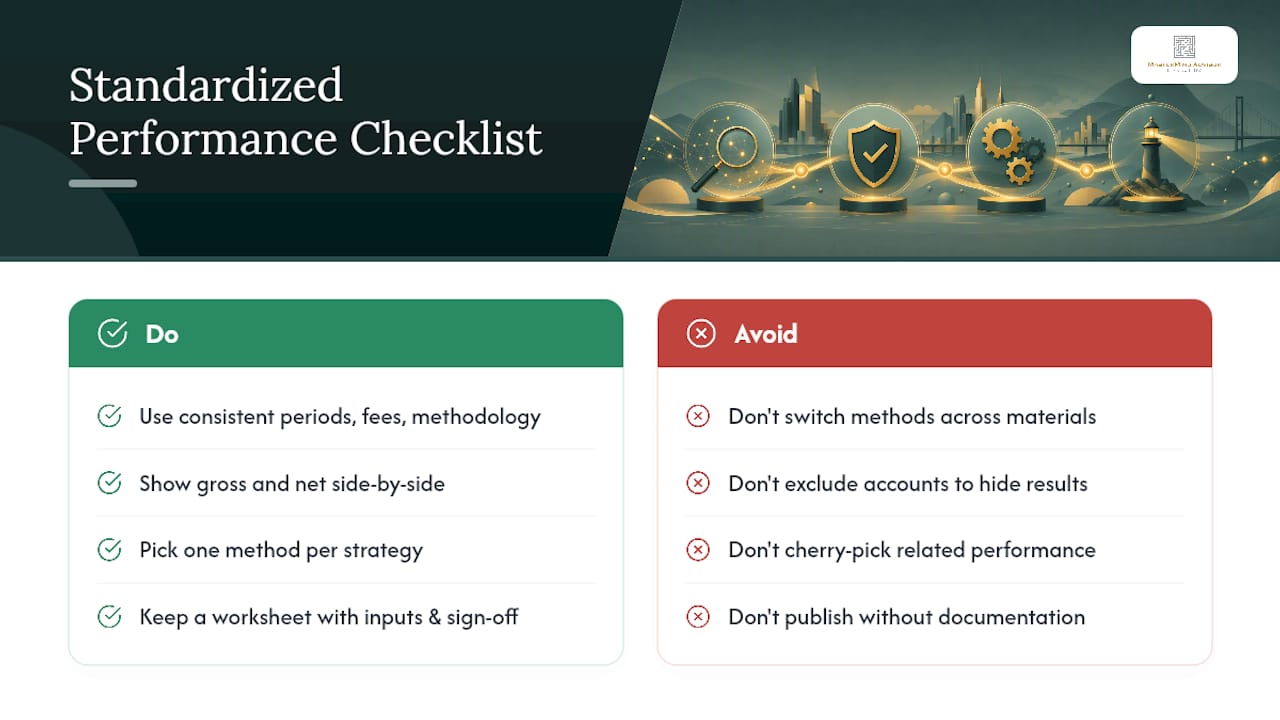
Standardized performance presentation starts with consistency: the same time periods, the same fee assumptions, and the same methodology applied every time you show a number. Gross performance reflects returns before fees and expenses; net performance reflects what a client actually experienced after your fees are deducted. Both belong side by side whenever gross appears.
Time-weighted or dollar-weighted returns each have their place, but switching methods between materials to make numbers look better is exactly the kind of inconsistency the rule's seventh prohibition targets. Pick one methodology per strategy and stick with it across every piece of marketing.
For composite performance, group only genuinely similar accounts and disclose your composite construction criteria. If you're excluding accounts from a composite, document why, because a composite built to hide underperforming accounts is a textbook example of a misleading presentation. Related performance, meaning results from other accounts managed using a substantially similar strategy, has to be presented in a way that doesn't cherry-pick your best-performing sleeve.
Build a standing worksheet template for every strategy you market. It should show the calculation inputs, the fee assumptions used for net figures, the time period, and a sign-off line for whoever reviewed it before publication. That single habit turns performance review from a fire drill into a repeatable process, and it's the first document an examiner will ask for if your performance claims come under scrutiny.
How the Marketing Rule Changes Digital and Social Media Advertising
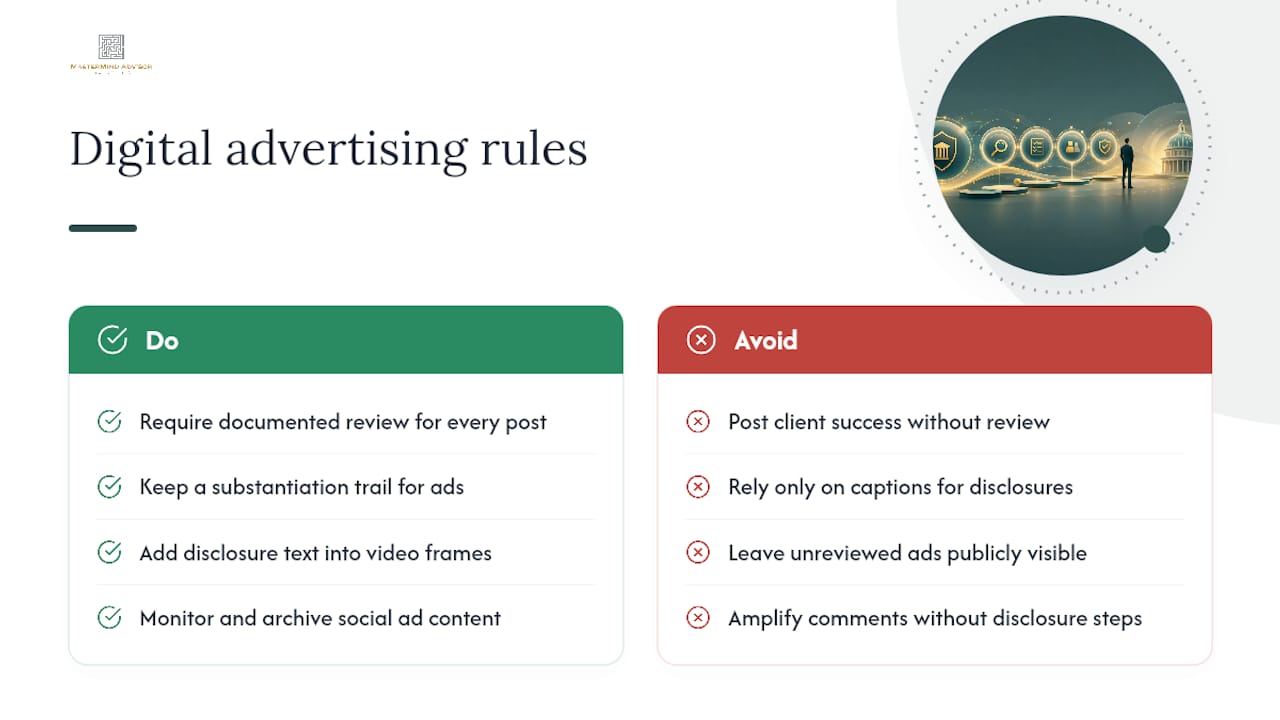
Digital channels got explicit attention under the modernized rule because the old advertising rule, written decades before social media existed, left too much ambiguous. Now, a single tweet, a LinkedIn post, or a paid social ad showing performance data faces the same seven prohibitions as a printed brochure.
The practical shift for advisers running social campaigns: every post needs the same substantiation trail as a formal ad with strong digital footprint management. If a team member shares a client success story on LinkedIn without a documented review, that post is technically an unreviewed advertisement sitting in public view indefinitely. Comments sections add another wrinkle. If a client posts unprompted praise in your comments and you don't respond or amplify it, that's generally not an adviser testimonial under the rule. But if you like, share, or repost it, you may have adopted it as your own marketing content, triggering testimonial disclosure requirements.
Video content, especially short-form video, raises its own substantiation challenge because performance claims spoken on camera are harder to caption with disclosures than a static graphic. Build disclosure text directly into the video frame rather than relying on a caption viewers might not read. For a practical playbook on running compliant campaigns across platforms, see our social media strategy guide for independent advisors.
Old Advertising Rule vs. the Modern Marketing Rule
The old Advertising Rule, adopted in 1961, and the old Cash Solicitation Rule, adopted in 1979, were built for a world of print brochures and in-person referrals. Both rules relied heavily on bright-line prohibitions, like outright bans on any testimonial, regardless of context or disclosure.
The modernized rule flips that approach. Instead of a blanket testimonial ban, it permits testimonials under disclosure and oversight conditions. Instead of treating solicitation and advertising as separate regimes with separate compliance obligations, it merges them into one framework, which eliminates the awkward line-drawing exercise of deciding whether a communication was "advertising" or "solicitation."
The bright-line ban felt safer on paper but ignored how real client relationships and referrals work. The principles-based standard asks more of your judgment and your documentation, but it also reflects how advisers actually market today, through referrals, reviews, and digital content the 1961 rule never anticipated.
Handling Forward-Looking Statements and Projections
Forward-looking statements, including projected returns, target yields, and hypothetical growth scenarios, sit in a particularly sensitive zone under the marketing rule. These aren't performance results in the traditional sense, but the SEC treats overly optimistic or unsubstantiated projections as a direct violation of the prohibition against statements lacking a reasonable basis.
If you show a projection, you need a documented, defensible methodology behind it, not a number pulled from a sales deck template. That means disclosing the assumptions driving the projection (expected market returns, inflation assumptions, contribution rates) and being explicit that the projection is hypothetical, not a promise of future results.
Hypothetical performance, a related category, generally can't be shown to a retail prospect unless you have policies designed to ensure the information is relevant to that specific prospect's financial situation and objectives. A generic "what if you'd invested $10,000 in 2010" graphic aimed at a mass social media audience is exactly the kind of hypothetical performance the rule restricts, because it can't reasonably be tailored to viewer's individual circumstances. Keep any projection or hypothetical scenario behind a documented eligibility check before it reaches a prospect.
Building a Compliance-First Marketing Program
Effective adviser marketing and defensible compliance aren't competing goals. Document the reasoning behind every marketing choice while you make it, not after an examiner asks. Compliance-friendly templates and built-in oversight workflows let your team move fast on content without losing the substantiation trail that keeps you exam-ready.
— Josh
How Mastermind Advisor Marketing Supports Compliant Adviser Growth
A marketing program built around the conditions the SEC marketing rule imposes can include customized lead-generation webinars, produced seminars, and a compliance-reviewed content library, paired with CRM integration and automated email follow-ups designed for long buying cycles typical in financial services.

Templates can be designed with the disclosure structure and oversight workflow that Rule 206(4)-1 requires, helping marketing content and recordkeeping obligations to align instead of creating extra work. That matters most for firms running lean compliance teams who need documented, repeatable processes rather than one-off ad reviews. If you're ready to put a compliance-aware marketing engine to work for your practice, visit the Mastermind Advisor Marketing landing page to see how the system maps to your firm's current advertising activity and start a conversation about implementation.
This article is general information, not a substitute for advice from a qualified financial advisor. Consult a qualified financial professional about your own circumstances before acting on anything here.