

Advertising in advisor marketing is the paid, promotional subset of financial marketing designed to generate prospects and drive immediate client conversions. The broader industry term is paid media, but financial advisors know it simply as advertising: digital ads, social media campaigns, paid search, and retargeting. The role of adv in advisor marketing is distinct from relationship-building activities. It operates under strict regulatory oversight from the SEC Marketing Rule and FINRA Rule 2210, both of which govern what advisors can say, show, and claim in any promotional material. This guide explains how advertising fits within your overall marketing strategy, what compliance requires in 2026, and how to run ads that actually attract qualified clients.
What is advertising in financial advisor marketing?
Advertising is the paid, targeted promotion of your services to people who do not yet know you. As Salesforce defines it, advertising drives awareness and entry into the sales funnel, while marketing builds long-term brand trust and loyalty. For financial advisors, that distinction matters operationally, not just theoretically.
Your marketing system includes everything: your website, email nurture sequences, client events, referral programs, and educational content. Advertising is the engine that pulls strangers into that system. Common advertising channels advisors use include:
- Google Search Ads targeting high-intent queries like "fee-only financial advisor near me"
- LinkedIn Ads reaching professionals by job title, income level, or industry
- Facebook and Instagram Ads using demographic targeting for retirement-focused audiences
- Retargeting campaigns that re-engage website visitors who did not convert
- YouTube pre-roll ads delivering short educational video content before relevant financial content
Each of these channels serves the Awareness phase of the client journey. They introduce your firm to a cold audience and direct prospects toward your broader marketing funnel, where trust-building takes over. Without advertising, most advisors rely entirely on referrals, which limits growth to the pace of existing relationships.
Pro Tip: Build your advertising campaigns to drive traffic to a specific landing page, not your homepage. A focused page with one call to action converts significantly better than a general website visit.

How do SEC and FINRA rules shape advisor advertising?
Regulatory compliance is the defining constraint of advertising in financial services. Two frameworks govern nearly every ad an advisor runs.
The SEC Marketing Rule replaced the prior advertising and solicitation rules and now covers a broad definition of advertising. SEC-registered advisers must maintain written compliance policies designed to prevent violations and keep advertising records for five years. The rule covers digital communications including emails, websites, and social media content. Any paid promotion that reaches a retail audience falls under its scope.
Performance presentations carry specific requirements. When an advertisement shows gross extracted performance, it must also display net extracted performance with correlated methodology and clear disclosure. Net performance requires deducting actual or model fees and expenses. Showing only gross returns without the net figure is a direct violation.
Testimonials and endorsements are now permissible under the updated rule, but with conditions. Advisers must clearly disclose any compensation paid to endorsers and identify conflicts of interest. Third-party ratings used in ads must meet fairness standards and include prominent disclosures. The rule treats a five-star Google review used in a paid ad very differently from the same review appearing organically on your website.
FINRA Rule 2210 applies to broker-dealers and covers all retail communications, including digital and social media advertising. The rule requires:
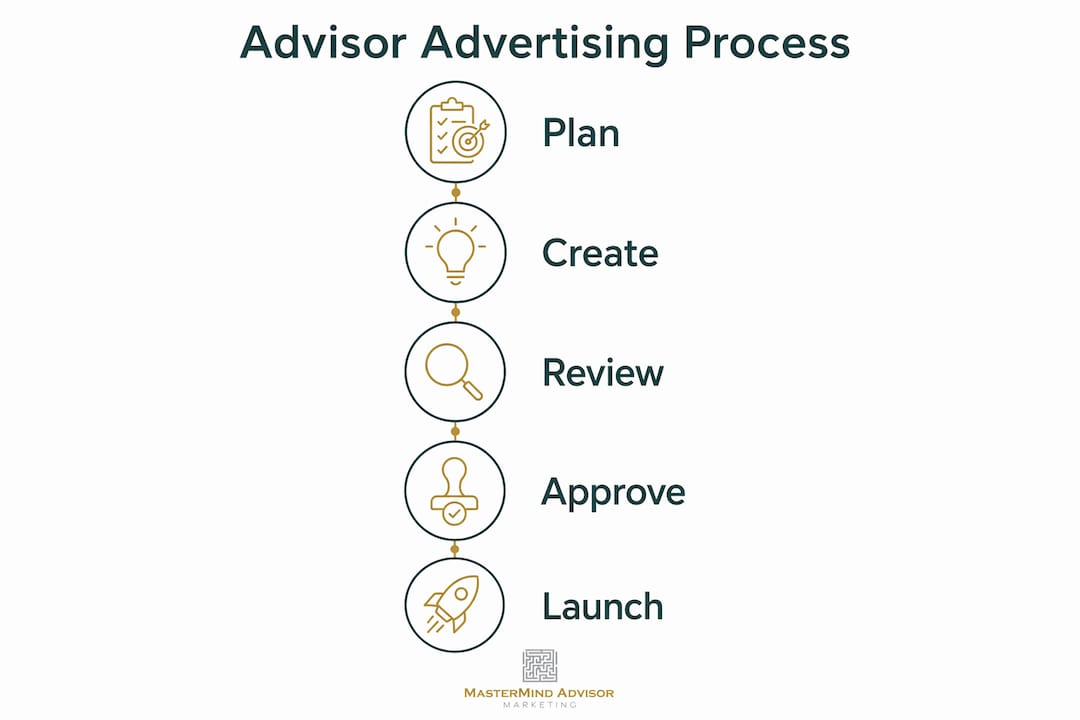
- Principal pre-approval before any retail communication goes live
- Documented approval logs with reviewer names and dates
- Pre-filing with FINRA for certain new member communications
- Recordkeeping of all retail communications for three years minimum
"Marketing Rule compliance is a core day-to-day obligation, not a one-time checklist. Enforcement focus has shifted toward unsubstantiated performance claims and testimonial disclosure failures." — InvestmentNews SEC Marketing Rule Guide
One area advisors consistently underestimate is content repurposing. Repurposed content changes its compliance classification when moved from organic to paid channels. A blog post that becomes a sponsored LinkedIn article, or a client quote that becomes a paid testimonial ad, requires a fresh compliance review and updated disclosures. Compliance teams must treat repurposing as a material marketing event, not a shortcut.
How advertising fits within the broader client prospect journey
Advertising and marketing are not interchangeable. Marketing builds trust and recognition as a foundation; advertising pulls prospects in quickly. Advisors who conflate the two tend to either overspend on ads without a nurture system to convert leads, or under-invest in advertising and stall their growth pipeline.
The client prospect journey maps to three stages: Awareness, Consideration, and Decision. Advertising primarily drives Awareness. Everything else in your marketing system handles the rest.
| Activity | Goal | Primary stage | Regulatory consideration |
|---|---|---|---|
| Google Search Ads | Generate inbound leads | Awareness | SEC Marketing Rule, FINRA 2210 |
| LinkedIn Sponsored Content | Brand visibility with professionals | Awareness | SEC Marketing Rule |
| Email nurture sequences | Build trust over time | Consideration | CAN-SPAM, SEC recordkeeping |
| Webinars and seminars | Educate and qualify prospects | Consideration/Decision | SEC Marketing Rule |
| Referral programs | Convert warm relationships | Decision | Solicitation disclosure rules |
| Client testimonial ads | Social proof for cold audiences | Awareness | SEC endorsement disclosures |
The table above shows why advertising tactics carry heavier regulatory weight. They reach cold, unqualified audiences at scale, which is exactly why the SEC and FINRA require pre-approval and disclosure. Marketing activities like email sequences and webinars reach warmer audiences who have already opted in, which shifts both the conversion dynamic and the compliance posture.
Pro Tip: Treat your advertising budget as a top-of-funnel investment, not a standalone revenue driver. Every dollar spent on ads should feed a nurture system that converts prospects over weeks or months, not days.
What are effective and compliant advertising tactics for advisors in 2026?
Running ads that work and stay compliant requires discipline in both creative strategy and operational process. The most effective formats for financial advisors in 2026 include:
- Video ads on YouTube and LinkedIn that explain your investment philosophy or planning process without making performance claims. Process-driven content converts well and carries lower compliance risk than results-focused messaging.
- Retargeting ads served to website visitors who viewed your services page but did not schedule a call. These audiences are already warm and convert at higher rates than cold traffic.
- Social media ads using compliant testimonials, where the client's quote is accompanied by required disclosures about compensation and conflicts. The role of client testimonials in paid advertising has expanded significantly under the updated SEC Marketing Rule.
- Paid search campaigns targeting specific life events like "retirement planning after selling a business" or "financial advisor for tech employees with RSUs."
On the compliance operations side, integrated approval workflows that assess all advertising assets collectively reduce the risk of inconsistent disclosures across your campaign. Approving a Google ad, a landing page, and a retargeting banner as a set, rather than individually, catches mismatches in performance data presentation before they go live.
For creative testing, keep regulated claims locked in pre-approved templates and test only non-regulated elements: headlines, imagery, audience segments, and educational hooks. Testing variable performance claims across ad versions is a direct compliance risk. Testing whether "We help executives retire on their terms" outperforms "Fee-only planning for high earners" is not.
AI tools can accelerate content creation and ad copy testing, but the structure and strategy behind their use matter as much as the tools themselves. Authenticity in messaging, aligned with your actual client base and planning approach, drives genuine conversion. AI-generated copy that sounds generic or overpromises will underperform regardless of targeting precision.
For advisors building their digital lead generation pipeline, the combination of compliant paid search, retargeting, and testimonial-based social ads represents the most scalable advertising approach available in 2026.
Key takeaways
Advertising in advisor marketing generates immediate awareness and leads, but only produces sustainable growth when integrated with compliant workflows and a broader marketing system built for trust and conversion.
| Point | Details |
|---|---|
| Advertising drives Awareness | Paid ads introduce your firm to cold audiences; broader marketing converts and retains them. |
| SEC and FINRA compliance is non-negotiable | Every ad requires pre-approval, accurate disclosures, and five-year recordkeeping under SEC rules. |
| Net performance must accompany gross | Any ad showing gross returns must also display net performance with methodology and disclosure. |
| Testimonials require explicit disclosure | Compensation, conflicts, and endorser relationships must be clearly stated in any paid testimonial ad. |
| Test creative, not compliance elements | Lock regulated claims in approved templates; test only non-regulated messaging and targeting variables. |
Why most advisors get advertising backwards
I have worked with enough advisors to recognize a pattern: they treat advertising as the entire marketing strategy rather than the entry point to one. They run Google Ads or LinkedIn campaigns, get some clicks, and then wonder why the leads do not convert. The answer is almost always that the advertising worked. The system behind it did not.
Advertising is a traffic mechanism. It gets the right person to raise their hand. What happens after that click, the landing page, the follow-up email, the webinar invite, the consultation booking process, determines whether that ad spend ever becomes revenue. Advisors who build that back-end system first and then turn on advertising see dramatically better results than those who run ads into a generic website.
The compliance piece is where I see the most costly mistakes. Not because advisors are careless, but because the rules are genuinely complex and the consequences of getting them wrong are serious. An unsubstantiated performance claim in a Facebook ad or a testimonial without proper disclosure is not just a compliance violation. It is a reputational risk that can undo years of trust-building. Treat your compliance workflow as a core part of your advertising operation, not an afterthought you address after the creative is already live.
The advisors who grow fastest through advertising are not the ones spending the most. They are the ones who have built a repeatable system: compliant creative, a tested landing page, an automated follow-up sequence, and a clear offer. That system compounds over time in ways that ad spend alone never will.
— Josh
How Mastermindadvisormarketing helps advisors advertise effectively

Mastermindadvisormarketing is built specifically for independent financial advisors who want to grow through advertising without the guesswork or compliance risk. The platform provides turnkey campaign management, compliance workflow integration, and content strategies designed around the SEC Marketing Rule and FINRA requirements. From customized webinars and seminar programs to automated email follow-ups and CRM integration, every component is designed to convert advertising traffic into qualified prospects and long-term clients. If you are ready to build an advertising system that generates leads and holds up to regulatory scrutiny, explore the full range of advisor marketing services at Mastermind Advisor.
FAQ
What is the role of advertising in advisor marketing?
Advertising is the paid, prospect-facing component of advisor marketing, focused on generating awareness and leads from cold audiences. It feeds the broader marketing system that converts and retains those prospects over time.
What does the SEC Marketing Rule require for advisor ads?
The SEC Marketing Rule requires advisers to maintain written compliance policies, keep advertising records for five years, and include accurate disclosures for performance data, testimonials, and endorsements in all advertisements.
Can financial advisors use client testimonials in paid ads?
Yes, under the updated SEC Marketing Rule, advisers can use client testimonials in paid advertising as long as they clearly disclose any compensation paid to the endorser and identify any material conflicts of interest.
How does FINRA Rule 2210 affect broker-dealer advertising?
FINRA Rule 2210 requires broker-dealers to obtain principal pre-approval before any retail communication goes live, maintain documented approval logs, and retain records of all retail communications for a minimum of three years.
What is the safest way to test advertising creative as a financial advisor?
Keep all regulated claims, including performance data and testimonials, locked in pre-approved templates. Test only non-regulated elements such as headlines, imagery, audience targeting, and educational messaging hooks to stay within compliance boundaries.