
Yes, advisors should run an omnichannel approach: centralize client data in one system, connect a single play (webinar plus email plus CRM follow-up), and automate the next logical step for every prospect. Do that well and you'll see better-qualified leads and shorter, more predictable follow-up cycles across a normal advisor sales timeline spanning several months.
TL;DR:
- Connecting channels so data flows seamlessly allows follow-ups to be relevant and timely, significantly improving engagement and trust in advisor marketing.
- Webinars, email sequences, and website SEO are the most cost-effective channels for building awareness, nurturing leads, and capturing intent-driven traffic.
- A unified tech stack with a CRM, marketing automation, and webinar software sharing data is crucial for reliable trigger-based personalized communication.
- Segmentation based on life stage, engagement behavior, and referral source enables tailored automation that accelerates conversion and enhances client relationships.
- Compliance can be maintained with pre-approved content libraries and clear consent processes, allowing fast execution without sacrificing trust or regulatory requirements.
Table of Contents
- What Is Omnichannel Advisor Marketing, and How Does It Differ From Multichannel?
- Which Channels Give Advisors the Best Return?
- Data and Tech Stack That Powers Omnichannel
- How Do You Personalize the Advisor Client Journey?
- What Tactics Work Best for Email, Social, Webinars, and Your Website?
- How Do You Stay Compliant Without Slowing Down?
- Which KPIs and Timelines Actually Matter?
- How Do You Build an Omnichannel Program in 90 Days?
- Why a Turnkey System Speeds Up Results
- How Should You Segment Advisor Prospects for Omnichannel Campaigns?
- How Do You Manage Data Privacy and Consent in Advisor Marketing?
- Can Referral Programs Work Inside an Omnichannel Strategy?
- An Advisor Marketing Consultant's Take on Priorities and Pitfalls
- Get an Omnichannel System Built for Advisors, Not Retrofitted From One
- Sources
What Is Omnichannel Advisor Marketing, and How Does It Differ From Multichannel?
Multichannel marketing means showing up on email, LinkedIn, and your website independently, each channel running its own message with no memory of what happened elsewhere. Omnichannel marketing connects those same channels so data flows between them, which means a prospect who registers for your retirement-planning webinar gets a follow-up email that actually references the webinar, not a generic newsletter blast.

For advisors, that distinction carries real weight. A prospect who spent 45 minutes on a webinar about Social Security timing shouldn't get treated like a cold lead the next week.
The EDHEC Online framework breaks omnichannel into four C's, and each one maps cleanly onto advisor practice:
- Customer experience: every touchpoint feels like it's coming from the same firm, not five disconnected vendors
- Content: messaging stays relevant to where the prospect is in the relationship
- Context: timing matters. A follow-up call two hours after a seminar lands differently than one three weeks later
- Collaboration: your CRM, email platform, and webinar tool share data instead of operating in silos
Financial services runs on trust built over repeated contact. Wharton's research on omnichannel strategy points to consistent tone and repeated exposure as the mechanism that builds that trust, which matters enormously given how long advisor sales cycles typically run.
Which Channels Give Advisors the Best Return?
Not every channel deserves equal investment. Independent advisors and small RIAs get the most mileage from a short list, each playing a distinct role in the funnel.
- Webinars and seminars drive top-of-funnel awareness and let you demonstrate expertise without a hard sell. A tax-planning webinar in February, timed around filing season, consistently outperforms generic "meet your advisor" events.
- Email carries the nurture weight. Once someone attends a webinar, a five-to-seven touch drip sequence keeps your firm visible while they decide whether to book a call.
- Your website, especially pages built around SEO for questions prospects actually search ("how much do I need to retire"), captures intent-driven traffic that webinars and social can't reach.
- LinkedIn works best for ongoing thought leadership and event promotion, not cold outreach. Advisors who post consistently see it function as a trust-builder rather than a lead source on its own.
- Phone and in-person meetings close what the other channels warm up. This is where the actual conversion happens.
A firm size can dictate the mix. A solo advisor might run one webinar per quarter with a tight email follow-up; a five-advisor RIA can support monthly seminars with staggered nurture tracks. The simplest working example: a Medicare-planning webinar feeds an email sequence, which triggers a phone call to anyone who opens three or more emails. That's the whole play.
Data and Tech Stack That Powers Omnichannel
None of this works without a single view of the client, as explained in detail in Omnichannel marketing: Unifying customer experience for growth. McKinsey's explainer on omnichannel marketing makes the point directly: without a central data hub, interaction data can't reliably trigger the next step in a journey. A prospect's webinar attendance has to actually reach your CRM, or your follow-up email goes out blind.
Adobe's guide to omnichannel marketing basics lists the essential categories advisors need:
- A CRM or customer data platform (CDP) that serves as the single record of every interaction
- Marketing automation software to run drip campaigns and trigger-based sequences
- Webinar or event software that reports attendance data back to the CRM automatically
- Website analytics tied to the same contact record, not a separate dashboard
Start with what you already own. Most advisors don't need a new platform; they need their existing CRM and email automation actually talking to their webinar tool. Postpone anything requiring a full CDP migration until the basic CRM-to-email-to-webinar loop is working reliably.
Pro Tip: Before buying new software, test whether your current CRM has a native or Zapier-style integration with your webinar platform. Half the "we need new tech" problems are actually "we never turned on the integration" problems.
How Do You Personalize the Advisor Client Journey?
Segmentation for advisors isn't about a hundred micro-audiences. Three or four clear buckets, tied to real signals, cover most of the work:
- Life stage: pre-retirees, recent retirees, business owners planning an exit
- Asset level or AUM band: different messaging for a $250,000 portfolio versus a $3 million one
- Engagement signal: webinar attendee, email opener, website visitor who read three retirement articles but never registered for anything
Trigger sequences turn segments into action. A webinar sign-up should kick off a confirmation email, a reminder 24 hours before, a same-day follow-up with the recording, and a call attempt for anyone who attended live. That's four automated touches from one registration.
Compliance doesn't have to slow this down if the content itself is pre-approved at the framework level rather than reviewed message by message. Build the templates once, get sign-off on the structure, and let automation handle the rest.
What Tactics Work Best for Email, Social, Webinars, and Your Website?
Each channel has its own playbook, and treating them identically wastes the format's strength.
- Email: segment by engagement level, not just demographics. Test subject lines around specific outcomes ("What changes to RMDs mean for you") rather than generic branding. Nurture sequences of four to six weeks outperform one-off blasts for advisor audiences.
- LinkedIn: post two to three times weekly with practical, non-promotional insight, then shift to direct event promotion two weeks before a webinar or seminar.
- Webinars and seminars: pick a specific, timely topic (tax law changes, market volatility, Social Security) over broad titles. A tight registration funnel with one form field beats a long intake form. Follow up within 24 hours, not days.
- Website: dedicated landing pages built for a single offer convert better than a generic "contact us" page, especially when the page matches the exact webinar or lead magnet driving the traffic.
How Do You Stay Compliant Without Slowing Down?
Speed and compliance don't have to fight each other if the approval process happens at the system level instead of the message level. A pre-approved content library, reviewed once by compliance and reused across email, social, and webinar follow-up, lets advisors move fast without putting every individual message through review.
Brand consistency reinforces the same trust the Wharton research points to. That means:
- One visual and voice standard across email templates, LinkedIn posts, and webinar slides.
- A clear owner for content approval, distinct from the person executing campaigns
- An audit trail showing what was sent, when, and under what approved template, which matters if a regulator ever asks
Pro Tip: Build your content library around evergreen topics (RMDs, Social Security timing, market volatility) rather than one-off event copy. Evergreen templates get reused for years; event-specific copy gets used once.
Which KPIs and Timelines Actually Matter?
Track fewer metrics, but track the right ones:
- Qualified leads generated per campaign, not raw form fills
- Webinar-to-meeting conversion rate
- Email open and click-through trends over time, not single-campaign snapshots
- Pipeline velocity, meaning how long it takes a lead to move from first touch to booked meeting
Avoid crediting a single channel for a conversion that took six touches to happen. Multi-touch attribution, even a simple version tracking every touchpoint before a booked call, beats last-click credit every time.
Expect quick wins in engagement metrics within 30 to 60 days (open rates, webinar attendance), while lead-to-client conversion signals typically take a full three-to-twelve-month cycle to show a clear trend, consistent with the long sales cycles Wharton describes as standard in financial services.
How Do You Build an Omnichannel Program in 90 Days?
- Weeks 1 to 4: Audit your current channels and tools. Pick exactly one play (webinar plus email plus CRM follow-up works well) and set up basic tracking and automation for it.
- Weeks 5 to 8: Run the play live. Watch engagement data closely and fix any broken integrations, like a webinar tool that isn't actually passing attendance data to your CRM.
- Weeks 9 to 12: Scale the play across a second channel, formalize your compliance approval process around the content that worked, and adjust based on actual KPI performance rather than assumptions.
Pro Tip: Resist the urge to launch three campaigns at once in week one. One working play beats three half-built ones, and you'll learn more from finishing one than starting five.
Why a Turnkey System Speeds Up Results
Building this stack from scratch takes most advisors far longer than 90 days, mostly because integration and compliance review eat the time budget. A system built specifically for independent advisors and RIAs skips the trial-and-error of stitching together a CRM, webinar tool, and content approval process from separate vendors, since those pieces already talk to each other and the content library already accounts for advisor compliance needs.
How Should You Segment Advisor Prospects for Omnichannel Campaigns?
Segmentation determines whether your automation feels personal or generic, and advisors have more useful signals available than most industries realize.
Start with financial life stage. A 35-year-old business owner accumulating assets needs entirely different content than a 68-year-old drawing down a portfolio. Layer in engagement behavior next: someone who attended a webinar and opened four follow-up emails is a hotter lead than someone who registered and never showed up, even if both sit in the same age bracket.
A third useful layer is referral source. Prospects who come through a client referral typically convert faster and need less nurturing than a cold website lead, so treating them identically in your drip sequence wastes an advantage you already earned.
Combine these into three or four working segments, not dozens. A common structure looks like:
- High-intent, high-fit: attended an event, matches your ideal client profile by asset level, needs a fast-tracked call invitation
- Warm, unqualified: engaged with content but doesn't match your typical client profile, gets longer nurture before any call attempt
- Referral-sourced: skips early-stage education content entirely and goes straight into a scheduling sequence
- Cold website traffic: enters the longest nurture track, starting with foundational content before any sales touch
Advisors who refine positioning around a specific niche find segmentation gets easier automatically, since the prospect pool is already narrower and more predictable.
How Do You Manage Data Privacy and Consent in Advisor Marketing?
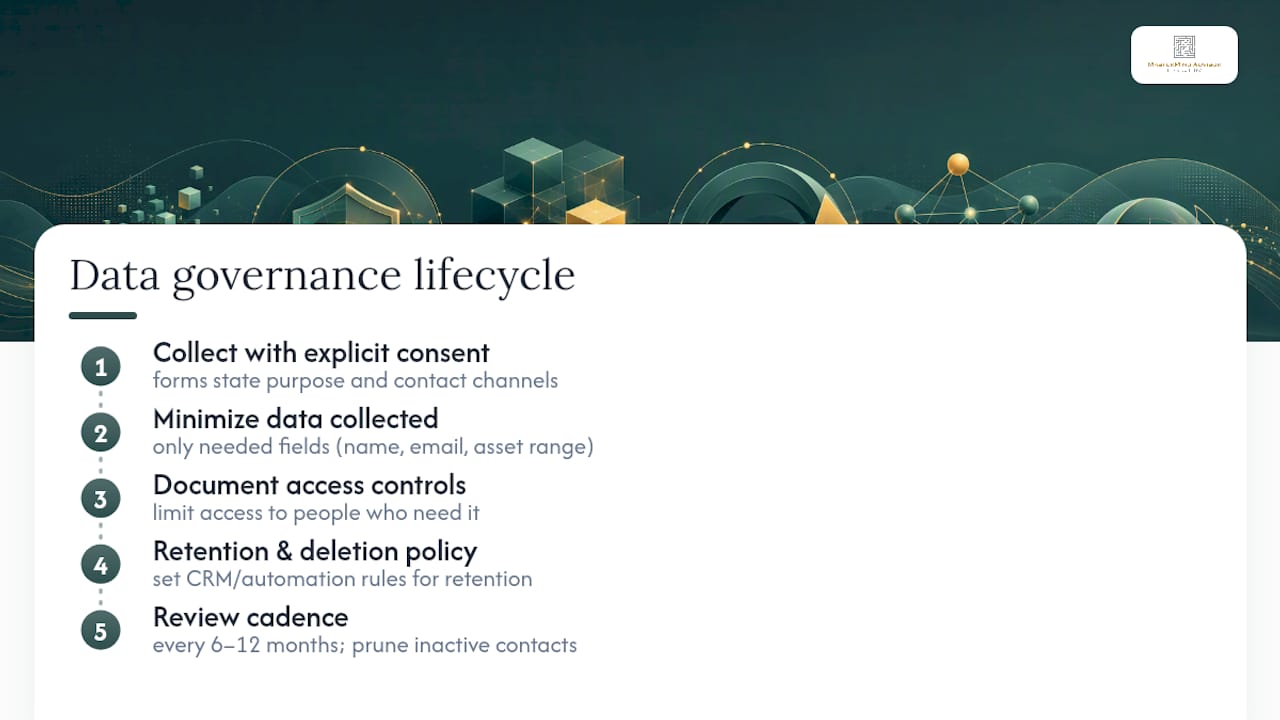
Every piece of client data flowing through your omnichannel system, from webinar registration to email opens to website visits, needs a documented basis for consent. That's not optional in financial services, where data handling gets scrutiny from both regulators and clients who are trusting you with sensitive financial details.
Practical consent management starts at the point of collection. Webinar registration forms and website opt-ins should state plainly what a prospect is signing up for and how follow-up will happen, whether that's email, phone, or both. Vague consent language creates both a compliance gap and a trust problem, since prospects who feel surprised by a follow-up call are less likely to become clients.
Data minimization matters just as much as consent. Collect what you need to run the specific play (name, email, asset range if relevant) rather than building intake forms that ask for unnecessary detail. A shorter form also converts better, so privacy discipline and lead-generation performance point in the same direction here.
Your CRM and marketing automation tools need clear retention and deletion policies too. A prospect who never converts and stops engaging after a year shouldn't sit in an active email sequence indefinitely. Build a review cadence, every six to twelve months, to prune contacts who've gone cold and confirm consent records are current. Document who has access to client data internally, and limit that access to people who actually need it for their role in running campaigns or follow-up.
Can Referral Programs Work Inside an Omnichannel Strategy?
Referrals have always been the highest-converting lead source for advisors, and folding them into your omnichannel system rather than treating them as a separate, informal process multiplies their value.
Start by making the ask systematic instead of occasional. A satisfied client who just finished a successful review meeting is in the best possible moment to make an introduction, so build a follow-up email template, part of your pre-approved content library, that goes out automatically after positive milestone meetings and asks for a referral directly.
Once someone refers a prospect, that prospect should enter your CRM with a distinct tag identifying the referral source. That single data point changes everything downstream: referral-sourced leads can skip early nurture content and move faster toward a scheduling call, since they arrive with built-in trust the content hasn't earned yet.
Close the loop with the referring client, too. A short thank-you touch, automated through the same email system running your other campaigns, keeps clients engaged in the referral habit rather than making it a one-time favor. Some advisors add a light incentive (a dinner, a donation to a client-chosen charity), though the follow-up and acknowledgment matter more than the size of any reward.
Track referral volume and conversion rate as its own KPI line, separate from webinar or website leads.
An Advisor Marketing Consultant's Take on Priorities and Pitfalls
Start with one integrated play, not five parallel experiments. Automate the next logical step before adding a new channel; a second untracked channel just creates a second data silo. Compliance paralysis kills more programs than actual violations do, so build the pre-approved framework first. Then let your KPIs, not your instincts, decide what to scale.
— Josh
Get an Omnichannel System Built for Advisors, Not Retrofitted From One
Mastermindadvisormarketing is the alternative to piecing together five vendors and hoping they integrate. Instead of buying a CRM here, a webinar tool there, and a compliance review process nobody enjoys, you get a turnkey system built specifically for independent advisors and RIAs, with the integration work and compliance framework already solved.
The system includes customized lead-generation webinars, fully produced seminars for both virtual and in-person delivery, a compliance-friendly content library, automated email drip campaigns, scheduled social content, and CRM integrations that connect every touchpoint automatically. It fits advisors who have the client relationships and expertise but lack the internal marketing bandwidth to build and maintain this stack alone.
If you're ready to see how this works for a practice like yours, visit the Mastermind Advisor Marketing site to review case studies and get a demo.
Sources
- Omnichannel marketing vs multichannel — Salesforce
- How to create an effective omnichannel strategy — EDHEC Online
- Omnichannel marketing basics: Benefits, strategies, and examples — Adobe
- What is omnichannel marketing? — Wharton