
Advisor brand identity is the distinct combination of visual, verbal, and experiential elements that communicate a financial advisor's value, personality, and promise to a specific audience. The industry term for this concept is "brand identity system," and it sits at the intersection of strategic positioning and tangible expression. A well-built identity does more than look professional. It tells prospects exactly who you serve, why you are different, and why they should trust you with their financial lives. For independent advisors competing in crowded markets, a clear brand identity is one of the most direct paths to stronger client engagement and sustainable growth.
What is advisor brand identity and why does it matter?
Advisor brand identity is defined as the structured set of elements, both visual and verbal, that represent a financial advisor's market position and client promise. The American Marketing Association defines brand identity as the outward expression of a brand, including its name, trademark, communications, and visual appearance. For financial advisors, this definition extends to every client touchpoint: your website, your emails, your seminar materials, and even how you open a discovery call.
A strong identity matters because trust drives decisions in financial services more than in almost any other industry. Clients are not buying a product they can return. They are handing over their retirement savings, their children's college funds, and their peace of mind. An advisor whose brand identity communicates clarity and consistency signals competence before a single conversation begins.

The business case is equally direct. A clear brand shortens sales cycles, improves client retention, attracts better prospects, and supports premium pricing. That is four measurable business outcomes tied directly to how well you present yourself in the market.
What are the fundamental components of a financial advisor's brand identity?
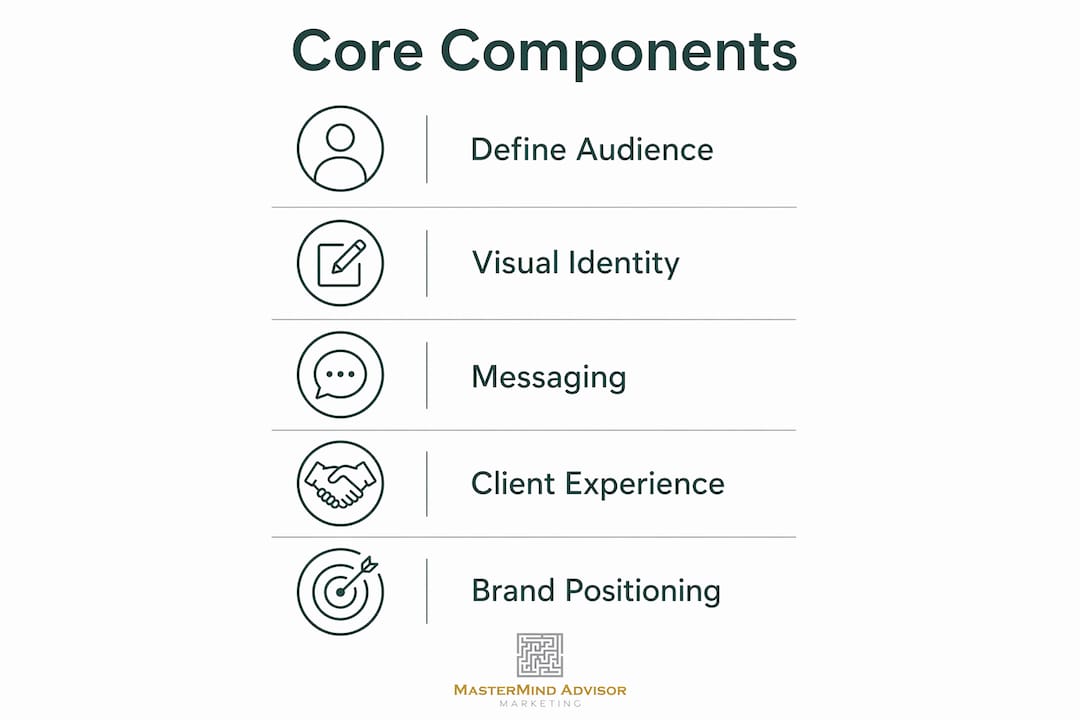
A complete advisor brand identity system includes five to six core components, according to branding experts. Each component serves a distinct function, and missing even one creates gaps that prospects notice.
| Component | Function |
|---|---|
| Target audience definition | Clarifies who you serve and filters out poor-fit prospects |
| Unique value proposition | States what makes you different from every other advisor |
| Messaging pillars | Gives you consistent language across all channels |
| Visual suite (logo, color, typography) | Creates instant recognition and signals professionalism |
| Photography style | Humanizes your brand and builds personal connection |
| Client experience design | Ensures your brand promise shows up at every interaction |
The visual suite is the most visible layer, but it is not the most important. Your logo and color palette create recognition. Your messaging pillars create meaning. Advisors who invest heavily in design without first defining their audience and value proposition end up with beautiful materials that say nothing specific to anyone.
Consistent visual identity across all client touchpoints, from onboarding packets to quarterly reports, reduces execution friction and reinforces your brand promise at every stage of the relationship. Consistency is not about being rigid. It is about being recognizable.
Pro Tip: Build a one-page brand guide that documents your logo usage, color codes, approved fonts, and tone of voice. Share it with anyone who creates content for your practice, including virtual assistants and compliance reviewers.
How does brand differ from brand identity, and why advisors need both?
Brand and brand identity are related but not interchangeable. Brand is the emotional and strategic position a firm holds in a client's mind. Brand identity is the tangible visual and verbal toolkit that communicates that position. One is the feeling. The other is the vehicle that creates the feeling.
An advisor who has a polished identity without a differentiated brand ends up with aesthetics and no substance. Their materials look professional, but nothing in them explains why a prospect should choose them over the advisor down the street. Conversely, an advisor with a strong brand positioning but no cohesive identity struggles to communicate that position clearly. Prospects sense something is off, even if they cannot name it.
The practical consequence is this: you need both working together. Your brand answers the question "Why you?" Your identity answers the question "How do I know it's you?" When both are aligned, prospects move through trust and decision-making faster.
Pro Tip: Write a one-sentence brand positioning statement before you design anything. The format is simple: "I help [specific audience] achieve [specific outcome] through [specific approach]." Every visual and verbal decision should pass through that filter.
Why does targeting a specific audience strengthen your brand identity?
Targeting a specific client segment is the single most effective way to sharpen your brand identity. Experienced advisors rely on the "riches in the niches" principle for differentiation and stronger client connections. A generalist brand speaks to everyone and resonates with no one. A niche brand speaks directly to the fears, goals, and decision styles of a defined group, and that specificity creates immediate relevance.
Identifying your niche requires looking at two dimensions:
- Demographics: Age range, income level, profession, life stage (pre-retirees, business owners, tech executives, widows)
- Psychographics: Risk tolerance, financial anxieties, decision-making style, values around money and legacy
- Pain points: What keeps this group up at night? What have they tried before that did not work?
- Communication preferences: Do they prefer data-heavy reports or plain-language summaries? Email or video?
Once you know your niche, every brand identity decision becomes easier. Your color palette, your website copy, your seminar topics, and your LinkedIn content all point in the same direction. The niche selection process is one of the highest-leverage decisions an independent advisor makes, because it shapes everything downstream.
Narrowing brand focus by targeting a specific niche addresses client fears and needs directly, vastly improving differentiation compared to generalized marketing. That is not a soft benefit. It translates into more referrals, higher close rates, and clients who stay longer because they feel genuinely understood.
How can advisors authentically express their brand identity to build trust?
Authenticity is the defining factor in advisor brand identity today. Investors seek advisors they relate to and trust, not just competent money managers. That shift changes what effective brand expression looks like. Polished stock photos and generic mission statements no longer build the emotional connection that converts prospects into long-term clients.
Authentic brand expression draws from three sources:
- Your origin story: Why did you become a financial advisor? What experience, personal or professional, shaped your approach to money and client relationships?
- Your core values: What do you believe about how financial advice should be delivered? Transparency, education, long-term thinking? Name them and repeat them.
- Your personality: Are you direct and data-driven, or warm and narrative-focused? Your communication style is part of your brand.
The channels where this expression lives matter as much as the content itself. 40% of investors under 35 use social platforms to find advisors, and half research online before establishing a relationship. Your brand identity must show up consistently on your website, LinkedIn profile, email newsletters, and seminar materials. A strong advisor website is the anchor for all of this. It is where prospects go to confirm what they have already sensed about you from other channels.
Authenticity in branding builds trust and drives growth by creating genuine emotional connections that polished but impersonal images cannot replicate. Behind-the-scenes content, client success stories (with permission), and personal reflections on financial planning all work because they show the human being behind the credentials.
Pro Tip: Record a 60-second video explaining why you became a financial advisor and post it to your website's About page. Video converts at a higher rate than text alone because it communicates tone, warmth, and credibility simultaneously.
For practical examples of what this looks like in practice, thought leadership content from advisors who have built strong personal brands shows the range of formats that work, from weekly market commentary to client education series.
What practical steps help implement a cohesive advisor brand identity?
Building a brand identity is not a one-time project. It is a phased process that requires both creative work and operational discipline. The following steps reflect the implementation framework used by branding professionals who specialize in financial services.
- Run a market diagnostic. Audit your current materials, client feedback, and competitive positioning. Identify what is working, what is inconsistent, and where your current identity fails to reflect your actual value.
- Define your messaging framework. Write your positioning statement, your value proposition, and three to five messaging pillars. These pillars become the recurring themes across all your communications.
- Develop your visual identity. Commission a professional logo, select a color palette with clear usage rules, choose two to three fonts, and establish a photography style. Document all of this in a brand guide.
- Map your client journey. Identify every touchpoint where a prospect or client encounters your brand: Google search, LinkedIn, website, discovery call, proposal, onboarding, and ongoing reporting. Audit each one for consistency.
- Align your team. Every person who interacts with clients or creates content must understand and apply the brand standards. Internal alignment is where most advisor brands break down.
- Measure and adjust. Track metrics tied to brand performance: website traffic, referral rates, close rates, and client retention. Strategic implementation requires governance and measurement to produce consistent business outcomes.
The most common pitfall is skipping the diagnostic and jumping straight to design. Advisors who do this often rebrand twice within three years because the visual update did not solve the underlying positioning problem. Start with strategy. The creative work follows naturally.
Key Takeaways
Advisor brand identity is the structured system of visual, verbal, and experiential elements that communicates your value, builds trust, and differentiates your practice in a competitive market.
| Point | Details |
|---|---|
| Brand vs. identity | Brand is your strategic position; identity is the tangible toolkit that communicates it. |
| Core components | A complete system includes audience definition, value proposition, messaging pillars, visual suite, and client experience design. |
| Niche targeting | Narrowing your focus to a specific audience sharpens every brand decision and improves differentiation. |
| Authenticity drives trust | Sharing your origin story, values, and personality builds stronger client connections than polished generic imagery. |
| Implementation requires governance | Brand identity needs a documented guide, internal alignment, and ongoing measurement to stay consistent. |
Why most advisors underestimate what brand identity actually does
I have worked with enough independent advisors to see the same pattern repeat. An advisor invests in a new logo and website, feels good about the refresh, and then wonders six months later why nothing has changed in their pipeline. The problem is almost never the design. It is that the design was never connected to a clear positioning strategy.
Brand identity is not decoration. It is the operating system for how your practice communicates. When it is built correctly, it does the heavy lifting before you ever get on a call. Prospects arrive pre-qualified because your brand has already told them who you serve and why you are different. That is the real value, and most advisors never experience it because they stop at the visual layer.
The advisors I have seen build genuinely strong brands share one trait: they are willing to be specific. They name their niche, they share their story, and they repeat their core message across every channel without apology. That consistency, over time, compounds. It builds recognition, referrals, and the kind of pricing power that generic practices never achieve.
If you are sitting on a practice that does great work but struggles to communicate that value to the outside world, the answer is almost always a brand identity problem. Fix the foundation, and the marketing gets easier.
— Josh
How Mastermindadvisormarketing helps advisors build a brand that works
Mastermindadvisormarketing is built specifically for independent financial advisors who want a marketing system that reflects their brand and generates real results.
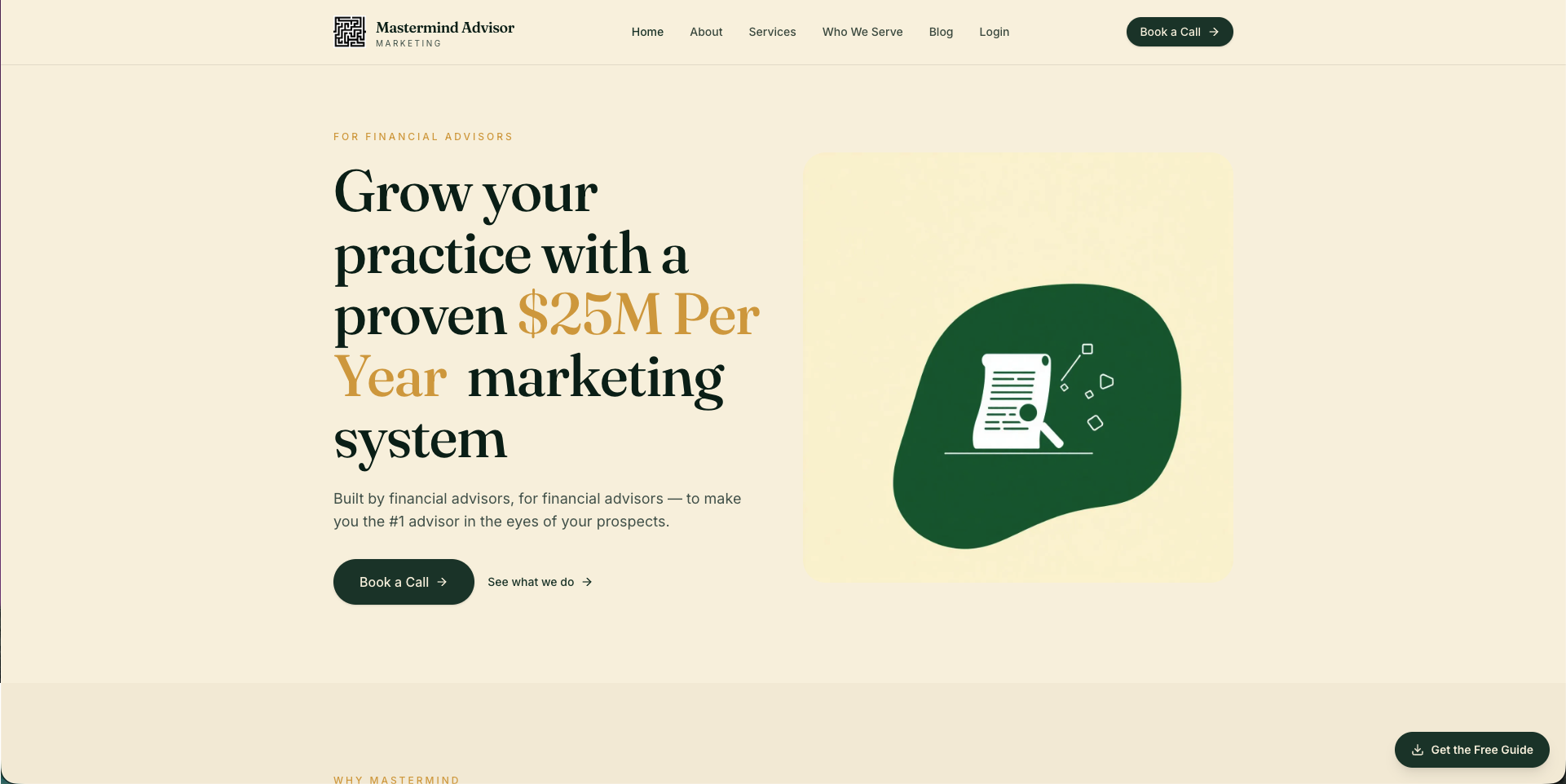
The platform provides customized webinars, seminars, and content marketing strategies designed to express your brand identity and engage your target audience at every stage of the relationship. Mastermindadvisormarketing integrates custom CRMs and automated email follow-ups that keep your brand visible and consistent between client meetings. Advisors who use the system report stronger lead generation and deeper client relationships, outcomes that trace directly back to a clearer, more consistent brand presence. Visit Mastermindadvisormarketing to see how the system works for practices at every stage of growth.
FAQ
What is advisor brand identity in simple terms?
Advisor brand identity is the complete set of visual, verbal, and experiential elements that communicate who you serve, what you stand for, and why clients should choose you. It includes your logo, messaging, tone of voice, and client experience design.
How does brand identity differ from a logo?
A logo is one element of brand identity. A full identity system also includes your color palette, typography, messaging pillars, value proposition, and the experience you deliver at every client touchpoint.
Why do financial advisors need a defined niche for their brand?
Niche targeting allows advisors to address a specific audience's fears and goals directly, which produces stronger differentiation and higher client relevance than generalized marketing.
How does storytelling fit into advisor brand identity?
Storytelling is a core component of advisor brand expression. Sharing your origin story, values, and personality builds emotional trust with prospects who are evaluating whether to hand you their financial future.
How long does it take to build a strong advisor brand identity?
The foundational work, including positioning, messaging, and visual identity, typically takes two to four months when done properly. Maintaining and evolving the brand is an ongoing process tied to client feedback and market changes.