

Content marketing for financial advisors is the strategic practice of publishing educational, compliant content that demonstrates expertise and attracts ideal clients without relying on overt sales tactics. Unlike generic digital marketing, advisor content operates inside a regulated environment where every blog post, LinkedIn update, and email newsletter is subject to rules like the SEC Marketing Rule and FCA Consumer Duty. The payoff is significant. Advisors who publish consistently build trust at scale, generate qualified leads, and reduce dependence on referrals alone. This guide covers content formats, compliance workflows, differentiation strategies, and measurement frameworks so you can build a content program that actually grows your practice.
What content marketing for advisors really means
Content marketing for advisors is the industry term for what marketers broadly call "inbound marketing," applied specifically to regulated financial services. The core idea is simple: publish content that answers the questions your ideal clients are already asking, and they will find you before they ever speak to a competitor.
The financial advisory context changes the rules in one critical way. Educational content must actively support client understanding and decision-making. That is both a legal requirement and a marketing advantage. Advisors who explain concepts clearly, use real numbers, and address genuine concerns build a level of trust that no paid ad can replicate.

Three platforms dominate advisor content distribution right now: LinkedIn for professional credibility, a well-structured website for SEO and AI visibility, and email newsletters for nurturing existing relationships. Each serves a different stage of the client journey, and the most effective advisors use all three in coordination rather than treating them as separate efforts.
The 2026 digital marketing strategy for financial services confirms that content marketing and SEO deliver the highest long-term return on investment by building sustainable traffic and trust over time, with paid search serving only as a short-term supplement.
What content formats and channels work best for advisors?
The right content format depends on your client segment, your production capacity, and where your prospects spend their time. Here is a direct comparison of the formats that produce results for independent advisors.
| Format | Best use case | Key advantage | Main limitation |
|---|---|---|---|
| Long-form blog posts | SEO and AI discovery | Builds authority, ranks for search queries | Requires consistent publishing |
| LinkedIn articles and posts | Professional networking | Direct access to HNW prospects and referral partners | Algorithm-dependent reach |
| Email newsletters | Client retention and nurturing | High open rates among existing contacts | Limited new prospect reach |
| Video explainers | Complex topic simplification | High engagement, underused by advisors | Production time and cost |
| Podcasts | Niche authority building | Builds deep loyalty with a targeted audience | Slow audience growth |
| Case studies | Late-stage trust building | Converts prospects already considering you | Requires compliance sign-off |
Videos are underused but highly effective for financial advisors. A short, two-minute video explaining how Roth conversions work will outperform a 1,500-word article on the same topic for engagement on LinkedIn and YouTube. The barrier is psychological, not technical. Most advisors assume video requires a production team. A smartphone, decent lighting, and a clear script are enough to start.
For format mix, a practical starting point is one long-form blog post per month, two to four LinkedIn posts per week, and one email newsletter every two weeks. This frequency is sustainable for a solo advisor and sufficient to maintain algorithmic visibility on LinkedIn and Google.
AI-driven content discovery rewards content with clear, specific headings and concise, self-contained paragraphs that answer individual questions. Write each section of a blog post as if it could stand alone as a featured snippet. That structure serves both human readers and AI recommendation engines like ChatGPT and Perplexity simultaneously.
Pro Tip: Before choosing a new content format, ask where your last three ideal clients spent time online before they contacted you. That answer tells you more than any industry benchmark.
How to build a compliant content marketing workflow
Compliance is not a final hurdle you clear before publishing. It is a step embedded in the production process from the start. Advisors who treat compliance as an afterthought spend more time on revisions and face greater regulatory risk than those who build review into their workflow from day one.
The SEC Marketing Rule, which took effect in November 2022 under Rule 206(4)-1, broadly defines advertisements to include blogs, LinkedIn posts, bulk emails, and website pages. Every piece of content you publish at scale is a regulated advertisement. That scope surprises many advisors who assumed "marketing rule" applied only to formal pitch materials.
Testimonials, performance claims, and endorsements require clear disclosures and carry significant compliance risk if mishandled. Marketing documents must be retained for five years. That retention requirement applies to social media posts, not just formal brochures.
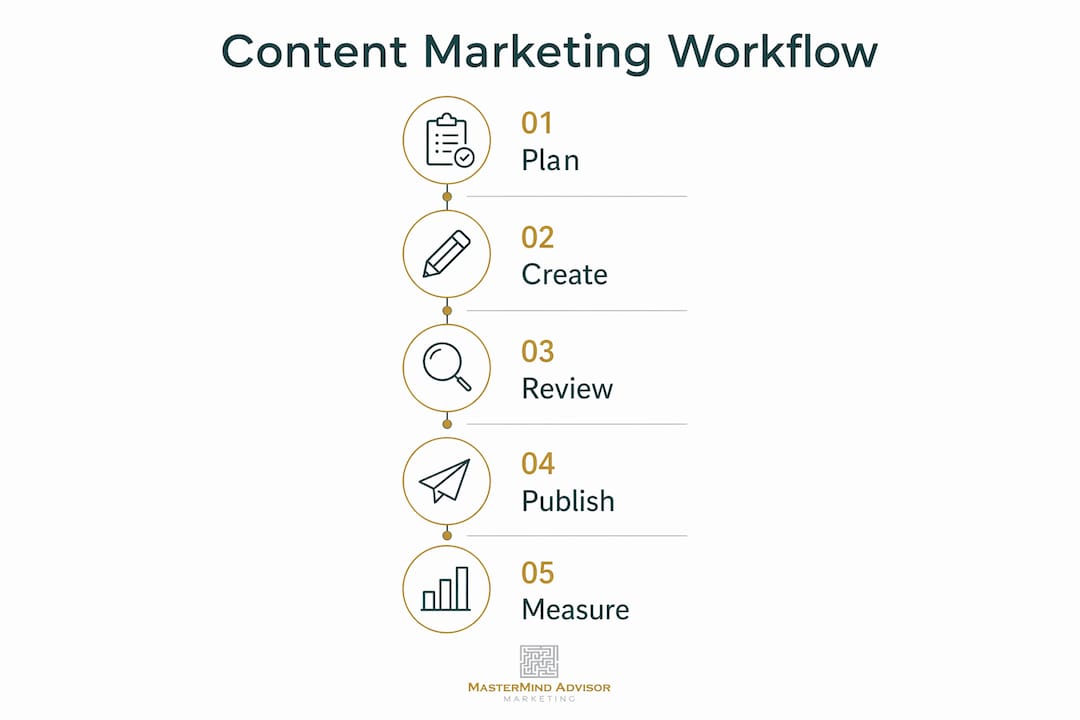
A practical compliant workflow includes these steps:
- Draft: Write content with compliance constraints in mind from the first sentence. Avoid performance claims, superlatives, and unqualified testimonials.
- Internal review: Route the draft through your compliance officer or designated reviewer before any external distribution.
- Version control: Save each draft with a date stamp. Use tools like Google Docs or Microsoft SharePoint to maintain a clear revision history.
- Sign-off: Obtain written approval before publishing. A simple email confirmation creates an auditable record.
- Recordkeeping: Archive the final published version and all prior drafts for the required retention period.
The FCA Consumer Duty, phased in from July 2023 to July 2024, adds a parallel requirement for UK-based advisors. All communications must be clear, fair, and not misleading, and must enable customers to make effective decisions. That standard applies to every marketing touchpoint, including social media captions.
Compliance requirements apply equally to new content and legacy materials. A blog post you published three years ago is still a regulated advertisement if it remains live on your website. Schedule quarterly audits of your existing content library to catch outdated claims, expired disclosures, or performance figures that no longer reflect current results.
Pro Tip: Use a content calendar tool to schedule compliance review deadlines alongside publishing dates. When review is on the calendar, it stops being skipped.
How do you attract ideal clients with your content?
The advisors who attract the best clients through content share one habit: they write about specific problems for specific people, not general financial topics for everyone. "How to reduce taxes in retirement" attracts a different reader than "How a 62-year-old teacher in Ohio can reduce taxes before taking Social Security." The second headline is more specific, more searchable, and far more likely to resonate with the exact client you want.
The most effective advisor content answers highly specific client questions, uses real numbers and examples, and reflects the advisor's unique expertise. Generic copy is invisible to AI recommendation engines and indistinguishable to prospects comparing multiple advisors. Specificity is your competitive advantage.
A pillar content framework is the most durable structure for building authority. Choose one deep expertise topic, such as retirement income planning for federal employees, and build a library of content around it. Write the definitive long-form guide as your pillar piece. Then create supporting cluster articles, short LinkedIn posts, and email sequences that all link back to that central resource. This structure signals topical authority to Google and gives AI systems a clear reason to recommend you.
Practical tactics to differentiate your content:
- Use real client scenarios (anonymized and compliant) to illustrate how you solve problems. Abstract advice is forgettable. A story about a client who avoided a $40,000 tax mistake is not.
- Publish your process. Explain exactly how you work with clients, what your first meeting looks like, and what clients can expect. Transparency reduces friction for prospects who are evaluating you.
- Leverage local SEO. Include your city, state, and niche in page titles and headings. "Fee-only financial advisor for physicians in Austin, Texas" ranks for searches that national firms ignore.
- Build a referral content layer. Create one-page PDF summaries of your best articles that existing clients can share with friends and colleagues. Referrals convert faster when the prospect has already read something useful from you.
Client testimonials build trust at the late stage of the decision process, but they require careful handling under the SEC Marketing Rule. Proper disclosures and written consent are mandatory. Done correctly, a single well-crafted testimonial on your website can do more conversion work than ten blog posts.
Pro Tip: Use precise, question-style headings in every article you publish. "What happens to my 401(k) if I retire early?" is more likely to be cited by ChatGPT or Perplexity than "Retirement Planning Considerations."
How do you measure content marketing success?
Measurement separates advisors who publish consistently and grow from those who publish sporadically and quit. The goal is not to track everything. It is to track the metrics that connect content activity to client acquisition.
Consistent publishing and content refresh cycles improve long-term results by building algorithmic trust with Google and audience trust with readers. An advisor who publishes one quality article per month for two years will outrank and outperform one who publishes twenty articles in a single quarter and then stops.
| Metric | Tool | What it tells you |
|---|---|---|
| Organic website traffic | Google Analytics 4 | Whether your SEO content is attracting new visitors |
| LinkedIn post reach and engagement | LinkedIn Insights | Which topics resonate with your professional network |
| Email open and click rates | Mailchimp, Constant Contact | How well your nurture content holds audience attention |
| Lead form completions | Google Analytics 4 goals | Whether content is converting visitors to prospects |
| Content-attributed revenue | CRM tracking | Long-term ROI of your content investment |
Test your AI visibility quarterly by typing your niche and location into ChatGPT, Perplexity, and Google's AI Overview. Ask "Who are the best fee-only advisors for retirees in [your city]?" If your name does not appear, your content lacks the specificity and authority those systems require. That test costs nothing and tells you more than most analytics dashboards.
Key takeaways
Advisor content marketing succeeds when educational value, compliance discipline, and consistent publishing work together as a single system rather than separate efforts.
| Point | Details |
|---|---|
| Define before you publish | Content marketing for advisors means regulated educational publishing, not general promotion. |
| Match format to client segment | Use long-form blogs for SEO, LinkedIn for networking, and email for nurturing existing relationships. |
| Embed compliance early | Build sign-off workflows and version control into production, not as a final step. |
| Specialize to stand out | Pillar content around a niche topic builds durable authority with both humans and AI systems. |
| Measure what connects to revenue | Track organic traffic, lead form completions, and CRM-attributed revenue to assess real ROI. |
What I've learned after years of watching advisors market themselves
Most advisors I work with come in believing compliance is the reason they cannot do content marketing well. After seeing hundreds of practices build real content programs, I am convinced the opposite is true. Compliance is the reason advisor content earns trust faster than content from any other profession. When a prospect reads an article that is clearly accurate, carefully worded, and backed by a credentialed professional, they respond differently than they do to a generic marketing blog.
The advisors who struggle are not the ones with strict compliance departments. They are the ones who treat content as a one-time project rather than a long-term practice. They publish eight articles in January, see no immediate leads, and stop. Content marketing compounds over time. A well-structured article published today may generate its best leads eighteen months from now when it finally ranks on page one of Google or gets cited by an AI assistant.
The other mistake I see constantly is writing for everyone. An advisor who specializes in divorce financial planning for women over 50 and writes exclusively about that topic will build a more profitable practice than one who covers every financial topic for every demographic. Specificity feels like a limitation. In practice, it is the fastest path to becoming the obvious choice for the clients who matter most to you.
The role of AI in content discovery is accelerating. Tools like ChatGPT and Perplexity are now the first stop for many prospects researching financial advisors. If your content does not answer specific questions with concrete detail, those systems will recommend someone else. That shift is already happening, and advisors who write with AI recommendation in mind are gaining ground quickly.
— Josh
How Mastermindadvisormarketing helps advisors build content that works
Independent advisors rarely lack expertise. They lack the systems to turn that expertise into a consistent, compliant content program that generates leads month after month.

Mastermindadvisormarketing is built specifically for this problem. The platform provides customized content marketing strategies, compliance-aware workflows, and multi-channel distribution support so you can publish with confidence and attract the clients you actually want to work with. From content calendar development to automated email follow-up sequences, every tool is designed for the specific realities of regulated financial advisory practice. Visit Mastermind Advisor to see how the system works, or explore the full range of advisor marketing services to find the right fit for your practice.
FAQ
What is content marketing for financial advisors?
Content marketing for financial advisors is the practice of publishing educational, compliant content, such as blogs, videos, and newsletters, to attract and convert ideal clients. It differs from traditional advertising by building trust through demonstrated expertise rather than direct promotion.
Which content format works best for advisor lead generation?
Long-form blog posts and LinkedIn articles produce the strongest long-term lead generation results by building SEO authority and professional credibility. Video explainers are underused but deliver high engagement when advisors commit to consistent production.
Does the SEC Marketing Rule apply to social media posts?
Yes. The SEC Marketing Rule defines advertisements broadly to include LinkedIn posts, blogs, and bulk emails, requiring all such content to meet compliance standards and be retained for five years.
How often should a financial advisor publish content?
One long-form article per month, two to four LinkedIn posts per week, and one email newsletter every two weeks is a sustainable baseline for a solo advisor. Consistency over time matters more than volume in any single period.
How do I know if my content is being recommended by AI?
Search your niche and location in ChatGPT, Perplexity, and Google's AI Overview quarterly. If your firm does not appear, your content likely lacks the specificity and structured formatting that AI recommendation systems require to surface your name.