

Financial advisor niche selection is the process of identifying a narrowly defined client segment that aligns with your expertise, interests, and market opportunity to build a focused, sustainable practice. Advisors who specialize consistently outperform generalists in referral rates, client retention, and marketing efficiency. The 2026 frameworks from Advisor.Guide and the SEC Marketing Rule have added new precision and compliance requirements to this process. This guide walks you through the types of financial advisor niches, a four-step selection framework, authority-building strategies, and ideal client profiling so you can stop marketing to everyone and start owning a market.
What is financial advisor niche selection and why does it matter?
Financial advisor niche selection is the formal practice of narrowing your client focus to a defined segment where your skills, personal story, and market demand intersect. Most advisors treat it as a branding exercise. It is actually a business architecture decision that shapes your marketing, your service model, and your referral network for years.
Client-type niches outperform service-type niches because they capture the full client relationship rather than a single transaction. "Financial planning for tech employees" is a stronger niche than "equity compensation planning" alone because it positions you as the go-to advisor for a person, not just a problem. That distinction drives referrals, because clients refer people like themselves, not people who share a tax situation.

The market opportunity is real and accessible. Most advisors need only 40 to 100 clients from a niche to run a profitable solo practice, which typically represents 1 to 2 percent of a local market. That is a manageable target for any advisor willing to commit to a defined segment.
What are the types of financial advisor niches?
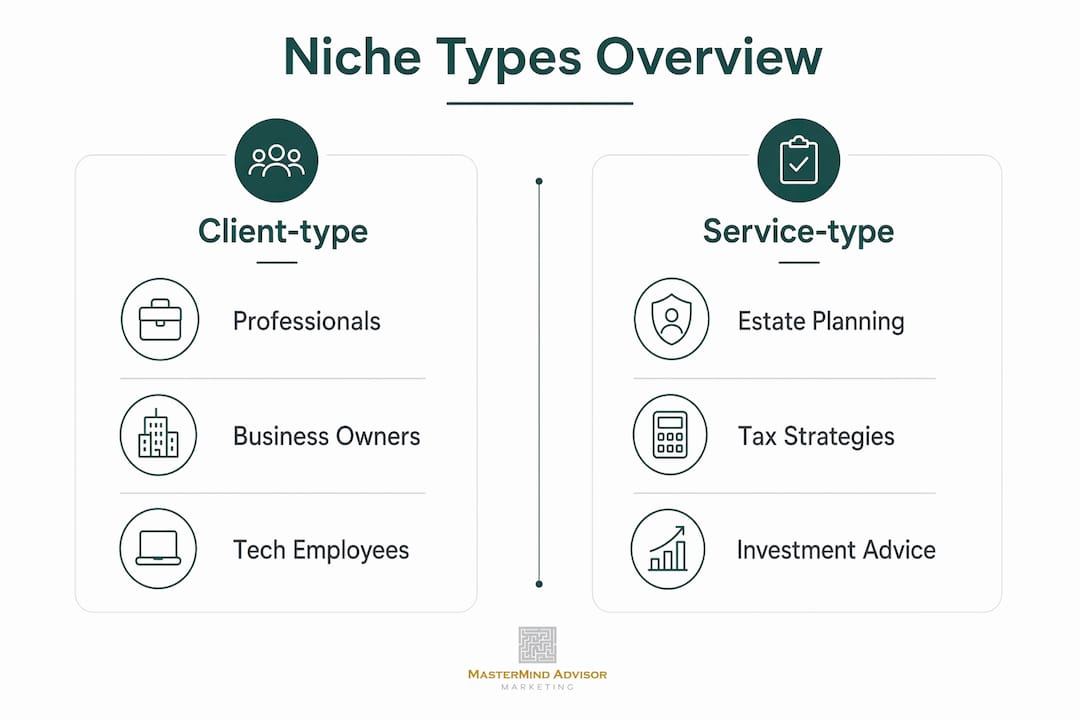
The two primary categories of financial advisor niches are client-type niches and service-type niches. Understanding the difference is the first decision you make in choosing a financial niche.
| Niche Type | Definition | Example | Strength |
|---|---|---|---|
| Client-type | Defined by who the client is | Tech employees at Google or Microsoft | Captures full relationship and referral network |
| Service-type | Defined by a specific financial task | Equity compensation planning | Limited to one problem, not the whole client |
| Hybrid | Client-type with a service specialty | Physicians navigating student loan forgiveness | Combines identity and complexity for deep authority |
The most popular financial advisor specialties in 2026 include physicians, small business owners, tech employees, federal employees, women in transition (divorce or widowhood), and pre-retirees in specific industries. Each of these works because the clients share not just financial complexity but a professional identity, a community, and a language.
Service-type niches like "tax-efficient investing" or "estate planning" have a structural weakness. Choosing a complexity niche without linking it to a client type undermines your marketing and limits full client engagement. A physician who needs estate planning still wants an advisor who understands their malpractice insurance, their partnership buyout, and their student loan history. Service niches answer one question. Client-type niches answer the whole person.
Pro Tip: If you are currently a generalist, look at your top 20 clients by revenue. If five or more share a profession, life stage, or employer, you already have a niche. You just have not named it yet.
How to identify your ideal niche using a four-step framework
The four-step approach to niche selection covers auditing your book, considering your strengths, assessing market demand, and testing your choice with real feedback. Each step builds on the last and prevents the most common mistake: choosing a niche based on income potential alone.
-
Audit your existing client book. Pull your top 30 clients by revenue and look for patterns. Shared employers, industries, life events, or financial problems are all signals. If you have six dentists, three federal employees, and four tech workers, the market has already voted. Your job is to read the results.
-
Assess your personal strengths and story. Your credentials, your background, and your personal experience are competitive advantages. A CFP who spent 15 years as a software engineer before becoming an advisor has an authentic edge with tech workers that no competitor can replicate. Credentials like the CDFA (Certified Divorce Financial Analyst) or CHFP (Certified Healthcare Financial Professional) signal specialized expertise to both clients and referral partners.
-
Evaluate market demand and profitability. Assess demand using factors like investable assets, referral likelihood, service complexity, and geographic accessibility. A niche with high complexity and low investable assets (early-career teachers, for example) is a poor fit for AUM-based practices. A niche with high assets, high complexity, and a tight professional community (surgeons, for example) scores well on every dimension.
-
Test and refine with real-world feedback. Run one seminar, publish three niche-specific blog posts, or reach out to five centers of influence in the target community. Track response rates, inquiry quality, and conversion. If the niche resonates, double down. If it does not, adjust before you have rebuilt your entire brand around it.
| Step | Action | Success Signal |
|---|---|---|
| Audit your book | Identify patterns in top 30 clients | 3 or more clients share a profession or life event |
| Assess strengths | Map credentials, background, and personal story | Clear, authentic connection to the niche |
| Evaluate demand | Score niche on assets, complexity, referrals, access | Niche scores well on at least 3 of 4 factors |
| Test and refine | Run a seminar or publish targeted content | Qualified inquiries and referral partner interest |
Pro Tip: The niche selection intersection of natural client attraction, personal enjoyment, and underserved demand is not a nice-to-have. A high-demand niche you do not enjoy will burn you out within two years. Sustainability requires all three.
How to build authority and market effectively within your niche
Authority in a niche is built through specificity, consistency, and community presence. Generic content does not work. Highly specific content addressing niche pain points builds credibility far faster than broad retirement tips. An article titled "3 tax moves Google employees should make before their RSUs vest" will outperform "How to invest for retirement" every time, because it speaks directly to a person's actual situation.
Your digital presence needs to reflect your niche at every touchpoint. A niche-focused advisor website with targeted messaging, niche-specific case studies, and a clear value proposition converts far better than a generic "we serve everyone" homepage. LinkedIn is particularly effective for client-type niches tied to professional communities. Publishing niche-specific content on LinkedIn positions you inside the professional conversation your prospects are already having.
Seminars and webinars remain the highest-conversion marketing channel for financial advisors. Partner with HR departments at target employers, medical associations, or professional groups to host educational events. These partnerships give you access to concentrated groups of ideal prospects and signal third-party credibility that digital ads cannot replicate. For retirement-focused niche strategies, combining seminar marketing with targeted follow-up sequences consistently produces the strongest lead quality.
Compliance is not optional in niche marketing. The SEC Marketing Rule in 2026 requires upfront disclosures, documented due diligence, and clear prominent disclosures in all marketing that involves testimonials or endorsements. The SEC focuses on substantiation and disclosure, not just the plausibility of claims. Niche marketers who use client success stories must have written agreements and clear disclosures in place before publishing.
"The advisors who get compliance wrong are not the ones making outrageous claims. They are the ones who assume a client quote on their website is harmless. Under the 2026 Marketing Rule, every testimonial is a regulated communication." — SEC Marketing Rule guidance, Mondaq 2026
Pro Tip: Before publishing any client testimonial or case study in your niche marketing, review your testimonial compliance obligations under the SEC Marketing Rule. One undisclosed endorsement can trigger an enforcement review.
Ideal client profiles vs. personas: what actually drives referrals
The difference between a persona and an ideal client profile is the difference between a sketch and a blueprint. Personas describe demographics. Ideal client profiles capture decision styles, trust signals, financial reality, and emotional triggers. Simple, repeatable profiles reduce poor-fit inquiries and improve referral quality from centers of influence more than stereotype-based personas ever will.
A strong ideal client profile for a physician-focused advisor includes more than "MD, age 40 to 55, income over $400,000." It includes the specific financial stressors physicians face (student loan burden, late career start, malpractice exposure), the trust signals that matter to them (credentials, peer referrals, demonstrated knowledge of their world), and the decision style typical of high-achieving professionals (data-driven, time-constrained, skeptical of sales pressure).
When you communicate this profile clearly to your centers of influence, referrals improve immediately. A CPA who understands you serve physicians navigating partnership buyouts will send you a very different referral than one who thinks you serve "high-income professionals." Specificity in your profile translates directly into specificity in the referrals you receive.
The components of a strong ideal client profile include:
- Financial reality: Asset range, income source, complexity level, and primary financial stressors
- Decision style: How they research, who they trust, how long they take to commit
- Trust signals: Credentials, community standing, peer referrals, or demonstrated niche knowledge
- Life stage and goals: Career phase, family situation, and the financial milestone they are working toward
- Disqualifiers: The characteristics that signal a poor fit, which are just as important as the qualifiers
Ideal client profiling improves marketing effectiveness and client retention by capturing the full picture of who you serve best. Advisors who invest in this process report fewer discovery calls that go nowhere and more clients who arrive already convinced they have found the right advisor.
Key takeaways
Financial advisor niche selection succeeds when you combine natural client attraction, personal enjoyment, and underserved market demand into a single, clearly defined client segment.
| Point | Details |
|---|---|
| Client-type niches win | Niches built around who the client is outperform service-type niches in referrals and retention. |
| Use the four-step framework | Audit your book, assess your strengths, evaluate demand, then test before committing fully. |
| Specificity drives authority | Niche-specific content like RSU tax tips for Google employees outperforms generic retirement advice. |
| Ideal client profiles beat personas | Profiles that include decision styles and trust signals produce better referrals from COIs. |
| Compliance is non-negotiable | The 2026 SEC Marketing Rule requires documented disclosures for every testimonial and endorsement. |
Why I think most advisors pick the wrong niche for the right reasons
I have worked with hundreds of advisors evaluating their financial advisor target market, and the pattern is consistent. They pick a niche based on where the money is, not where their energy is. They read that physicians are a lucrative segment, so they pivot to physicians. Six months later, they are burned out because they do not actually enjoy the complexity of medical practice finances, and they have no authentic story to tell.
The advisors who build durable niche practices pick segments they would talk about at dinner without being paid to. One advisor I worked with had a background in federal government before transitioning to financial planning. He was nervous that federal employees were "too boring" as a niche. Three years later, he runs one of the most referred practices I have seen, because he speaks the language of FERS, TSP, and CSRS with genuine fluency and enthusiasm.
Pivoting a niche is also more common than people admit. Niches are marketing strategies, not permanent identities. Repositioning takes months of updated messaging and consistent outreach, but it is entirely achievable without starting over. The advisors who struggle with pivots are the ones who waited too long to admit the first niche was not working.
The compliance piece is where I see the most avoidable damage. Marketing compliance failures often come from advisors who assume informal client quotes are harmless. They are not. Get your disclosures documented before you publish anything that looks like a testimonial. The cost of getting it right upfront is a fraction of the cost of an SEC inquiry.
— Josh
How Mastermindadvisormarketing helps you build and market your niche
Once you have identified your niche, the next challenge is executing a marketing system that consistently attracts the right prospects and converts them into clients.

Mastermindadvisormarketing is built specifically for independent financial advisors who need a turnkey marketing system that works within their niche. The platform provides customized webinars and seminars designed around your target client segment, automated email follow-up sequences, and a custom CRM that tracks prospect engagement from first contact to signed client. Every tool is built with compliance in mind, including support for client testimonial compliance under the 2026 SEC Marketing Rule. If you are ready to stop marketing to everyone and start owning your niche, explore the platform and see how advisors are growing focused, profitable practices with a system built for exactly this work.
FAQ
What is financial advisor niche selection?
Financial advisor niche selection is the process of identifying a narrowly defined client segment where your expertise, personal story, and market demand align. The goal is a focused practice that attracts ideal clients through specific, relevant marketing rather than broad outreach.
How narrow should my financial advisor niche be?
Your niche should be narrow enough that a prospect immediately recognizes themselves in your messaging. A profitable solo practice typically requires only 40 to 100 clients from a niche, which represents 1 to 2 percent of a local market.
What are the best niches for financial advisors in 2026?
The strongest niches combine a defined professional identity with financial complexity and referral-friendly communities. Physicians, tech employees, federal employees, small business owners, and women navigating divorce or widowhood consistently rank among the most profitable and referral-rich segments.
How do client-type niches differ from service-type niches?
Client-type niches define who you serve (tech employees, physicians), while service-type niches define what you do (equity compensation planning, estate planning). Client-type niches capture the full client relationship and generate stronger referrals because clients refer people like themselves.
What compliance rules apply to niche marketing for financial advisors?
The 2026 SEC Marketing Rule requires upfront disclosures, written agreements, and documented due diligence for any marketing that includes testimonials or endorsements. Written agreements and disclosures are required before publishing any client quote or success story in niche marketing materials.