

An advisor positioning strategy is the deliberate process of defining and communicating a financial advisor's specific, credible place in the market so that the right clients recognize you, choose you, and refer others to you. It is not a tagline or a logo refresh. It answers three questions that every prospect is silently asking: Who do you actually serve? What problem do you solve better than anyone else? Why should I believe you?
Positioning strategy in advisory practices falls into four main types: category positioning (defining a new market space), competitive positioning (contrasting directly with alternatives), attribute or benefit positioning (leading with a specific strength or outcome), and use-case or user positioning (owning a defined client situation). Most advisors who struggle with growth are not using any of them deliberately. They are defaulting to inherited language that sounds like everyone else.
The core elements of a strong advisor positioning strategy:
- Ideal client clarity: A factual, specific description of who you serve best, not a vague demographic like "individuals and families"
- Unique value proposition: A promise only you would make, grounded in your actual process, expertise, or client outcomes
- Proven differentiation: Evidence that backs your claims, whether that is a named planning method, a defined niche, or a documented track record
- Consistent messaging: The same positioning expressed across your website, LinkedIn, referral conversations, and discovery meetings
When those four elements align, your brand stops being background noise. Prospects start saying things like "you specialize in exactly what we need" before you have said a word about fees.
How to build a distinct brand identity as a financial advisor
Most advisory websites read like they were written by the same person. "Trusted. Holistic. Client-first. Fiduciary." Every one of those words appears on thousands of advisor sites, and none of them help a prospect decide. Effective financial advisor positioning conveys a clear, credible market stance that shortens sales cycles and attracts well-fit clients. Generic claims do the opposite.
Building a distinct brand starts with translating your real strengths into plain language. If your edge is a proprietary tax-transition process for executives with concentrated stock, say that. If you have spent fifteen years working exclusively with physicians, lead with that. The specificity is the brand. Visuals, color palettes, and website design matter, but they amplify a clear position; they cannot substitute for one.

A strong brand also passes what you might call the "spouse test." When your client describes you to their partner, can they repeat your value accurately without you in the room? If the answer is "he's a good financial guy," your advisor brand identity has not landed yet. The goal is for your positioning to be so specific and memorable that referrals arrive pre-qualified.
Practical steps for building a differentiated brand:
- Audit your current messaging for generic terms and replace each one with a specific claim you can prove
- Write a one-sentence positioning statement that names your client type, their core problem, and your distinct approach
- Align your visual identity (colors, photography, typography) with the market you actually serve, not the market you wish you served
- Test your messaging with three people outside your firm; if they cannot repeat your difference in their own words, revise it
How to identify and target the right client segments
The single highest-leverage move in advisor market positioning is choosing a specific client you are unmistakably for. Not "business owners," but "founders of service-based businesses with $2M–$10M in revenue who are planning their first exit." That level of specificity feels risky. In practice, it attracts more qualified prospects and makes referrals far more accurate, because the people sending you clients finally know exactly who to send.
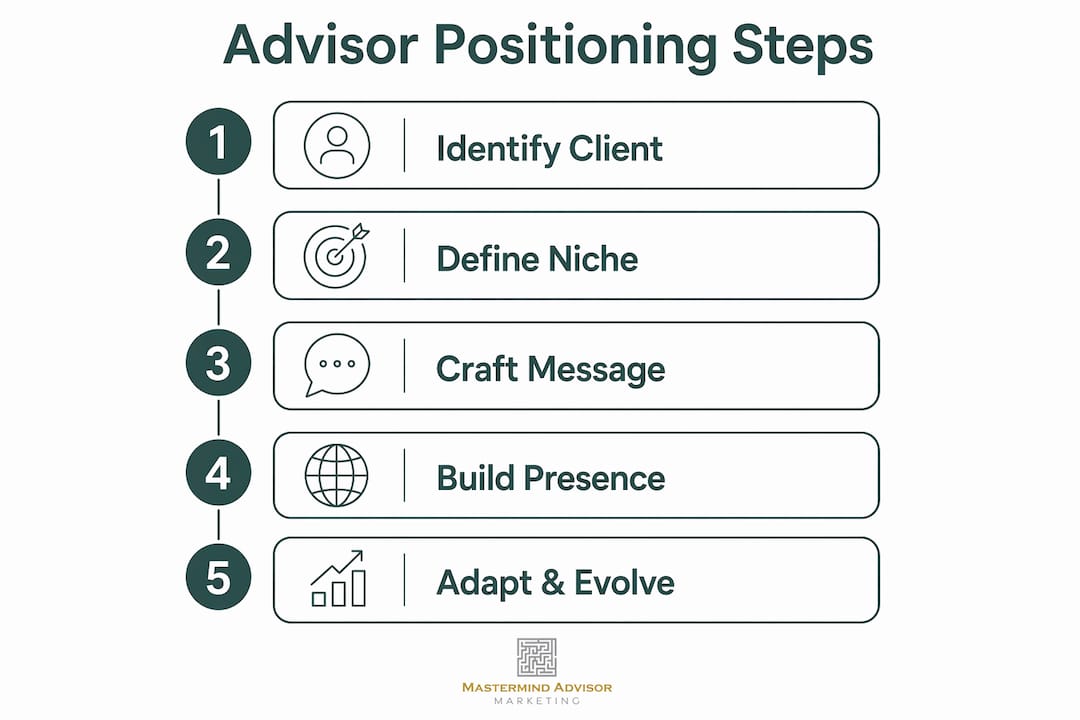
Narrowing your niche does not shrink your pipeline. It concentrates demand. When your positioning speaks to a defined group's shared situation, you stop competing on fees and rapport alone, and you start competing on fit, which is a much stronger position.
| Segmentation Criterion | What to Define | Why It Matters |
|---|---|---|
| Demographics | Age, profession, income band, geography | Shapes where you find clients and what language resonates |
| Life stage or trigger event | Retirement, business sale, divorce, inheritance | Identifies urgency and the specific problem to solve |
| Financial complexity | Asset level, tax situation, equity compensation | Determines service model and fee structure |
| Values and priorities | Legacy, simplicity, impact, growth | Drives chemistry and long-term retention |
| Referral source | COIs, employer plans, professional associations | Tells you where to concentrate relationship-building |
Steps for profiling and validating your ideal client:
- Pull your top 20 clients by revenue and satisfaction, then look for patterns in profession, life stage, and the problem that brought them to you
- Write a one-paragraph profile of your single best client type, using factual descriptors, not preferences
- Test the profile against your pipeline: do your current prospects match it? If not, your marketing and your positioning are misaligned
- Validate the niche by researching whether a reachable community exists (associations, LinkedIn groups, employer plans, events)
- Revisit the profile annually as your firm grows and your best-client patterns shift
Pro Tip: If you serve physicians and also serve retirees and also serve small business owners, you are not positioned at all. Pick the one group where your process, your network, and your genuine interest converge. That is where your positioning becomes defensible.
Common pitfalls in niche selection include choosing a segment based on aspiration rather than evidence, selecting a niche with no reachable community, and defining the niche so broadly that it offers no real filter. The niche selection process works best when it starts with your existing best clients, not a blank-slate brainstorm.
How to communicate your positioning and build a digital presence
Positioning only works when it is expressed consistently everywhere a prospect encounters you. That means your website homepage, your LinkedIn headline, your referral partner conversations, your discovery meeting opener, and your email signature all need to carry the same core message. One inconsistency and the clarity you built evaporates.

Your website is usually the first place a prospect goes after a referral. If your homepage says "comprehensive financial planning for individuals and families" while your referral partner described you as the go-to advisor for tech executives with RSUs, the prospect feels a mismatch. That friction costs you the meeting. A messaging architecture built across every channel prevents that gap.
Thought leadership is the most durable way to reinforce your positioning online. Writing a monthly article on concentrated stock risk for tech employees, hosting a webinar on the financial decisions physicians face at partnership, or publishing a LinkedIn post on the tax traps in a business sale all do the same thing: they prove your expertise to people who have not met you yet. Content does not replace positioning; it amplifies it.
Prospects also evaluate advisors using what researchers call the 3 C's framework: Competence, Communication, and Chemistry, with a fourth C sometimes added for Character. Your digital presence addresses all four before a prospect ever books a call. A clear, specific website signals competence. A consistent content voice signals communication. A visible personal story or philosophy signals character. Chemistry is the one thing that happens in the room, but the first three C's determine whether you get the meeting.
Key communication practices for advisors:
- Write your LinkedIn headline as a positioning statement, not a job title ("I help tech executives turn RSU complexity into a 20-year wealth plan" beats "Senior Financial Advisor at XYZ Wealth")
- Use client success stories (with permission) that describe the specific situation, the problem, and the outcome, not generic testimonials
- Build a referral script for your COIs that gives them one sentence to describe who you serve and why you are different
- Publish content on a consistent schedule, even monthly, rather than in bursts followed by silence
Pro Tip: Ask your three best clients to describe what you do in their own words. Record it. The language they use is almost always clearer and more compelling than anything you would write yourself. Use it.
Relationship marketing plays a long game here. Advisors who build genuine communities around their niche, through events, newsletters, or LinkedIn groups, create a relationship marketing flywheel where positioning reinforces itself over time.
How to evaluate and adapt your positioning over time
Positioning is not a document you file and forget. Markets shift, your firm grows, your best-client profile evolves, and what worked in 2022 may not be the sharpest version of your story in 2026. The advisors who stay well-positioned treat it as an ongoing practice, not a one-time project.
The clearest signal that your positioning is working is not your own confidence in it. It is what prospects say back to you. When a first-time prospect opens a discovery meeting with "I heard you specialize in exactly this," your positioning is landing. When prospects arrive confused about what you do or who you serve, the problem is almost never your marketing budget. It is your positioning clarity.
Three practical metrics for evaluating your positioning:
- Clarity rate: How quickly does a new prospect understand who you serve and what you do? If it takes more than two minutes of explanation, the positioning is not doing its job.
- Referral accuracy: Are the people your clients refer actually matching your ideal client profile? Inaccurate referrals are a direct sign that your positioning has not transferred to the people who advocate for you.
- Perception drift: Ask a referral partner or COI to describe your practice six months after you briefed them. If their description has drifted back to generic language, your messaging needs more repetition and specificity.
Practical steps for ongoing evaluation and adaptation:
- Run a brief positioning audit every six months: review your website, LinkedIn, and last ten prospect conversations for consistency
- Survey new clients in their first 90 days about what they understood your practice to be before they hired you
- Track which referral sources send the best-fit clients and double down on those relationships
- Identify any market shifts in your niche (regulatory changes, industry consolidation, demographic shifts) that might require a positioning update
- Set a calendar reminder to revisit your ideal client profile annually and compare it against your actual new client data
When a repositioning is warranted, common triggers include entering a new market segment, a significant change in your service model, firm growth that makes your original niche too narrow, or a realization that your current positioning attracts the wrong clients. Repositioning does not mean starting over. It usually means sharpening what already exists.
Evidence-based positioning: what industry experts and proven frameworks show
The advisors who build the most durable practices are not the ones with the biggest marketing budgets. They are the ones whose positioning is specific enough that prospects can repeat it, and credible enough that prospects believe it. That combination, specificity plus credibility, is what separates a positioning strategy from a marketing slogan.
Amy Parvaneh and the team at Select Advisors Institute have spent over a decade working with wealth management firms collectively managing more than $300 billion in assets. Their consistent finding is that advisors who invest in logos and websites before defining their positioning end up with a brand that sounds like everyone else. The fix is not better design. It is a clearer answer to who you serve and why you are the right choice for them.
James Lee, CFP and past president of the Financial Planning Association board, advises clients to interview at least three advisors before choosing one, evaluating communication style, values alignment, and trust. That behavior tells you something direct about what your positioning needs to accomplish: it must create a clear, felt sense of fit before the prospect even meets you, so that when they do meet you, the chemistry confirms what they already suspected.
Sujoy Basak's observation cuts to the core of the whole discipline: the highest-leverage positioning move is choosing a specific client you are unmistakably for, rather than using broad claims that apply to everyone and therefore compel no one.
Key insights advisors can apply immediately:
- Replace "trusted advisor" with a specific claim about who you serve and what you solve for them
- Use the 3 C's framework (Competence, Communication, Chemistry) as a self-audit: does your digital presence demonstrate all three before a prospect calls you?
- Differentiate on who you serve and how you work, not on performance claims, since the former is compliant and the latter is not
- Build your positioning statement as an internal document first, then translate it into every client-facing channel
- Treat referral accuracy as your primary positioning metric: if referrals are off-target, your positioning has not transferred
The ADV disclosure process also plays a role here. Your ADV Part 2 brochure is often the first formal document a prospect reads, and its description of your services, client types, and investment approach either reinforces or contradicts your positioning. Advisors who align their ADV language with their market positioning create a consistent experience from first impression to signed agreement.
Good marketing coaching for advisors always starts with positioning before tactics, because tactics built on a vague foundation produce vague results. The framework is not complicated: know who you serve, know what you solve, prove it, and say it the same way everywhere.
How Mastermindadvisormarketing helps advisors put positioning into practice
Knowing what advisor positioning strategy means is one thing. Building the systems that express it consistently, at scale, is another. Mastermindadvisormarketing is a turnkey marketing system built specifically for independent financial advisors, designed to close that gap.
The platform provides customized webinars and seminars that let advisors demonstrate their expertise to the exact client segment they are positioned to serve. It pairs that with content marketing strategies, automated email follow-ups, and custom CRM tools that keep positioning consistent across every prospect touchpoint, from first contact through signed agreement. Advisors who have used the system report stronger lead quality and clearer brand recognition among their target clients.
If your positioning is clear but your marketing is not amplifying it, Mastermind Advisor gives you the infrastructure to change that. And if you are ready to put your positioning in front of a live audience, the seminar hosting guide is a practical starting point.
Key Takeaways
A financial advisor's positioning strategy works only when it is specific, credible, and expressed consistently across every channel where prospects encounter the practice.
| Point | Details |
|---|---|
| Define who you serve precisely | Replace broad demographics with a factual, specific client profile tied to a shared situation or trigger event. |
| Lead with provable differentiation | Base your positioning on your actual process, niche expertise, or client outcomes, not generic virtues like "trusted" or "holistic." |
| Align messaging across all channels | Your website, LinkedIn, referral scripts, and discovery meetings must carry the same core positioning statement. |
| Measure referral accuracy | If referrals do not match your ideal client profile, your positioning has not transferred to the people advocating for you. |
| Treat positioning as ongoing | Audit your positioning every six months and revisit your ideal client profile annually as your firm and market evolve. |