
Build a compliant, advisor-level review and monitoring program now. That single move does more for lead flow than any rebrand or ad spend increase, but only if you pair it with real SEC and FINRA discipline. Mastermind Advisor Marketing builds exactly this as a turnkey system, and compliance isn't optional overhead here. It's the mechanism that makes the reviews trustworthy enough to convert.
TL;DR:
- Building a compliant review and monitoring system at the advisor level is essential, as it significantly influences prospects' trust and decision-making.
- Use a structured sequence for collecting reviews, including personalized asks, transparent disclosures, recordkeeping, and archiving for five years to stay compliant.
- Regularly monitor search results, review sites, social platforms, and media to detect reputation issues early and respond swiftly with compliance in mind.
- Content formats like authentic bios, anonymized success stories, and short videos reinforce trust more effectively than reviews alone.
- Outsourcing reputation management can be advantageous for practices lacking bandwidth, but vendors must demonstrate clear compliance procedures and record retention.
Table of Contents
- What reputation management for advisors should prioritize first
- How do you build a compliant reviews program?
- What should you monitor, and how do you triage problems?
- Which content formats actually reinforce trust?
- Should you manage reputation in-house or outsource it?
- What KPIs actually prove reputation work is paying off?
- SEC and FINRA compliance checklist before you publish anything
- How Mastermind Advisor Marketing builds compliance into reputation programs
- Client communication practices that quietly build reputation
- Crisis management: what to do when reputation takes a hit
- Legal considerations beyond SEC and FINRA rules
- Building reputation before you ever need a review
- Social media reputation management built for advisors
- Why the standard reputation advice misses what advisors actually need
- A turnkey path if you'd rather not build this yourself
- Sources
What reputation management for advisors should prioritize first
Not every tactic deserves equal time. Advisors juggling client work, compliance filings, and a marketing budget that never quite feels big enough need a ranked list, not a wish list.
Here's what actually moves prospects from "researching" to "calling":
- Request and respond to reviews at the advisor level, not just the firm level.
- Publish individual advisor profiles on your website and on third-party directories.
- Monitor mentions across search, review sites, and social platforms weekly.
- Create advisor-led content (bios, videos, short explainers) that humanizes the person behind the CFP mark.
- Use compliant review platforms built for the SEC Marketing Rule rather than generic business-review tools.
- Pursue selective PR and awards that add third-party credibility without triggering testimonial disclosure headaches.
The reason advisor-level reviews sit at the top of that list isn't a guess. InvestmentNews reports that a significant portion of affluent investors name reputation a major factor in choosing an advisor, and many say positive reviews on independent sites are essential to their decision. Fee transparency is also highly valued by this group. Reviews and clear pricing information aren't nice-to-haves. They're the filter prospects use before they ever pick up the phone.
How do you build a compliant reviews program?
A reviews program that ignores the SEC Marketing Rule is a liability wearing a marketing hat. Here's the sequence that keeps you compliant while still generating the kind of reviews prospects actually read.
- Personalize the ask. Send review requests from the individual advisor, timed shortly after a positive interaction (a completed plan review, a successful onboarding), rather than a mass blast to the whole client list.
- Disclose clearly and prominently. The SEC Marketing Rule permits testimonials and endorsements, but only with clear disclosure of whether the reviewer is a current client and whether any compensation changed hands.
- Never pay for reviews without disclosing it. Undisclosed compensation for testimonials is one of the fastest ways to draw regulator attention.
- Track every invite and response. Log who was asked, when, and what they said, using a simple spreadsheet or your CRM's activity notes.
- Archive everything for five years. The Marketing Rule requires firms to retain records of advertisements, reviews included, for that full period.
- Surface reviews at the advisor level on your site and on third-party platforms, since that's where prospects actually look.
A compliance-focused checklist built specifically for independent advisors makes this sequence repeatable instead of something you reinvent every quarter.
What should you monitor, and how do you triage problems?
You can't manage what you don't see. Reputation damage rarely announces itself. It shows up as a one-star review buried on page two of a search result, or a comment thread on a financial subreddit that nobody on your team noticed for three weeks.
Watch these channels on a recurring basis:
- Search results for your name and firm name, including image and video results.
- Review sites, both general (Google) and finance-specific directories.
- Social platforms where clients or critics might tag or mention you.
- Press and local media, especially anything picked up by aggregators.
- AI answer engines like ChatGPT and Perplexity, which increasingly summarize advisor reputations from scraped review data.
When something surfaces, triage it fast: alert goes to a designated response owner, that person loops in compliance before anything gets posted publicly, and only then does a response go out (public reply or private outreach, depending on severity). Tool categories worth considering include mention-monitoring software, review-aggregation platforms, and profile-management services. Choose based on how well each integrates with your existing CRM, not just feature lists.
Which content formats actually reinforce trust?
Reviews alone don't build reputation. They confirm it. Content is what gets a prospect to the review in the first place.
Formats that consistently perform for advisors:
- Advisor bios that read like a person wrote them, not a compliance department.
- Anonymized client story summaries that illustrate outcomes without naming or identifying anyone.
- Short explainer videos (two to three minutes) covering common client questions.
- Earned media placements, even small local ones, that add third-party validation.
On the technical side, structured advisor profiles with proper schema markup help both traditional search and AI-driven answer engines surface your reviews accurately. Industry guides on advisor discoverability point to schema and consistent off-site profiles as the difference between a review that gets found and one that sits invisible. Every piece still needs a compliance pass before it goes live. Authenticity and approval aren't opposites here. They're both required.
Should you manage reputation in-house or outsource it?
This comes down to bandwidth and risk tolerance more than budget alone. A solo advisor with three hundred clients and no marketing staff faces a very different calculation than a twelve-person RIA with a dedicated ops lead.
Consider outsourcing when:
- Nobody on staff has time to monitor mentions weekly or respond within 48 hours.
- You need compliance built into the workflow from day one, not bolted on after a near-miss.
- You want to scale review volume faster than manual outreach allows.
If you do outsource, vet vendors against a short list: documented compliance procedures, audit logs showing who approved what and when, clear data retention policies, a defined reporting cadence, and evidence they've actually worked with regulated advisors before. A partner focused on general ORM processes can be a useful reference point for how due diligence on third-party platforms should work, even outside the advisor-specific context.
What KPIs actually prove reputation work is paying off?
Track five numbers and ignore the vanity metrics:
- Verified review count, broken out by advisor.
- Sentiment trend over rolling ninety-day windows.
- Referral-to-contact conversion rate, comparing referred prospects to cold ones.
- Profile-page lead conversion, meaning how many profile visitors actually submit a contact form.
- Media and award mentions, tracked as a simple running log.
For benchmarking, lean on what the data already shows: with 61% of affluent investors calling third-party reviews essential and advisors mentioned by name nearly 25 times more often than the firm itself, a realistic target is steady month-over-month growth in advisor-level reviews rather than a single splashy campaign. For ROI, the math is simple: if better reviews lift referral conversion by even two or three percentage points, multiply that by your average client's lifetime value to see whether the program pays for itself. For most practices, it does within a single quarter.
SEC and FINRA compliance checklist before you publish anything
Skipping this step is how firms end up in enforcement letters instead of client meetings.
- Confirm clear, prominent disclosure on every testimonial or endorsement, stating whether the reviewer is a current client and disclosing any compensation or material conflict.
- Retain records for five years. The SEC Marketing Rule requires this for all advertisements, reviews included.
- Document due diligence on any third-party rating site before referencing it, including how the ratings are calculated and whether the site accepts payment for placement.
- Route every piece through principal supervision before it goes live, per FINRA's communications guidance.
- Flag common red flags before they become findings: hyperlinked disclosures instead of prominent ones, missing compensation disclosures, and undocumented vendor vetting. SEC staff have specifically called out firms that skipped these steps.
Pro Tip: Keep a simple approval log, one line per piece of content, showing who reviewed it, when, and what changed. When an examiner asks for evidence of supervision, a clean log beats a scramble through email threads every time.
A ranked breakdown of message types by regulatory risk is worth keeping on hand for anyone drafting content who isn't a compliance specialist by training.
How Mastermind Advisor Marketing builds compliance into reputation programs
Mastermind Advisor Marketing designs its review workflows around the constraint most vendors ignore: advisors operate under the Marketing Rule and FINRA supervision requirements every single day, not just during an audit. That means CRM integration and automated follow-ups are built with disclosure language and record retention already baked in, rather than added after a compliance officer flags a problem.
The practical detail that matters here is documentation. Templates for testimonial disclosures, tracking sheets for review invites, and archival processes to hit the five-year retention window come standard rather than as a custom build. For a firm rolling out advisor-level reviews across multiple producers, that consistency is what keeps the program from becoming five different processes run five different ways.
Client communication practices that quietly build reputation
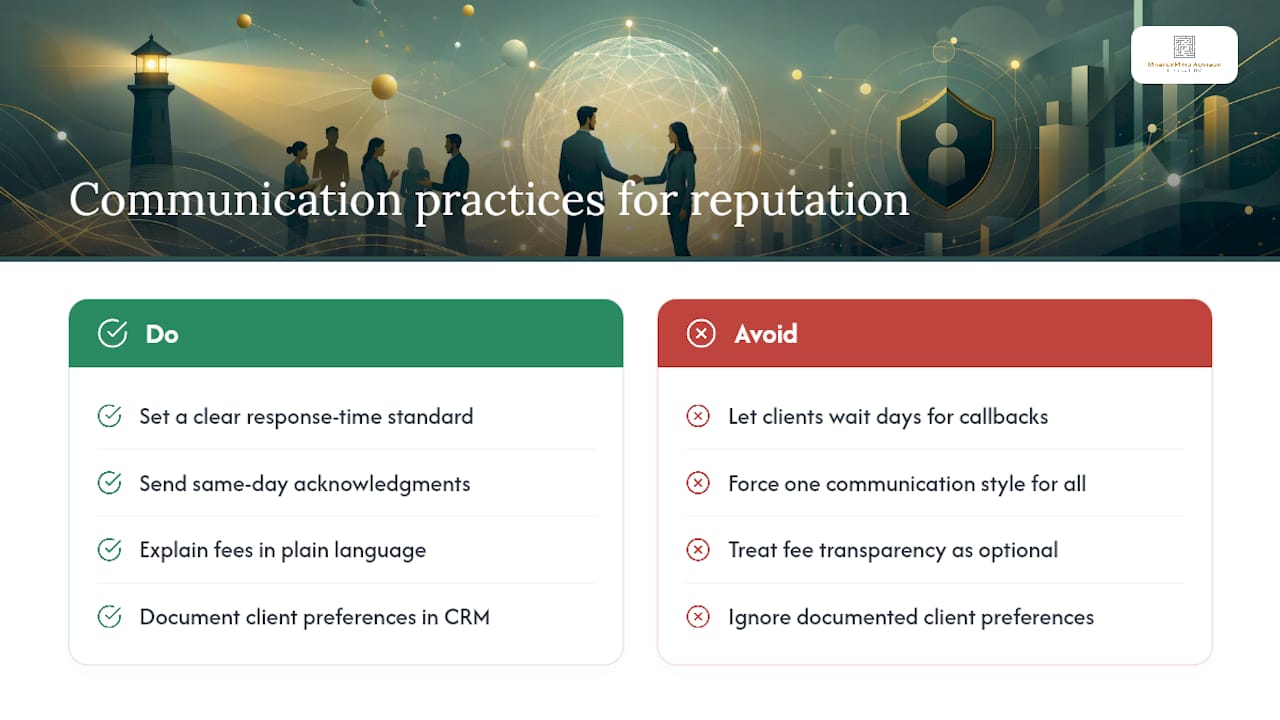
Reviews and monitoring get the attention, but most reputation damage traces back to a communication gap long before anyone left a bad review. Prospects and clients form impressions based on responsiveness, clarity, and whether they feel heard, and those impressions eventually show up in what they say publicly.
Set a response-time standard and stick to it. Clients who wait four days for a callback on a simple account question start wondering what happens during an actual emergency. A same-day acknowledgment, even if the full answer takes longer, resets that expectation immediately.
Match the channel to the client. Some clients want a quarterly letter; others want a two-line text confirming a trade went through. Forcing everyone into the same communication style creates friction that eventually surfaces as a complaint, even when the underlying advice was sound.
Explain fees and performance in plain language every time, not just at onboarding. Fee transparency ranked as essential for 73% of affluent investors researching advisors, and that expectation doesn't disappear once someone signs. Clients who understand what they're paying for and why rarely become the client who leaves a scathing review six months later.
Document communication preferences and follow through. If a client asked for a call instead of an email, and gets an email anyway, that's a small thing that compounds. Build the habit into your CRM notes so every team member honors it, not just the advisor who took the original request.
Crisis management: what to do when reputation takes a hit
A bad review, a client complaint that goes public, or a regulatory inquiry that leaks. Reputation crises for advisors tend to fall into a few predictable categories, and having a plan before one hits changes the outcome dramatically.
Speed matters, but speed without compliance review creates a second problem on top of the first. The right sequence: acknowledge the issue privately within hours, loop in compliance before any public statement goes out, and respond publicly only once legal and regulatory exposure has been assessed. A public response drafted in anger, or rushed out to "get ahead of it," is how a single bad review becomes a supervisory finding.
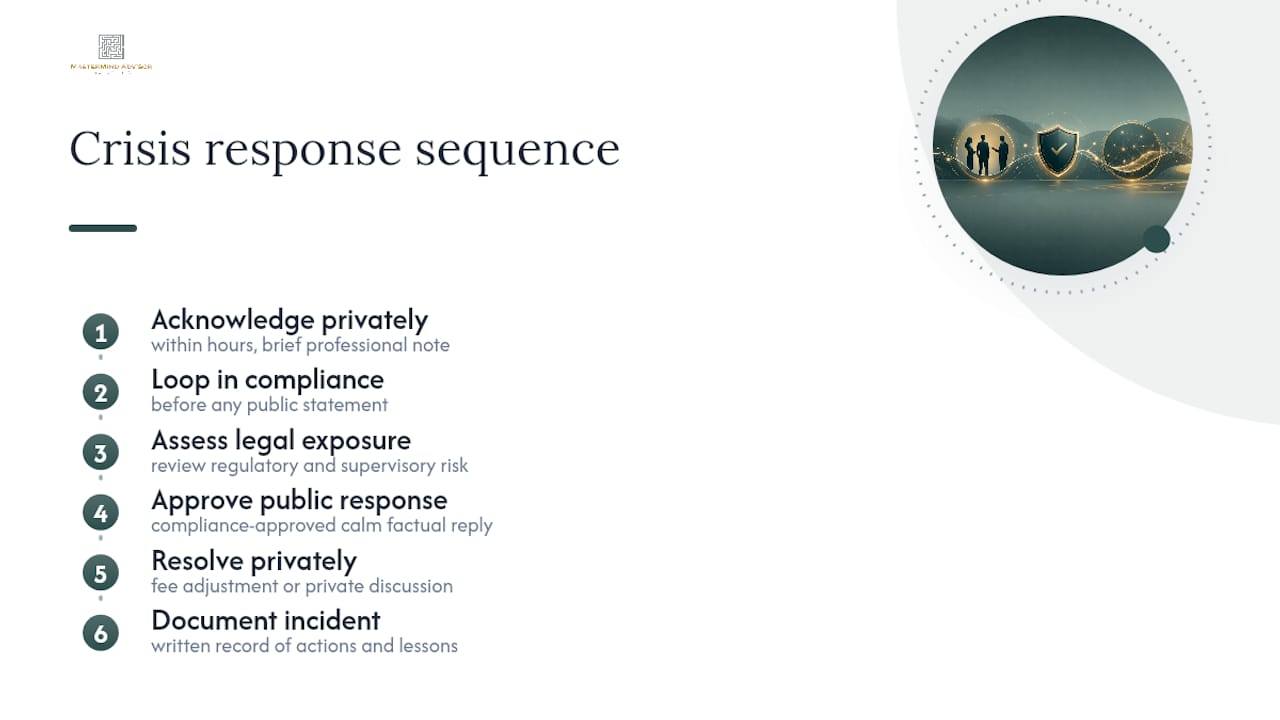
Separate the public response from the private resolution. A one-star review deserves a brief, professional public reply acknowledging the concern and inviting the client to discuss it directly. The actual resolution, whether it's a fee adjustment or a clarified misunderstanding, happens in a private conversation, not in the review's comment section.
Don't argue with a reviewer in public. Even when the review is factually wrong, a defensive public exchange reads worse to prospects than the original complaint did. State the facts calmly once, offer to discuss further offline, and stop.
Prepare a holding statement template in advance for the scenarios most likely to hit your practice: a market downturn triggering client complaints, a departing employee making public claims, or a data security concern. Having language ready, reviewed by compliance ahead of time, cuts the response window from days to hours.
Track the incident the same way you'd track a compliance event, with a written record of what happened, how it was resolved, and what changed afterward. That record protects you in a future examination and often reveals a process gap worth fixing regardless.
Legal considerations beyond SEC and FINRA rules
Compliance with securities regulators covers advertising and testimonials, but it doesn't cover everything that can go wrong with a client's name, image, or complaint attached to your firm.
Privacy law matters more than most advisors realize. Publishing a client testimonial, even a glowing one, without documented consent for how their name, initials, or account details will be used creates exposure under state privacy statutes, separate from anything the SEC requires. Get written consent that specifically covers marketing use, not just a verbal "sure, go ahead."
Defamation cuts both directions. A client posting factually false claims about you publicly can constitute defamation, and you have legal options beyond a public rebuttal. But responding to a negative review by publicly disclosing private account details or disputing specifics of a client relationship can expose you to a privacy or breach-of-confidentiality claim of your own. The safer path is almost always a general, professional response paired with a private follow-up.
State-level advertising rules sometimes layer on top of federal requirements. Some states impose their own disclosure or recordkeeping standards for advisor communications, particularly around testimonials, and those requirements don't disappear just because you've satisfied the SEC Marketing Rule. Check with your state securities regulator or compliance counsel before assuming federal compliance is sufficient everywhere you're registered.
Employee and former-employee statements carry separate risk. A departing advisor who takes clients and then makes public claims about the firm creates a legal question that sits outside marketing compliance entirely. That scenario usually needs an employment attorney, not a marketing plan.
Building reputation before you ever need a review
The strongest advisor reputations aren't built reactively. They're built through consistent visibility long before a prospect ever searches your name.
Community involvement does more than most advisors give it credit for. Speaking at a local business association, sponsoring a nonprofit event, or teaching a free retirement-planning workshop at a library builds the kind of local credibility that shows up in conversations, not just search results. Wealthtender's research suggests clients treat an advisor's broader presence, not just review counts, as part of their evaluation.
Consistent educational content, published over years rather than months, compounds in a way a single viral post never will. An advisor who's published a monthly market commentary for three years has a body of work that signals stability and expertise, independent of any star rating.
Credentials and continuing education matter more than advisors sometimes market them. Sixty-three percent of affluent investors prioritize credentials and certifications when evaluating an advisor, which makes a visible CFP, CFA, or similar designation part of your reputation infrastructure, not just a line on a business card.
Strategic partnerships with estate attorneys, CPAs, and other professionals generate referral relationships that double as reputation signals. A prospect who hears your name from their accountant arrives already primed to trust you, which is a form of reputation management that no review platform can replicate.
Social media reputation management built for advisors
Social platforms carry unique compliance weight for advisors that a typical small business never has to think about. FINRA's guidance distinguishes static content (a profile bio, a pinned post) from interactive content (comments, direct replies), and each carries different supervision and recordkeeping expectations.
Every post needs a home in your firm's supervision and archival system before it goes live, not after. That includes comments and replies, which count as communications with the public just as much as the original post does.
Choose platforms based on where your actual clients spend time, not where marketing trends say you should be. LinkedIn tends to outperform for advisor-to-prospect relationship building, while platforms built around short-form video demand more content but reach a different, often younger, prospect pool.
Train every team member who touches a firm social account on what they can and cannot say publicly, including in replies to comments. A well-meaning junior staffer answering a specific investment question in a comment thread can create a supervision gap nobody planned for.
A social media strategy built specifically for independent advisors accounts for these supervision requirements from the start, rather than retrofitting compliance onto a content calendar built for a different industry entirely.
Why the standard reputation advice misses what advisors actually need
Most reputation management content treats advisors like any other local business: collect reviews, respond politely, watch your star rating. That advice isn't wrong, exactly. It's incomplete in a way that can actually hurt you.
Generic reputation guidance skips the two things that make this industry different: the SEC Marketing Rule's disclosure requirements and FINRA's supervision expectations. A restaurant can run a review-generation campaign with a Yelp widget and a gift card incentive. An advisor who does the equivalent, incentivized reviews without disclosure, is looking at a potential Marketing Rule violation, not just a marketing miscalculation.
The data backs a narrower, sharper focus than most advisors currently apply. With reviews mentioned by name nearly 25 times more often than firm-level mentions, the biggest opportunity most practices leave on the table is treating reputation as a firm-level project instead of an advisor-level one. Fix that allocation before spending another dollar on brand awareness.
My honest read: compliance isn't the obstacle to a strong reputation program. It's the thing that makes prospects trust the reviews they're reading in the first place. An advisor who can point to a documented, compliant process for collecting and displaying reviews has a credibility edge that an unregulated business simply can't claim. Lean into that difference instead of treating disclosure requirements as friction to minimize.
— Josh
A turnkey path if you'd rather not build this yourself
Everything above is buildable in-house with enough time, a compliance officer's attention, and a CRM that plays nicely with review requests. Most independent advisors don't have that spare capacity sitting around. Mastermind Advisor Marketing exists for exactly that gap: a done-for-you system where advisor-level review collection, profile management, and content production come compliance-checked from the start, instead of assembled piecemeal across three different vendors.

The core advantage here is integration. Your review requests, CRM records, and automated follow-ups run through one connected system rather than a patchwork of disconnected tools that each need their own compliance review. Before requesting a demo, have three things ready: your current review volume by advisor, your existing CRM setup, and the name of whoever handles compliance sign-off at your firm. That's enough for Mastermind Advisor Marketing to map a program to how your practice actually runs, not a generic template.
Sources
- How do Americans find and hire financial advisors? New research breaks it down - InvestmentNews
- SEC — Investment adviser marketing compliance guide
- FINRA — Communications with the public guidance
- Additional Observations Regarding Advisers’ Compliance with the Advisers Act Marketing Rule