
Yes, registered investment advisors can use client testimonials in marketing, but only when three conditions are satisfied at the moment the testimonial goes live: clear and prominent disclosures, documented adviser oversight backed by a reasonable basis for belief, and a written agreement with any paid promoter (unless a $1,000 de minimis exception applies). Social media posts, reviews, and compensated referrals almost always trigger these rules, even when advisors don't intend them to.
TL;DR:
- Advisors must ensure testimonials disclose whether clients or non-clients provided them, if they were paid, and any conflicts of interest at the time of publication.
- A written agreement with any paid promoter is required unless total compensation over 12 months stays below $1,000, measured cumulatively across all channels.
- Social media posts or reviews are considered testimonials if curated, edited, or highlighted by the advisor, especially when involving paid endorsements or embedded links.
- Compliance gaps frequently involve unclear disclosures, lack of disqualification screening, and incomplete recordkeeping of agreements and compensation logs.
- Implementing an integrated review workflow, including classification, screening, documentation, and pre-approval, significantly reduces the risk of violating SEC marketing rules.
Table of Contents
- What Counts as a Testimonial or Endorsement Under the SEC Marketing Rule
- The Conditions That Make a Testimonial Legal to Use
- How Social Media, Reviews, and Third-Party Ratings Fit In
- What SEC Examiners Are Actually Flagging
- Building a Pre-Publication Compliance Checklist
- Disclosure Language, Form ADV, and What to Report
- Documenting a Reasonable Basis for Belief
- Where Testimonials Fit Into a Broader Marketing Strategy
- Getting Compliant Testimonials Into Your Marketing Without the Guesswork
- Where to Go Deeper on SEC Marketing Rule Compliance
- Sources
What Counts as a Testimonial or Endorsement Under the SEC Marketing Rule
The SEC Marketing Rule, codified at 17 CFR § 275.206(4)-1-1), splits third-party promotion into two categories. A testimonial is a statement by a current client or private fund investor describing their experience with the advisor or encouraging others to become clients. An endorsement covers the same kind of statement made by someone who isn't a current client, such as an influencer, industry peer, or former client. Both count whether they're spoken at a seminar, printed in a brochure, or posted as a five star review.
The rule's format is deliberately broad. The SEC's adopting release IA-5653 explains that testimonials and endorsements can appear:
- In writing, including emails, newsletters, and website copy
- Orally, such as remarks at a client event or on a podcast
- On social media, including reposts, shares, and tagged comments
- Through referral or "refer a friend" arrangements, which typically qualify as compensated endorsements
If a communication solicits new clients or investors and comes from someone other than the advisory firm itself, treat it as covered until you've confirmed otherwise. Reviewing the different types of RIA fiduciary marketing messages by risk level helps clarify where testimonials sit relative to case studies, rankings, and other promotional content.
The Conditions That Make a Testimonial Legal to Use
Publishing a testimonial without meeting every applicable condition is what turns an SEC marketing rule testimonials question into an enforcement risk. The adopting release sets four requirements advisors must satisfy before using one:
- Clear and prominent disclosure. At the time the testimonial is disseminated, disclose whether the person is a client or non-client, whether they were compensated, the material terms of that compensation, and any material conflicts of interest tied to the relationship.
- A written agreement with paid promoters, describing the scope of the arrangement, the compensation structure, and the promoter's obligations, unless the $1,000 de minimis exception applies. That exception measures total compensation paid to a single promoter over the trailing 12 months, aggregated across every channel, not per post or per campaign.
- Disqualification screening. Advisors cannot compensate a promoter who has a disqualifying event, such as certain SEC, criminal, or regulatory actions, within the prior 10 years. If a promoter becomes disqualified after onboarding, the agreement and compensation need to stop or be restructured.
- Recordkeeping tied to each of the above, including copies of agreements, compensation logs, and the testimonial as it actually appeared with disclosures visible.
Pro Tip: Track promoter compensation in a running ledger, not a folder of invoices. Advisors who assess the de minimis exception payment by payment, instead of cumulatively across 12 months, are one of the most common ways firms accidentally skip the written agreement requirement.
How Social Media, Reviews, and Third-Party Ratings Fit In
Whether a Yelp review or a LinkedIn comment counts as a testimonial depends on facts and circumstances, not the platform. Historical SEC staff guidance on the testimonial rule and social media lays out the test: if an advisor curates, edits, or highlights third-party commentary, it can become the advisor's own advertisement. Simply existing on a public platform that a client happens to post on generally does not.
A few practical distinctions matter:
- Linking to an independent review site the advisor doesn't control is lower risk than embedding a widget that only displays favorable reviews.
- Suppressing negative comments or hand-picking quotes for a homepage carousel pulls that content into scope for disclosure requirements.
- Lead-generation firms and influencer partnerships that route prospects to an advisor almost always qualify as compensated endorsements, even when payment is a flat referral fee rather than a percentage of assets.
- Google and Yelp aggregate ratings displayed without editorial selection tend to preserve independence, provided the advisor isn't paying to boost visibility of specific reviews.
The safer approach: link out to unedited third-party pages rather than reproducing curated excerpts on your own site.
What SEC Examiners Are Actually Flagging
The Division of Examinations' risk alert on Marketing Rule compliance reads less like theory and more like a checklist of what goes wrong in practice. Examiners repeatedly cite the same handful of gaps:
- Disclosures that exist somewhere in fine print but aren't clear and prominent at the point the testimonial is seen or heard
- No documented process for confirming a promoter isn't disqualified before compensation begins
- Compliance policies updated on paper but never operationalized through actual monitoring or sampling
- Aggregate compensation miscalculated because payments across multiple channels weren't tracked together
- Form ADV disclosures that don't reflect current promoter or testimonial arrangements
Exam staff typically ask for the testimonial as it appeared live, the underlying promoter agreement, and the compensation record, then check whether the three line up. Firms that only produce a policy document, with no evidence it was followed, tend to draw follow-up requests.
Building a Pre-Publication Compliance Checklist
Most testimonial problems get caught before publication, not after, if the workflow forces the right questions early. Here's a sequence that works for most RIAs:
- Classify the source. Is this person a current client, a private fund investor, or a non-client endorser? That classification determines which disclosure language applies.
- Screen for disqualifying events. Run a background check against the promoter before any compensation discussion, and repeat it periodically for ongoing arrangements.
- Total the trailing 12-month compensation. Confirm whether the promoter falls under the $1,000 de minimis threshold or needs a written agreement.
- Draft the disclosure language covering client status, compensation, and conflicts, and place it adjacent to the testimonial rather than buried in a footer.
- Route through pre-approval before anything goes live, whether that's a compliance officer sign-off or a documented review step.
- Capture an archival snapshot with a timestamp showing the testimonial and its disclosures exactly as published.
Pro Tip: Build these steps into your existing Rule 206(4)-7 annual review process rather than creating a parallel testimonial-only procedure. Examiners respond better to one integrated compliance program than to a patchwork of side processes. A documented compliance review workflow makes this easier to demonstrate during an exam.
Disclosure Language, Form ADV, and What to Report
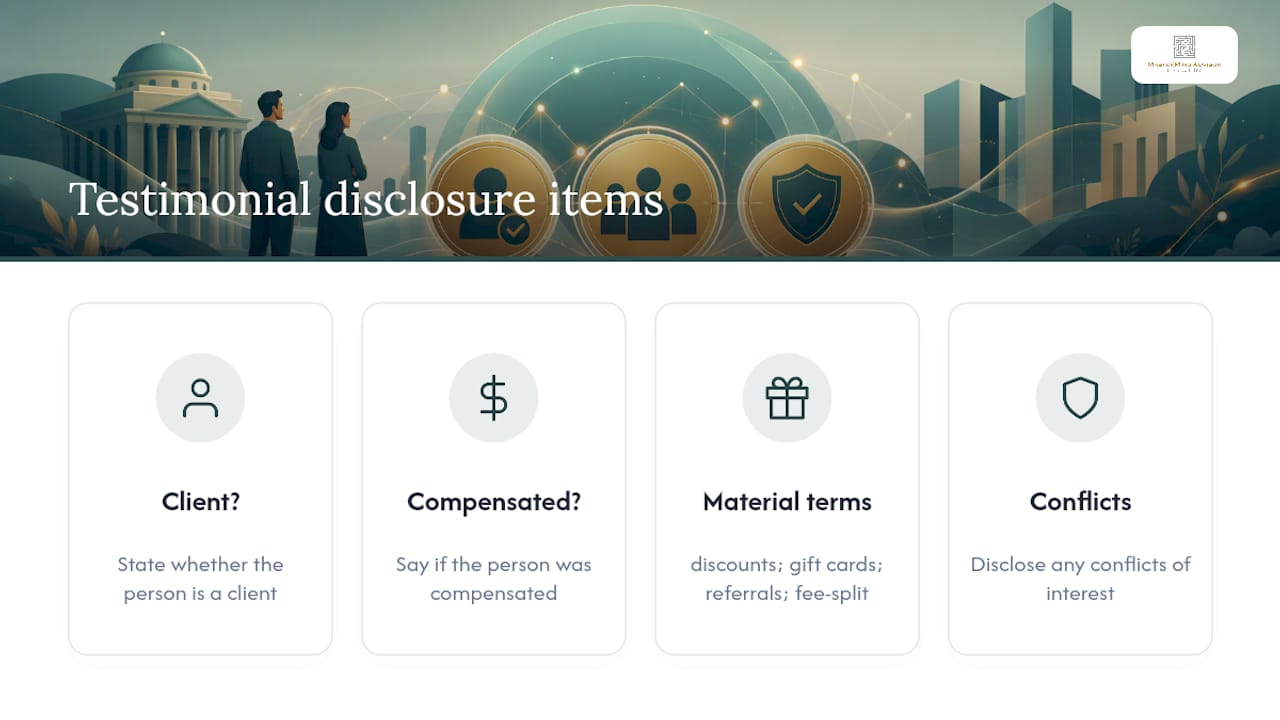
Every testimonial needs disclosure covering the same core elements, regardless of format: whether the person is a client, whether they were compensated, the material terms of that compensation, and any conflicts of interest. Material compensation isn't limited to cash. It includes fee discounts, gift cards, referral credits, and fee-splitting arrangements, all of which need to be disclosed in plain terms rather than generic language like "compensated party."
Promoter relationships also need to show up on Form ADV, where advisors report the use of testimonials and endorsements as part of their marketing disclosures. Rule 204-2 books-and-records requirements then obligate firms to retain the underlying agreements, compensation records, and the testimonial as disseminated. Reviewing compliant testimonial examples can help calibrate what "clear and prominent" actually looks like in finished marketing copy.
Documenting a Reasonable Basis for Belief
A reasonable basis for belief isn't a one-time judgment call. It's an ongoing file examiners can review. Keep these on hand:
- Signed promoter agreements outlining scope, compensation, and content limits
- Compensation logs showing cumulative 12-month totals per promoter
- Timestamped copies of each testimonial as it appeared, disclosures included
- Records of periodic sampling or check-ins with promoters to confirm continued eligibility
Retention generally follows Rule 204-2 timelines, and an archived screenshot showing disclosures were visible at posting time heads off a lot of "was this edited later" questions during an exam.
Where Testimonials Fit Into a Broader Marketing Strategy
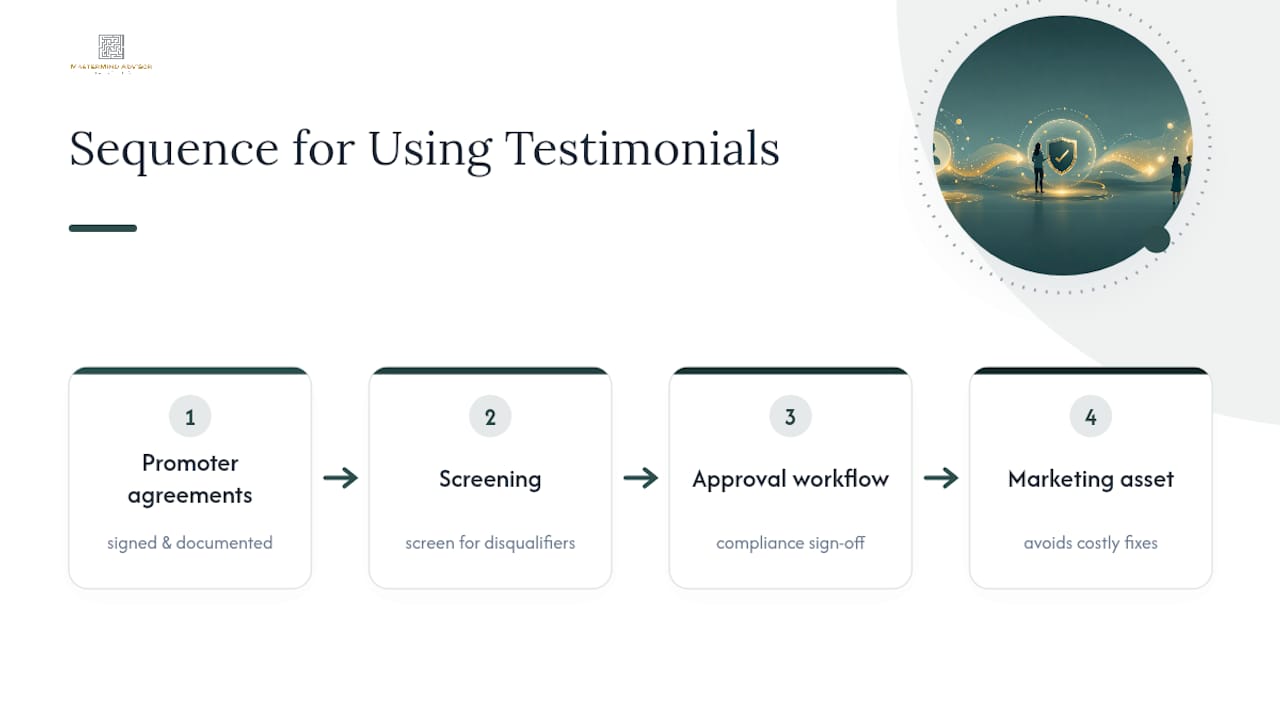
Testimonials work best for advisors with a clean compliance process already running, not as a first marketing move. If your firm doesn't yet have promoter agreements, disqualification screening, or an approval workflow in place, anonymized case studies or process-focused content (how you build a financial plan, how often you communicate) deliver credibility without the same compensation and disclosure overhead.
Mastermind Advisor Marketing builds testimonial programs around that sequencing: compliance controls first, then the marketing asset. That order matters more than most advisors expect. Firms that reverse it usually spend more fixing disclosures after the fact than they would have spent building the workflow up front.
— Josh
Getting Compliant Testimonials Into Your Marketing Without the Guesswork
There are services that offer alternatives to hiring outside compliance counsel for publishing client testimonials. Instead of drafting disclosure language from scratch for every post, you can use systems built around compliance-ready templates, CRM tracking that logs promoter compensation automatically, pre-approval workflows before anything goes live, and content production that already accounts for disclosure placement.

That combination matters most for advisors juggling long sales cycles and multiple marketing channels, where a missed disclosure on one social post can turn into a Form ADV gap during the next exam cycle. Our testimonial program services walk through how the process works for independent advisory practices, from initial promoter screening to archived proof of disclosure. If you're weighing whether a referral program or client testimonial page is worth the compliance lift, reviewing how referral networking fits into marketing growth is a useful starting point before you commit. Request a look at how the workflow applies to your firm at Mastermind Advisor.
Where to Go Deeper on SEC Marketing Rule Compliance
- The SEC's adopting release IA-5653 is the authoritative source for the rule's text and intent.
- The Division of Examinations risk alert shows what examiners actually flag.
- The SEC's marketing compliance FAQs clarify disqualification and disclosure edge cases.
- An independent advisor compliance marketing checklist turns these rules into a repeatable internal process.
This article is general information, not a substitute for advice from a qualified financial advisor. Consult a qualified financial professional about your own circumstances before acting on anything here.
Sources
- SEC adopting release IA-5653 — Final rule: Marketing by Investment Advisers
- SEC Division of Examinations — Risk Alert: Observations Regarding Adviser Compliance with the Marketing Rule