

Financial planning content is defined as educational material covering the core personal finance domains individuals need to manage money, build wealth, and protect assets. The six foundational categories recognized across the financial industry are cash flow and budgeting, debt management, investment planning, retirement planning, insurance and risk management, and estate planning. Understanding the types of financial planning content available helps you choose the right resources at the right time. Nearly 50% of U.S. adults report significant gaps in foundational financial knowledge, which means the quality and format of the content you consume directly shapes your financial outcomes.
1. What are the foundational types of financial planning content?
Cash flow and budgeting content forms the base of any personal finance education. It covers income tracking, expense categorization, and spending plans using frameworks like zero-based budgeting or the 50/30/20 rule. Without this foundation, every other financial decision becomes harder to execute.
Debt management content addresses how to prioritize, reduce, and eliminate liabilities. The two most widely taught methods are the debt avalanche (paying off highest-interest debt first) and the debt snowball (paying off smallest balances first for psychological momentum). Strong debt content explains the real cost of carrying balances and gives readers a clear path forward.

Emergency fund education rounds out the foundational tier. This content teaches readers to build a liquid reserve covering three to six months of expenses before taking on investment risk. It also explains where to hold those funds, typically in a high-yield savings account, and when to replenish after a withdrawal.
Strong foundational financial content shares several features:
- Plain language definitions of terms like APR, net income, and liquidity
- Step-by-step frameworks readers can apply immediately
- Real-dollar examples rather than abstract percentages
- Clear explanations of why each step matters, not just what to do
- Progress checkpoints so readers know when they have mastered a concept
Pro Tip: When engaging with budgeting content, apply the material to your actual numbers within 24 hours of reading. Passive consumption of financial advice rarely changes behavior. Active application does.
2. How does investment, retirement, and tax planning content support wealth building?
Investment planning content defines goals, explains risk tolerance, and covers asset allocation across stocks, bonds, real estate, and alternative assets. The best investment resources connect abstract concepts like diversification to concrete portfolio examples. They also explain the difference between short-term speculation and long-term wealth building, which is a distinction many new investors miss.
Retirement planning content covers account types such as 401(k), IRA, Roth IRA, and SEP-IRA, along with contribution limits, employer matching, and withdrawal rules. It also addresses income strategies for the distribution phase, including Social Security optimization and required minimum distributions. Readers who engage with retirement planning guides early gain a significant compounding advantage over those who start late.
Tax planning content goes beyond filing a return. It covers deduction optimization, tax-loss harvesting, Roth conversion strategies, and entity structuring for self-employed individuals. Tax planning is a year-round process involving audit risk management and strategic filing decisions, not a once-a-year event.
Key takeaways from each content type:
- Investment content teaches asset allocation, risk management, and the compounding effect of time
- Retirement content maps account types to income needs and explains tax treatment at withdrawal
- Tax content identifies legal strategies to reduce liabilities across income, investments, and estate transfers
These three content types work together. A tax-efficient investment strategy inside a retirement account is more powerful than any one of those ideas applied in isolation.
Pro Tip: Layer these content types in sequence. Master budgeting first, then investment basics, then tax strategy. Readers who skip ahead to tax optimization without understanding cash flow often misapply the advice.
3. What role does insurance and estate planning content play in protecting finances?
Insurance planning content covers the four major protection categories: life, health, disability, and property and casualty. Each type addresses a different financial risk. Life insurance content explains term versus permanent coverage and how to calculate the right death benefit. Disability insurance content, often overlooked, addresses the risk that a working-age adult loses income due to illness or injury, which statistically is more likely than premature death for most people under 60.
Estate planning content covers wills, trusts, powers of attorney, and beneficiary designations. Estate planning goes beyond asset transfer, incorporating family values, tax efficiency, and legacy goals. Many readers assume estate planning is only for the wealthy, but anyone with dependents, property, or specific wishes for their assets needs at least a basic estate plan.
The table below compares the core elements covered in insurance and estate planning content:
| Content Area | Key Topics Covered | Primary Goal |
|---|---|---|
| Life insurance | Term vs. permanent, death benefit sizing | Replace lost income for dependents |
| Health insurance | Deductibles, networks, HSA accounts | Manage medical cost risk |
| Disability insurance | Short-term vs. long-term, benefit periods | Protect earned income |
| Property and casualty | Homeowners, auto, umbrella policies | Cover asset loss and liability |
| Wills and trusts | Revocable trusts, pour-over wills | Direct asset distribution |
| Legacy planning | Charitable giving, values-based transfers | Preserve family wealth and intent |
Protection content and growth content must work together. A well-funded retirement account with no disability coverage is vulnerable. A solid estate plan with no life insurance leaves dependents exposed. The most effective personal finance education treats these domains as interconnected, not separate.
4. Which specialized and emerging financial planning content types address unique needs?
Tax optimization content goes deeper than standard tax planning. It covers strategies like qualified opportunity zone investments, backdoor Roth conversions, and business entity elections for high earners. Content creators should match depth to the reader's lifecycle stage, using introductory explanations for new learners and detailed comparisons for readers already implementing strategies.
Financial content for life transitions addresses events like divorce, inheritance, job loss, or the sale of a business. Divorce financial planning content, for example, covers the division of retirement accounts using a Qualified Domestic Relations Order (QDRO), the tax treatment of alimony, and how to rebuild a financial plan as a single-income household. These niche topics serve readers at high-stakes moments when the quality of information matters most.
Gamification and interactive tools like quizzes, calculators, and scenario-based simulations significantly boost retention and engagement in financial literacy. They let readers practice decisions in a low-risk environment before applying them in real life. This format is especially effective for investment and retirement content, where the consequences of errors compound over time.
Emerging content formats making an impact on financial learning engagement include:
- Interactive retirement calculators with adjustable assumptions
- Scenario-based quizzes testing real-world financial decisions
- Progress-tracked content series using the Zeigarnik Effect to maintain reader momentum
- Short-form video explainers paired with downloadable worksheets
- Comparison formats like "what people think vs. what actually happens" that boost shareability
Financial content creators who align format to the reader's decision stage see stronger results. Discovery-stage readers need clear definitions and relatable examples. Consideration-stage readers need detailed comparisons and outcome projections. Mapping content to lifecycle stages reduces drop-off and increases the chance readers act on what they learn.
Key Takeaways
The most effective financial planning content covers all six core domains and matches format to the reader's knowledge level and decision stage.
| Point | Details |
|---|---|
| Six core domains | Cash flow, debt, investment, retirement, insurance, and estate planning form the complete framework. |
| Format drives retention | Interactive tools like calculators and quizzes improve learning outcomes over passive reading. |
| Tax content is year-round | Effective tax planning content covers deductions, conversions, and filing strategy, not just annual returns. |
| Protection content is often skipped | Insurance and estate planning content addresses risks that growth-focused readers frequently overlook. |
| Match content to your stage | Discovery-stage readers need basics; consideration-stage readers need detailed comparisons and projections. |
What I have learned about financial content that actually works
Most financial content fails readers not because the information is wrong, but because it is written for the writer, not the reader. I have seen well-researched articles on Roth conversions that assume the reader already knows what a marginal tax rate is. That assumption loses the reader on sentence two.
The content types that produce real behavior change share one trait: they use clear language and chunked information to reduce cognitive load. When a reader does not have to work hard to understand the words, they can focus on applying the idea. That is when financial education becomes financial action.
I also think the industry underestimates how much format matters. A 3,000-word article on asset allocation and a five-question interactive quiz can cover the same material. The quiz will produce better retention for most readers. Video content for financial topics works for the same reason: it removes the friction of dense text and replaces it with a format the brain processes more naturally.
The readers who improve their financial literacy fastest are the ones who treat content consumption as a practice, not a one-time event. They return to retirement planning guides when their situation changes. They revisit budgeting content after a raise or a job loss. Financial planning content works best when readers treat it as a living resource, not a checklist.
— Josh
How Mastermindadvisormarketing helps advisors deliver content that connects
Financial advisors who produce the right content for the right audience at the right stage build trust faster than those who rely on generic materials. Mastermindadvisormarketing specializes in content marketing for advisors who want to attract qualified prospects and nurture them through every stage of the decision process.
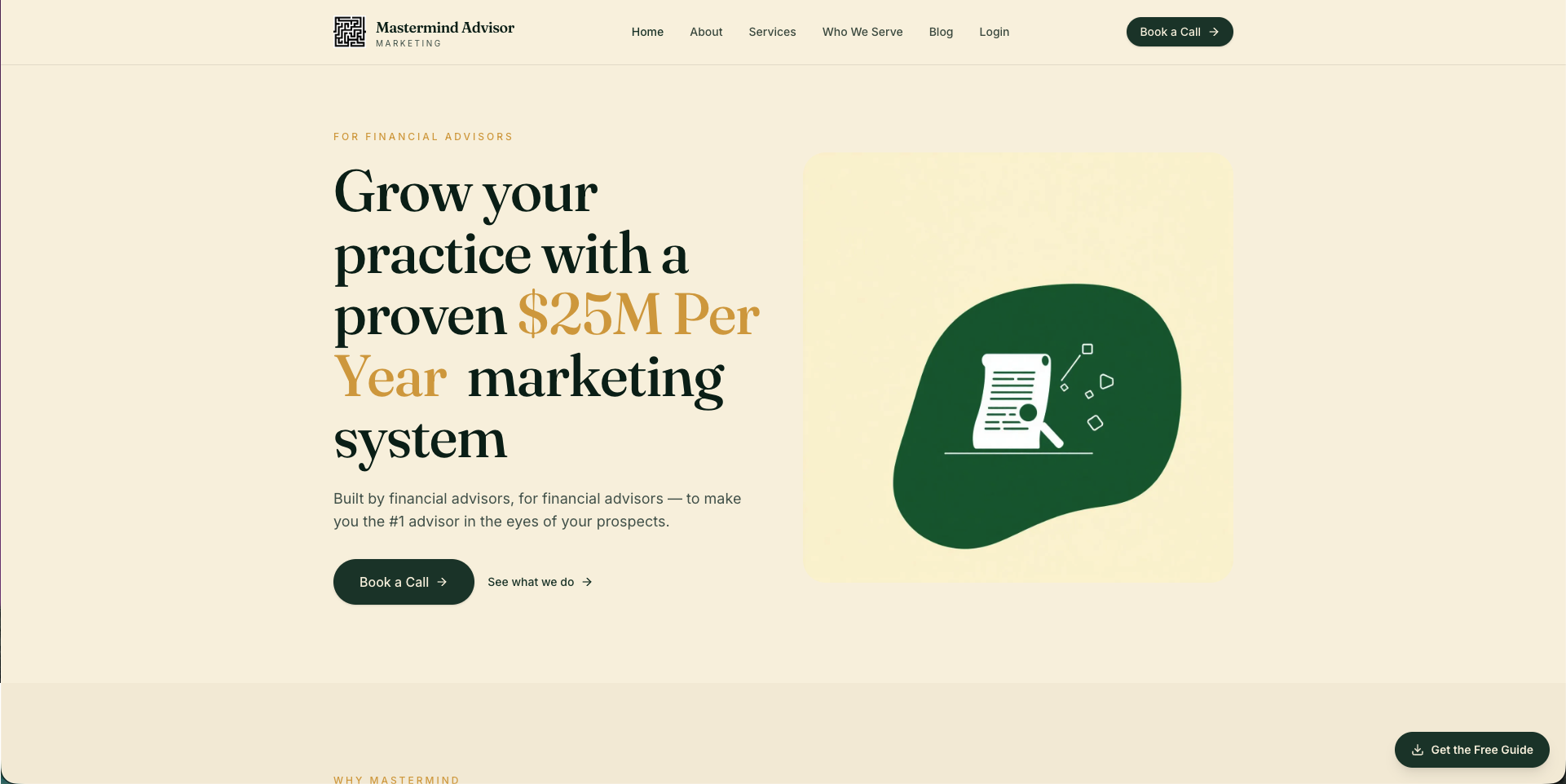
The platform provides customized webinars, seminars, and content strategies built specifically for independent advisors. Every piece is designed to address the financial literacy gaps your prospects actually have, not the ones a generic template assumes. If you want a system that connects educational content to real client relationships, the strategic planning resource at Mastermindadvisormarketing is a practical starting point. You can also explore the full suite of advisor marketing tools at Mastermind Advisor.
FAQ
What are the six core types of financial planning content?
The six core types are cash flow and budgeting, debt management, investment planning, retirement planning, insurance and risk management, and estate planning. These categories are recognized across the financial industry as the foundational pillars of personal finance education.
Why does content format matter in financial education?
Format determines whether readers retain and apply what they learn. Interactive tools like calculators and quizzes improve retention by letting readers practice decisions in a low-risk environment, which passive reading alone does not achieve.
What is the difference between tax planning and tax filing content?
Tax filing content covers annual return preparation, while tax planning content addresses year-round strategies like deduction optimization, Roth conversions, and audit risk management. Tax planning content is more complex and has a greater impact on long-term wealth.
How do I know which financial planning content to read first?
Start with cash flow and budgeting content, then move to debt management, and then investment basics. Readers who skip foundational content and jump to advanced topics like tax optimization often misapply the strategies because the underlying financial structure is not yet in place.
What makes financial literacy content effective?
Behavior-focused financial content that produces measurable improvements combines plain language, practical examples, and applied exercises. Content that asks readers to act on the material, not just read it, produces the strongest long-term results.