

Mastermind Advisor Marketing is a peer-driven, strategy-focused marketing system for independent financial advisors, while Acquire Up is a technology-driven, seminar-based execution platform built to grow lead pipelines through educational and meal-based events. When evaluating acquire up vs mastermind advisor marketing, the core distinction is not which platform is "better." It is whether your practice needs a strategic roadmap and peer accountability, or a done-for-you seminar machine that fills seats and generates appointments. Most advisors get this wrong because they choose a solution before diagnosing the actual bottleneck in their growth.
How do Acquire Up and Mastermind Advisor Marketing differ in approach?
The difference between these two platforms comes down to a well-documented split in how marketing work gets done. Marketing advisors spend roughly 80% of their time on strategy and only 20% on execution, while marketing agencies invert that ratio entirely. This means that choosing between a mastermind model and a seminar execution platform is essentially choosing where you want the heavy lifting to happen.
Acquire Up sits firmly in the execution camp. The platform handles the logistics, targeting, and delivery of seminar and educational event marketing so advisors can focus on showing up and converting attendees. It is a strong fit for advisors who already know what they want to communicate but lack the infrastructure to run events at scale.

Mastermindadvisormarketing operates from the opposite direction. The platform centers on a curated mastermind group model where advisors work through strategic challenges together, hold each other accountable, and develop marketing roadmaps grounded in peer experience. A typical mastermind meeting includes hot seats, strategy roundtables, accountability check-ins, and expert guest sessions, usually with 8 to 20 vetted members. That structure produces clarity, not just content.
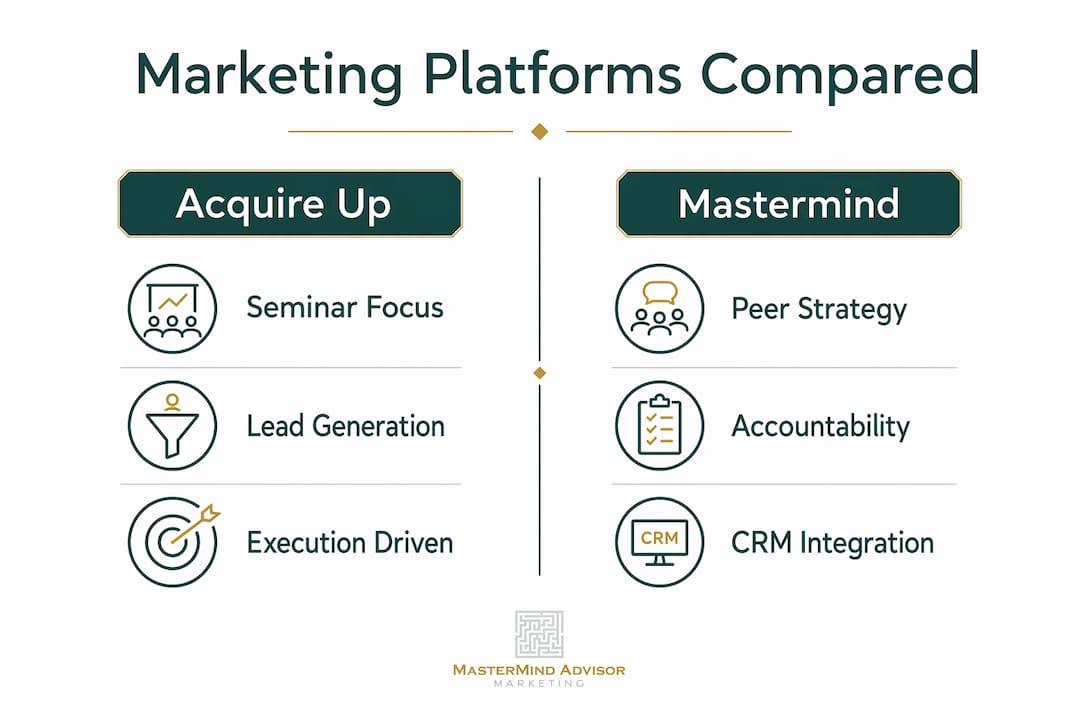
| Feature | Acquire Up | Mastermindadvisormarketing |
|---|---|---|
| Primary focus | Seminar execution and lead generation | Strategic mastermind and peer accountability |
| Who does the work | Platform handles event logistics | Advisor implements with peer guidance |
| Best for | Advisors ready to scale event marketing | Advisors refining strategy and growth direction |
| Technology role | Central to delivery and targeting | Supports CRM and follow-up automation |
| Engagement model | Campaign-based | Ongoing community and accountability |
The technology angle matters here too. Mastermindadvisormarketing integrates custom CRMs and automated email follow-ups to support the advisor's own marketing execution. Acquire Up uses technology to power the seminar pipeline itself. Neither approach is passive. Both require the advisor to show up prepared and engaged.
Pro Tip: Before choosing either platform, write down your single biggest marketing constraint. If it is "I don't know what to do," a mastermind is your answer. If it is "I know what to do but can't execute at scale," a seminar platform fits better.
What do these platforms cost, and what ROI should you expect?
Cost is where advisors often get surprised, and not always pleasantly. Agency-focused masterminds cost between $500 and $1,500 per month for virtual participation, with premium in-person versions running $25,000 to $75,000 annually. The encouraging data point is that well-structured masterminds often pay for themselves within six months. That timeline assumes active participation, not passive attendance.
Seminar marketing programs like Acquire Up carry their own cost structure, which typically includes platform fees, event costs, and any internal staff time needed to follow up on leads generated. This is where a critical insight applies: hiring an advisor without internal staff to implement their strategies results in paying for unused strategies. The same logic applies to seminar platforms. If your team cannot handle the follow-up volume a successful event generates, your cost-per-acquisition climbs fast.
Here is a practical breakdown of what to factor into your ROI calculation for each model:
- Mastermind model: Monthly membership fee, time investment of 4 to 8 hours per month in sessions, plus internal execution time to act on strategic guidance received
- Seminar model: Platform or agency fees, event venue and catering costs, staff time for pre-event promotion and post-event follow-up, and CRM management
- Both models: Opportunity cost of your own time, which is the most underestimated line item in any advisor's marketing budget
The payback period for mastermind participation depends almost entirely on how aggressively you implement what you learn. Advisors who treat mastermind sessions as a learning exercise without committing to specific actions between meetings see minimal returns. Joining a mastermind without actionable challenges or engagement goals results in minimal ROI. Active participation is not optional. It is the product.
Pro Tip: Track one specific metric before joining either platform, whether that is cost per lead, appointments booked per event, or revenue per new client. Without a baseline, you cannot measure whether the investment is working.
Which platform fits your specific growth bottleneck?
Choosing the wrong solution for the right problem is one of the most expensive mistakes in advisor marketing. Hiring marketing consultants without diagnosing whether your bottleneck is strategy or execution leads to wasted budget and misaligned outcomes. The same principle applies here.
Use this decision framework to identify where you actually are:
- You need Mastermindadvisormarketing if: Your pipeline is inconsistent because you are not sure which marketing channels to prioritize, you lack peer accountability to follow through on marketing plans, or you want to learn from advisors who have already solved the problems you are facing.
- You need Acquire Up if: You have a clear value proposition and target market, you want a repeatable event-based lead generation system, and your team has the capacity to convert seminar attendees into clients.
- You may benefit from both if: You are scaling a practice that needs strategic direction at the leadership level and execution capacity at the campaign level. Some advisors use a mastermind to set quarterly priorities and a seminar platform to execute against those priorities.
- You should pause before either if: You have not defined your ideal client profile, you do not have a follow-up process for new leads, or your current client base is not generating referrals. No marketing platform fixes a broken client experience.
Programmatic marketing approaches that include predefined target criteria and repeatable playbooks outperform ad-hoc efforts by generating 3.9% excess total shareholder return over a decade. That data point applies directly here. Whether you choose a mastermind or a seminar platform, the advisors who win are the ones who build repeatable systems, not one-off campaigns.
The hybrid approach is underused and underrated. An advisor who spends two hours per month in a mastermind hot seat refining their acquisition strategy, then uses a seminar platform to execute that strategy at scale, is operating with both a compass and an engine. Most advisors pick one or the other and wonder why growth stalls.
What are the best mastermind marketing tips for financial advisors?
Getting real value from either platform requires more than showing up. These are the practices that separate advisors who see measurable results from those who stay stuck.
Successful mastermind communities emphasize predictable rituals like weekly goal-setting and focused hot seat sessions aligned with measurable member transformations. That structure is not accidental. It is what converts peer conversation into business results.
For mastermind participation, the most effective advisors bring a specific, data-backed challenge to every session. Not "I need more clients" but "My seminar attendance is strong but my conversion rate from attendee to appointment is 12%. Here is what I have tried." That level of specificity is what triggers useful peer input and holds you accountable to a measurable outcome.
Mastermind groups that function as a Board of Advisors with accountability for financial goals produce the highest ROI by shifting perspectives from tasks to system optimization. This is the difference between talking about marketing and actually building a marketing system that runs without you micromanaging every campaign.
For seminar marketing, the tactics that consistently improve lead quality include narrowing your event topic to a specific audience concern (Social Security timing decisions, for example, rather than "retirement planning"), using pre-event email sequences to qualify attendees, and having a defined next step ready before the event ends. Advisors who leave follow-up to chance after a seminar lose the majority of the value they just paid to generate.
Technology integration matters in both models. Mastermindadvisormarketing's built-in CRM and automated follow-up tools give advisors a way to act on strategy without building a tech stack from scratch. For advisor prospecting to convert, the follow-up process needs to be faster and more personalized than most advisors currently manage manually.
Pro Tip: After every mastermind session or seminar event, write down one specific action you will complete within 72 hours. The advisors who grow fastest are not the ones with the best ideas. They are the ones who execute the fastest.
Key takeaways
Choosing between Acquire Up and Mastermindadvisormarketing requires diagnosing your actual marketing bottleneck first, because the right platform depends entirely on whether you need strategic clarity or execution capacity.
| Point | Details |
|---|---|
| Strategy vs. execution split | Mastermind models prioritize strategic clarity; seminar platforms like Acquire Up prioritize execution at scale. |
| Cost and ROI timeline | Mastermind memberships typically pay for themselves within six months when members participate actively and implement guidance. |
| Diagnose before you buy | Advisors who misidentify their bottleneck waste budget; determine if you lack strategy or execution capacity first. |
| Hybrid approach works | Using a mastermind for strategy and a seminar platform for execution gives advisors both direction and delivery. |
| Participation drives returns | Neither platform delivers ROI passively. Active engagement, specific challenges, and fast implementation separate results from regret. |
Why I think most advisors are solving the wrong problem
I have seen advisors spend significant money on seminar marketing platforms when what they actually needed was two hours per month in a room with peers who had already figured out their positioning. I have also seen advisors join masterminds and spend six months talking about strategy while their pipeline dried up because nobody was executing anything.
The uncomfortable truth is that most advisors do not have a marketing problem. They have a diagnosis problem. They feel the symptom (not enough leads) and immediately reach for the most visible solution (a lead generation platform). But the real question is whether the shortage of leads comes from not knowing what to do, or from not having the infrastructure to do it consistently.
The best mastermind groups mirror a Board of Advisors, providing peer accountability and focusing on key financial metrics rather than casual networking. That framing changed how I think about the value of peer groups entirely. A mastermind is not a support group. It is a performance environment.
What I have found actually works is this: advisors who grow their practices fastest in 2026 are the ones who treat marketing as a system, not a series of campaigns. They use digital marketing strategy to set direction, peer accountability to stay on track, and execution platforms to scale what is already working. The sequence matters. Strategy before execution, always.
If you are evaluating these two platforms right now, my honest recommendation is to spend 30 minutes writing down your last three marketing efforts, what you expected, and what actually happened. That exercise will tell you more about your real bottleneck than any platform comparison will.
— Josh
See how Mastermindadvisormarketing can accelerate your practice
Independent financial advisors who want both strategic direction and execution support have a clear starting point. Mastermindadvisormarketing offers a turnkey marketing system built exclusively for advisors, combining mastermind group access with custom CRM tools, automated follow-up sequences, and proven seminar and webinar frameworks.

Advisors who have used the platform report stronger lead pipelines and more consistent client engagement, not because the system is complicated, but because it is built around how advisors actually work. If you are ready to move from scattered campaigns to a repeatable growth system, explore Mastermind Advisor Marketing and see which program fits your current stage. You can also review their seminar hosting resource to understand how event-based marketing fits into a broader advisor growth strategy.
FAQ
What is the main difference between Acquire Up and Mastermind Advisor Marketing?
Acquire Up is a seminar execution platform that handles event-based lead generation for financial advisors, while Mastermindadvisormarketing is a peer-driven mastermind system focused on strategic growth, accountability, and marketing roadmap development.
How much does a mastermind group cost for financial advisors?
Virtual mastermind memberships typically run $500 to $1,500 per month, with premium in-person programs reaching $25,000 to $75,000 annually. Most well-structured groups pay for themselves within six months for active participants.
When should a financial advisor choose a seminar platform over a mastermind?
Choose a seminar platform when you have a defined value proposition and target market and need a repeatable system to generate and convert leads at scale. Choose a mastermind when your primary gap is strategic clarity or peer accountability.
What are the most effective mastermind marketing tips for advisors?
Bring specific, data-backed challenges to every session, commit to one concrete action within 72 hours of each meeting, and track a single measurable metric before and after joining. Passive participation produces no measurable return.
Can financial advisors use both Acquire Up and a mastermind at the same time?
Yes, and the combination is often more effective than either alone. A mastermind provides the strategic direction and quarterly priorities, while a seminar platform executes against those priorities at scale.