
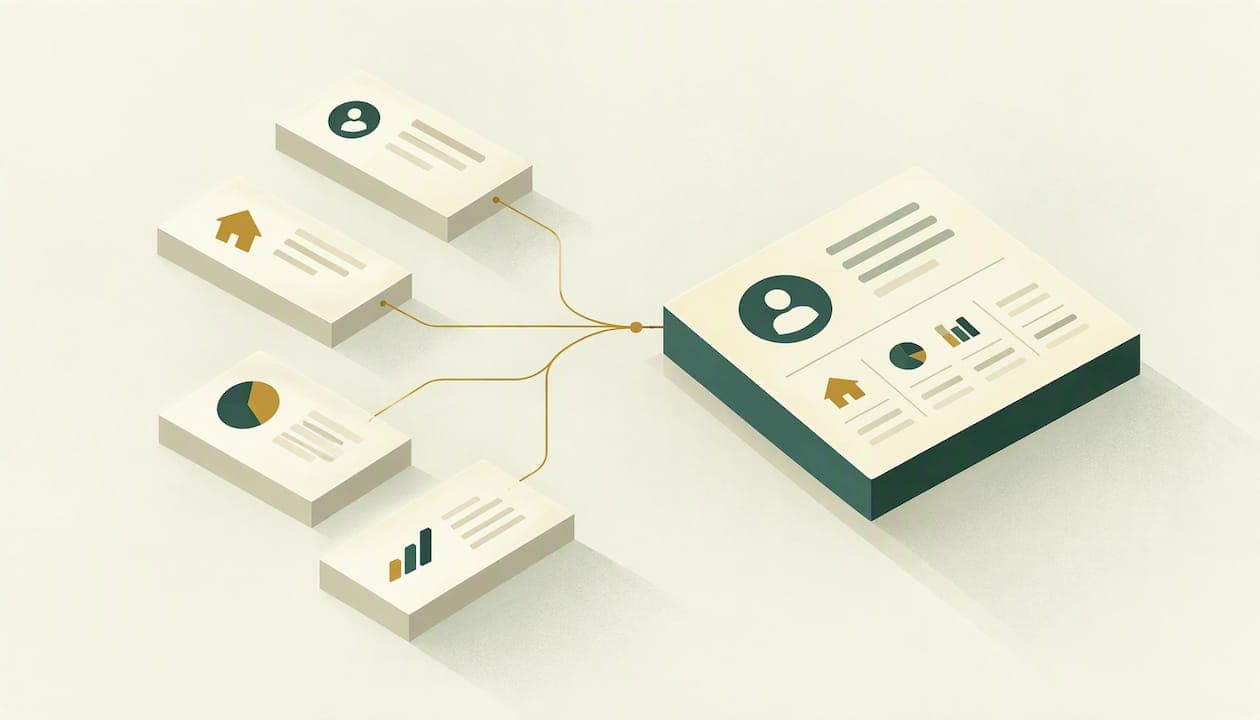
Advisor CRM data hygiene is a recurring routine, not a one-time cleanup. You audit the records, merge duplicates, standardize formats, assign an owner, and recheck on a fixed schedule. For an RIA the stakes go beyond tidy reports: stale or inaccurate client data can undermine the records you are required to keep, and it quietly breaks the segmentation your email, webinars and referral outreach depend on. This guide gives you the routine, the schedule, the metrics worth tracking, and a way to turn clean data into useful segments.
TL;DR
- Data hygiene means regularly reviewing CRM data so it stays clean, current and free of duplicates. Give one person ownership and put the checks on a calendar.
- The usual culprits are duplicate records, inconsistent names and formats, outdated contact details and conflicting data between the CRM, custodian and portfolio system.
- Run a focused cleanup over 30 to 60 days with weekly check-ins, then settle into daily, monthly, quarterly and annual tasks.
- Clean household records make segmentation by household assets, client profitability and referral relationships possible.
- Books and records must be true, current and accurate, and communications must be retained. Treat hygiene as part of compliance, not just marketing.
Table of Contents
- What data hygiene means for an advisory firm
- Where advisor records go wrong
- Why hygiene is a compliance matter, not just a marketing one
- A 30-to-60-day cleanup plan
- A maintenance schedule that keeps data current
- What to measure
- Using clean data to segment clients and prospects
- Common mistakes
- Perspective: why data hygiene comes before more lead generation
- Where our system fits
- A starting checklist
- FAQ
- Sources
What data hygiene means for an advisory firm
CRM data hygiene is a regular review of your CRM data to make sure it is clean and updated. It corrects errors and duplication, and it can make the system easier to use, improve team efficiency, and sharpen client relationships and marketing segmentation, according to an investment-industry CRM guide.
The general-purpose guides that rank for this topic are written for sales teams chasing pipeline. An advisory practice has a different problem set:
- Your relationships are households, not single contacts. A couple, their trust, an adult child and a business entity may all belong to one relationship.
- Buying cycles are long. A prospect who attended a seminar two years ago may become a client next quarter, so old records are assets, not clutter.
- Your data lives in several places: the CRM, the custodian, portfolio-management software, financial-planning tools and, often, spreadsheets.
- Regulators expect your records to be reliable, and they expect certain communications to be kept.
There is also a human reason to care. Academic research on customer data quality found that marketing professionals will work around or neglect a CRM when they do not trust the data inside it, which undermines any long-term customer strategy (Zahay, 2012). If your team keeps a private spreadsheet "because the CRM is wrong," you already have a hygiene problem.
Where advisor records go wrong
Before you clean anything, know what you are looking for. Wealth-management data guides describe the same patterns again and again: fragmented identities across systems, inconsistent names and formats, changing contact details, and duplicates created by separate systems, migrations, imports and manual entry (client data consolidation guide).
Identity fragmentation
The same household can appear under different names or entity structures in the CRM, the custodian, the portfolio system and the planning software. "Robert and Linda Hayes," "Hayes Family Trust" and "R. Hayes" may be one relationship, or three. Until they are tied together, you cannot see total household assets, and you cannot send one coherent message.

Stale and conflicting details
Advisor-focused sources frequently cite outdated addresses, phone numbers and email addresses; inconsistent household relationships; incomplete beneficiary information; and conflicting data between the CRM, the portfolio system, the custodian and spreadsheets (client data issues overview). Each one has a practical cost: a bounced email, a misaddressed statement, a birthday outreach sent to the wrong person.
Inaccurate suitability and profile data
This is the most serious category. In a 2023 decision, FINRA found that overstating customers' financial resources and investment experience caused a firm to maintain inaccurate books and records (FINRA, 2023). A 2024 decision likewise found that overstating customers' income, net worth, investment experience, objectives and risk tolerance led to inaccurate books and records and contributed to unsuitable recommendations (FINRA, 2024). Those cases involved broker-dealer conduct, but the lesson carries over to any firm: client profile fields are not cosmetic, and whoever edits them should be accountable for their accuracy.

Why hygiene is a compliance matter, not just a marketing one
The SEC's recordkeeping framework for investment advisers, Rule 204-2, requires books and records that are true, current and accurate. Stale or inaccurate client and transaction data are therefore not merely operational defects; they can undermine required records (SEC filing discussing the framework).
A few related obligations shape how you clean and use CRM data:
- Marketing Rule records. The SEC's Investment Adviser Marketing final rule, effective May 4, 2021, includes recordkeeping requirements for advertisements and testimonials. If your CRM holds lead-source notes, campaign lists or testimonial-related records, they may belong in your archive.
- Communications retention. FINRA guidance states that business communications, including email, social media and messaging, must be retained in a retrievable, supervised manner for at least three years (FINRA, 2018). Check with your compliance officer how this applies to your registration type, and make sure a cleanup never deletes something you must keep.
- Safeguarding client information. The same final rule discussion covers the FTC Safeguards Rule's written information security programs, oversight of service providers, and privacy notices under the Gramm-Leach-Bliley Act. Any vendor that touches your CRM data is part of that oversight.
The practical takeaway: before you bulk-delete or bulk-merge, confirm the retention rule for the record type, export a backup, and log what changed. For more on what to archive, see our guide to RIA advertising records for SEC exams.
A 30-to-60-day cleanup plan
A one-off scramble rarely sticks. One practice-data checklist recommends that a focused data quality assessment have a designated leader, a 30-to-60-day window and weekly progress checks (data quality checklist). Here is how that can look for a small or midsize RIA.
Week 1: Assign ownership and take a snapshot
- Name one data owner, usually an operations lead or a client service associate with authority. Their job is accountability, not doing every edit.
- Export the full CRM, including notes and activity history, as a backup.
- Count your records: households, individuals, entities, prospects, inactive contacts. This is your baseline.
- List every system that feeds or reads the CRM: custodian, portfolio software, planning tools, email platform, website forms, webinar registrations.
Weeks 2 to 3: Define your standards
Write a one-page data dictionary. Decide, once, how you will record:
- Names (legal name versus preferred name, suffixes, trusts and entities)
- Phone numbers and addresses (one format, one place for primary versus secondary)
- Household structure (who is the head, who are members, how entities link)
- Lead source and referral source (a fixed pick-list, not free text)
- Client status (prospect, active client, former client, centers of influence)
- Required fields for each record type
Pick-lists matter more than most firms expect. When one advisor types "Referral - CPA" and another types "CPA referral," you cannot report on your best referral channel.
Weeks 3 to 5: Deduplicate
Most modern CRMs have a duplicate management tool. HubSpot's documentation, for example, describes using its duplicates manager to identify potential duplicates, review property values and matching rules, merge confirmed duplicates or reject false matches, and export the merge history (HubSpot, updated October 2026). Whatever platform you use, the same discipline applies:
- Review before merging. Two "Michael Chen" records might be a father and son. Spouses sharing an email address are not duplicates.
- Reject false matches explicitly so they do not resurface every week.
- Keep a merge log. If an examiner or a colleague asks why a record changed, you want an answer.
- Merge the household last. Fix individuals first, then link them into households.
Weeks 5 to 8: Reconcile against source systems
Compare the CRM to the custodian and portfolio system for a sample of households, then expand. Check names, account registrations, addresses, beneficiaries and household relationships. When the CRM and custodian disagree, determine which is the system of record for that field and document it. Contact details are often best confirmed with the client at the next review meeting rather than guessed.
Final week: Lock in the routine
Publish the standards, schedule the recurring checks below, and share the before-and-after counts with the team. Visible progress is what keeps people entering data properly.
A maintenance schedule that keeps data current
Cleanup decays without maintenance. A practical rhythm uses structured processes, review cycles and automated checks that flag inconsistencies. Charles Schwab's data-management workflow for advisors, for instance, lays out daily, monthly, and quarterly and annual tasks, including obtaining custodian data and spot-checking account values, returns and billing using reports or exports (Schwab, 2012). That document is dated, so treat it as a model for the cadence and adapt the details to your own tools.
Here is a version you can adapt:
| Frequency | Task | Owner |
|---|---|---|
| Every new record | Search for an existing household before creating one; fill required fields; use pick-lists | Whoever enters the record |
| Weekly | Review new records and web-form or webinar registrations for duplicates and missing fields; check email bounces | Data owner |
| Monthly | Run saved reports: missing email, missing household, no assigned advisor, no lead source; fix or assign | Data owner |
| Quarterly | Reconcile a sample of households against the custodian and portfolio system; review inactive contacts | Operations plus lead advisor |
| Annually | Confirm contact details and beneficiaries at client reviews; review the data dictionary; confirm retention and archiving with compliance | Chief compliance officer plus data owner |
If you have already built a meeting cadence for client reviews, attach the annual verification to it. Asking "Is this still the best email and mobile number for you?" costs thirty seconds.
What to measure
For regulated records, the standard to keep in mind is whether your books and records are true, current, accurate and easily accessible. Translate that into a handful of measures you can pull from a saved report each month:
- Completeness: percentage of active households with a valid email, phone, mailing address, assigned advisor and household link.
- Duplicate rate: potential duplicates flagged per 1,000 records, tracked monthly.
- Bounce rate: hard bounces from your last email campaign. A spike points to stale addresses.
- Freshness: percentage of active clients whose contact details were verified in the last 12 months.
- Source coverage: percentage of new leads with a recorded lead source from your pick-list.
- Reconciliation exceptions: count of mismatches between CRM and custodian found in each quarterly sample, and how many were resolved.
Set your own targets. There is no universal benchmark worth copying, and the trend over time tells you more than any single number.
Using clean data to segment clients and prospects
Segmentation is where hygiene pays off in marketing. With consolidated household records, you can segment by household assets under management, client profitability and referral relationships (client data consolidation guide). Age-band and demographic stability data also matter for realistic revenue projections and practice transition planning (data quality checklist).
Below are segments that tend to work for independent advisors. They are suggestions for you to test, not benchmarks.
| Segment | Built from | What it enables |
|---|---|---|
| Household tier | Household assets, service model | Different review cadence and event invitations by tier |
| Life stage | Age band, retirement date, planning stage | Retirement-income content for pre-retirees, accumulation content for younger clients |
| Referral source | Referral field, centers of influence | Thank-you outreach and joint events with CPAs and attorneys |
| Prospect stage | Lead source, last activity, event attendance | Nurture sequences that match where the person is |
| Next-generation heirs | Household relationships | Introductions before a wealth transfer, not after |
| Dormant prospects | Last activity date, past event attendance | Re-engagement after a long buying cycle |
Notice what each segment needs: a required field, a pick-list, or a household link. If those are blank or inconsistent, the segment is a guess. That is why we put the data dictionary before the marketing plan, not after.
Segmentation and compliance
Segments change who sees which message, and messages are regulated. Keep these habits:
- Hold every segment-specific message to the same review standard as your general content. Our compliance marketing checklist covers the pre-publication questions.
- Archive the campaign, the audience definition and the date sent, so you can show who received what.
- Add pre-send controls to automated email. Our guide to advisor email compliance walks through them.
- Review testimonial and performance-related content against the SEC Marketing Rule steps before it goes to any segment.
- Use only the data you need. Do not pull sensitive profile fields into marketing lists when a simple tag will do, and keep vendor access to nonpublic personal information within your written security program.
Common mistakes
- Deleting instead of merging. Deleted records take their history with them. Merge, or archive with a status.
- Cleaning without fixing the intake. If web forms, webinar registrations and imports still create duplicates, you will be back in a month. Add required fields and duplicate checks at the door.
- No owner. Shared responsibility becomes nobody's job.
- Free-text everywhere. Free text feeds typos and unreportable fields.
- Treating the CRM as separate from compliance. Notes about client conversations, suitability information and marketing activity are part of your records picture. Involve your chief compliance officer when you define standards.
- Overwriting profile data to look better. Never inflate or adjust client financial or risk information to fit a desired outcome. The FINRA decisions above show what inaccurate profile data can lead to.
Perspective: why data hygiene comes before more lead generation
We are practicing advisors who have grown real advisory practices, and the pattern repeats: firms rush to buy more leads while the leads they already have sit in a messy database.
A seminar or webinar can only turn into a relationship if the registrant is recorded once, tagged with the right source, and followed up on a schedule. Long buying cycles make that harder, not easier. The prospect who attends in spring may be ready in the fall, and only a clean record will tell you that.
That is why our system is designed around the full path: events, content, email follow-up and the CRM behind them, all built for the regulatory constraints of financial services rather than adapted from a generic agency playbook. Clean data is what lets automation behave like a thoughtful associate instead of a mass mailer.
Start with the dictionary, the owner and the calendar. Everything you build on top of that gets cheaper to run and easier to supervise.
Josh
Where our system fits
If you want clean data to feed a marketing engine rather than a spreadsheet, that is what we build. Our turnkey system for independent advisors includes lead-generation webinars, produced seminars, a compliance-friendly content library, automated email drip campaigns, scheduled social media, advisor websites, and integration with custom CRM and email automation tools, all mapped to a growth strategy for your practice. You can see the full list on our services page.
If you would rather start with the plan, our growth strategy work maps your segments, your follow-up sequences and your compliance review points before anything goes live.
A starting checklist
- Name a data owner this week.
- Export a full backup of the CRM.
- Write the one-page data dictionary and pick-lists.
- Run duplicate detection, review matches by hand, and keep the merge log.
- Reconcile a sample of households with the custodian and portfolio system.
- Build saved reports for missing fields, duplicates and bounces.
- Put weekly, monthly, quarterly and annual checks on the calendar.
- Confirm retention and archiving rules with your chief compliance officer.
- Build two or three segments from the cleaned data and test one campaign.
FAQ
How often should an advisor clean CRM data?
Run light checks weekly, saved-report reviews monthly, and custodian reconciliation samples quarterly. Verify client contact details and beneficiary information at least once a year, ideally at the annual review. The first cleanup can take 30 to 60 days if you give it an owner and weekly check-ins.
What is the first thing to fix in an advisor CRM?
Start with ownership and standards, then duplicates. A named data owner and a short data dictionary prevent new problems while you clear old ones. After that, merge confirmed duplicates and link individuals into households.
Does CRM data hygiene matter for SEC compliance?
Yes. The SEC's Rule 204-2 framework expects true, current and accurate books and records, so stale client data can undermine required records. Marketing Rule recordkeeping and communications retention also apply. Ask your chief compliance officer how they apply to your firm before deleting or merging in bulk.
How do I segment clients if my data is incomplete?
Begin with the segments that need only a few fields, such as referral source, household tier and prospect stage. Make those fields required and pick-list based, then backfill existing records at client reviews. Add more segments as completeness improves.
Sources
- CRM data hygiene for investment firms
- Zahay, building the foundation for customer data quality in CRM (2012)
- Client data consolidation for wealth management
- FINRA 2023 decision on books and records
- FINRA 2024 hearing officer decision
- Client data issues for advisors
- SEC filing on Rule 204-2 books and records
- SEC Investment Adviser Marketing final rule
- FINRA social media and digital communications (2018)
- HubSpot: review and manage duplicate records
- Data quality checklist for practice valuation
- Schwab data management workflow