
Advisor networking is the deliberate practice of building structured, purposeful relationships with complementary professionals, such as accountants, attorneys, and estate planners, to generate consistent referrals and grow your advisory practice. This is the core concept behind what is advisor networking explained in most professional development circles, though the industry term is "referral networking" or "structured professional networking." Financial advisors who treat networking as a system rather than a social activity see measurably better client acquisition results. Groups like BNI (Business Network International) have formalized this approach, and the principles they use apply directly to independent advisors building their own referral ecosystems.
What is advisor networking and how does it work in practice?
Advisor networking is a system where financial professionals meet regularly with other non-competing professionals to exchange qualified referrals and build mutual business growth. The key word is "system." This is not attending a chamber of commerce mixer and hoping someone calls you. It is a repeatable process with defined roles, meeting formats, and accountability.
Structured professional networking groups typically meet weekly or monthly, with each session focused on passing referrals rather than casual conversation. The difference between a productive group and a time-wasting one comes down to that structure.

BNI meetings use a consistent 90-minute agenda that includes timed speaking slots, a formal "I have" segment where members pass qualified referrals, and a rotating education component. Every member knows exactly what to expect and what is expected of them. That predictability builds the trust that makes referrals flow.
The meeting itself is only part of the picture. One-to-One meetings outside the main group session are where real relationship depth develops. A financial advisor who schedules monthly one-to-ones with a CPA in the group learns that CPA's ideal client profile, communication style, and professional standards. That knowledge makes every future referral more accurate and more likely to convert.
Here is how a typical structured advisor networking cycle works:
- Weekly or monthly group meeting: Members share referrals, give brief business updates, and hear from a featured speaker.
- Timed speaking slots: Each member gets 60 to 90 seconds to describe their ideal referral for that week.
- One-to-One meetings: Scheduled between members outside the main meeting to build deeper professional understanding.
- Referral follow-up: Members track referrals passed and received, creating accountability within the group.
- Annual or quarterly reviews: The group evaluates membership alignment and referral quality.
Pro Tip: Schedule your One-to-One meetings for the same week as the group meeting. Combining both in one week keeps momentum high and prevents relationship-building from falling off your calendar.
What are the key benefits of advisor networking?
The primary benefit of advisor networking is a consistent, predictable stream of qualified client introductions. Most advisors rely on existing clients to refer friends and family, but that source is unpredictable. Structured advisor networks generate a steady stream of introductions to qualified prospects, which removes the feast-or-famine cycle from your prospecting calendar.
The advisor networking benefits extend well beyond referrals. Here is what a well-run network delivers:
- Expanded professional knowledge: Regular exposure to CPAs, estate attorneys, and insurance specialists keeps your technical knowledge current without formal continuing education.
- Co-marketing opportunities: Joint client events and workshops increase your visibility to an entirely new audience without doubling your marketing budget.
- Enhanced credibility: Being recommended by a trusted CPA or attorney transfers their credibility to you before the prospect ever meets you.
- Access to niche expertise: When a client has a complex estate issue, you have a trusted attorney in your network to call, which improves your service delivery.
- Career growth through collaboration: Advisors in active networks report faster practice growth because they learn from peers who face the same challenges.
The credibility transfer point deserves emphasis. A warm introduction from a respected professional carries far more weight than any advertisement or cold outreach. The prospect arrives pre-sold on your trustworthiness because someone they already trust vouched for you. That is the importance of advisor networking that most advisors underestimate until they experience it firsthand.
What critical structures ensure successful advisor networking?
Structure is what separates a referral machine from a monthly lunch club. Without a clear framework for generating referrals, networking meetings drift into social conversation and produce no business results. The advisors who get the most from their networks treat structure as non-negotiable.
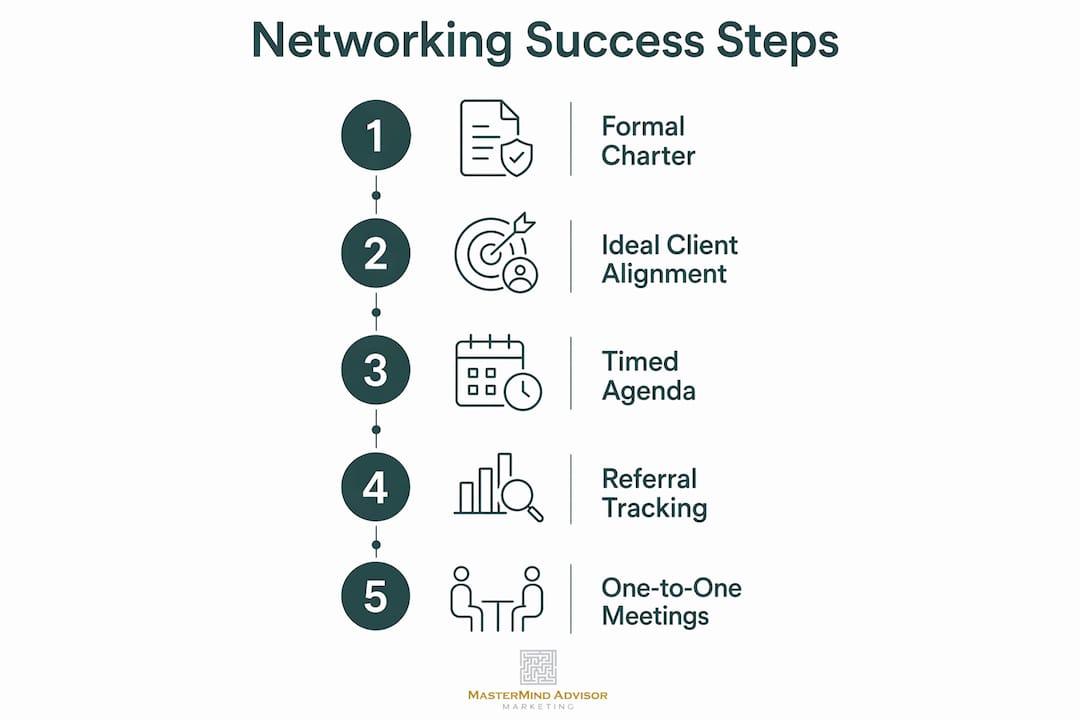
The most important structural element is a formal group charter. A formal networking group charter defines the group's purpose, membership criteria, meeting format, referral processes, and communication guidelines. Without it, members have different expectations, accountability disappears, and referral quality drops.
| Element | Without structure | With structure |
|---|---|---|
| Meeting agenda | Open conversation, no time limits | Timed segments, defined roles, referral passing |
| Membership criteria | Anyone who shows up | Defined by profession, ideal client alignment |
| Referral process | Informal, inconsistent | Tracked, accountable, reviewed quarterly |
| Group charter | None | Written document signed by all members |
| Conflict resolution | Ad hoc or ignored | Defined process in charter |
The second critical structure is ideal client alignment. Alignment around similar ideal client profiles ensures every member benefits from accessing the same client community. A financial advisor whose ideal client is a business owner aged 45 to 60 needs a CPA, an attorney, and a commercial banker who serve the same profile. Misalignment means referrals that waste everyone's time.
Pro Tip: Before joining or forming a networking group, ask every potential member to describe their ideal client in writing. If the profiles do not overlap significantly, the referral potential is limited regardless of how much you like the people.
Structured agendas also prevent the most common networking failure: the meeting that feels productive but produces nothing. When every member has a timed speaking slot and a specific referral request, the group stays focused. Joint marketing activities, such as co-hosted seminars or client appreciation events, add another layer of value by giving members a reason to introduce each other to their existing client bases.
Advisor networking strategies: how can financial advisors maximize results?
The advisors who get the most from their networks follow a deliberate approach. These are the strategies that consistently produce results.
1. Join or build a group aligned with your ideal client. The group's composition determines its referral quality. Seek out professionals who serve the same demographic you do. A retirement-focused advisor benefits most from estate attorneys, Medicare specialists, and tax planners who work with pre-retirees.
2. Develop a clear, specific value proposition. Value clarity and consistent follow-through maintain your credibility within the network. "I help business owners transition out of their companies tax-efficiently" is far more referable than "I do financial planning." The more specific you are, the easier it is for a CPA to recognize your ideal client and make the introduction.
3. Use LinkedIn alongside in-person events. LinkedIn lets you stay visible to your network between meetings. Sharing relevant content, commenting on members' posts, and connecting with their connections extends your reach without adding meeting time. Twitter (now X) works for advisors in more public-facing niches, but LinkedIn remains the primary platform for professional referral relationships.
4. Give referrals before you expect to receive them. Referral etiquette is real. Advisors who pass referrals first build social capital that comes back to them. Track the referrals you give and follow up to confirm the introduction was made. That follow-through signals professionalism to every member watching.
5. Schedule One-to-One meetings with intention. Prepare for each One-to-One by reviewing what you know about that member's practice. Bring two or three specific questions about their ideal client and their current challenges. The meeting should end with a clear next step, whether that is a joint seminar, a client introduction, or a follow-up call.
6. Coordinate collaborative marketing efforts. Co-hosting seminars or educational workshops with a CPA or attorney puts both of you in front of a combined audience. You share the cost, share the credibility, and both walk away with new prospect relationships. Mastermindadvisormarketing's seminar hosting resources provide a practical framework for advisors who want to run these events professionally.
7. Review your network's performance quarterly. Track referrals given and received. Identify which relationships produce the most qualified introductions and invest more time in those. Replace members who are not contributing referrals after a fair evaluation period. Treating your network like a business asset means measuring it like one.
Key Takeaways
Advisor networking works because structured, aligned referral groups produce consistent introductions that no amount of advertising can replicate at the same trust level.
| Point | Details |
|---|---|
| Structure drives results | Groups with formal charters and timed agendas produce far more referrals than casual networks. |
| Alignment is non-negotiable | Members must serve the same ideal client profile for referrals to be accurate and valuable. |
| One-to-Ones build trust | Meetings outside the main group session deepen relationships and improve referral quality. |
| Give referrals first | Advisors who pass referrals proactively build the social capital that generates returns. |
| Measure your network | Track referrals given and received quarterly to identify your highest-value relationships. |
What I have learned after watching hundreds of advisors network
Most advisors join a networking group with high expectations and quit within six months. The reason is almost always the same: they expected the group to do the work for them. Networking is not passive. You do not show up, hand out business cards, and wait for the phone to ring.
The advisors I have seen build genuinely productive networks share one trait: they treat every meeting as a business appointment, not a social obligation. They prepare. They bring specific referral requests. They follow up the same day. They schedule One-to-Ones before they leave the room.
The other mistake I see constantly is joining the wrong group. A group full of people you enjoy spending time with is not automatically a group that will grow your practice. The question is not "Do I like these people?" The question is "Do these people talk to my ideal clients every week?" If the answer is no, the group will feel productive and produce nothing.
Consistency matters more than most advisors realize. The referrals do not come in the first month or even the third. They come after you have shown up reliably enough that every member in the room trusts you completely. That takes time. The advisors who quit early never get to see the compounding effect that makes structured networking one of the most cost-effective referral program strategies available to independent advisors.
Build a network with intention, protect its structure, and show up every single week. The results will follow.
— Josh
How Mastermindadvisormarketing supports your networking and growth
Financial advisors who build strong networks still need the marketing infrastructure to convert introductions into clients.

Mastermindadvisormarketing provides independent advisors with a complete marketing system built around seminars, referral marketing, and automated client follow-up. When a networking partner sends you a warm introduction, your follow-up process needs to be professional and consistent. Mastermindadvisormarketing's tools handle that automatically, so no introduction falls through the cracks. Advisors looking to host joint seminars with their networking partners can use the seminar calendar planning guide to build a full-year event schedule. For a broader look at what a structured marketing system can do for your practice, the Mastermind Advisor platform is the place to start.
FAQ
What is advisor networking in simple terms?
Advisor networking is the practice of building structured relationships with complementary professionals, such as CPAs and attorneys, to exchange qualified client referrals consistently. It is a system, not a social activity.
How does advisor networking differ from casual networking?
Casual networking relies on chance conversations at events. Structured advisor networking uses formal groups, defined agendas, and accountability systems to generate predictable referral flows.
How often do advisor networking groups typically meet?
Structured networking groups meet weekly or monthly, with additional One-to-One meetings scheduled between members outside the main group session.
What makes a networking group productive for financial advisors?
A formal charter, ideal client alignment among members, and timed meeting agendas are the three factors that separate productive groups from ones that waste time.
How can financial advisors start building a referral network?
Identify three to five professionals who serve your ideal client, propose a structured monthly meeting with a defined agenda, and commit to passing referrals before expecting to receive them.