

Choose a turnkey marketing system built specifically for independent advisors, not a patchwork of disconnected point tools. The best software for advisors right now is an integrated platform that connects webinar production, compliance-vetted content, CRM automation, and lead tracking into one managed system. Mastermindadvisormarketing delivers exactly that, and it's the only category of solution that addresses both the SEC Marketing Rule's documentation requirements and the 6–18 month sales cycles typical in financial services.
Three reasons this recommendation holds:
- Integrated funnel: Webinars feed a high-converting website, which feeds a CRM, which triggers automated email nurture. No gaps, no manual handoffs.
- Compliance-first content: Every asset is built with audit-trail documentation, keeping you on the right side of SEC Marketing Rule requirements without slowing your marketing calendar.
- Measurable time-to-first-lead: A structured system produces trackable results at 30, 60, and 90 days, so you know what's working before the quarter ends.
Table of Contents
- Why does advisor marketing fail, and how does a turnkey system fix it?
- What features should you insist on in a turnkey advisor marketing system?
- How do you evaluate vendors before signing a retainer?
- What do real advisor outcomes look like after switching to a turnkey system?
- What does a 90-day onboarding roadmap look like?
- What is the verdict, and what should you do next?
- Key Takeaways
- Why the turnkey approach is the only one worth building on
- Mastermindadvisormarketing: what you get and how to get started
- Useful sources and further reading
Why does advisor marketing fail, and how does a turnkey system fix it?
The single biggest reason advisor marketing fails is tactical fragmentation: treating lead generation as a series of one-off projects rather than a connected system. An advisor runs a webinar in March, sends a few emails in April, posts on LinkedIn sporadically, and then wonders why the pipeline is empty in June. Each tactic works in isolation; none of them compound.
The contrast with a sustained flywheel is stark. Digital advertising delivers fast lead volume but demands continuous budget, technical management, and compliance oversight. Educational content and automated nurture are slower to build but produce durable marketing equity, the kind that keeps generating meetings long after the initial investment. A turnkey system combines both: paid or event-driven lead capture at the top, content and CRM-connected nurture through the middle, and a booked discovery call at the bottom.
Three evidence-based points advisors consistently underestimate:
- Patience matters. Advisor sales cycles typically span many months, so a system that stops measuring prematurely will always look like it failed.
- Measurement alignment is non-negotiable. If your vendor tracks impressions but you need booked meetings, you are measuring the wrong thing.
- Ideal client profile clarity drives everything. Vague targeting produces high lead volume and low conversion; niche targeting produces fewer leads that actually close.
Pro Tip: Before adding any friction to your lead forms or tightening qualification rules, set up end-to-end tracking from first touch to booked meeting. You cannot optimize what you cannot see, and most advisors cut too early because they are looking at the wrong metric.
What features should you insist on in a turnkey advisor marketing system?
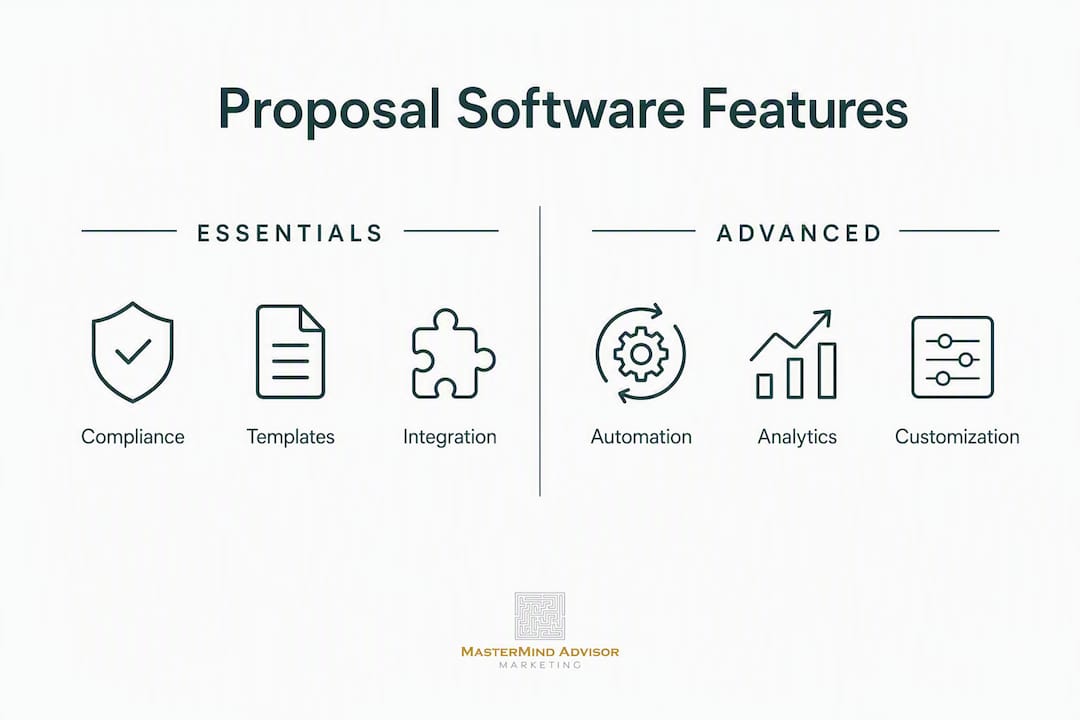
Not every platform that calls itself a "marketing solution" is built for the compliance and relationship complexity of financial services. Here is what separates a genuine advisor-grade system from a generic marketing tool.
| Feature | Why It Matters | Minimum Standard |
|---|---|---|
| Webinar/seminar production | Targeted lead capture with high intent; virtual and in-person formats reach different prospect segments | Full production support, not just a Zoom link |
| Compliance-vetted content library | Audit-ready materials that satisfy SEC Marketing Rule documentation | Audit log per asset, version control |
| High-converting advisor website | First impression and lead-capture hub; generic templates lose prospects | Advisor-specific design with opt-in tracking |
| CRM and calendar integration | Faster conversion; no lead falls through a manual handoff | CRM sync within days of opt-in |
| Automated email drip sequences | Nurtures prospects through a lengthy decision cycle without manual effort | a series of emails over a sustained period |
| Social media scheduling | Consistent visibility without daily time investment | Pre-approved, compliance-cleared posts |
| Lead tracking and reporting | Shows what is working at each funnel stage | Booked-meeting attribution, not just clicks |
| Security and data controls | Protects client prospect data; required for regulatory credibility | SOC 2 or equivalent, opt-in audit trail |
Lead generation landing pages are the connective tissue between your webinar traffic and your CRM. A weak landing page wastes every dollar spent on lead capture upstream. Insist on advisor-specific templates with tested conversion rates, not a generic drag-and-drop builder.

Content and SEO remain the highest long-term ROI channels for advisory practices, which means your website needs to be more than a digital business card. Local, niche, and technical SEO built into the platform architecture is a feature, not an add-on.
How do you evaluate vendors before signing a retainer?
Discovery calls reveal more than sales decks. Ask these questions directly:
- RIA-specific case studies: — Which independent advisors have you worked with, and what were the measurable outcomes at 90 days?
Pricing models break into two shapes. Retainer-based engagements cover ongoing production, CRM management, and reporting for a fixed monthly fee. Project fees apply to one-time deliverables like a website build or a single webinar series. Most advisors benefit from a retainer because the flywheel effect requires continuity. Independent RIAs typically allocate a moderate portion of their gross revenue to marketing, with growth-stage practices generally budgeting a higher range. Use those ranges as a sanity check against any vendor's pricing.
| Stage | Timeline | What You Should See |
|---|---|---|
| Discovery | Week 1–2 | Strategy map, ICP definition, channel selection |
| Setup/Build | Week 3–6 | Website live, CRM configured, first content assets approved |
| First lead | Week 6 | Webinar registrations, opt-ins, initial nurture sequence active |
| Measurable pipeline | Day 60–90 | Booked discovery calls, conversion rate baseline established |
Red flags to walk away from: no RIA-specific case studies, vague reporting that tracks impressions instead of meetings, no audit trail for content assets, and any promise of immediate high-AUM clients without documented evidence.
Third-party lead platforms can accelerate volume but often deliver inconsistent lead quality and require strict compliance oversight on your end. Owned channels, built through a turnkey system, give you control over both quality and documentation.
What do real advisor outcomes look like after switching to a turnkey system?
Advisors who move from fragmented tactics to an integrated marketing system consistently report two things: more qualified leads and shorter time-to-meeting. The shift is not about doing more; it is about connecting what was already being done.
A second pattern shows up in practices that had previously relied on referrals alone. Adding a webinar-driven lead capture channel, connected to an automated nurture sequence, produces a measurable second pipeline that does not depend on existing client relationships.
The common thread: measurable improvement happens when the funnel is complete, not when individual tactics are improved in isolation.
What does a 90-day onboarding roadmap look like?
Phase 1: Discovery (Days 1–14)
- Define your ideal client profile and niche
- Map existing assets (website, email list, CRM)
- Agree on success metrics: booked meetings, not impressions
Phase 2: Build (Days 15–42)
- Website goes live with advisor-specific design and opt-in tracking
- CRM configured and integrated with lead capture forms
- First compliance-vetted content assets approved and scheduled
- Webinar topic and format confirmed; registration page live
Phase 3: Launch (Days 43–60)
- First webinar or seminar executed
- Automated email nurture sequence active (5–7 emails over 30–60 days)
- Social media scheduling running on pre-approved content calendar
Phase 4: Optimize (Days 61–90)
- First qualified leads and booked discovery calls tracked
- Conversion rate baseline established from opt-in to meeting
- Reporting reviewed; underperforming channels adjusted before month four
By day 90, a well-run system should show at least one booked discovery call from the webinar pipeline, an active nurture sequence with measurable open and click rates, and a clear picture of cost-per-lead against your revenue percentage target.
What is the verdict, and what should you do next?
The turnkey route wins for independent advisors because it removes the coordination tax. You are not managing a web developer, a content writer, a CRM admin, and a compliance reviewer separately. One system, one point of contact, one reporting dashboard.
Marketing automation is not a luxury for growth-stage RIAs; it is the mechanism that turns a single webinar into a 90-day nurture sequence without adding hours to your week. The advisors who grow fastest are not the ones who market harder. They are the ones who built a system and let it run.
Your next step: Schedule a 30-minute discovery call with Mastermindadvisormarketing to get a pricing range and a proposed onboarding timeline specific to your practice size and revenue stage.
Key Takeaways
A turnkey marketing system built for independent advisors outperforms fragmented tactics because it connects lead capture, compliance-ready content, CRM automation, and reporting into one managed flywheel.
| Point | Details |
|---|---|
| Choose turnkey over fragmented | Tactical fragmentation is the primary reason advisor marketing fails; an integrated system fixes it. |
| Insist on CRM integration | CRM sync within days of opt-in prevents leads from going cold during the typically long sales cycle in financial advising. |
| Budget by revenue percentage | Independent RIAs typically spend 2–5% of gross revenue on marketing; growth-stage practices commonly spend 5–8%. |
| Expect a 30–90 day ramp | First qualified leads and booked discovery calls typically appear after some weeks of onboarding. |
| Mastermindadvisormarketing | Delivers the full turnkey system: webinars, compliance content, CRM integration, email nurture, and high-converting websites. |
Why the turnkey approach is the only one worth building on
Most advisors I talk to have tried at least two or three of the right tactics. A webinar here, a drip sequence there, a LinkedIn post schedule that lasted six weeks. The tactics were not wrong. The missing piece was always the connection between them.
The reason Mastermindadvisormarketing builds the system the way it does, starting with webinars and compliance-vetted content and running everything through a CRM, is that advisors do not have time to be marketing directors. The webinar is not just a lead-capture event. It is the first step in a documented, audit-ready sequence that moves a prospect from curious to committed without requiring the advisor to manually follow up after every touchpoint. That is what a real system does. And the advisors who commit to it long enough to see the 90-day results rarely go back to doing it any other way.
Mastermindadvisormarketing: what you get and how to get started
Independent advisors who want qualified leads without managing five separate vendors get one thing from Mastermindadvisormarketing: a complete, done-for-you marketing engine built around how financial services actually sells.
Deliverables include fully produced webinars and seminars (virtual and in-person), a compliance-ready content library with audit logs, a high-converting advisor website, CRM and calendar integration, automated email nurture sequences, and scheduled social media content. Everything is built for the SEC Marketing Rule environment, so you are not retrofitting compliance after the fact.
On an initial 30-minute discovery call, you will get a pricing range tied to your practice size, a proposed onboarding timeline, and a clear picture of what 90-day results look like for an advisor at your revenue stage. No vague promises, no impressions-based success metrics.
Book your discovery call and get a turnkey system that starts producing trackable leads within 60 days of launch.
Useful sources and further reading
When you are vetting vendors or building your own evaluation framework, these sources give you the clearest picture of what works and what to watch out for:
- Building an RIA marketing funnel? Here's how to do it right | Financial Planning — the clearest explanation of tactical fragmentation and why integrated funnels outperform one-off tactics
- Solutions for Lead Generation: Pros & Cons for Financial Advisors in 2026 | Bedrock — channel-by-channel trade-offs including compliance risk and lead quality for each approach
- 18 Top Lead Generation Strategies for Financial Advisers | Growform — practical lead-capture tactics and multi-step form design strategies worth reviewing alongside any vendor evaluation
Consult these sources alongside your vendor's case studies and compliance documentation before signing any retainer agreement.