
Professional networks are the single most reliable growth engine available to independent financial advisors, providing referral pipelines, client service depth, and career resilience that no marketing budget alone can replicate. The role of professional networks for independent advisors goes well beyond casual relationship building. It is a structured, measurable practice that directly shapes how many clients you win and how well you serve them. Centers of Influence (COIs), the industry's recognized term for high-value professional contacts like CPAs, estate attorneys, and insurance specialists, now account for 13.9% of new client acquisition for advisors. That figure has grown steadily since 2021, and Cerulli Associates' research confirms the trend is accelerating.
How do professional networks drive client acquisition for independent advisors?
Referrals remain the dominant source of new advisory clients, with client and family referrals accounting for 52.4% of new business. COI referrals rank second. That positioning matters because COI referrals arrive pre-qualified. A CPA who sends a client to you has already established trust with that person. The prospect walks in expecting to work with you, not just interview you.
The mechanics of COI referral relationships are specific. Joint meetings, reciprocal referrals, and shared client interests are the top tactics Cerulli identifies for forming effective COI alliances. A joint meeting where you and a client's CPA sit together to discuss tax-efficient withdrawal strategies does two things at once. It solves a real client problem, and it shows the CPA exactly how you work. That demonstration is worth more than any elevator pitch.

63% of practice management professionals rate COI collaboration as highly effective for marketing. The reason is that COI relationships create a client ecosystem, not just a referral transaction. When your clients know their advisor, CPA, and estate attorney all communicate and coordinate, they feel genuinely supported. That feeling drives retention and word-of-mouth referrals on top of the COI channel itself.
Pro Tip: Track every COI referral in your CRM with the date, source, and outcome. After 90 days, review which COI relationships produced the most qualified prospects. Redirect your relationship-building time toward those contacts first.
| Referral source | Share of new client acquisition |
|---|---|
| Clients and family | 52.4% |
| Centers of Influence | 13.9% |
| COI growth since 2021 | Up from 12.5% |
The importance of advisor networks shows up clearly in these numbers. COI referrals grew while other channels held steady or declined, which signals that advisors who invest in professional relationships are pulling ahead of those who rely solely on client word-of-mouth.
What types of professional relationships matter most for advisors?
Not all professional relationships deliver the same value, and treating them as interchangeable wastes time. Three distinct categories define most advisor networks: COIs, peer advisors, and specialist collaborators.
COIs are professionals in adjacent fields who serve the same client demographic you do. CPAs, estate attorneys, insurance specialists, and mortgage brokers are the most common. They refer clients because doing so serves their own clients well, not because they owe you a favor. That distinction matters. Durable professional alliances develop through mutual respect and shared client-first commitment, not through frequent social events or transactional arrangements. The advisors who build the strongest COI relationships focus on being genuinely useful to the COI's clients, not on asking for referrals.
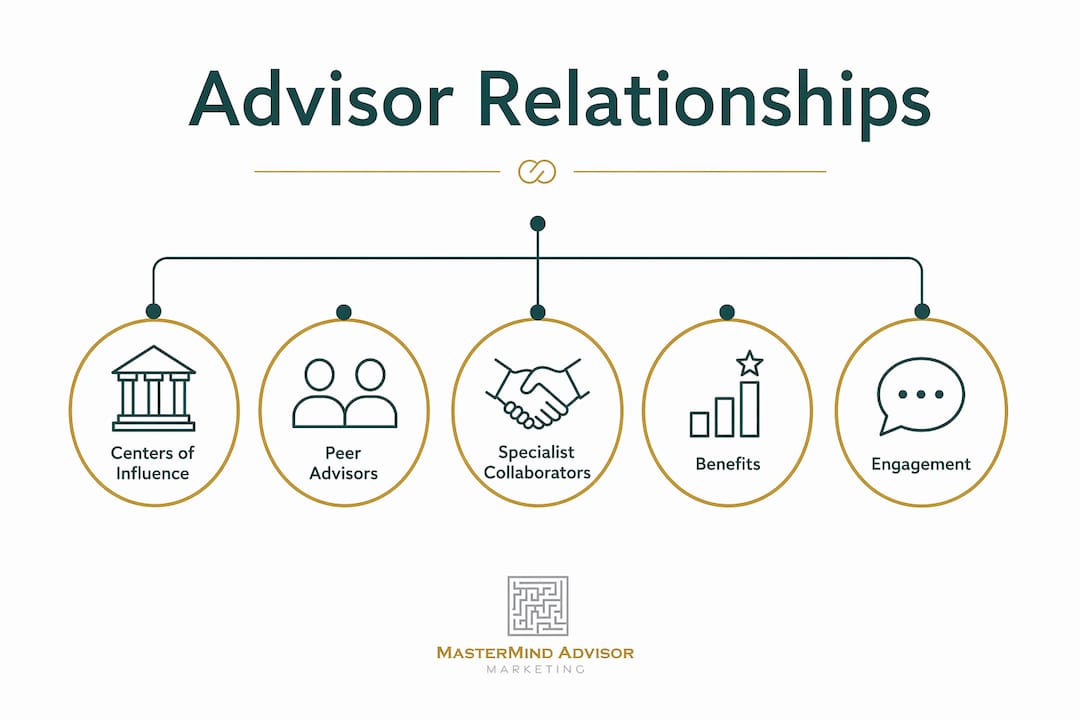
Peer advisors are colleagues at the same career stage or in complementary specialties. A peer who focuses on business owner planning can send you retiree clients who no longer fit their practice, and you can return the favor. These relationships work best when both advisors have clearly defined niches. Vague positioning makes it hard for a peer to know who to send your way.
Specialist collaborators sit outside the financial planning world entirely. Think of a geriatric care manager who works with aging clients, or a business valuation expert who serves entrepreneurs. These relationships rarely produce high referral volume, but the referrals they do produce are often complex cases with significant assets and deep planning needs.
| Relationship type | Primary benefit | Best engagement approach |
|---|---|---|
| Centers of Influence | High-quality referrals | Joint client meetings, reciprocal introductions |
| Peer advisors | Niche-specific referrals | Regular case discussions, defined specialty boundaries |
| Specialist collaborators | Complex, high-value cases | Co-hosted educational events, shared client resources |
Effective professional networks require tailored engagement for each relationship type. A formal referral agreement works well with a CPA. An informal lunch twice a year works better with a specialist collaborator you rarely need but want to keep warm.
Pro Tip: Create a simple relationship map with three columns: COIs, peers, and specialists. Rate each contact on a 1–3 scale for referral quality and recency of contact. Any contact rated 1 on both dimensions gets a personal outreach within the week.
How can independent advisors build and maintain their networks?
Building a professional network that actually produces referrals requires a system, not sporadic effort. Advisors who treat networking like a portfolio, with consistent quarterly tracking and 48-hour follow-up after every meeting, build stronger pipelines over time. The 48-hour rule is specific and worth adopting. A follow-up email sent two days after a first meeting has a dramatically higher response rate than one sent two weeks later.
Start with professional associations. The Financial Planning Association (FPA) and the National Association of Personal Financial Advisors (NAPFA) both offer local chapter meetings, study groups, and national conferences. These venues put you in the same room as CPAs, attorneys, and peer advisors who are actively looking for trustworthy colleagues to refer clients to. Showing up consistently matters more than showing up perfectly.
Value-first networking outperforms direct referral requests every time. Before you ask a CPA for a referral, send them a tax planning article relevant to a client type you both serve. Invite them to a client education event you are hosting. Share a case study (anonymized) that shows how you handled a complex situation their clients might face. These gestures position you as a resource, not a salesperson.
Shared interests and co-hosted events build authentic connections that formal networking rarely achieves. An advisor who organizes a golf outing for local CPAs and attorneys creates two hours of unstructured conversation that no conference breakout session can replicate. The key is genuine shared interest. If you do not play golf, do not host a golf event. Pick an activity you actually enjoy, and the authenticity shows.
- Join FPA or NAPFA and attend at least one local chapter meeting per month.
- Follow up within 48 hours after every new professional contact.
- Host or co-host one educational event per quarter with a COI partner.
- Send one value-add resource per month to your top 10 COI contacts.
- Review your relationship map quarterly and identify contacts that have gone cold.
Digital networking complements in-person efforts but does not replace them. LinkedIn is the most effective platform for maintaining visibility with professional contacts between meetings. Posting a short insight on tax planning, estate law changes, or retirement income strategies keeps you visible to COIs who may not see you for months at a time. For deeper community building, independent advisor community examples show how advisors use online groups and forums to stay connected with peers across geographic boundaries.
What operational advantages come from a broad independent network?
A broad professional network does more than generate referrals. It makes you a better advisor by giving your clients access to coordinated expertise they cannot get from a single firm. Collaborating with estate attorneys, tax advisers, and insurance experts equips clients with support that goes far beyond portfolio management. When a client faces a business sale, a divorce, or a parent's estate, you can connect them with the right specialist immediately. That speed and coordination builds loyalty that no investment return alone can create.
Independent networks also protect clients when professionals change firms or retire. A captive network tied to a single firm collapses when a key person leaves. An independent advisor's network, built across multiple firms and specialties, remains flexible and functional regardless of personnel changes. You can always find another estate attorney or tax specialist who fits a specific client's needs.
- Clients get faster access to estate planning, tax strategy, and insurance review.
- Advisors can coordinate multi-professional solutions for complex life transitions.
- Network independence prevents single-point failures when a COI retires or relocates.
- Advisors who connect clients to the right specialists earn a reputation as a trusted hub, not just a portfolio manager.
The relationship marketing principles that drive client loyalty in professional services apply directly here. Clients who feel their advisor actively manages a team of experts on their behalf stay longer and refer more often than clients who see their advisor as a solo practitioner.
Key Takeaways
Professional networks are the most cost-effective client acquisition and retention tool available to independent financial advisors, with COI relationships producing measurable, growing referral volume.
| Point | Details |
|---|---|
| COIs drive measurable growth | COI referrals grew from 12.5% to 13.9% of new client acquisition between 2021 and 2026. |
| Quality beats quantity in relationships | Durable alliances form through mutual respect and shared client focus, not frequent social events. |
| Systematic follow-up is non-negotiable | A 48-hour follow-up rule and quarterly relationship reviews prevent pipeline decay. |
| Independent networks protect clients | Broad, firm-agnostic networks keep clients connected to specialists even when professionals move or retire. |
| Value-first networking outperforms asking | Sending resources and hosting events builds trust faster than direct referral requests. |
Why most advisors underestimate their network's potential
Most advisors I have observed treat their professional network like a contact list. They add names, attend a few events, and then wait for referrals to appear. That approach produces occasional results and a lot of frustration.
The advisors who build genuinely productive networks treat the activity like managing a client portfolio. They segment their contacts, track engagement, and make deliberate decisions about where to invest their time. They also accept that networking advances advisor resilience in ways that go beyond referrals. A strong network means you always have someone to call when a client faces a problem outside your expertise. That capability is what separates a good advisor from a great one.
The other mistake I see constantly is advisors who network transactionally. They show up to events, hand out cards, and follow up with a referral request within a week. That approach signals to every professional in the room that you are there for yourself, not for them. The advisors who build the most referral-rich networks are the ones who give first, consistently, and without keeping score. The importance of networking in marketing research confirms this: relationships built on genuine value exchange outperform transactional ones in both volume and quality of referrals.
Measure your network's output every quarter. Count referrals received, referrals given, and joint meetings held. If those numbers are flat or declining, the problem is almost always inconsistent follow-up or a failure to provide value between meetings. Fix the process before you add more contacts.
— Josh
How Mastermindadvisormarketing supports your network-building efforts
Building a professional network takes time, but the right tools accelerate the process significantly. Mastermindadvisormarketing offers independent advisors a turnkey system that includes customized seminars and webinars designed to attract both prospective clients and COI partners to the same room.

Hosting a well-run educational event is one of the fastest ways to establish credibility with CPAs and attorneys in your market. Mastermindadvisormarketing provides the event framework, follow-up automation, and CRM integration that make those events repeatable and measurable. Advisors who use the platform report stronger COI relationships and more consistent referral pipelines. Learn how to host effective seminars that position you as the go-to advisor in your community, or visit Mastermind Advisor to see the full suite of tools built specifically for independent advisors.
FAQ
What are Centers of Influence for financial advisors?
Centers of Influence (COIs) are professionals in adjacent fields, such as CPAs, estate attorneys, and insurance specialists, who serve the same client demographic as a financial advisor and can refer clients based on shared professional trust.
How much of new client acquisition comes from COI referrals?
COI referrals account for 13.9% of new client acquisition for advisors as of early 2026, up from 12.5% in 2021, making them the second-largest referral source after clients and family.
What is the most effective way to build COI relationships?
Joint client meetings, reciprocal referrals, and consistent value-first outreach are the most effective tactics. Cerulli Associates research identifies joint meetings as the top strategy for forming durable COI alliances.
How often should advisors follow up with their professional contacts?
Advisors should follow up within 48 hours after any new professional meeting and conduct a full relationship review quarterly to identify contacts that have gone cold and need re-engagement.
Why do independent advisors benefit more from broad networks than captive ones?
Independent networks span multiple firms and specialties, so they remain functional when individual professionals retire or change firms. Captive networks tied to a single firm create single-point failures that disrupt client access to specialists.