

Independent advisor online visibility is defined as the degree to which a potential client can find, verify, and trust an independent financial advisor through search engines, social media, client reviews, and AI-driven platforms. This is not a soft marketing concept. 83% of consumers research an advisor's reputation online before making contact, and 72% visit advisor websites during due diligence. That means your digital presence is doing the first meeting before you ever shake a hand. Advisors who treat online visibility as optional are, in practice, invisible to a majority of prospects. The SEC's review disclosure rules add a compliance layer that makes this even more complex to get right.
What is independent advisor online visibility made of?
Online visibility for an independent financial advisor is not a single thing. It is a combination of search engine rankings, social media presence, independent client reviews, media mentions, and structured content that AI tools can read and cite. Each element reinforces the others.
Search engine optimization (SEO)
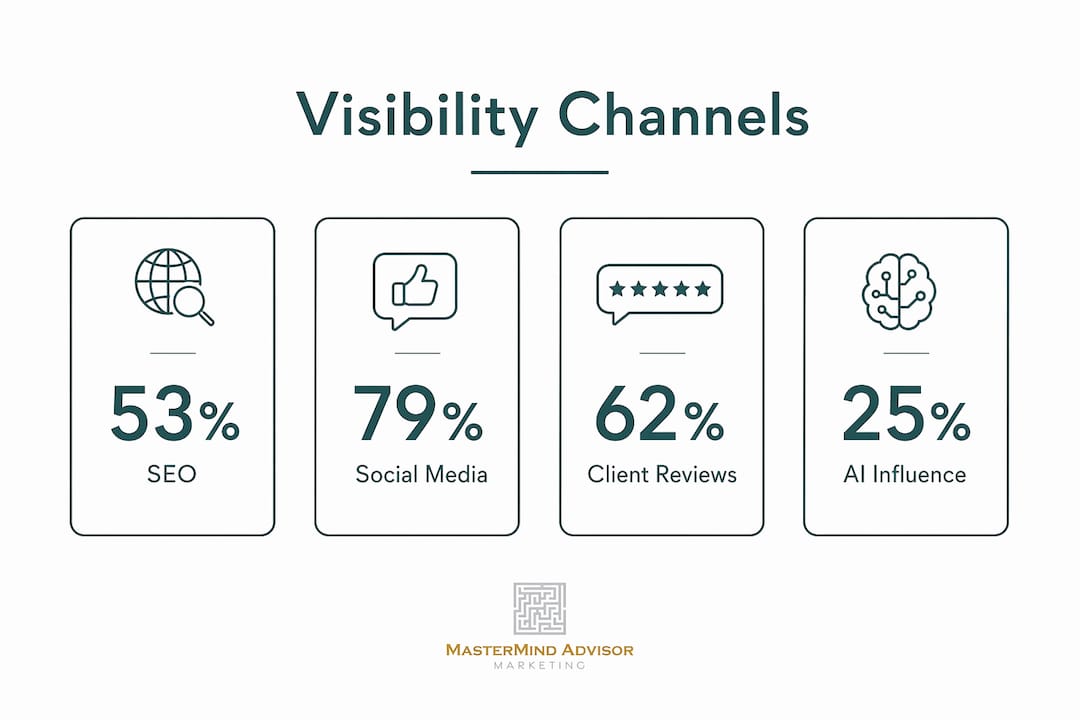
SEO is the foundation. 53% of advisory firms use SEO as their primary digital marketing tool. A well-built website with clear service pages, location-specific content, and client-centered language ranks higher in Google and drives organic traffic from people actively searching for an advisor.

Answer engine optimization (AEO) and generative engine optimization (GEO)
AEO and GEO are the newer disciplines. Generative engine optimization and answer engine optimization represent a frontier where advisors must make their thought leadership clear and citable for AI tools like ChatGPT and Perplexity. These platforms pull answers from structured, authoritative content. If your website does not have that content, you will not appear in AI-generated responses.
Social media presence
Social media is not optional for advisors who want to reach younger investors. 79% of Gen Z and Millennials use social media to source financial advice. Advisors who generate leads through social media post approximately 35 times per month, mixing original content with direct engagement. That is a real commitment, but the payoff in reach and trust is measurable.
Independent client reviews
Reviews on third-party sites carry more weight than testimonials on your own website. 62% of leads still come from referrals, but every referred prospect digitally validates the advisor using independent review platforms. SEC guidelines require transparent disclosures when displaying client reviews, so compliance is part of the review strategy, not an afterthought.
Pro Tip: Run a free GEO audit on your website to see whether AI tools can currently find and cite your content. Most advisors are surprised by how little of their site is structured for AI discoverability.
Why do independent advisors struggle with visibility?
The gap between knowing visibility matters and actually achieving it is wide. Several specific obstacles explain why independent advisors struggle with visibility more than their wirehouse counterparts.
- Compliance constraints. SEC disclosure rules govern how advisors present client testimonials, performance claims, and endorsements online. Many advisors avoid publishing content at all rather than risk a violation. The result is a sparse digital presence that prospects interpret as a lack of credibility.
- Volume versus authenticity confusion. The instinct is to post more. The reality is that digital visibility is about authenticity at scale, not volume. An outdated website or a LinkedIn profile with three posts from 2022 actively damages trust, even when a referral has already been made.
- Time allocation. Independent advisors run their own practices. Every hour spent on content creation is an hour not spent with clients. Without a system or outside support, digital marketing gets deprioritized until it becomes a crisis.
- Misunderstanding AI search. Most advisors still think of Google as the only search channel that matters. AI tools are already changing referral dynamics, especially for under-45 investors who use multiple digital methods simultaneously. Advisors who ignore this shift risk becoming invisible to an entire generation of prospects.
- Lack of a documented strategy. Without a written plan, visibility efforts are reactive and inconsistent. Consistency is what builds trust over time, and inconsistency is the most common reason digital marketing fails for independent advisors.
How to improve online visibility as an independent advisor
Improving your independent advisor online presence requires a structured approach, not a collection of one-off tactics. The following steps build on each other.
-
Build a client-centered website. Your website is the hub of your digital presence. 55% of advisory firms tailor their websites to an ideal client persona. That means writing for a specific person, not for every possible prospect. A page that speaks directly to pre-retirees in the Pacific Northwest converts better than a generic "we serve all clients" homepage. Learn more about why a website matters for independent advisors in 2026.
-
Add structured FAQ and Q&A pages. FAQ pages using natural language queries are among the most effective formats for AI discoverability. Write questions the way a client would actually ask them: "How do I know if I need a financial advisor?" performs better than "Financial advisor services overview."
-
Collect independent, SEC-compliant reviews. Ask satisfied clients to leave reviews on third-party platforms. Document your disclosure process to stay within SEC guidelines. Reviews on independent sites carry more trust than anything you publish about yourself.
-
Post consistently on social media. Choose one or two platforms where your ideal clients spend time. LinkedIn works well for professionals and business owners. Post original content, respond to comments, and engage with others in your niche. Consistency over 90 days produces more results than a burst of activity followed by silence.
-
Combine digital with live events. Webinars and in-person seminars generate leads that digital content alone cannot always close. Combining digital and traditional marketing tactics produces compounding results. A seminar attendee who also follows you on LinkedIn and receives your email newsletter is far more likely to become a client.
-
Document your ideal client persona and value proposition. Top-performing advisory firms that document these two elements gain 67% more new clients and 68% more assets than firms that do not. Clarity about who you serve and why you are the right choice makes every piece of content more effective.
Pro Tip: Use marketing automation tools to maintain consistent email follow-up after events and content downloads. Automation keeps you present in a prospect's mind without requiring daily manual effort.
The table below shows which visibility channels produce the strongest results for each advisor goal.
| Goal | Best channel | Why it works |
|---|---|---|
| Attract new prospects | SEO + FAQ content | Captures active searchers at the moment of intent |
| Build trust with referrals | Independent reviews | Third-party validation confirms what the referral said |
| Reach younger investors | Social media (LinkedIn) | 79% of Gen Z and Millennials use social for financial advice |
| Stay visible in AI search | GEO and AEO content | Structured content gets cited by ChatGPT and Perplexity |
| Nurture warm leads | Email automation | Consistent follow-up converts interest into appointments |
How is AI reshaping online visibility for advisors?
AI is not a future concern. It is already changing how prospects find advisors. 25% of mass-affluent Americans planned to use AI search tools like ChatGPT to find financial advisors as of 2025–2026. That number will grow.
The shift from traditional SEO to AI-driven search requires a different type of content. Traditional SEO rewards keyword density and backlinks. AI tools reward clarity, structure, and authority. A well-written FAQ page that directly answers "What does a fee-only financial advisor charge?" is more likely to appear in a ChatGPT response than a 2,000-word article stuffed with keywords.
GEO and AEO require advisors to think like the AI. What question is a prospect asking? What is the clearest, most direct answer? What proof of expertise supports that answer? Advisors who write content this way become citable sources. Those who do not become invisible in AI-generated results.
The practical steps are straightforward. Write FAQ pages in natural language. Use clear headings that match real questions. Publish original analysis and commentary that demonstrates expertise. Build online trust through consistent, authoritative content that AI tools can verify against other sources.
AI tools also pull from social media profiles and third-party review sites. An advisor with a complete LinkedIn profile, a set of verified independent reviews, and a structured website gives AI tools multiple signals to confirm credibility. An advisor with none of those elements simply does not appear.
Key Takeaways
Independent advisor online visibility is built through consistent, structured, and authentic digital presence across search, social, reviews, and AI-ready content.
| Point | Details |
|---|---|
| Visibility starts with a client-centered website | Tailor your site to a specific ideal client persona to convert visitors into prospects. |
| AI search requires structured content | FAQ pages and natural language Q&A formats get cited by ChatGPT and Perplexity. |
| Independent reviews outperform self-published testimonials | Third-party review sites build trust that your own website cannot replicate. |
| Social media is non-negotiable for younger investors | 79% of Gen Z and Millennials use social media to source financial advice. |
| Documented strategy produces measurable results | Firms with documented personas and value propositions gain 67% more new clients. |
Why authenticity beats volume every time
Most advisors I talk to assume visibility is a numbers game. Post more, publish more, show up everywhere. That instinct is wrong, and I have seen it backfire repeatedly.
A prospect who receives a referral will Google you within minutes. What they find either confirms the referral or kills it. A LinkedIn profile with 12 posts from three years ago, a website that has not been updated since 2021, and zero independent reviews sends one clear message: this advisor does not take their digital presence seriously. The referral dies before the first call.
The advisors who build real visibility do the opposite. They pick two or three channels and show up consistently. They write content that actually answers client questions, not content designed to impress other advisors. They collect reviews on independent platforms and keep their website current. Over 12 to 18 months, that consistency compounds into a digital footprint that converts referrals, attracts organic search traffic, and appears in AI-generated results.
AI is the part most advisors are not thinking about yet. That is actually an opportunity. The advisors who structure their content for AI discoverability now will have a significant head start when AI-driven advisor searches become the norm. The window to act is open. It will not stay open forever.
The financial services digital marketing environment in 2026 rewards advisors who treat visibility as a long-term investment, not a quarterly campaign. Build the foundation now. The results follow.
— Josh
How Mastermindadvisormarketing supports your online visibility
Independent advisors who want to build real digital presence without sacrificing client time have a clear path forward with Mastermindadvisormarketing.
Mastermindadvisormarketing offers a turnkey marketing system built specifically for independent financial advisors. The platform combines custom CRM tools, automated email follow-up sequences, and content marketing strategies designed to keep you visible and compliant. Webinars, seminars, and social media support are integrated into a single system, so you are not managing five separate tools. Advisors who have used the platform report stronger lead pipelines and more consistent client engagement. See how it works and find out whether it fits your practice.
FAQ
What is independent advisor online visibility?
Independent advisor online visibility is the degree to which a potential client can find and verify an independent financial advisor through search engines, social media, client reviews, and AI-driven platforms. It directly affects whether prospects contact you or choose someone else.
Why do most advisors struggle to build online visibility?
The main barriers are SEC compliance constraints, lack of time, and misunderstanding how AI search works. Most advisors underestimate how much a sparse or outdated digital presence costs them in lost referral conversions.
How does AI affect how prospects find financial advisors?
AI tools like ChatGPT pull answers from structured, authoritative content on advisor websites and social profiles. Advisors without FAQ pages, clear expertise signals, or independent reviews are unlikely to appear in AI-generated advisor recommendations.
How often should an advisor post on social media?
Advisors who generate leads through social media post approximately 35 times per month, combining original content with direct engagement. Consistency matters more than volume on any single day.
Do independent client reviews really matter for visibility?
Reviews on third-party platforms carry more trust than testimonials on your own website. All referred prospects digitally validate advisors using independent review sites, making reviews a critical part of the conversion process.