
Marketing automation is software that handles repetitive marketing tasks — email sequences, lead follow-ups, appointment reminders, and client segmentation — without manual effort from the advisor. Financial advisors who adopt it gain a measurable edge: 76% of businesses using marketing automation report a positive ROI within the first year. That figure matters because most advisors are already stretched thin managing clients, compliance, and business development simultaneously. Understanding why advisors need marketing automation starts with recognizing that time is the scarcest resource in any advisory practice, and automation is the most direct way to protect it.
Why advisors need marketing automation to stay competitive
Marketing automation for financial advisors is not a luxury add-on. It is the infrastructure that keeps a practice running when the advisor is in client meetings, on the road, or simply unavailable. Without it, leads go cold, follow-ups get missed, and prospects choose a competitor who responded faster.
The core problem is simple: advisors cannot personally manage every touchpoint across a growing client base. Automated workflows handle onboarding, appointment scheduling, and educational content delivery without the advisor lifting a finger. That consistency builds trust at scale, which is exactly what a growing practice needs.

Automation also connects marketing, sales, and client management around a shared view of customer data, which improves lead quality and shortens the time from first contact to signed client. For advisors, that means fewer dropped balls and a cleaner pipeline.
How does automation improve efficiency and lead management?
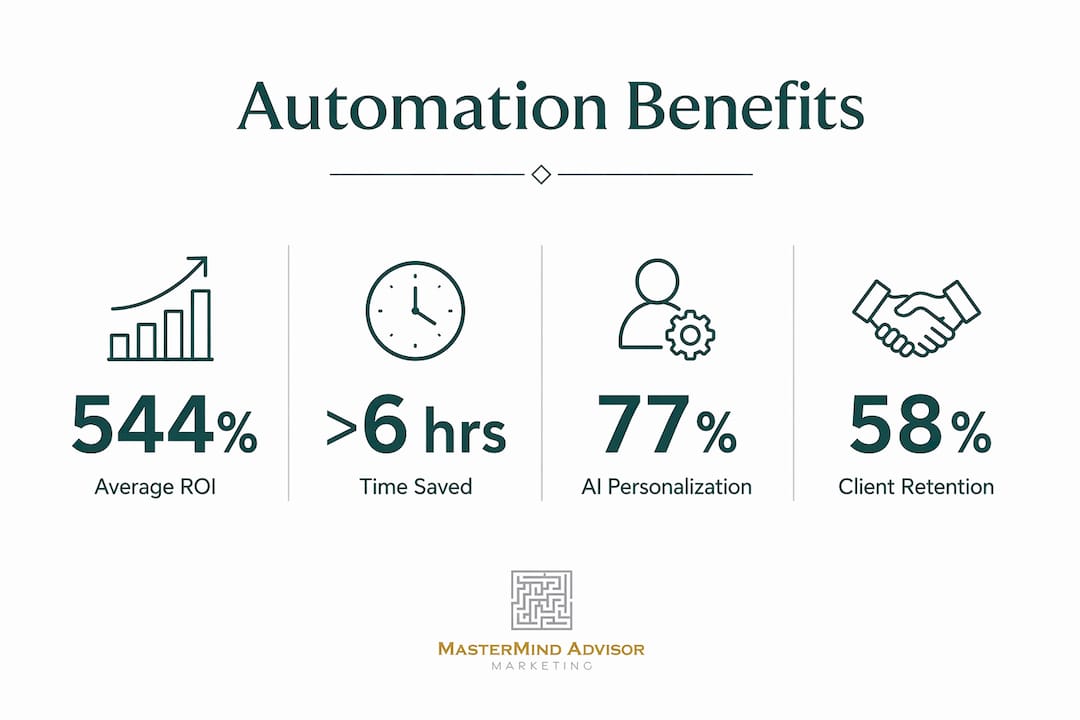
Efficiency is the most immediate benefit advisors feel when they implement marketing automation. Automation saves more than 6 hours per week by eliminating repetitive manual tasks. Six hours per week is roughly a full workday every month returned to high-value activities like financial planning and client consultations.
Lead management improves just as dramatically. Businesses using automation report an 85% more efficient lead management process. For advisors, that translates to faster response times, consistent follow-up sequences, and fewer prospects falling through the cracks.
Here is what a typical automated advisor workflow looks like in practice:
- A prospect registers for a webinar. The system immediately sends a confirmation email, a calendar invite, and a pre-event educational sequence.
- After the webinar, the system triggers a follow-up email series based on whether the prospect attended, partially attended, or missed the event.
- If the prospect clicks a specific link about retirement planning, the CRM tags them and routes them into a retirement-focused nurture sequence.
- After 14 days without a response, the system flags the lead for a personal outreach call from the advisor.
This kind of workflow runs without the advisor touching it. The advisor only steps in when a lead is warm and ready for a real conversation. For advisors building their digital lead pipeline, this structure is the difference between a scalable practice and a chaotic one.
Pro Tip: Set up a lead scoring system in your CRM so automation routes only the highest-intent prospects to your personal follow-up queue. This keeps your calendar focused on conversations that convert.
What personalization capabilities does automation offer advisors?
Personalization at scale is the feature most advisors underestimate before they use it. Automation personalizes communications using behavioral data triggers, meaning the system sends the right message based on what a prospect or client actually does, not just who they are.
77% of marketing automation users use AI tools for personalization. That means the majority of advisors using automation are already delivering tailored content without writing individual emails. The system segments contacts by age, life stage, asset level, or expressed interest and delivers relevant content automatically.
The table below shows the difference between manual and automated personalization in an advisory context:
| Task | Manual approach | Automated approach |
|---|---|---|
| Post-meeting follow-up | Advisor writes individual email | System sends personalized recap within minutes |
| Birthday or milestone outreach | Advisor relies on memory or assistant | CRM triggers a personal note automatically |
| Educational content delivery | Advisor selects and sends manually | Behavioral tags route relevant articles to each client |
| Seminar reminder sequence | Staff sends one generic reminder | System sends 3-touch sequence tailored to registration status |
| Re-engagement of cold leads | Advisor reviews list periodically | Automation triggers a re-engagement sequence after inactivity |
Consistent automated check-ins and educational content after onboarding strengthen client retention. In fact, 58% of automation users report timelier follow-ups as a direct result. Timely follow-ups signal to clients that their advisor is attentive, even when the advisor is focused elsewhere.
Pro Tip: Use life-event triggers in your CRM, such as a client turning 65 or a child reaching college age, to send proactive planning content. Clients remember advisors who reach out before they have to ask.
How does automation support scalable growth for advisory firms?
Growth creates a paradox for advisors. The more clients you add, the less time you have for marketing. Kitces Research calls this the capacity crossroads, the point where advisor-led marketing becomes unsustainable without systems to support it. Advisor time costs can represent nearly 8% of marketing expenses as firms scale. That cost compounds quickly without automation absorbing the repetitive work.
The solution is treating marketing as a systemic infrastructure rather than a series of one-off tasks. Advisors who build automated systems, similar to how they use a CRM for client records, create a foundation that grows with the practice. The system does not get tired, forget to follow up, or take a vacation.
The key is knowing which tasks to automate and which to keep personal. Here is a practical breakdown:
- Automate lead nurturing sequences. Prospects who are not ready to meet still need consistent contact. Automation handles this without advisor involvement.
- Automate appointment reminders and confirmations. These are high-frequency, low-complexity tasks that consume staff time unnecessarily.
- Automate post-meeting follow-ups. A summary email with next steps can be templated and triggered immediately after a meeting ends.
- Automate educational content distribution. Monthly newsletters, market updates, and planning guides go out on schedule without manual sending.
- Keep personal the first discovery call, complex planning conversations, and referral outreach. These require the advisor's voice, judgment, and relationship capital.
Advisory firms that differentiate tasks requiring advisor expertise from those suitable for automation avoid pipeline burnout and sustain growth through market cycles. Automation handles volume. The advisor handles depth.
What tools and best practices should advisors use for automation success?
The right tools make automation practical rather than overwhelming. Most advisors start with a CRM that supports automated workflows, such as Salesforce, Redtail, or Wealthbox, and layer in email sequence software on top. The goal is a connected system where client data flows between tools without manual data entry.
Best practices for financial advisors adopting automation include:
- Compliance first. Every automated communication must pass through your firm's compliance review before going live. Build approval workflows into your setup from day one.
- Segment before you automate. Sending the same message to a 35-year-old accumulator and a 68-year-old retiree is worse than sending nothing. Segment by life stage, goal type, and relationship status before building sequences.
- Measure open rates, click rates, and conversion rates. Automation generates data. Advisors who review that data monthly can identify which sequences convert and which need revision.
- Integrate with seminar and webinar marketing. Automated pre-event and post-event sequences dramatically increase attendance rates and convert more attendees into appointments.
The 544% average ROI on marketing automation comes from lower cost per campaign and reallocation of effort toward high-impact activities. Advisors who measure their results and adjust their sequences capture that return. Those who set it and forget it leave most of the value on the table.
For advisors building out their email campaign setup, the most effective starting point is a five-email onboarding sequence that introduces the advisor's philosophy, shares a client success story, and ends with a clear call to schedule a meeting. That sequence alone can replace dozens of hours of manual outreach per year.
Advisors should also connect automation to their marketing funnel so every stage from awareness to signed client has a defined automated touchpoint. Without that structure, automation becomes a collection of disconnected emails rather than a system that moves prospects forward.
Pro Tip: Review your automation sequences every quarter. Markets change, client concerns shift, and sequences that converted well in one environment may need updating. Treat your automation like a financial plan: review and adjust regularly.
Key takeaways
Marketing automation gives financial advisors the capacity to grow their practice without proportionally growing their workload.
| Point | Details |
|---|---|
| Automation saves significant time | Advisors recover more than 6 hours per week by eliminating repetitive manual tasks. |
| Lead management improves measurably | Businesses report 85% more efficient lead management after adopting automation. |
| Personalization scales with behavioral triggers | CRM-based segmentation delivers tailored content automatically based on client actions. |
| Growth requires systemic infrastructure | Advisors at the capacity crossroads must automate volume tasks to sustain firm growth. |
| ROI is documented and substantial | Marketing automation delivers an average 544% ROI by reducing campaign costs and improving conversion. |
Where automation ends and the advisor begins
I have worked with enough financial advisors to know that the biggest obstacle to adopting automation is not technical. It is psychological. Advisors worry that automating communications will make their practice feel impersonal, and that clients will notice they are getting a sequence rather than a personal note.
That concern is legitimate. But the advisors I have seen struggle most are not the ones who automated too much. They are the ones who tried to do everything manually and burned out by year three of growth. They were writing the same follow-up email for the fifteenth time that month while their pipeline sat unworked.
Automation does not replace the advisor's voice. It amplifies it. When you write a strong onboarding sequence once, every new client gets your best thinking delivered consistently. When you build a retirement planning content series, every prospect in that segment gets educated before they ever sit across from you. The advisor who shows up to that first meeting is not starting from zero. The relationship already has context.
The mindset shift is this: automation handles the repetitive, and you handle the irreplaceable. The advisors who grow fastest are the ones who get comfortable with that division of labor early. They use tools like marketing automation software to handle volume and reserve their personal attention for the conversations that require judgment, empathy, and trust.
The advisors still doing everything manually are not more personal. They are just slower.
— Josh
How Mastermindadvisormarketing helps advisors put automation to work
Mastermindadvisormarketing builds marketing systems specifically for independent financial advisors, which means the tools and workflows are designed around how advisors actually work, not adapted from generic small business templates.
The platform combines custom CRM integration, automated email follow-up sequences, and seminar marketing tools into one connected system. Advisors using Mastermindadvisormarketing do not have to stitch together separate tools or figure out compliance on their own. The system is built with advisory workflows in mind from the start. For advisors ready to build a practice that grows without requiring more hours, Mastermind Advisor is the place to start. The seminar marketing resources on the platform also show how to connect live events with automated follow-up sequences to convert more attendees into clients.
FAQ
What is marketing automation for financial advisors?
Marketing automation is software that handles repetitive marketing tasks, including email sequences, lead nurturing, and appointment reminders, without manual effort. For financial advisors, it keeps client communication consistent while freeing time for planning and relationship work.
How much time does marketing automation save advisors?
Automation saves more than 6 hours per week by eliminating repetitive manual tasks. That time compounds over a year into hundreds of hours redirected toward client-facing and revenue-generating activities.
Does automation make advisor communications feel impersonal?
Not when built correctly. Behavioral triggers and CRM segmentation allow advisors to send messages tailored to each client's life stage and goals automatically. The communication feels personal because it is based on what the client actually does and needs.
What is the ROI of marketing automation for advisors?
Businesses using marketing automation report an average 544% ROI, driven by lower cost per campaign and more efficient lead conversion. The industry-specific use cases for advisory firms show similar returns when automation is implemented with proper segmentation and measurement.
Which marketing tasks should advisors automate first?
Start with lead nurturing sequences, appointment reminders, and post-meeting follow-ups. These are high-frequency, low-complexity tasks that consume significant advisor time and are easy to template without losing the personal quality of the communication.