

A marketing funnel for financial advisors is a structured framework that maps how potential clients move from first discovering your advisory practice to becoming loyal, referring advocates. HubSpot, Amplitude, and Pipedrive define marketing funnels as structured pathways guiding prospects from initial exposure through conversion and beyond. For independent advisors, this model is not a marketing abstraction. It is the operational backbone of every client acquisition system worth building. Tools like HubSpot CRM and Pipedrive make funnel tracking measurable, so you can see exactly where prospects stall and what messaging moves them forward.
What is a marketing funnel for financial advisors?
A marketing funnel, also called a purchase funnel or client acquisition funnel, is a visual model representing the stages a prospect passes through before becoming a paying client. The term "funnel" reflects a simple truth: many people enter at the top through awareness, and progressively fewer reach the bottom through conversion. For financial advisors, this process carries unique weight because the decision to hire an advisor involves high trust, long consideration cycles, and multiple touchpoints before a prospect ever books a call.
Full-funnel marketing strategies address customer needs throughout awareness, purchase, and loyalty, which means the funnel does not end at the signed engagement letter. Advocacy, where satisfied clients refer peers and family, is the stage most advisors underinvest in. That oversight costs real revenue. Understanding the full funnel gives you a map for every dollar you spend on marketing and every hour you invest in client communication.

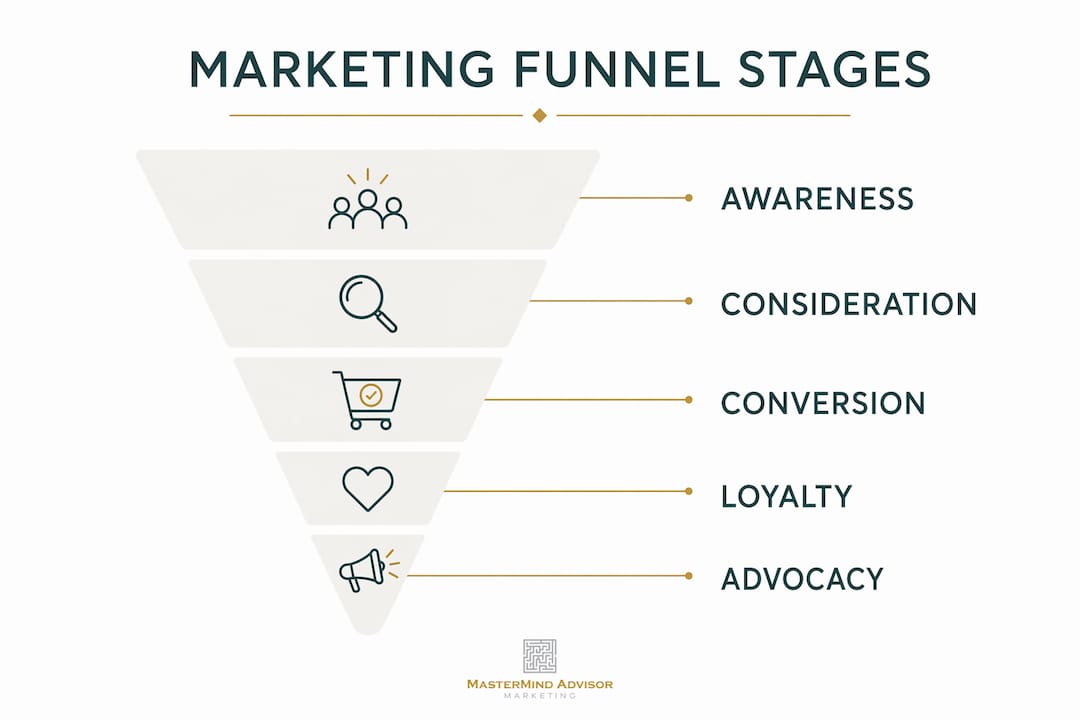
The marketing funnel definition most useful for advisors breaks into five stages: awareness, consideration, conversion, loyalty, and advocacy. Each stage demands different messaging, different channels, and different success metrics. Treating all prospects the same regardless of where they are in their journey is the single most common reason advisor marketing underperforms.
What are the main stages of a marketing funnel for financial advisors?
The five-stage funnel model gives advisors far more precision than the basic three-stage version (awareness, consideration, conversion). Here is how each stage maps to advisor-specific behavior and goals.
| Funnel stage | Prospect behavior | Strategic goal |
|---|---|---|
| Awareness | Discovers your practice via search, social, or referral | Generate visibility and first impressions |
| Consideration | Researches your credentials, reads content, compares options | Build credibility and educate |
| Conversion | Schedules a consultation or signs an engagement | Remove friction and close |
| Loyalty | Engages regularly, expands services, stays long-term | Deepen relationship and increase lifetime value |
| Advocacy | Refers peers, leaves reviews, participates in events | Turn clients into a growth channel |
The basic three-stage model (top, middle, bottom) works for simple consumer purchases. For advisor-specific funnel stages, the five-stage version is more accurate because it captures the post-conversion relationship that drives referral-based growth.
Classifying prospects correctly at each stage matters. A prospect who downloaded your retirement planning guide is in consideration, not conversion. Sending them a hard close message at that point breaks trust. B2B environments, including financial services, rarely follow a linear path. Buyers engage multiple stakeholders and research cycles, which means your funnel strategy must be flexible enough to re-engage prospects who go quiet and return weeks later.
Which metrics and KPIs should advisors monitor at each funnel stage?
Tracking funnel performance without defined KPIs produces noise, not insight. B2B funnel benchmarks for financial services include lead generation rates of 2 to 5%, MQL-to-SQL conversion rates of 20 to 40%, and win rates of 20 to 30%. These numbers give you a baseline for diagnosing whether your funnel has a traffic problem, a nurturing problem, or a closing problem.
Here are the core metrics to monitor at each stage:
- Awareness stage: Website traffic, social media reach, and content impressions. Low numbers here signal a visibility gap, not a messaging problem.
- Consideration stage: Email open rates, content downloads, webinar registrations, and time on page. These indicate whether your credibility-building content is resonating.
- Conversion stage: Consultation booking rate, proposal acceptance rate, and cost per acquisition. This is where most advisors focus, but it is rarely where the real problem lives.
- Loyalty stage: Client retention rate, service expansion rate, and net promoter score. High retention with low expansion means clients are satisfied but not fully engaged.
- Advocacy stage: Referral rate and review volume. A referral rate below 20% for an established practice suggests the advocacy stage is being ignored entirely.
Analyzing metrics at each funnel stage reveals which step needs optimization to improve overall conversion rates. That is a critical distinction. Advisors who only look at total leads miss the bottleneck sitting two stages upstream.
Pro Tip: Set a monthly funnel review using your CRM dashboard. Compare stage-to-stage conversion rates month over month, not just total lead volume. A 5% improvement in MQL-to-SQL conversion compounds faster than doubling your ad spend.
How do content and marketing tactics change along the funnel?
Funnel effectiveness depends on delivering the right message at the right moment based on prospect stage, not just generating volume. This principle reshapes how advisors should think about content investment. Producing one type of content for all prospects is the equivalent of giving every client the same financial plan regardless of their goals.
Here is how content and tactics shift at each stage:
- Top of funnel (awareness): LinkedIn articles, YouTube explainers, SEO-optimized blog posts, podcast appearances, and paid social ads. The goal is reach, not conversion. Content should address broad financial concerns like retirement readiness or tax efficiency without asking for anything in return.
- Middle of funnel (consideration): Webinars, case studies, email nurture sequences, free consultations, and downloadable guides. This is where advisors build the trust that separates them from competitors. Advisor prospecting tactics at this stage focus on demonstrating expertise and social proof.
- Bottom of funnel (conversion): Personalized proposals, objection-handling emails, testimonials, and clear calls to action. The prospect already trusts you. Your job now is to remove the final friction points and make the decision easy.
Pro Tip: Webinars are the highest-converting middle-of-funnel tactic for financial advisors. A well-structured 45-minute webinar on a specific topic like Social Security optimization or estate planning basics can move prospects from consideration to conversion faster than six months of email nurturing.
Content strategy must adapt dynamically to prospect needs, with educational content driving early funnel success and case studies plus direct calls to action closing deals effectively. Advisors who invest only in top-of-funnel content build audiences but not pipelines. Advisors who skip top-of-funnel entirely starve their pipeline within 12 to 18 months.
How to implement and optimize a marketing funnel for your advisory business
Building a funnel is a one-time effort. Optimizing it is an ongoing discipline. The advisors who see compounding growth from their marketing are the ones who treat their funnel as a living system, not a set-it-and-forget-it structure.
| Implementation step | Tools to use | Metric to track |
|---|---|---|
| Map your client journey and personas | Whiteboard, Google Docs, client interviews | Persona accuracy vs. actual client profiles |
| Build stage-specific content assets | WordPress, Canva, Zoom for webinars | Content engagement rate per stage |
| Integrate CRM and automation | HubSpot, Pipedrive, ActiveCampaign | Lead stage progression rate |
| Set up funnel analytics and reporting | Google Analytics 4, CRM dashboards | Stage-to-stage conversion rates |
| Test, review, and adjust monthly | A/B testing tools, CRM reports | Month-over-month conversion improvement |
CRM tools like HubSpot and Pipedrive provide a single source of truth for monitoring funnel stage performance and automating workflows. That single-source principle matters more than most advisors realize. When prospect data lives in three spreadsheets, two email platforms, and a calendar app, you cannot diagnose funnel problems with any accuracy.
The most common implementation pitfall is skipping persona definition. Advisors who build funnels without a clear picture of their ideal client end up with content that attracts everyone and converts no one. Define your top two or three client personas before writing a single piece of content. Lead generation landing pages built around specific personas consistently outperform generic pages.
Pro Tip: Run a quarterly funnel audit. Pull your stage-to-stage conversion data, identify the single biggest drop-off point, and dedicate your next 30 days of marketing effort to fixing only that stage. Focused optimization beats scattered improvement every time.
Funnel tracking metrics are vital for pinpointing friction points and improving stage-specific conversion. That means the data you collect is only as valuable as your willingness to act on it. Advisors who review their funnel metrics but make no changes are collecting data for its own sake.
Key takeaways
A marketing funnel for financial advisors works because it aligns specific messaging, content, and tactics to each stage of the client journey, turning a scattered marketing effort into a measurable acquisition system.
| Point | Details |
|---|---|
| Five-stage funnel model | Awareness, consideration, conversion, loyalty, and advocacy each require distinct strategies and metrics. |
| Stage-specific KPIs | Track lead generation rates, MQL-to-SQL conversion, and win rates to identify bottlenecks, not just total leads. |
| Content must match stage | Educational content drives awareness; webinars and case studies convert; testimonials and CTAs close. |
| CRM integration is non-negotiable | HubSpot or Pipedrive as a single source of truth enables accurate funnel diagnostics and automated follow-up. |
| Optimization is ongoing | Monthly funnel reviews and quarterly audits compound improvements faster than one-time funnel builds. |
Why most advisors are building funnels backward
After working with financial advisors on their marketing systems, the pattern I see most often is this: advisors build from the bottom up. They start with a consultation booking page, add an email sequence, and call it a funnel. What they have built is a closing mechanism with no pipeline feeding it.
The real leverage in a marketing funnel sits at the top and middle stages. If your awareness content is weak, no amount of conversion optimization fixes the problem. You are trying to close prospects who never fully trusted you in the first place. The advisors I have seen grow fastest are the ones who invested six months in building genuine awareness content, whether that was a weekly LinkedIn post, a monthly webinar, or a targeted blog series, before they ever worried about their booking page copy.
The other misconception I encounter constantly is that automation replaces personalization. It does not. Balancing automation with personalized engagement is the defining challenge of funnel management in advisory businesses. Automated email sequences keep you present. A personal phone call or handwritten note closes the deal. The advisors who treat every touchpoint as an automation opportunity eventually wonder why their conversion rate is falling despite a growing list.
The funnel is a framework for thinking, not a machine that runs without you. Use it to identify where your attention is most needed, then show up there with genuine expertise and human presence.
— Josh
How Mastermindadvisormarketing helps advisors build better funnels
Mastermindadvisormarketing was built specifically for independent financial advisors who need a proven client acquisition system, not a generic marketing template. The platform provides customized webinars, seminars, and content marketing strategies designed to move prospects through every funnel stage with precision.
If you are ready to stop guessing and start building a funnel that generates consistent leads, the advisor marketing services at Mastermindadvisormarketing give you the tools, automation, and expert guidance to make it happen. From custom CRMs to automated follow-up sequences, every component is designed for the specific demands of financial advisory client acquisition. You can also explore the seminar hosting resource to see how live events accelerate middle-of-funnel conversion for advisors who want faster results.
FAQ
What is a marketing funnel in financial advising?
A marketing funnel for financial advisors is a structured model tracking how prospects move from first discovering your practice through to becoming loyal, referring clients. It typically includes five stages: awareness, consideration, conversion, loyalty, and advocacy.
How many stages does an advisor marketing funnel have?
The most effective model for financial advisors uses five stages rather than the basic three-stage version, because it captures post-conversion loyalty and advocacy, which are the primary drivers of referral-based growth.
Which CRM tools work best for advisor funnel management?
HubSpot and Pipedrive are the most widely used CRM platforms for advisor funnel tracking. Both provide stage-specific dashboards, automated follow-up workflows, and conversion reporting that make funnel diagnostics accurate and repeatable.
What content works best at the top of the funnel for advisors?
Top-of-funnel content for advisors includes LinkedIn articles, SEO-optimized blog posts, YouTube explainers, and podcast appearances. The goal is broad visibility and trust-building without asking for a commitment.
How do you measure marketing funnel performance for an advisory practice?
Track stage-to-stage conversion rates using your CRM, with benchmarks of 2 to 5% for lead generation, 20 to 40% for MQL-to-SQL conversion, and 20 to 30% for win rates. Monthly reviews against these benchmarks reveal exactly where your funnel needs attention.