

Financial advisor email campaign setup is the process of building compliant, targeted email communications that drive client engagement and generate qualified leads. Done right, it combines audience segmentation, regulatory compliance under FINRA Rule 2210 and CAN-SPAM, platform selection, and automated nurture sequences into one repeatable system. Tools like HubSpot and Sender give independent advisors the infrastructure to execute this at scale. This guide walks you through every layer of that process, from choosing the right email service provider to optimizing your campaigns for conversions.
What platforms work best for financial advisor email campaign setup?
The right email service provider (ESP) is the foundation of every advisor campaign. Not all ESPs are built for financial services. You need a platform that handles compliance workflows, supports automation, and integrates with your CRM.
HubSpot, sender, and mailchimp compared
HubSpot is the strongest all-in-one option for advisors who want CRM and email in the same system. Campaign creation in HubSpot includes recipient segmentation, preview and testing, and scheduling features built directly into the workflow. Sender is a leaner alternative that works well for advisors focused on simplicity. Its 4-stage campaign workflow covers Settings, Design, Recipients, and Review and Send, with options to send immediately or schedule future sends. Mailchimp offers strong template libraries but lacks the native compliance features that regulated advisors require.
| Platform | Compliance Features | Automation | CRM Integration | Best For |
|---|---|---|---|---|
| HubSpot | Approval workflows, record logs | Advanced workflows | Native CRM | Full-stack advisors |
| Sender | Basic segmentation, scheduling | Triggered sequences | Third-party | Budget-conscious advisors |
| Mailchimp | Limited | Standard automations | Third-party | Simple newsletters |
Technical deliverability requirements
Before you design a single email, your sending domain must be authenticated. SPF, DKIM, and DMARC protocols are mandatory prerequisites for inbox placement and spoofing prevention. Skipping this step means your campaigns land in spam regardless of how well-written they are. Deliverability is the foundation. Every design and growth effort you layer on top depends on getting this right first.
Pro Tip: Connect your ESP directly to your CRM before you build any campaigns. Advisors who integrate HubSpot with their existing client database from day one avoid the painful data migration that derails most campaigns six months later.

How do you stay compliant with email marketing regulations?
Compliance is not optional for financial advisors. Two regulatory frameworks govern your email marketing: FINRA Rule 2210 and the CAN-SPAM Act. Violating either carries serious consequences.
What FINRA rule 2210 requires
FINRA Rule 2210 classifies most advisor marketing emails as "retail communications." Record retention under FINRA 2210 requires keeping retail communication records for at least three years, with two years in an accessible format. That means every email you send must be archived in its final, approved form. Supervisory review is also required before distribution for certain content categories, including performance claims and investment recommendations.
The most efficient way to manage this is through pre-approved template libraries. Templates with built-in disclosures reduce regulatory risk and speed up approval workflows significantly. Instead of reviewing every custom email individually, your compliance officer approves the template once. You fill in the variables.
Can-spam essentials every advisor must follow
The CAN-SPAM Act adds a second layer of requirements. Commercial emails must include a valid physical address, a working opt-out mechanism, and non-deceptive subject lines and headers. Opt-out requests must be honored within 10 business days. That is not a suggestion. It is a legal requirement with FTC enforcement behind it.
Compliance should be integrated into the campaign creation process through technology platforms that enforce approvals and archive content properly, not treated as a manual checklist after the fact.
One critical and often overlooked risk: using unmonitored personal devices or messaging platforms breaks the chain of compliance archiving required under FINRA and SEC rules. All business communications must be archived regardless of the platform used. That includes texts, WhatsApp messages, and personal email accounts if they touch client business.
Pro Tip: Build a disclosure library inside your ESP before writing a single campaign. Pre-approved language for risk disclosures, performance caveats, and unsubscribe notices turns a two-week compliance review into a two-minute template selection.
What are the key steps to set up your first email campaign?
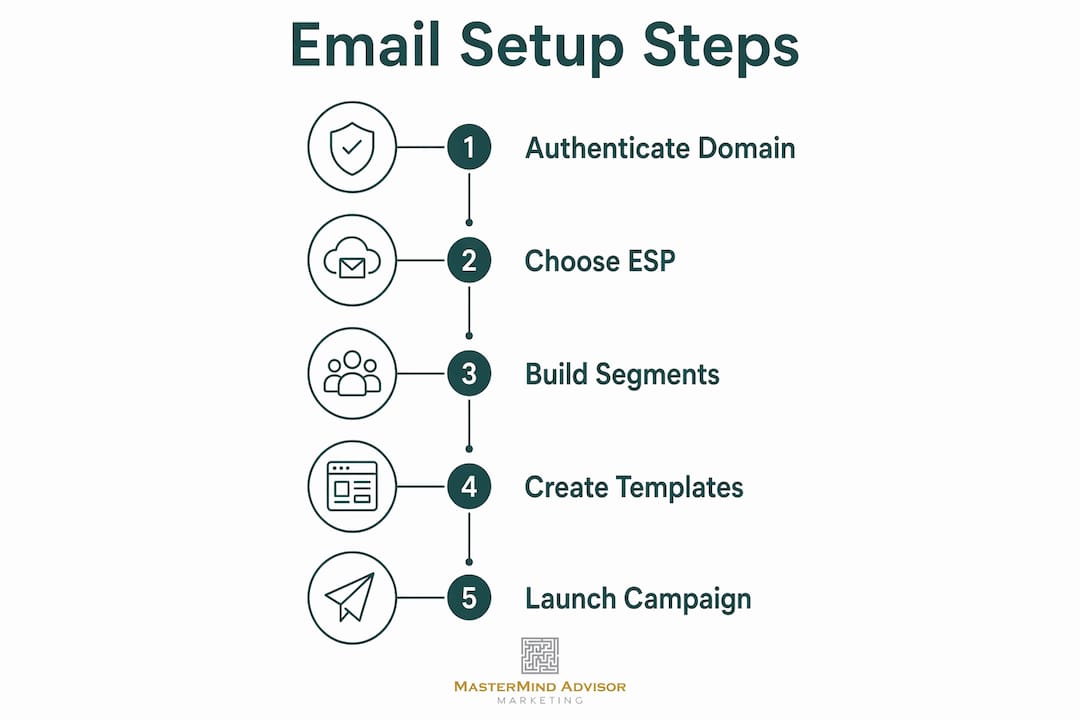
A structured setup process prevents the most common advisor mistakes: sending to unsegmented lists, skipping mobile preview, and launching without tracking in place. Follow these steps in order.
- Define your audience segment. Separate your list into at least three groups: current clients, warm prospects, and cold leads. Each group needs different messaging. Sending a retirement planning newsletter to a 32-year-old prospect who just downloaded a tax guide is a missed opportunity.
- Authenticate your domain. Set up SPF, DKIM, and DMARC records through your domain registrar before sending anything. This is a one-time technical step that protects every campaign you run going forward.
- Choose your campaign type. In HubSpot, you choose between a Regular email for one-time sends and an Automated email for workflow-triggered sequences. In Sender, you move through the four-stage workflow: Settings, Design, Recipients, and Review and Send.
- Build your template with pre-approved disclosures. Use your compliance-approved template library. Write a subject line under 50 characters. Write preview text that adds context rather than repeating the subject line.
- Test before you send. Send test emails to at least three devices: desktop, iPhone, and Android. Check every link. Confirm the unsubscribe button works.
- Schedule and send. For financial advisor newsletters, tuesday through thursday mornings between 8 a.m. and 10 a.m. consistently outperform other time slots for open rates.
- Track performance metrics. Monitor open rate, click-through rate, unsubscribe rate, and reply rate. Open rate tells you if your subject line works. Click-through rate tells you if your content delivers on the subject line's promise.
For advisors building their first list, digital lead generation strategies that combine landing pages with email opt-ins produce the cleanest, most engaged subscriber bases.
| Metric | Benchmark | What It Tells You |
|---|---|---|
| Open Rate | 20–25% | Subject line and sender name effectiveness |
| Click-Through Rate | 2–5% | Content relevance and call-to-action clarity |
| Unsubscribe Rate | Under 0.5% | List health and content fit |
| Reply Rate | 1–3% | Engagement depth and relationship quality |
How do you optimize email campaigns for better engagement?
Getting your campaign live is step one. Getting people to open, read, and act on it is the ongoing work. Optimization separates advisors who grow their practices through email from those who just maintain a list.
Segmentation and automation triggers
Segmentation by client stage is the single highest-leverage optimization you can make. Automation triggers mapped to CRM pipeline stages send relevant messages at the right time, supporting lead nurturing across the full sales cycle. Typical stages include new lead, contacted, discovery scheduled, and discovery completed. Each stage gets its own email sequence with content matched to where the prospect is in their decision process. A new lead gets an educational sequence about your process. A prospect who completed a discovery call gets a follow-up sequence with specific next steps.
For engagement-based segmentation beyond pipeline stage, consider segmenting by email behavior: who opened your last three campaigns, who clicked a specific link, and who has gone 90 days without engaging. Each of those groups needs a different approach.
Personalization and timing
Personalization goes beyond inserting a first name. Dynamic content blocks let you show different sections of the same email to different segments. A client in the accumulation phase sees content about portfolio growth. A client approaching retirement sees content about income planning. Both receive the same email send, but the experience feels tailored.
Frequency matters as much as content. Most financial advisors send too infrequently, not too often. A monthly newsletter plus one event-triggered email per quarter is a reasonable floor. Advisors who send nothing for three months and then blast a promotional email see the highest unsubscribe rates.
Common mistakes to avoid:
- Using a no-reply sender address. Replies are relationship signals. Use a real inbox.
- Skipping mobile optimization. Over 60% of emails are opened on mobile devices. If your template breaks on a phone, you lose the read.
- Ignoring suppression lists. Remove unsubscribes and bounces immediately. Sending to bad addresses damages your sender reputation.
- Writing subject lines that overpromise. "Double your returns this quarter" triggers spam filters and destroys trust.
Pro Tip: Run a 30-day re-engagement sequence for any subscriber who has not opened an email in 90 days before removing them from your list. A simple subject line like "Still want to hear from us?" recovers 10–15% of dormant contacts and keeps your list metrics accurate.
Key takeaways
A successful financial advisor email campaign setup requires compliant tools, authenticated domains, segmented lists, and automation sequences mapped to your CRM pipeline stages.
| Point | Details |
|---|---|
| Platform selection matters | Choose HubSpot or Sender based on your compliance and automation needs, not just price. |
| Compliance is non-negotiable | FINRA Rule 2210 requires three-year record retention; CAN-SPAM requires opt-out within 10 business days. |
| Domain authentication first | Set up SPF, DKIM, and DMARC before sending any campaign to protect deliverability. |
| Segment before you send | Separate clients, warm prospects, and cold leads into distinct sequences with matched content. |
| Map automation to your CRM | Trigger email sequences by pipeline stage to send the right message at the right moment. |
What i've learned running advisor email campaigns
Most advisors I talk to treat email as an afterthought. They set up a Mailchimp account, import their client list, and send a quarterly newsletter with no segmentation, no automation, and no compliance review. Then they wonder why it doesn't generate leads.
The advisors who actually grow their practices through email do three things differently. First, they treat compliance as a system, not a task. Pre-approved templates and a disclosure library are not bureaucratic overhead. They are the infrastructure that lets you send confidently and consistently without a two-week review cycle every time. Second, they connect their email platform to their CRM from day one. The moment a prospect fills out a form on your website or attends a webinar, they should enter an automated sequence. Manual follow-up is too slow and too inconsistent to compete. Third, they measure what matters. Open rate is a vanity metric if you never look at click-through rate and reply rate together. Those two numbers tell you whether your content is actually moving people toward a conversation.
The compliance piece trips up more advisors than anything else. I have seen campaigns get shut down mid-send because someone used a personal Gmail account to follow up with a prospect. All business communications must be archived regardless of platform. That rule applies to your phone, your personal email, and any messaging app you use for client contact. Build your systems around that reality from the start, and you will never have to rebuild them under pressure.
Email is still the highest-ROI channel available to independent advisors. The advisors who invest in getting the setup right in 2026 will have a compounding advantage over those who keep treating it as a side project.
— Josh
How Mastermindadvisormarketing helps you build campaigns that convert
Setting up a compliant, effective email campaign system takes time, tools, and a clear process. Mastermindadvisormarketing is built specifically for independent financial advisors who want a turnkey marketing system without the trial-and-error.
Mastermindadvisormarketing provides custom CRM integration, automated email follow-up sequences, and content marketing strategies designed around the compliance requirements advisors face every day. The platform includes pre-built campaign frameworks, webinar and seminar lead generation tools, and educational resources that connect your email campaigns to a full advisor marketing system. If you are ready to move from a scattered email list to a structured campaign engine, Mastermindadvisormarketing gives you the infrastructure to do it right.
FAQ
What is financial advisor email campaign setup?
Financial advisor email campaign setup is the process of configuring compliant, segmented email communications to engage clients and generate leads. It includes platform selection, domain authentication, list segmentation, compliance workflows, and automated nurture sequences.
Which email platform is best for financial advisors?
HubSpot is the strongest choice for advisors who need CRM integration and advanced automation in one system. Sender works well for advisors who want a simpler, lower-cost workflow with solid segmentation options.
How long must financial advisors keep email records?
FINRA Rule 2210 requires keeping retail communication records for at least three years, with two years in an easily accessible format. This applies to all marketing emails sent to clients and prospects.
What does can-spam require for advisor emails?
Every commercial email must include a valid physical address, a working unsubscribe link, and non-deceptive subject lines. Opt-out requests must be honored within 10 business days of receipt.
How often should financial advisors send marketing emails?
A monthly newsletter combined with event-triggered emails tied to CRM pipeline stages is a practical baseline. Advisors who send more frequently with well-segmented, relevant content consistently outperform those who send less often to unsegmented lists.