
Independent advisor case studies are documented real-world examples showing how financial advisors grew revenue, retained clients, and built sustainable practices through specific, repeatable methods. The industry term for these is "advisory practice case studies," and they serve as the most direct form of professional education available to practicing advisors. The examples in this article cover AI automation, life-event client retention, solo RIA economics, niche content marketing, and supported independence transitions. Each case includes hard numbers, not generalizations. If you want to understand how advisors solve client issues and scale their firms, these are the benchmarks worth studying.
1. Examples of independent advisor case studies: AI automation in a 3-advisor RIA
AI-driven workflow automation is the fastest documented path to margin improvement in small independent RIAs. One 3-advisor firm replaced manual quarterly report production with AI, cutting report time from 40 to 9 hours per cycle. That is not a minor efficiency gain. It is a structural change in how the firm operates.
The same firm used AI to automate client outreach and meeting preparation. Prospect conversion improved from 18% to 31%. The firm added 11 new client households and generated $145,000 in additional annual revenue. AUM grew 22% over six months.

Compliance documentation also improved. Automated workflows created consistent audit trails without adding staff time. That matters because SEC examination readiness is an ongoing cost for independent RIAs, and manual documentation is where errors accumulate.
Pro Tip: Before deploying AI reporting tools, audit your current quarterly workflow by task. Advisors who map each step first reduce implementation time and identify the highest-value automation targets immediately.
Firms using AI and automation can reclaim 25–40 hours per advisor per quarter. That time goes directly into business development, which is the activity most advisors consistently underinvest in.
| Metric | Before AI | After AI |
|---|---|---|
| Report production time | 40 hours/quarter | 9 hours/quarter |
| Prospect conversion rate | 18% | 31% |
| New client households added | Baseline | +11 |
| Additional annual revenue | Baseline | +$145,000 |
| AUM growth (6 months) | Baseline | +22% |
2. Client retention through life-event automation in a 4-advisor RIA
Proactive client engagement is a stronger retention tool than reactive service. A 4-advisor RIA implemented life-event automation to detect and respond to major client milestones such as job changes, inheritances, and retirement transitions. The system detected 31 at-risk life events in eight months.
The firm responded to 94% of those events within 48 hours. That response speed matters because clients who experience a major life event and do not hear from their advisor within days are statistically more likely to consider switching firms. The automation converted potential attrition into planning conversations.
The financial outcome was direct. The firm retained $890,000 in AUM that was previously at risk. Proactive outreach also generated $47,000 in new planning revenue from clients who had not previously engaged in comprehensive planning services.
- Life events detected: 31 in 8 months
- Response rate within 48 hours: 94%
- AUM retained from at-risk clients: $890,000
- New planning revenue generated: $47,000
Life-event automation creates measurable ROI by converting personal milestones into planning opportunities. The shift from reactive to proactive service is the core lesson here. Advisors who wait for clients to call lose the window when clients are most open to advice. Pairing this approach with marketing automation tools extends the same proactive logic to prospect engagement.
3. Solo RIA financials: a real-world independent advisor example
A solo RIA after four years of operation generated $320,000 in annual revenue from 35 client households. Average fees ran $9,100 per household. Overhead held at 15%, producing a take-home income near $272,000 before tax. The advisor worked 20–25 hours per week.
Those numbers challenge the assumption that independence requires scale to be profitable. A wirehouse advisor at the same revenue level would typically take home 35–45% after firm splits and overhead allocations. The solo RIA model inverts that math entirely.
The key to keeping overhead at 15% is focusing on high-net-worth households rather than chasing volume. Fewer clients with higher fees and more complex needs produce better margins than a large book of smaller accounts. Solo RIAs that keep lean operations by avoiding unnecessary staff and office costs maintain this advantage long-term.
Pro Tip: Set a minimum fee threshold before taking on new clients. This solo RIA's $9,100 average fee was not accidental. It resulted from a deliberate minimum that filtered out lower-value relationships early.
| Financial Metric | Solo RIA Result |
|---|---|
| Annual revenue | $320,000 |
| Client households | 35 |
| Average fee per household | $9,100 |
| Overhead percentage | 15% |
| Owner take-home (pre-tax) | ~$272,000 |
| Weekly hours worked | 20–25 |
4. Niche marketing and supported independence: growth and retention strategies
Microtargeted content marketing produces stronger growth than broad networking for independent advisors. A $500M AUM RIA grew by targeting oil and gas professionals with highly specific articles addressing their unique compensation structures, deferred income, and equity considerations. Generic financial content would not have reached that audience. Specialized content did.
The mechanism is straightforward. Niche audiences share content within their professional communities. An article written specifically for petroleum engineers gets forwarded among petroleum engineers. That organic distribution is more cost-effective than paid advertising and builds credibility faster than cold outreach. Advisors who build a niche content strategy around a specific professional or demographic group create a compounding referral effect over time.
Supported independence produces a parallel benefit on the retention and fee side. One breakaway advisor who joined a supported independent platform retained near 100% of clients post-transition and raised fees confidently because the platform provided the infrastructure to deliver higher-level service. Many captive advisors assume independence means losing support. The supported model disproves that assumption directly.
"Clear, well-articulated value propositions are key to premium fee adoption in independent advisory models, enabling fee raises without client loss."
Workshops, blogs, and podcasts serve dual purposes in this model. They educate existing clients and attract new ones simultaneously. An advisor who hosts a quarterly workshop for tech employees on equity compensation builds authority, generates referrals, and deepens existing client relationships in a single event.
Legal compliance during transitions is non-negotiable. Advisors who honor nonsolicitation agreements avoid costly litigation that can consume the first year of independence. The practical rule is simple: do not contact former clients until the agreement period expires, and document every client interaction after the transition date. A 60–90 day RIA transition supported by a dedicated operational team allows brand launch, technology setup, and client communications to proceed simultaneously without losing momentum.
- Use specialized content targeting a defined professional niche, not general financial topics
- Articulate your value proposition clearly before raising fees
- Select a supported independence platform if you need infrastructure during transition
- Comply strictly with nonsolicitation agreements to protect the new practice
- Use workshops and educational content to serve existing clients and attract new ones
Key takeaways
The strongest independent advisor success stories share one pattern: they replace reactive, manual processes with proactive, systematic ones, whether through AI, automation, niche content, or lean operational models.
| Point | Details |
|---|---|
| AI automation drives margin growth | Cutting report time from 40 to 9 hours freed advisor capacity for business development and added $145,000 in annual revenue. |
| Life-event automation retains AUM | Detecting and responding to 31 client life events within 48 hours retained $890,000 in at-risk AUM. |
| Solo RIA economics favor lean models | A 35-household solo RIA generated $272,000 take-home at 15% overhead by focusing on high-net-worth clients. |
| Niche content outperforms broad networking | Microtargeted content helped one RIA reach $500M AUM by writing specifically for oil and gas professionals. |
| Supported independence enables fee increases | Breakaway advisors on supported platforms retain near 100% of clients and raise fees by delivering clearly articulated value. |
What these case studies taught me about running a better practice
The most underrated lesson across all these real-life examples of advisors is that the advisors who grew fastest were not the ones who worked harder. They were the ones who changed the structure of their work.
The AI automation case is the clearest example. Cutting quarterly report time from 40 to 9 hours did not just save time. It changed what the advisors did with their days. They moved from production work to relationship work, and conversion rates jumped as a direct result. That is not a technology story. It is a business model story.
The life-event automation case makes the same point differently. Most advisors know they should reach out when a client changes jobs or inherits money. Almost none do it consistently because there is no system forcing the behavior. Automation removes the human inconsistency from a process that should never be inconsistent.
What I find most advisors miss is the niche marketing insight. Broad content does not build authority. Specific content does. Writing one article for petroleum engineers is worth more than ten generic retirement planning posts. The audience is smaller, but the conversion rate and referral quality are dramatically higher.
The solo RIA financial model also deserves more attention than it gets. The idea that you need a large team to earn a strong income is simply wrong. Thirty-five households, a clear minimum fee, and lean overhead produce a take-home that most wirehouse advisors will never see, with a schedule that most wirehouse advisors will never have.
The legal caution around nonsolicitation agreements is the one area where I see advisors get overconfident. The transition is exciting, and the temptation to reach out to former clients immediately is real. One litigation dispute can consume the financial gains of the first two years. Patience here is not timidity. It is math.
— Josh
How Mastermindadvisormarketing supports independent advisors
The case studies in this article share a common thread: advisors who grew their practices had systems behind them, whether for marketing, client outreach, or content creation.
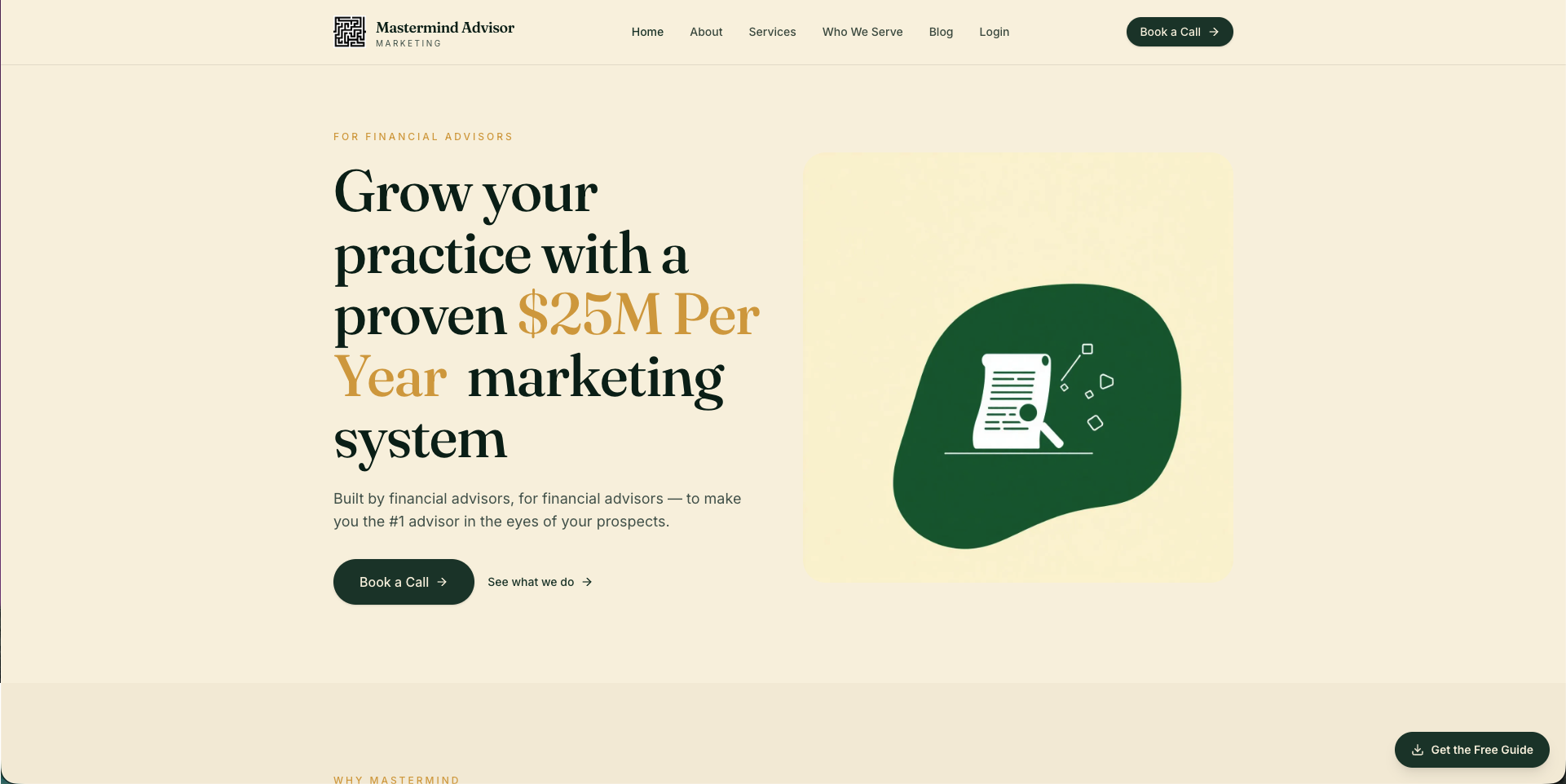
Mastermindadvisormarketing builds those systems specifically for independent financial advisors. The platform provides customized webinars, seminars, and content marketing tools that generate leads and deepen client relationships. Automated email follow-ups and custom CRMs handle the outreach consistency that most solo and small-team advisors struggle to maintain manually. Advisors looking to apply the niche marketing and retention strategies from these case studies can find practical resources, including a guide on hosting effective seminars, at Mastermindadvisormarketing.
FAQ
What are independent advisor case studies?
Independent advisor case studies are documented accounts of how real financial advisors grew revenue, retained clients, or improved operations using specific methods. They serve as practical benchmarks for advisors looking to replicate proven strategies.
How do advisors use AI to grow their practices?
AI reduces time spent on manual tasks like report production and client outreach, freeing advisors for business development. One 3-advisor RIA cut report time from 40 to 9 hours and grew AUM by 22% in six months.
What is life-event automation in financial advisory?
Life-event automation detects major client milestones such as job changes or inheritances and triggers immediate advisor outreach. A 4-advisor RIA used this method to retain $890,000 in at-risk AUM and generate $47,000 in new planning revenue.
Can a solo RIA generate strong income without a large team?
A solo RIA with 35 households and a $9,100 average fee generated $272,000 in take-home income at 15% overhead, working 20–25 hours per week. Lean operations and a high-net-worth client focus are the key factors.
Why does niche content marketing outperform broad networking for advisors?
Niche content reaches a defined professional audience that shares it within their own networks, creating organic referral growth. A $500M AUM RIA built its book by writing specifically for oil and gas professionals rather than producing general financial content.