
Advisor webinars are live or recorded online presentations that financial professionals use to educate clients, attract prospects, and maintain professional credentials. These sessions typically run 30–60 minutes and include structured Q&A, making them one of the most direct formats for demonstrating expertise at scale. Unlike static content like blog posts or newsletters, a well-run webinar creates real-time trust. For independent advisors competing for high-net-worth clients, that trust is the difference between a warm lead and a closed relationship.
What are the best practices for structuring effective advisor webinars?
Effective advisor webinars run 30–60 minutes and include live Q&A to boost engagement and demonstrate real-time value. Session length directly affects conversion. Too short and you lose credibility. Too long and you lose the audience.
Structure your session in three clear blocks: a focused opening that frames the problem, a content middle that delivers the core insight, and a closing Q&A that invites dialogue. Each block should serve a distinct purpose. Advisors who treat Q&A as an afterthought miss the highest-trust moment of the entire session.

Interaction tools matter more than most advisors realize. Real-time polls, chat prompts, and raise-hand features keep passive viewers engaged. Platforms like Zoom and GoToWebinar both support these features natively. Even one mid-session poll can reset attention and signal to attendees that their input shapes the conversation.
Pro Tip: Schedule live sessions during lunch hours (noon to 1 p.m.) or early evening (5 to 6 p.m.) to fit your clients' schedules. Timing your webinar to match peak availability is one of the simplest ways to lift attendance without spending more on promotion.
Registration and follow-up timing also drive results. Send a confirmation email immediately after sign-up, a reminder 24 hours before, and a replay link within 24 hours after the session ends. Advisors who skip the post-event follow-up leave the highest-intent prospects uncontacted at exactly the wrong moment.
- Keep sessions to 30–60 minutes with a hard stop
- Open with the client problem, not your firm's background
- Use one poll or chat prompt per 15 minutes of content
- Send three touchpoints: confirmation, reminder, and replay
- Test your audio and screen share setup 30 minutes before going live
How to differentiate webinar content to build trust with high-net-worth clients
The most effective webinars for high-net-worth clients avoid influencer-style marketing in favor of transparent, actionable insights into strategies such as option-income, asset custody, and tax workflows. Generic market commentary does not build trust. Explaining exactly how a strategy works does.
Jay Hatfield, a recognized voice in income investing, structures his sessions around the mechanics of Nasdaq-exposed income strategies rather than broad market predictions. That approach gives attendees something they cannot get from a news segment or a competitor's brochure. Emily Rassman, who focuses on tax planning workflows for advisors, applies the same principle: show the process, not just the outcome.
"Advisors gain more client trust when they present the mechanics and operational details of investment strategies rather than high-level market analysis." — Income Investing with Nasdaq Exposure
Content segmentation by client niche amplifies this effect. A session on option-income strategies speaks directly to retirees seeking yield. A session on tax-loss harvesting workflows speaks to business owners in high tax brackets. Trying to serve both audiences in one session dilutes the message and reduces the perceived expertise of the presenter.
Topics that consistently perform well with high-net-worth audiences include:
- Option-income and covered-call strategy mechanics
- Tax workflow walkthroughs for business owners and executives
- Asset custody and account structure explanations
- Social Security optimization timelines
- Estate planning coordination between advisors and attorneys
Pro Tip: Record a short 90-second preview clip of your webinar and send it to your email list three days before the live session. Advisors who show a sample of their content before the event see meaningfully higher registration rates than those who rely on a text-only invitation.
Repeatable workflows for technical topics allow advisors to turn complex subjects like tax planning into scalable client experiences rather than one-off events. Building a reusable slide deck and speaker outline for each core topic cuts preparation time significantly after the first session.
What compliance considerations impact advisor webinars in 2026?
Live attendance is required to receive CFP and other professional continuing education credits from advisor webinars in 2026. Recorded sessions are available for education but do not qualify for CE credit. This distinction matters for advisors who promote webinars as CE opportunities to attract registrants.
Typical CE credits for qualifying sessions range from 0.5 to 1.0 hour per session. That means a 60-minute live session with an approved provider can satisfy one full CE credit hour. Advisors maintaining CFP, CFA, or ChFC designations need to track these credits carefully across the calendar year.
| Format | CE Credit Eligible | Best Use Case |
|---|---|---|
| Live webinar (approved provider) | Yes (0.5–1.0 credit) | CE maintenance, designation renewal |
| Live webinar (non-approved) | No | Client education, lead generation |
| Recorded session | No | Drip campaigns, prospect nurturing |
| Hybrid (live + replay) | Live portion only | Broad reach with compliance intact |
Regulatory guidance in 2026 continues to require verifiable attendance tracking for CE-eligible sessions. Platforms like Zoom Webinar and ON24 both support attendance reporting exports that satisfy most CE provider requirements. Advisors should confirm their chosen platform's reporting format with their CE provider before the session date, not after.
Recorded sessions still carry real value even without CE eligibility. They work well in email nurture sequences, on landing pages, and as gated content for lead capture. The compliance constraint applies only to credit, not to the educational or marketing use of the content.
How can financial advisors integrate webinars into their broader marketing strategy?
Integrating webinars into marketing funnels through landing pages and targeted emails improves conversion rates and lead nurturing. A webinar without a dedicated registration page is a missed lead capture opportunity. Every session should have its own landing page with a clear headline, a short description of what attendees will learn, and a single call to action.
Recorded webinars remain valuable in drip campaigns and for nurturing prospects within marketing funnels, even when they do not qualify for CE credit. An advisor who runs four live sessions per year can build a library of recorded content that works around the clock. That library becomes a lead generation asset that compounds over time.
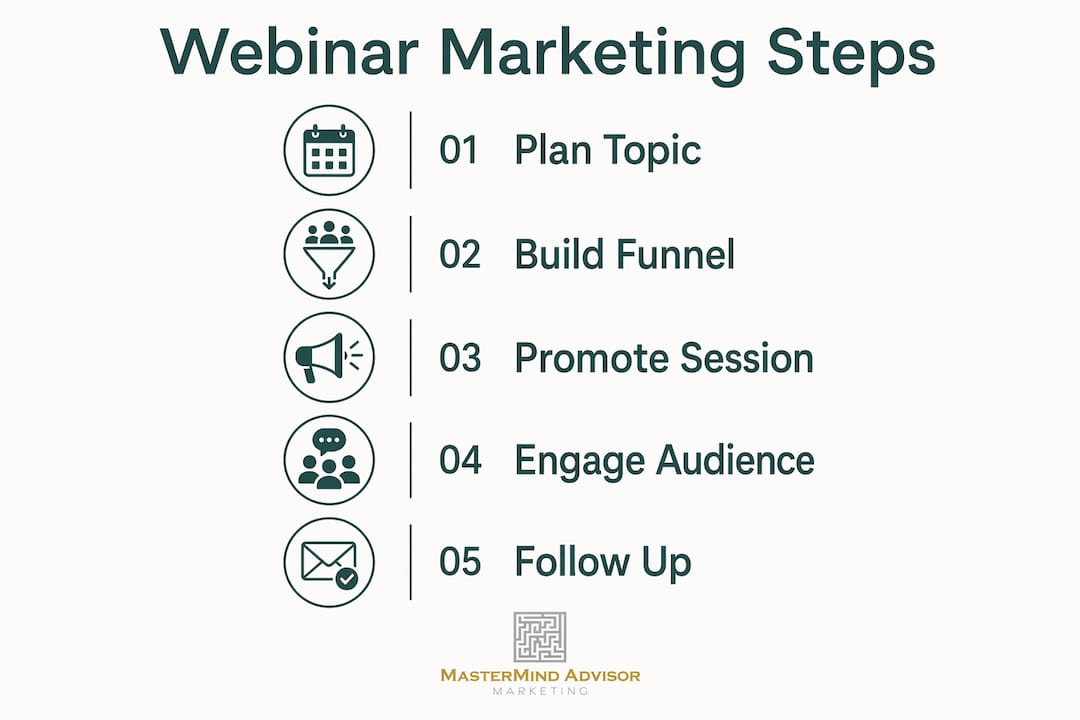
Here is a practical sequence for integrating a single webinar into a broader marketing workflow:
- Build a dedicated lead generation landing page with a registration form tied to your CRM
- Send a three-part email sequence: announcement, reminder, and last-chance notice
- Host the live session and capture the recording immediately
- Send the replay link to all registrants within 24 hours
- Add the recording to a drip sequence for cold prospects in your CRM
- Repurpose key clips as short-form video content for LinkedIn or email newsletters
- Review registration and attendance data to refine the next session topic
| Webinar Use | Primary Goal | Channel |
|---|---|---|
| Live session promotion | New lead acquisition | Email, social media, paid ads |
| Recorded replay | Prospect nurturing | Email drip, CRM automation |
| Gated replay page | Lead capture | Landing page, organic search |
| Clip repurposing | Brand visibility | LinkedIn, YouTube, newsletters |
Aligning webinar topics with the client lifecycle increases relevance at every stage. A prospect who just inherited assets needs different content than a long-term client approaching retirement. Advisors who map their content marketing calendar to client lifecycle stages consistently generate more qualified leads than those who pick topics based on what feels timely.
Free advisor webinars work particularly well as top-of-funnel tools. Offering a no-cost session on a high-interest topic like Social Security timing or Roth conversion strategy attracts prospects who are actively researching. Those registrants self-identify as high-intent leads before the session even begins.
Connecting webinar strategy to a small business lead generation framework helps advisors see their practice as a business with a repeatable pipeline, not just a service delivered to existing clients.
Key takeaways
Advisor webinars generate leads and build client trust most effectively when they combine transparent, mechanics-focused content with repeatable workflows, live compliance tracking, and a structured marketing funnel that extends the value of every session.
| Point | Details |
|---|---|
| Session structure drives conversion | Run 30–60 minute sessions with live Q&A and at least one interactive element per 15 minutes. |
| Mechanics beat marketing language | Show how strategies work in detail. High-net-worth clients respond to transparency, not broad market commentary. |
| Live attendance is required for CE credit | CFP and other designation credits require live participation. Recorded sessions do not qualify. |
| Recorded sessions fuel your funnel | Use replays in email drip sequences and on gated landing pages to nurture prospects year-round. |
| Webinars need a full marketing wrapper | Pair every session with a landing page, a three-part email sequence, and CRM integration to capture and convert leads. |
What I have learned from running advisor webinars that most guides skip
Most articles on advisor webinars focus on the mechanics of the platform. Pick Zoom. Add a poll. Send a reminder. That advice is fine, but it misses the real problem most advisors face: they treat each webinar as a standalone event instead of a repeatable system.
The advisors I have seen build real pipelines from webinars are not running better presentations. They are running the same great presentation multiple times, refining it each time, and feeding every registrant into a CRM sequence that keeps working after the session ends. The webinar is the front door. The follow-up is where the relationship actually starts.
The other mistake I see constantly is confusing depth with complexity. High-net-worth clients are not impressed by jargon. They are impressed by clarity. An advisor who can explain a covered-call strategy in plain language, with a real example, earns more trust in 45 minutes than a competitor who sends a 12-page white paper. Transparency is the differentiator, not sophistication.
One more thing: do not wait until you have a perfect topic to start. The first webinar is always the hardest. The second one is faster. By the fifth, you have a system. Start with what you know best, keep it to 45 minutes, and let the Q&A tell you what to cover next.
— Josh
How Mastermindadvisormarketing supports your webinar marketing
Financial advisors who want to run webinars that actually generate leads need more than a platform. They need a system that handles promotion, follow-up, and lead capture as one connected workflow.
Mastermindadvisormarketing is built specifically for independent financial advisors who want to turn webinars and seminars into a consistent source of qualified prospects. The platform combines webinar and seminar hosting resources with custom CRM integration and automated email follow-up sequences that keep prospects engaged long after the session ends. Advisors who want a complete system for planning, promoting, and converting through virtual events can explore everything Mastermindadvisormarketing offers.
FAQ
What is an advisor webinar?
An advisor webinar is a live or recorded online presentation hosted by a financial professional to educate clients, attract prospects, or fulfill continuing education requirements. Sessions typically run 30–60 minutes and include a live Q&A segment.
Do advisor webinars qualify for CFP CE credits?
Live attendance at an approved session is required to earn CFP continuing education credits, with typical sessions offering 0.5 to 1.0 credit hour. Recorded replays do not qualify for CE credit under 2026 guidelines.
How long should a financial advisor webinar be?
The most effective sessions run 30–60 minutes. Shorter sessions reduce credibility. Longer sessions lose audience attention. A 45-minute presentation with a 15-minute Q&A is the format that consistently performs best for advisor lead generation.
Can recorded webinars still generate leads?
Recorded sessions are highly effective for lead nurturing even without CE eligibility. Advisors use replays in email drip campaigns, on gated landing pages, and as evergreen content within their marketing funnels to reach prospects who missed the live event.
What topics work best for high-net-worth client webinars?
Topics that explain the mechanics of specific strategies, such as option-income approaches, Roth conversion timelines, or tax workflow walkthroughs, consistently outperform broad market commentary. Transparency about how a strategy works builds more trust than general financial advice.