
Segmentation lets advisors protect their time, match service intensity to client value, and grow revenue without hiring their way there. Start with a quick audit: pull last year's revenue by client and estimate hours spent serving each one. The gap between your top clients and your time-sinks will tell you exactly where to build your first tier.
TL;DR:
- Formal client segmentation can significantly improve engagement, personalization, and operational efficiency, leading to better client retention and growth.
- The most common criteria for segmentation include AUM, revenue potential, referral activity, and engagement levels, with referral value gaining more weight as revenue grows.
- Using a CRM with both quantitative and qualitative data fields, along with automated workflows, is essential for maintaining accurate, repeatable segmentation systems.
- Clear, defined service promises and response times for each tier are critical to building trust and avoiding client dissatisfaction.
- Pilot segmentation models on small client groups first, and use targeted communication strategies like seminars and automated emails to facilitate client understanding and referral generation.
Table of Contents
- Why Client Segmentation Advisors Actually Need It
- Segmentation Models and the Criteria Advisors Actually Use
- Data, CRM, and Systems: The Technology That Makes Segmentation Repeatable
- Designing Service Tiers and What Each Segment Actually Gets
- A Practical Weighted-Score Example You Can Adapt
- Operationalizing Segmentation Without Losing Clients in the Process
- Measuring Success: The KPIs That Prove Segmentation Works
- Common Pitfalls That Sink Segmentation Programs
- How Mastermind Advisor Marketing Supports Segmentation-Driven Growth
- Customizing Segmentation for Independent vs. Institutional Advisory Models
- Author Perspective: The First 90 Days
- An Alternative for Advisors Who Want Implementation Support
- Sources
Why Client Segmentation Advisors Actually Need It
Only 37% of advisory firms have implemented a formal client segmentation strategy, according to Fidelity Institutional. That gap is the opportunity. Most firms informally know their best clients but never write down who gets what level of service, so service creep quietly eats margin every year.
Firms that segment formally report real gains. Industry survey respondents cited improved client engagement (63%), more effective personalization (61%), and increased operational efficiency (51%) as the top payoffs of segmenting their book.
Those numbers translate directly into what you're trying to build:
- Higher engagement means fewer client fire drills and more proactive planning conversations.
- Better personalization means your A clients get quarterly reviews while your smaller accounts get scaled digital content.
- Efficiency gains free up hours you can reinvest in prospecting or your highest-value relationships.
Delay costs you compounding inefficiency. Every quarter without segmentation is another quarter where a $50,000 client and a $2 million client get roughly the same service model.
Segmentation Models and the Criteria Advisors Actually Use
Three approaches dominate advisory practices, and each fits a different stage of growth.
- Single-factor ranking sorts clients by one number, usually AUM or annual revenue. It's fast to build and easy to explain to staff, but it misses clients who generate referrals, hold complex planning needs, or sit on assets you don't yet manage.
- Weighted-score models combine several factors, each assigned a percentage weight tied to your business goals. A firm chasing growth might weight referral potential at 25%, while a firm optimizing margin weights revenue at 40%.
- Behavioral or needs-based segmentation groups clients by qualitative traits: decision-making style, life stage, planning complexity, or responsiveness to communication. This requires notes from actual client conversations, not just portfolio data, so it works best layered on top of a scoring model rather than replacing one.
The criteria advisors use most consistently across weighted models include AUM, revenue potential (including held-away assets), engagement frequency, and referral value. Firms increasingly weight referral value higher than raw AUM once they've built a strong existing revenue base, since a well-connected client at $300,000 can outperform a passive client at $2 million.
Pro Tip: Don't build your first model around more than four criteria. Advisors who start with a simple, three or four factor score adjust faster than firms that try to capture every nuance on day one.
Data, CRM, and Systems: The Technology That Makes Segmentation Repeatable
Segmentation dies without a system to enforce it. That's why most advisory firms use their CRM as the hub for segmentation rather than a spreadsheet or manual list.
Your CRM needs both quantitative and qualitative fields to make classification meaningful:
- AUM, revenue, and household net worth (updated at least quarterly)
- Referral count and source, plus engagement metrics like meeting frequency and email response rate
- Life stage, planning complexity, and communication preference, captured as free-text or tagged fields
- Last review date and next scheduled touchpoint
Tag each client with their tier and automate workflows around it, so a client tagged "Tier 1" automatically triggers a quarterly review reminder while "Tier 3" triggers a scheduled email sequence instead. Integrate your CRM with portfolio management and billing systems so revenue and AUM figures update without manual entry, and connect it to your email platform so tier-based content actually reaches the right inbox.
Assign one person, often an operations lead or senior paraplanner, to own quarterly data audits. Stale tags are the most common reason segmentation programs quietly fail within a year.
Designing Service Tiers and What Each Segment Actually Gets
A tier without a defined deliverable is just a label. Every tier needs a specific service promise your staff can execute without checking with you first.
A typical three-tier structure might look like this:
- Tier 1 (top clients): Quarterly in-person or video reviews, direct advisor access, same-day response commitment, invitations to exclusive seminars.
- Tier 2 (core clients): Semiannual reviews, advisor or senior paraplanner contact, 48-hour response standard, access to tiered content library.
- Tier 3 (emerging or smaller clients): Annual review, paraplanner-led contact, automated email nurture, self-service portal access.
Response-time expectations belong in your service-level agreement, not just in your head. If Tier 1 promises same-day responses, staff need a workflow that flags those emails automatically.
Pricing by tier is where firms get nervous. Roughly half of advisors use different fee structures across segments, and most who do call it effective. The risk isn't losing clients to lower-cost competitors, it's failing to communicate the value difference clearly before the fee conversation happens.
Staffing follows naturally: advisors handle Tier 1 relationships directly, paraplanners and associate advisors carry Tier 2 and 3 workloads, and client persona work helps define exactly who fits where before you assign anyone.
Pro Tip: Write the fee conversation script before you launch tiers, not after a client asks why their neighbor pays less.
A Practical Weighted-Score Example You Can Adapt
Here's a five-factor matrix a mid-sized RIA might use, with weights tied to a growth-and-retention goal:
| Attribute | Weight | Scoring basis |
|---|---|---|
| Assets under management | 30% | 1 to 5 scale by AUM bracket |
| Revenue (fees generated) | 25% | 1 to 5 scale by annual revenue |
| Referral activity | 20% | Count of referrals |
| Engagement frequency | 63% | Meetings and calls per year |
| Growth potential | 10% | Held-away assets, career stage, inheritance signals |
Run this manually in a spreadsheet if you have fewer than 100 households. Beyond that, automate scoring through CRM workflows that pull AUM and revenue directly from your portfolio system.
- Run the score for every household on a set schedule, typically quarterly.
- Flag the top and bottom 10% for manual review before finalizing tier assignment, since a one-time deposit or temporary market swing can distort a raw score.
- Assign the confirmed tier and update the client's CRM tag.
- Push results to a dashboard visible to advisors and support staff so everyone works from the same classification.
Operationalizing Segmentation Without Losing Clients in the Process
A segmentation program without a written policy is just an opinion your team might not follow next quarter. Your policy should define eligibility criteria for each tier, review cadence, and an escalation path for clients who feel misclassified.
Before firmwide rollout, pilot the model on 20 to 30 households:
- Test the scoring matrix against clients your senior advisors already know well, to catch obvious misclassifications early.
- Gather staff feedback on workflow friction before scaling to the full book.
- Survey a small group of transitioning clients on how the new service structure feels to them.
Transition conversations need structure. Lead with what's improving (more proactive contact, dedicated planning time), not with what's changing about fees or access. Time the conversation before any service change takes effect, never after a client notices something is different.
Pro Tip: Frame every transition around added value, not reduced access. "We're building a dedicated quarterly planning process for you" lands better than "your service level is changing."
Handle objections by acknowledging the client's concern directly and offering a specific alternative, like a paid planning engagement, rather than quietly grandfathering everyone who complains.
Measuring Success: The KPIs That Prove Segmentation Works
Track retention by tier first. If your Tier 1 clients churn at the same rate as Tier 3, your segmentation isn't actually driving differentiated service.
Core KPIs to watch monthly or quarterly:
- Retention rate by tier
- Revenue per client, tracked by tier over time
- Cost-to-serve, estimated by hours logged against each tier
- Net Promoter Score and referral count by segment
On the operational side, track advisor hours by tier and capacity utilization, meaning how close each advisor runs to their planned client load. A dashboard combining these figures, reviewed monthly for the first two quarters and quarterly afterward, catches drift before it becomes a retention problem. The engagement and efficiency gains firms report after segmenting, 63% and 51% respectively, only materialize if someone actually reads the dashboard.
Common Pitfalls That Sink Segmentation Programs
Most segmentation failures trace back to the same handful of mistakes.
- Over-complication: Building six or seven tiers with overlapping criteria confuses staff and clients alike. Three to four tiers cover most books.
- Stale data: Tags that never get updated turn a $3 million client into a permanent Tier 2 because nobody re-scored them after a liquidity event.
- Vague promises: "Enhanced service" means nothing without a defined response time and meeting cadence attached to it.
- Fee misalignment: Charging premium fees without a visibly different service experience breeds resentment fast.
On the client-facing side, transparency about fees and compensation is one of the clearest trust signals in the industry, and it applies directly to tier communication. Fix these issues by simplifying your tier count, scheduling recurring data audits, and aligning staff incentives to service quality rather than just AUM growth.
How Mastermind Advisor Marketing Supports Segmentation-Driven Growth
Once your tiers exist, the harder problem is communicating them without spooking clients. This is where marketing infrastructure earns its keep.
Turnkey seminars and webinars give you a natural venue to announce enhanced offerings to Tier 1 clients while generating referral introductions from the same room. Content mapped to each tier, paired with automated email follow-ups, keeps Tier 2 and Tier 3 clients engaged without eating advisor hours.
A few things worth testing as you roll this out:
- Build distinct audience personas for each tier before writing a single email, since a retiree persona and a young executive persona respond to completely different messaging.
- Test seminar invitations against email-only nurture campaigns to see which drives more Tier 1 referrals.
- Track open rates by tier segment, not just in aggregate. Aggregate numbers hide which tier is actually disengaged.
Customizing Segmentation for Independent vs. Institutional Advisory Models
An independent RIA with 150 households and a two-person institutional team managing a handful of pension funds need entirely different segmentation logic, even though both are technically "advisory firms."
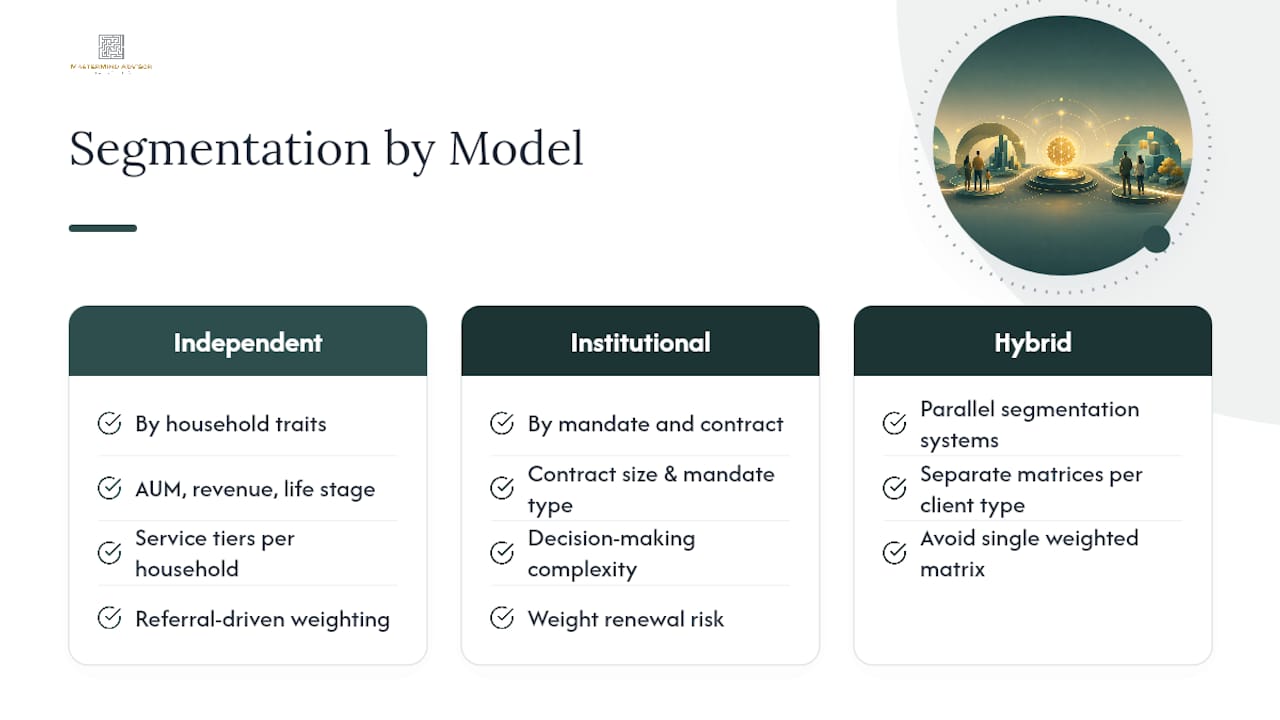
Independent advisors typically segment by household characteristics: AUM, revenue, referral behavior, and life stage. Their tiers map to individual service experiences, quarterly reviews for top clients, digital nurture for smaller ones, because the buying unit is a person or family making emotional and financial decisions together.
Institutional advisors, by contrast, often segment by mandate type, contract size, and decision-making complexity rather than individual wealth. A $50 million pension mandate with a five-person investment committee requires a completely different service cadence than a $50 million family relationship, even though the dollar figures match. Institutional tiers tend to weight relationship complexity and renewal risk over raw referral potential, since institutional clients rarely refer new business the way individual households do.
Hybrid firms serving both individual and institutional clients often run two parallel segmentation systems rather than forcing one model to fit both populations. Trying to score a pension fund and a retiree household on the same weighted matrix produces distorted results for both.
Whichever model fits your practice, the underlying discipline stays the same: define criteria that match how that client type actually generates value and risk, then build service tiers around it rather than adapting a generic template. Positioning your firm around a specific client type from the start makes this customization far easier down the line.
Author Perspective: The First 90 Days
Pilot the new tier structure on that group for 60 days, tracking retention and advisor hours weekly. Skip the full firmwide rollout until the pilot proves out. Small, measured tests beat sweeping changes that staff haven't been trained to execute.
— Josh
An Alternative for Advisors Who Want Implementation Support
Building a segmentation model is one project. Communicating it to 150 households without losing goodwill is a different skill entirely, and it's usually the part advisors underestimate.
A turnkey system is available specifically for the announcement and communication challenge independent advisors face after segmenting. Seminars and webinars designed around introducing new service tiers, a content library mapped to each segment, and automated email follow-ups help keep Tier 2 and Tier 3 clients engaged without adding to staff workload. CRM integration can tie into segmentation work so that tier tags drive messaging automatically instead of requiring manual list-building every quarter.
If you're planning a client-facing rollout of new tiers, start with how to host the best seminars to see how the announcement and referral generation pieces fit together.
Sources
- Four steps to successful client segmentation | Fidelity Institutional
- Maximizing Wealth Management client segmentation (WMIQ / Pershing white paper)
- Think your financial advisor has your back? These 5 red flags say otherwise — CFP Board