

A client persona advisor is a concise, evidence-based profile that financial advisors use to tailor communication, services, and marketing to a specific type of client. Think of it as a fictional but research-grounded character built from real data about your best clients' goals, values, and behaviors. According to PreciseFP, a well-crafted persona lets advisors scale personalization and guides choices for onboarding, content, and service delivery.
Three reasons to start building personas today:
- Better conversations: You walk into every meeting knowing what this type of client worries about and values most.
- Targeted outreach: Your emails, webinars, and social posts speak directly to one person's situation instead of nobody's.
- Scalable personalization: One persona profile powers dozens of client interactions without starting from scratch each time.
Start with a single persona project this week. Pick your most common client type and build from there.
Key Takeaways
A client persona built on behavioral and motivational data, not just demographics, is the most direct path to better client conversations, targeted marketing, and scalable personalization for financial advisors.
| Point | Details |
|---|---|
| Personas beat demographics | Add money scripts and decision drivers to every profile; demographics alone miss what drives client behavior. |
| Five core persona types | Pre-retiree, business owner, dual-income couple, inherited-wealth client, and wealth-preserver cover most advisor books. |
| Build in one week | Audit CRM, review meeting notes, run three interviews, cluster by goals, then pilot one email campaign. |
| Validate before scaling | Use CRM filter tests and A/B subject lines to confirm a persona resonates before building a full campaign. |
| Review annually | Refresh personas after major life events and at least once per year to keep them accurate. |
Table of Contents
- What is a client persona advisor, and how does it differ from segmentation?
- Core components every advisor client persona should include
- Five sample client personas advisors can adapt right now
- How to build advisor client personas step by step
- How to validate personas before you build campaigns around them
- Applying personas in meetings, onboarding, and marketing
- Common persona mistakes advisors make and how to fix them
- Why money scripts matter more than demographics in persona work
- The effort is smaller than you think
- Sources
What is a client persona advisor, and how does it differ from segmentation?
Most advisors already segment clients by AUM or age bracket. A persona goes further. Where a demographic segment tells you who someone is on paper, a persona tells you how they think, what they fear, and what finally gets them to act.
| Dimension | Demographic segment | Client persona |
|---|---|---|
| Data used | Age, income, AUM | Goals, values, money scripts, behaviors |
| Communication | Broad, category-level | Specific to motivations and objections |
| Marketing efficiency | Low personalization | Message matches the reader's actual situation |
| Retention impact | Reactive | Proactive, anticipates life events |
| Onboarding design | Generic checklist | Tailored to persona priorities |
Two quick examples show the difference in practice. Suppose you have a 55-year-old client with $800K in assets. The demographic lens says "pre-retiree, moderate risk." The persona lens says "Sandra, a recently divorced professional who equates financial control with personal freedom and needs to feel heard before she trusts any recommendation." Those two framings produce completely different opening lines in a discovery meeting.
Second example: a 42-year-old small business owner. Demographic view: "accumulation phase, higher risk tolerance." Persona view: "Marcus, who sees his business as his real retirement plan and resists traditional investment talk because it feels disconnected from how he actually builds wealth." That insight changes which content you send him, which webinar topic you invite him to, and how you frame your value proposition.
Industry commentary from ProSight Financial Association confirms that persona strategies fail when built on stereotypes. Behavioral inputs and attention channels are far more useful for targeting and product suggestions than surface demographics alone.
Core components every advisor client persona should include
A persona without the right fields is just a name and a photo. These are the elements that actually drive advisory decisions, along with why each one earns its place in your CRM.
- Name and headline: A memorable label ("The Cautious Accumulator," "The Transition-Ready Executive") that your whole team can reference instantly. Track it as a custom CRM field.
- Life stage: Current phase (early accumulation, peak earning, pre-retirement, wealth transfer) shapes which products and conversations are relevant. Map to a CRM lifecycle tag.
- Primary goals: The one or two outcomes this client type is working toward. Validate by reviewing meeting notes for recurring themes.
- Financial profile shape: Not just AUM, but whether assets are concentrated (one employer stock, one property) or diversified. Informs risk conversations and planning complexity.
- Money script and values: The deep belief driving financial behavior, such as "money is security" or "money is freedom." Kitces research argues these psychological drivers predict messaging fit better than demographics.
- Decision drivers: What tips this client from interested to committed? A second opinion? A spouse's approval? A deadline? Note it in meeting records.
- Behaviors and preferred channels: Do they read long-form emails or skim bullet summaries? Do they prefer in-person reviews or video calls? Track open rates and meeting format preferences.
- Common objections: The two or three hesitations that come up before they sign. Knowing these in advance lets you address them proactively.
- Service expectations: Response time, meeting frequency, reporting format. Mismatches here drive attrition more than investment performance does.
eMoney Advisor recommends keeping personas short and accessible so advisors actually use them before outreach, not just during annual reviews.
Five sample client personas advisors can adapt right now
These profiles are starting points. Adjust the details to match your actual client base.
1. The Cautious Pre-Retiree (Sandra, 57)
- Divorced two years ago, rebuilding financial confidence
- Primary goal: guaranteed income in retirement, not market exposure
- Money script: "Money equals security"
- Preferred channel: phone calls, not email
Opening line: "Sandra, I know the last few years have been a lot of change. Let's start by mapping out what 'secure' looks like for you specifically."
Immediate action: Send a one-page income-floor explainer before the first meeting.
2. The Business-Owner Accumulator (Marcus, 44)
- Runs a $3M revenue services firm, sees the business as his primary asset
- Primary goal: exit planning and tax-efficient wealth transfer
- Money script: "I built this, so I control this"
- Preferred channel: brief text or voice message, not long reports
Opening line: "Marcus, most advisors treat your business and your personal wealth as separate. We don't."
Immediate action: Share a one-page business-exit timeline checklist at intake.
3. The Dual-Income Planner (Priya and David, 38)
- Two professional incomes, two 401(k)s, one toddler, and a mortgage
- Primary goal: college funding and first real estate investment
- Money script: "We're doing everything right, but we're not sure it's enough"
- Preferred channel: evening video calls, shared Google Doc summaries
Opening line: "You're both high earners doing the right things. The question is whether the pieces are working together."
Immediate action: Run a coordinated 401(k) contribution analysis as the first deliverable.
4. The Inherited-Wealth Inheritor (Claire, 31)
- Recently inherited $400K, no prior investment experience
- Primary goal: don't lose it, don't make a mistake
- Money script: "This money came with responsibility"
- Preferred channel: in-person meetings, written summaries afterward
Opening line: "There's no rush here. Let's spend the first meeting just making sure you understand every option before we touch anything."
Immediate action: Provide a plain-language glossary of investment terms before the second meeting.
5. The Retired Wealth-Preserver (Robert, 68)
- $1.2M portfolio, Social Security started, wants to leave something for grandchildren
- Primary goal: tax-efficient withdrawals and legacy planning
- Money script: "I've earned this, and I want it to mean something"
- Preferred channel: quarterly in-person reviews, printed reports
Opening line: "Robert, let's look at your withdrawal sequence first. That's where most retirees leave money on the table."
Immediate action: Build a Roth conversion analysis for the first planning session.
How to build advisor client personas step by step
A four-step process from Commonwealth Financial Network covers the full workflow: discover, build, validate, use. Here is how to run it in a week.
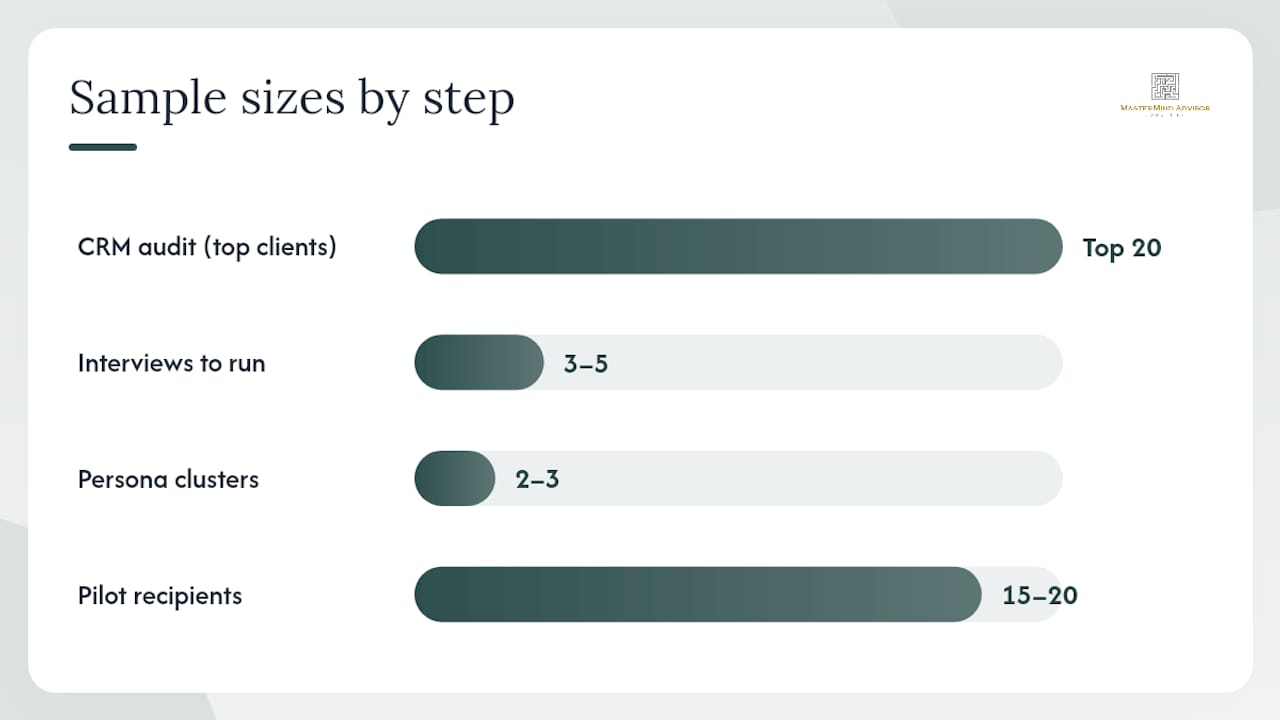
- Audit your CRM data. Pull your top 20 clients by revenue or satisfaction score. Note life stage, goals, AUM shape, and any behavioral tags already in the system.
- Review meeting notes and emails. Look for recurring phrases, objections, and questions. These are raw persona material hiding in plain sight.
- Run three to five short interviews. Ask current clients: "What were you most worried about before you hired an advisor?" and "How do you prefer to get financial updates?" eMoney Advisor's interview framework suggests keeping questions focused on communication preferences, goals, and decision triggers.
- Identify two or three natural clusters. Group clients by shared goals and money scripts, not just age or AUM. Patterns will emerge quickly.
- Name and document each persona. Write a one-page profile using the fields from Section 3. Store it in a shared folder your whole team can access.
- Run a pilot campaign. Send a persona-specific email or webinar invite to 15–20 matching clients. Measure open rate, click-through, and meeting requests over 30 days.
For aspirational growth, The Financial Brand recommends also building personas for the clients you want to attract, not only those you already serve. Just make sure the aspirational profile aligns with your firm's actual service capabilities.
Pair your persona work with a target market framework to make sure each persona maps to a reachable segment.
How to validate personas before you build campaigns around them
Building a persona on gut instinct is a starting point, not a finished product. Validation turns assumptions into evidence.
Quick validation checklist:
- Three client interviews: Ask two current clients and one prospect whether the persona description feels accurate. You will catch wrong assumptions fast.
- Short survey (five questions max): Use a tool like SurveyMonkey or Typeform. Ask about communication preferences, biggest financial concern, and how they found you.
- CRM filter test: Tag 10 clients with a persona label and run a filtered email. If open rates are above your baseline, the persona is resonating.
- A/B message test: Write two subject lines, one demographic ("Planning for retirement?") and one persona-driven ("Wondering if your income will actually last?"). The difference in open rate tells you which frame lands.
Three interview questions you can use this week:
- "Before you hired a financial advisor, what was your biggest hesitation?"
- "When you think about your financial future, what keeps you up at night?"
- "How do you prefer to get updates from your advisor, and how often?"
Commonwealth's four-step playbook recommends using CRM tags and A/B tests to measure whether persona-based messaging improves engagement and conversions over time. Track those signals for at least 60 days before drawing conclusions.
For a broader look at how behavioral data improves content performance, this guide on audience insights covers the same principle applied to content strategy.
Applying personas in meetings, onboarding, and marketing
A persona sitting in a folder does nothing. Here is how to wire it into your actual workflow.
Meeting opening scripts by persona type:
- For the security-driven client: "Before we look at numbers, tell me what 'financially safe' feels like to you."
- For the control-oriented business owner: "You've built something real. Let's make sure your personal wealth reflects that."
30–60–90-day onboarding flow (mapped to persona priorities):
- Days 1–30: Deliver the persona's highest-priority first deliverable (income floor analysis, business exit checklist, coordinated 401(k) review). Set communication cadence to match preferred channel.
- Days 31–60: Send one piece of content matched to the persona's money script. A security-driven client gets a "what happens if" scenario plan. A legacy-focused client gets a beneficiary review checklist.
- Days 61–90: Run a short check-in call. Ask one question: "Is there anything we haven't talked about that you think about often?" The answer updates the persona.
Content mapping by persona goal:
- Pre-retiree worried about income: invite to a Social Security timing webinar; send a retirement income checklist.
- Business owner planning an exit: send a buy-sell agreement explainer; invite to a tax-efficiency workshop.
- Dual-income couple: send a "coordinating two 401(k)s" email sequence; share a college savings comparison guide.
- Inherited-wealth client: send a plain-language investment primer; offer a one-on-one "no pressure" Q&A session.
Advisors using structured intake and persona-driven workflows can scale personalization and cut repetitive data requests. Pair this with a content strategy that maps persona pain points to specific content types and you have a system, not just a plan.
For timing persona-focused outreach to life events, a seasonal marketing calendar helps you schedule the right message at the right moment.
Common persona mistakes advisors make and how to fix them
Most persona projects fail not because advisors lack data, but because they cut corners in the wrong places.
- Relying on age and AUM alone. Two 60-year-olds with $900K each can have completely different money scripts and service expectations. Age and AUM describe the envelope, not the person inside it. Fix: add at least one behavioral or motivational field to every persona.
- Building personas from one source. A persona built only from CRM data misses what clients say in meetings. One built only from surveys misses what they actually do. Fix: triangulate across CRM data, meeting notes, and at least two direct interviews.
- Stereotyping by demographic group. Assuming all women are risk-averse or all millennials prefer digital-only contact is not a persona strategy. ProSight Financial Association notes that behavioral inputs and attention channels are more predictive of engagement than demographic assumptions. Fix: let behavioral evidence override demographic assumptions every time they conflict.
- Never updating personas. A persona built in 2022 may not reflect a client who has since retired, divorced, or sold a business. Fix: review personas annually and after any major life event trigger (inheritance, job change, market shock).
- Confusing aspirational personas with current-client profiles. They serve different purposes. Keep them in separate folders and label them clearly.
FINRA's regulatory guidance is worth reviewing when designing communication frameworks, particularly around risk disclosure language and licensing representations.
Why money scripts matter more than demographics in persona work
Demographics describe the surface. Money scripts explain the behavior underneath.
A money script is a core belief about what money means, usually formed in childhood and rarely examined as an adult. Common examples: "Money is dangerous," "Rich people are greedy," "I don't deserve to be wealthy," or "More money means more security." These beliefs drive the decisions clients make, including whether they follow your advice.
Kitces argues that the most valuable persona fields are psychological drivers, specifically money scripts and decision drivers, because they predict messaging fit better than demographics. A client who believes "money is security" will respond to loss-framing and guaranteed-income language. A client who believes "money is freedom" will respond to optionality and flexibility messaging. Same AUM, completely different pitch.
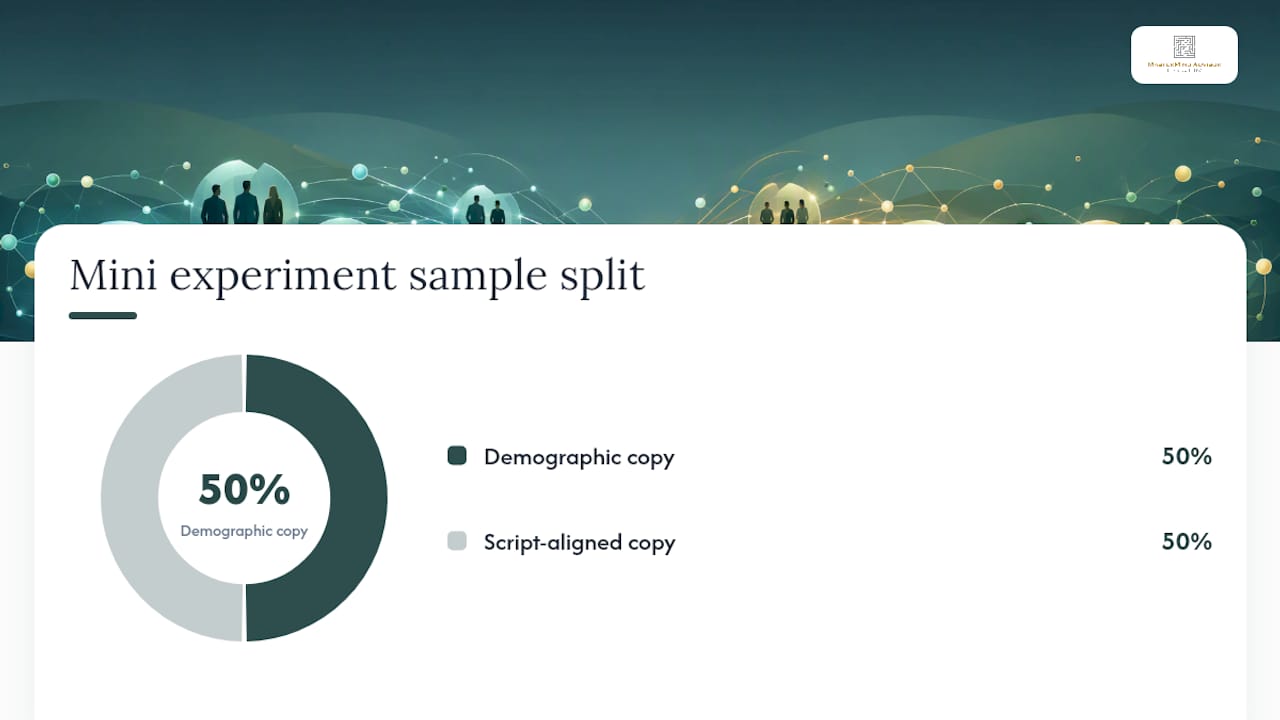
Mini experiment to run this month:
- Pick one persona with a clear money script.
- Write two versions of a subject line or meeting opener: one demographic ("Planning for retirement at 60?") and one script-aligned ("Want to know your income is covered no matter what?").
- Send each version to 10 matching clients or prospects.
- Measure open rate and meeting requests over two weeks.
Pro Tip: You only need 10 contacts per version to get a directional signal. You are not running a clinical trial. You are checking whether the frame resonates before you build a full campaign around it.
Buyer persona research from the broader marketing field confirms that motivation-aligned messaging consistently outperforms demographic targeting across industries, and financial services is no exception.
The effort is smaller than you think
Most advisors delay persona work because they picture a six-month research project. It is not. One afternoon of CRM review and two client phone calls will get you a working first draft.
The real payoff is not the persona document. It is what happens when your whole team uses the same language to describe the same client type. Onboarding gets faster. Emails get opened. Prospects feel understood before you have said anything about your credentials.
Start with your single most common client type. Build one persona, run one pilot email, and measure the response. That one experiment will tell you more about your clients than a year of demographic analysis.
The advisors who get the most from persona work are not the ones who built the most elaborate profiles. They are the ones who built simple, honest profiles and actually used them.
Sources
These resources are worth bookmarking before you start your first persona project.
- Creating client personas for financial advisor marketing (Kitces)
- ‘The persona touch’: Can customer profiles forge deeper connections and grow deposits? - ProSight Financial Association
- Power Marketing Playbook: 4 Steps to Creating Client Personas
- Simple Questions to Ask When Building Client Personas - eMoney Advisor
- Finra