
Financial advisors who grow their practices in 2026 share one trait: they publish content with a plan behind it. Not occasional LinkedIn posts or a quarterly newsletter that goes out when someone remembers. A real strategy, one that defines who you are talking to, what you want them to do, and how every piece of content moves them closer to a conversation with you.
Here is why that matters right now:
- Crowded market, thin differentiation. Prospects research advisors online before they ever call. Without consistent, authoritative content, you are invisible to the clients most likely to choose you.
- Niche clarity drives better leads. Advisors focusing on niche client segments with tailored content produce stronger client acquisition outcomes than those broadcasting generic financial tips.
- Purposeful publishing beats random activity. A documented plan aligns every blog post, email, and webinar with a specific business goal, whether that is building a referral pipeline, entering a new market segment, or retaining existing clients through a volatile period.
- Multi-channel reach compounds over time. Email, social media, blogs, and webinars each reach different segments of your audience at different stages of the decision process. A strategy ties them together instead of letting each channel operate in isolation.
- Compliance and efficiency require structure. Financial advisors face regulatory review requirements that can kill content momentum without a workflow designed around them.
A content strategy is not a marketing luxury. For independent advisors competing against large institutions with full marketing departments, it is the most cost-effective way to build authority and attract clients at scale.
Table of Contents
- How do you build a strong content foundation as an advisor?
- What content types actually move the needle for financial advisors?
- Mistakes that quietly kill your content marketing results
- How do you handle FINRA compliance without killing your content momentum?
- How do you measure whether your content strategy is actually working?
- Story-driven marketing is the real competitive edge in 2026
- Key Takeaways
- Mastermindadvisormarketing gives independent advisors a real content system
How do you build a strong content foundation as an advisor?
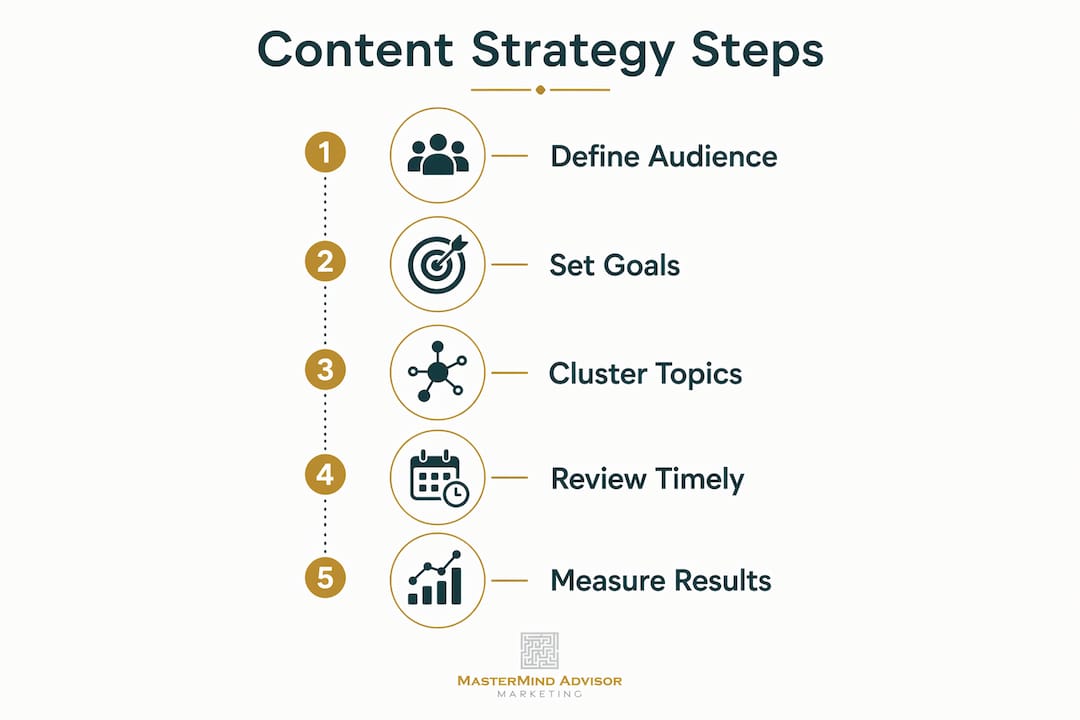
Every effective content program starts with two decisions that most advisors skip: who exactly you are writing for, and what you want that writing to accomplish. Get those wrong and the rest of the work is wasted.

Define your ideal client before you write a single word. Not "mass-affluent pre-retirees" as a demographic bucket, but a specific person. A 58-year-old corporate executive in the Pacific Northwest who is three years from retirement, worried about sequence-of-returns risk, and skeptical of advisors who lead with product pitches. That level of specificity shapes your topic choices, your tone, and the platforms where you show up. Your advisor positioning strategy is the foundation everything else is built on.
Document your plan. A content strategy that lives in your head is not a strategy. Write down your goals, your audience profile, your core topics, and the metrics you will use to judge success. Before producing content across any platform, you need to know what you want to achieve. That clarity prevents the common trap of publishing content that feels productive but generates no leads.
A 90-day rolling content calendar is the most practical planning tool for a solo or small-team practice. Here is what it should include:
- Core topics by month, mapped to client concerns (tax season, market volatility, retirement milestones, estate planning triggers)
- Content format per piece: blog post, email newsletter, LinkedIn article, short video, or webinar
- Distribution channel and publish date for each asset
- Goal alignment: which business objective does this piece serve?
- Compliance review window: built into the timeline, not bolted on at the end
Content clustering around related topics, writing three or four pieces on retirement income sequencing rather than one, boosts your search rankings and keeps prospects engaged across multiple touchpoints. The calendar is where that kind of intentional planning actually happens.
Pro Tip: Set a recurring 30-minute weekly slot to review your calendar, swap in timely topics (a Fed rate decision, a tax law update), and confirm the next two weeks of content are ready for compliance review. Consistency at the planning level is what prevents the "I haven't posted in three weeks" spiral.
What content types actually move the needle for financial advisors?
The formats that consistently drive engagement and client acquisition for advisors fall into a short list. The key is not using all of them at once, but choosing the ones that fit your audience and executing them well.
Educational blogs and planning guides remain the highest-leverage format for organic search. A well-written article on "Roth conversion strategies for executives near retirement" can generate inbound consultation requests for years after it is published. The types of financial planning content that build real literacy with prospects tend to be specific, scenario-based, and written for a reader who already knows the basics.
Email sequences tied to CRM data deliver the strongest measurable return. AI tools connected to platforms like Salesforce Financial Services Cloud, Redtail, or Wealthbox can trigger personalized messages based on client life events: an approaching retirement date, a beneficiary change, a portfolio milestone. Personalized, AI-driven email sequences are delivering the highest measured ROI of any content application in financial services, with top firms reporting strong revenue gains from AI-assisted email programs.
Video and social media have become primary trust-building channels, particularly on LinkedIn. Short-form video, even recorded on a phone, outperforms polished production when the content is specific and the advisor is genuinely on camera. Advisors using AI tools to repurpose long-form blog posts into LinkedIn carousels, short video scripts, and email snippets report producing nine distinct content assets from a single source piece. That is a meaningful output multiplier from the same content investment. For a deeper look at how video fits into a diversified strategy, video content for advisors has become a genuine client acquisition channel, not just a branding exercise.

Webinars and live events serve a different function: they compress the trust-building timeline. A prospect who attends a 45-minute webinar on Social Security optimization strategies has spent more time with you than most first meetings allow. That depth of engagement converts at a higher rate than any passive content format.
A few execution principles worth keeping:
- Mix original content with curated commentary on market events. You do not need to write everything from scratch.
- Repurpose aggressively. One webinar becomes a blog post, three email segments, and six LinkedIn posts.
- Every piece needs a next step. A call-to-action is not optional.
Mistakes that quietly kill your content marketing results
Most advisor content programs do not fail dramatically. They fade. Posting slows, topics drift, and six months later the blog has three articles and the newsletter goes out once a quarter. These are the patterns that cause it.
Spreading too thin across channels. Trying to maintain a presence on LinkedIn, Instagram, Twitter/X, YouTube, a podcast, and a blog simultaneously with a one-person operation is a recipe for mediocrity everywhere. Advisors who focus on one or two channels and build genuine authority there outperform those who spread their effort thin. Pick the channel where your ideal client actually spends time, and own it.
Generic content that could have been written by anyone. "Five tips for retirement planning" with no specific angle, no named client scenario, and no opinion is invisible. Prospects have seen it a hundred times. Content that does not reflect your actual perspective and expertise does not build trust.
Ignoring your audience's specific concerns. Content written for "everyone" reaches no one. If you serve physicians navigating student loan repayment alongside retirement savings, write directly to that situation. Generic financial content is not a competitive asset.
No calls to action, or the wrong ones. Content must feature contextual calls to action that address the reader's actual decision point, not a generic "schedule a call" button at the bottom of every page. A reader in the research phase needs a different prompt than one who has been on your email list for six months.
Treating compliance as an afterthought. Building a content calendar without accounting for review time leads to either rushed approvals or missed publish dates. Both erode the consistency that makes content marketing work.
Inconsistent publishing cadence. Audiences and search engines both reward regularity. An advisor who publishes one strong piece per week for a year will outperform one who publishes five pieces in January and then disappears until April.
How do you handle FINRA compliance without killing your content momentum?
Compliance is the friction point that stops more advisor content programs than any other factor. The review process feels slow, the rules feel vague, and the fear of getting something wrong leads to either over-cautious content that says nothing or content that never gets published at all.
The good news: the compliance bottleneck is more manageable than most advisors assume, and the tools to address it have improved significantly.
Structured pre-screening catches most issues before human review. Tools like Hearsay, FMG Suite AI, and Jasper for Financial Services include pre-configured compliance flags that surface language requiring legal review before a human ever reads the draft. That front-end filter removes the back-and-forth that inflates review timelines. AI-assisted workflows have reduced average compliance review cycles from 8.3 days to 2.1 days at firms using these structured processes.
Build the review window into your calendar, not around it. If your compliance team needs five business days to review a piece, your calendar should show the submission date, not just the publish date. Treating compliance as a parallel workflow rather than a final gate changes the entire dynamic.
Best practices that reduce regulatory friction:
- Avoid performance claims and forward-looking statements in educational content. These are the most common triggers for compliance holds.
- Use pre-approved language libraries for recurring topics like risk disclosures and regulatory references. Your compliance team can build these once; you use them repeatedly.
- Separate evergreen content from timely commentary. Evergreen pieces can be pre-approved in batches. Timely commentary on market events needs a faster lane, which is where AI pre-screening earns its keep.
- Document your review process. FINRA requires records of your review workflow. A documented process also makes it easier to onboard new team members and scale content production.
Balancing compliance with authentic messaging is a real tension. The solution is not to strip all personality from your content to make it easier to approve. It is to understand which elements require legal review and which do not, so you can be direct and opinionated in the parts of your content that are yours to own.
How do you measure whether your content strategy is actually working?
Most advisors track the wrong things. Follower counts and email open rates feel like progress, but they do not tell you whether content is generating clients. Here is what to actually watch.
Primary metrics tied to business outcomes:
- Inbound consultation requests originating from content (track the source in your CRM)
- Lead conversion rate from content-sourced prospects versus referral or cold outreach
- Client retention indicators: are existing clients engaging with your content? Engagement here often precedes referrals.
- Organic search traffic to your website, specifically to pages targeting your niche keywords
Secondary metrics that signal content health:
- Email click-through rates on specific topics (tells you what your audience actually cares about)
- LinkedIn post engagement by content type (video versus text versus carousel)
- Time on page for blog content (a proxy for whether the content is genuinely useful)
Firms that committed to an AI-powered SEO content strategy for at least two consecutive quarters saw organic search traffic grow by an average of 138% and inbound consultation requests increase by 47%. Those results do not appear in month one. The compounding effect is the point: every published article is a permanent asset that generates leads without additional spend.
Set realistic timelines. For a solo practice starting from scratch, expect three to six months before content generates measurable inbound leads. SEO compounds over 12 to 18 months. Email and social media can show results faster, but only if your list and following are already built. Advisors who quit after 90 days because they do not see immediate ROI are abandoning the investment right before it starts paying off.
Use your data to refine, not to second-guess. If your retirement income articles consistently outperform your estate planning content in click-throughs, write more retirement income content. If LinkedIn video generates more consultation requests than blog posts, shift your format mix. The metrics tell you where to double down.
Story-driven marketing is the real competitive edge in 2026
The single biggest shift in financial advisor marketing right now is not an AI tool or a new social platform. It is the move from generic educational content to content that makes people feel something.
AI has flooded the internet with technically accurate, perfectly formatted, completely forgettable financial content. Every advisor's blog can now produce weekly market commentary, tax planning explainers, and retirement guides. The volume is there. The differentiation is gone. What cuts through in 2026 is specificity and humanity, and the most effective vehicle for both is storytelling.
"The only real differentiator left is how you make people feel... Storytelling will dominate... People want signals of humanity." — Advisorpedia, 2026
Anonymized client scenarios outperform abstract advice. "Here is how a 61-year-old teacher we worked with restructured her Social Security claiming strategy to add $47,000 in lifetime income" is more compelling than "Social Security optimization can significantly increase your retirement income." The scenario is specific. It is real. It signals that you have actually solved this problem for someone.
Vulnerability and opinion build more trust than polish. An advisor who writes "I made this mistake with a client's portfolio in 2022 and here is what I learned" will generate more engagement and referrals than one who publishes only authoritative, error-free content. Clients are not looking for perfection. They are looking for someone they trust to be honest with them.
Client referrals remain the top source of new clients for most advisory practices. Story-driven content accelerates referrals because it gives existing clients something worth sharing. A technically accurate article on tax-loss harvesting is not something a client forwards to a friend. A story about how a client avoided a $30,000 tax bill by acting in November is.
The competitive advantage in 2026 belongs to advisors who use AI-powered content workflow to handle the volume and mechanics of content production, freeing up their own time for the human elements that AI cannot replicate: genuine opinions, real client scenarios, and the kind of direct, personal voice that makes a prospect feel like they already know you. That combination, AI efficiency plus human authenticity, is what story-driven content marketing for advisors looks like at its best.
Key Takeaways
A documented content strategy is the single most important marketing investment an independent financial advisor can make in 2026, because it turns scattered publishing activity into a compounding client acquisition system.
| Point | Details |
|---|---|
| Strategy before content | Define your ideal client and business goals before producing any content across platforms. |
| Niche focus drives results | Advisors targeting specific client segments with tailored content generate stronger leads than those publishing broadly. |
| Email ROI leads all formats | AI-driven personalized email sequences deliver ROI as high as $11.40 in new AUM revenue per $1 spent at top firms. |
| Compliance is manageable | AI-assisted workflows have reduced average compliance review cycles from 8.3 days to 2.1 days at firms using these structured processes. |
| Mastermindadvisormarketing | Offers a turnkey content and webinar marketing system built specifically for independent financial advisors. |
Mastermindadvisormarketing gives independent advisors a real content system
Independent advisors who read this far know what a content strategy should look like. The harder question is who actually builds and runs it when you are also managing client relationships, compliance obligations, and a full advisory practice.
Mastermindadvisormarketing was built specifically for that gap. The platform delivers customized webinars, seminars, and content marketing programs designed around your niche and client base, not a generic template adapted from a different industry. The CRM integration and automated email follow-up sequences mean that every prospect who engages with your content enters a nurture workflow without requiring manual follow-up from you. That is the difference between a content strategy that generates leads and one that generates content.
The compliance piece is built in, not bolted on. Mastermindadvisormarketing's system is designed with regulatory requirements in mind, so you can scale content production without creating new compliance risk. Advisors using the platform have increased inbound leads and strengthened their practice authority, with a system that handles the mechanics so they can focus on the client relationships that actually close.
If you are ready to move from ad hoc content to a system that works, hosting a client seminar is one of the highest-converting first steps the platform supports. Start there, and build the rest of your content strategy around it.