

Yes, advisors can measure content marketing ROI reliably. It works when every content touchpoint gets tied to CRM-recorded booked meetings and closed revenue, not vanity metrics like impressions or shares. The fastest path forward: instrument your CRM with campaign and source fields today, then start tracking cost per qualified lead and meeting-to-client rate. Content Marketing Institute benchmarks and the SEC Marketing Rule both shape how that tracking should work, and firms like Mastermind Advisor Marketing build systems around exactly this loop.
TL;DR:
- Content ROI for advisors is most accurate when tied to booked meetings and closed revenue rather than vanity metrics, with tracking best suited to a fully instrumented CRM.
- Fully loaded costs—including advisor planning, production, compliance, and follow-up—must be included in ROI calculations, which are often underestimated if omitted.
- Weighted multi-touch attribution assigns credit to initial, middle, and closing content interactions, better reflecting long buying cycles than last-touch models.
- Industry benchmarks suggest a strong content marketing ROI is around 5:1, with podcasts and webinars often outperforming social media on cost-per-client metrics.
- Rapid ROI improvements come from focusing on one high-value asset, repurposing it across channels, and optimizing conversion paths with targeted testing.
Table of Contents
- What Content Marketing ROI Means for Advisory Firms
- Key Metrics and KPIs to Record in Your CRM
- Attribution Models That Work for Advisor Funnels
- Benchmarks and Channel Costs Advisors Should Expect
- How to Improve ROI Quickly Without a Bigger Budget
- Compliance and the SEC Marketing Rule: Protecting Your ROI
- The Implementation Checklist: CRM Fields and Reporting Cadence
- Treating Content Like a Measurable Product
- How Mastermind Advisor Marketing Puts This Playbook to Work
- Sources
- FAQ
What Content Marketing ROI Means for Advisory Firms
The formula that actually works for advisors looks different from a typical B2B ROI calculation: (content-attributed gross profit or recurring fee revenue minus fully loaded content cost) divided by fully loaded content cost. Two words matter most there: "attributed" and "fully loaded."
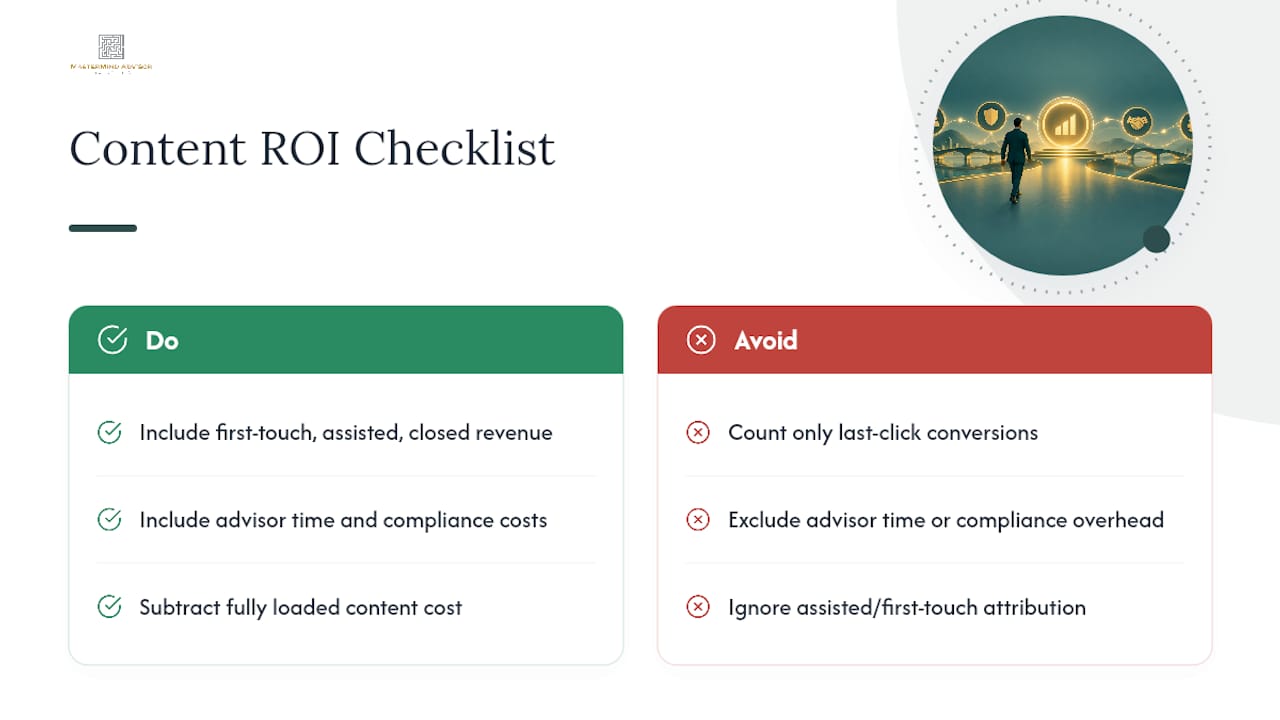
Most advisors get the revenue side wrong by counting only last-click conversions. A prospect who watches a webinar in March, reads three blog posts in April, and books a meeting in June didn't convert because of the meeting request form. Count first-touch, assisted, and closed-revenue contributions together, or you'll undercredit the content that actually built trust over a long buying cycle. CMI's 2025 benchmarks found that 56% of B2B marketers struggle to attribute ROI and track the customer journey accurately, and advisory practices face a sharper version of that problem given how long financial services buying cycles run.
The cost side trips people up too. Fully loaded cost includes advisor time spent planning and delivering content, compliance review hours, production costs, software subscriptions, ad spend, and the labor that goes into following up with every lead. Skip advisor time and compliance overhead, and your ROI number will look artificially strong.
Key Metrics and KPIs to Record in Your CRM
Your CRM needs to capture six numbers well, and most advisor practices track none of them consistently. Building the right fields now saves you from reconstructing data later when a partner asks whether the marketing budget is working.
- Cost per qualified lead — total campaign spend divided by leads that meet your minimum criteria (assets, income range, life stage).
- Cost per booked meeting — spend divided by discovery calls actually scheduled, not just leads captured.
- Meeting-to-client rate — the percentage of booked meetings that convert to signed clients.
- Customer acquisition cost (CAC) — fully loaded cost divided by new clients closed in a given period.
- Payback period — how many months of recurring fee revenue it takes to recover CAC.
- Lifetime client value (LTV) — projected recurring revenue over the expected client relationship, used to judge whether CAC is sustainable.
Structure your CRM with campaign and source fields on every contact record, timestamp every touch, define what "qualified lead" and each pipeline stage actually mean, and keep UTM tagging consistent across every link you publish. CMI's advisor-relevant metric guidance recommends reporting by campaign and source rather than in aggregate, which is the only way to know which webinar or which blog series is actually pulling weight.
Pro Tip: Review leading indicators (leads, booked meetings) monthly, but wait for quarterly reviews to judge revenue outcomes. Financial advisory sales cycles run long enough that monthly revenue numbers are mostly noise.
Attribution Models That Work for Advisor Funnels
Single-touch attribution, whether first-click or last-click, badly misrepresents how advisor prospects actually decide. A prospect might discover you through a podcast, warm up over six months of email nurture, then book a meeting after seeing a seminar invitation. Crediting the seminar alone ignores the five months of content that made the prospect receptive in the first place.
A simple weighted multi-touch model gets you most of the way there without requiring a data science team:
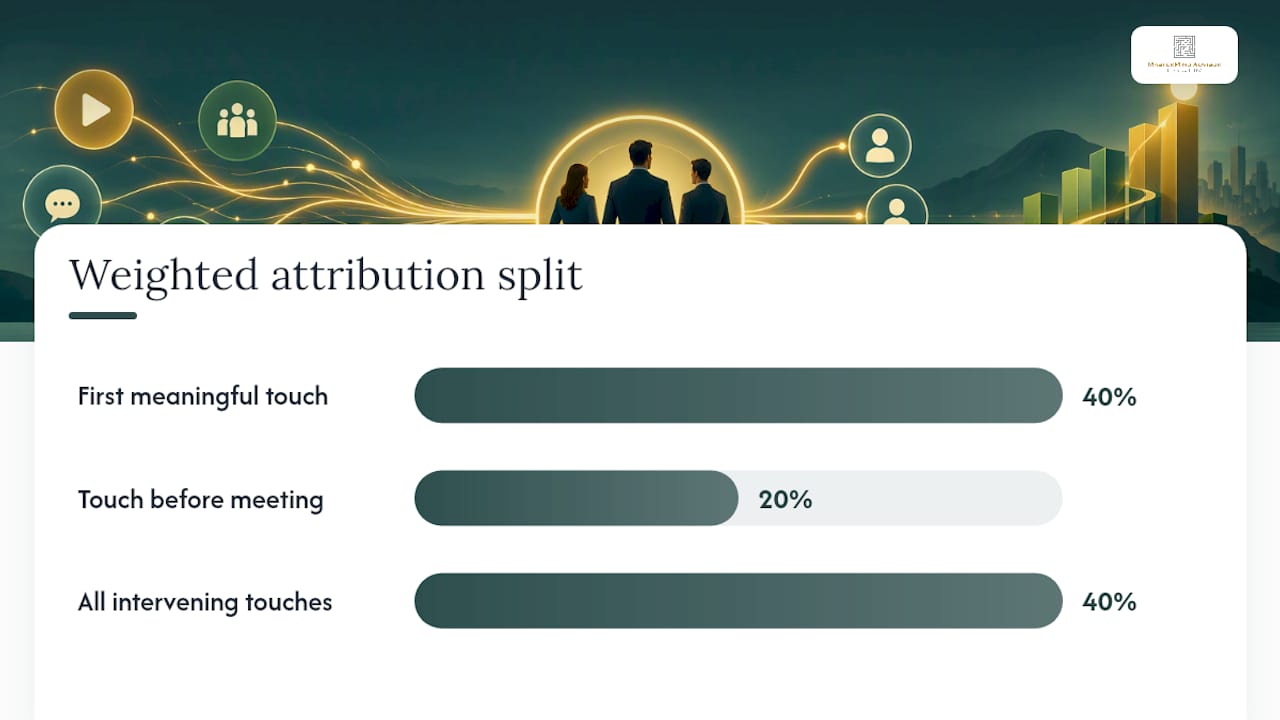
- Assign 40% credit to the first meaningful touch (the asset that started the relationship)
- Assign 20% to the touch immediately before the meeting was booked
- Split the remaining 40% evenly across every touch in between
Adjust those weights by channel over time. Educational, longer-form content (podcasts, webinars) tends to deserve more first-touch credit because it does the trust-building work; retargeting ads usually deserve more last-touch credit because they're closing an already-warm prospect.
To put this into practice, timestamp every content interaction in your CRM, export the data to a spreadsheet or BI tool quarterly, and compare first-touch, weighted, and pure multi-touch views side by side. Last-touch models systematically overcredit the final interaction in a long educational funnel, so treat any report that only shows last-click numbers as incomplete.
Benchmarks and Channel Costs Advisors Should Expect
Industry ROI ranges give you a reality check before you set internal targets. Investopedia's marketing ROI guidance treats a 5:1 return as strong performance and 10:1 as exceptional, while anything near 2:1 usually signals a channel or funnel problem worth fixing.
Social media often looks like the cheapest channel on a spreadsheet, but Kitces analysis puts the true cost at roughly $16,700 per acquired client once you account for the advisor time spent creating, posting, and engaging, not just the ad spend line item.
Compare that to a properly instrumented education-based channel. One advisor's retirement-focused podcast generated about $130,000 in recurring revenue from 9 new clients on an $11,000 spend, once the funnel and calls-to-action were tightened.
A few patterns hold across advisor channels:
- Webinars and podcasts tend to outperform social media on cost-per-client once soft costs are counted honestly
- Evergreen assets (a strong webinar recording, a cornerstone guide) keep generating leads for years, which lowers their cost-per-lead the longer they stay in rotation
- Repurposing one core asset into shorter formats multiplies its return without multiplying its production cost with content marketing automation that streamlines production and scaling.
How to Improve ROI Quickly Without a Bigger Budget
Better ROI usually comes from doing less, better, rather than producing more content. Here's a sequence that works inside a single quarter:
- Pick one high-value asset. Choose a webinar, a long-form retirement or tax guide, or a podcast episode covering a topic your ideal client actually searches for.
- Repurpose it aggressively. Turn the recording into three to five email sequences, a landing page, and a handful of short social clips. One production effort, five distribution channels.
- Test the conversion path, not just the content. Run A/B tests on landing page headlines, calendar-booking CTAs, and nurture email subject lines. Track how each variant moves your CAC and payback period, not just click rate.
- Narrow your audience before you widen your reach. AI tools have made generic content cheap to produce and easy to ignore. A narrowly targeted piece, aimed at business owners nearing a liquidity event or federal employees weighing a pension decision, consistently outperforms broad, generic advisor content in a crowded feed.
Pro Tip: Before creating anything new next quarter, audit last year's content for the one asset that generated the most booked meetings. Repurpose that winner before you brainstorm a new topic.
Compliance and the SEC Marketing Rule: Protecting Your ROI
Compliance failures don't just create legal risk. They destroy ROI directly, because content that gets pulled or rewritten mid-campaign stops generating leads and wastes the production cost already spent on it. The SEC's marketing rule risk alert flags testimonials, endorsements, third-party ratings, performance presentations, and disclosure gaps as the most common exam findings, and cites books-and-records deficiencies as a recurring problem.
Build these controls in before you publish, not after an exam flags something:
- A written approval checklist that every content asset clears before it goes live
- Version control so you can show exactly what was published, when, and who approved it
- Standard disclosure templates for testimonials, performance claims, and third-party mentions
- A retained-records process that satisfies books-and-records requirements without manual scrambling
Firms that treat compliance as a line item added at the end tend to lose usable lifetime on their best assets. A step-by-step compliance workflow built into your content calendar from day one keeps a strong webinar or guide in rotation for years instead of getting shelved after one exam cycle.
The Implementation Checklist: CRM Fields and Reporting Cadence
Here's the sequence that turns everything above into a working system rather than a one-off experiment:
- Define your ideal client and the specific outcome you want the content to drive (a booked meeting, a webinar registration).
- Choose one core asset as your quarter's centerpiece.
- Build a landing page with a consented nurture sequence attached.
- Add campaign and source fields to every CRM contact record before launch, not after.
- Define what counts as a "qualified lead" and what each pipeline stage means, in writing.
- Route the asset through compliance approval and keep the sign-off on record.
- Launch, then repurpose the asset across email, social, and landing pages.
- Review leading indicators (leads, meetings booked) every month.
- Review revenue outcomes, CAC, and LTV every quarter.
Calculate fully loaded cost using your own hourly rate for advisor time, plus compliance review hours, so the cost side of your ROI formula isn't quietly understated.
| CRM field or report | Why it matters |
|---|---|
| Campaign and source tags | Lets you attribute leads to the specific asset that generated them |
| Touch timestamps | Enables first-touch, weighted, and multi-touch comparisons |
| Qualified-lead and meeting-stage definitions | Keeps cost-per-lead and meeting-to-client numbers consistent over time |
| Monthly leading-indicator report | Flags underperforming campaigns before quarterly numbers arrive |
| Quarterly CAC/LTV/payback report | Confirms whether marketing spend is sustainable long term |
Treating Content Like a Measurable Product
Most advisors treat content as a marketing expense instead of a product with its own lifecycle and profit-and-loss statement. That framing is the real gap. A webinar that costs $3,000 to produce and generates two clients over 18 months has a payback period and an LTV, just like any other business investment, and it deserves the same scrutiny a partner would give a new hire.
This kind of measurement system has been operationalized for advisory practices. If you're not tracking CAC and payback period yet, start with one asset this quarter and measure it end to end before scaling anything else.
— Josh
How Mastermind Advisor Marketing Puts This Playbook to Work
Building CRM fields, campaign tags, and compliance approval workflows from scratch takes time most advisors don't have between client meetings. A turnkey system exists to close that gap, built by professionals with advisory practice experience instead of as a generic agency guessing at what advisors need.
The services correspond with the checklist above, offering core educational assets like webinars and seminars, a compliance-friendly content library to maintain consistent approval processes, automated email campaigns and CRM integration to capture necessary campaign and source data, and scheduled social media content to manage repurposing efficiently. These offerings are designed for the regulatory and long-buying-cycle realities of financial services.
If you're ready to put a measurable system behind your next campaign, review the full range of services and start mapping which piece fits your practice first.
This article is general information, not a substitute for advice from a qualified financial advisor. Consult a qualified financial professional about your own circumstances before acting on anything here.
Sources
- SEC — Additional observations regarding advisers’ compliance with the Advisers Act Marketing Rule
- Measuring Marketing ROI: Calculate campaign effectiveness — Investopedia
FAQ
What Is the ROI of Content Marketing for Advisors?
It varies widely by channel and how well the funnel is instrumented, but Investopedia treats a 5:1 return as strong and 10:1 as exceptional for marketing generally. Advisor-specific returns depend heavily on whether you're counting fully loaded costs, including advisor time and compliance review.
What Counts as a Good ROI for a Marketing Campaign?
A 5:1 ratio of gain to cost is generally considered strong, while returns near 2:1 often signal a funnel or targeting problem worth investigating. For advisors, payback period and meeting-to-client rate matter just as much as the raw ratio, since a slow payback can strain cash flow even when the eventual return looks fine.
Is a 1% ROI Good for Content Marketing?
No. A 1% return means you barely broke even on cost, and by most industry standards that signals the campaign needs rework rather than more budget. Compare it against a channel like an education-based podcast, where one advisor case generated roughly $130,000 in recurring revenue on an $11,000 spend once the funnel was optimized.
What Does Mastermind Advisor Marketing Cost?
Pricing for webinars, seminars, the content library, email marketing, social media, and website services is available directly on the Mastermind Advisor Marketing services page, since costs depend on the scope of the engagement.
How Do I Track Content ROI Without a Data Team?
Add campaign and source fields to your CRM, timestamp every content touch, and compare first-touch versus weighted multi-touch attribution in a spreadsheet or BI tool. This gets you most of the accuracy of a dedicated analytics setup without hiring anyone, and a step-by-step pilot guide can walk you through initial months of setup.