

The fastest path to defensible marketing ROI at an advisory firm is a focused 60–90 day pilot that connects CRM close data to marketing spend and tracks three numbers: client acquisition cost (CAC), lifetime value (LTV), and your lead-to-client conversion rate. Everything else is refinement.
Here is what to do in the next two weeks:
- Pick one or two channels to test (webinars, paid search, or referral programs are the highest-signal starting points for RIAs).
- Define your funnel stages in writing: what counts as a lead, a marketing-qualified lead (MQL), a sales-qualified lead (SQL), and a closed client.
- Tag all traffic with UTM parameters and confirm your CRM captures lead source on every new record.
- Verify that closed deals in your CRM carry a revenue figure and a close date you can reconcile back to a campaign.
Pro Tip: If your CRM does not currently capture lead source at the contact level, fix that field before you spend another dollar on campaigns. Every week without it is a week of attribution data you can never recover.
Mastermindadvisormarketing's turnkey pilot program handles the CRM configuration, UTM architecture, and dashboard setup for you, so you can have clean data within the first 30 days rather than spending that time on infrastructure.

Table of Contents
- What does marketing ROI actually mean for an advisory firm?
- Why advisory firms need precise ROI tracking more than most
- How to build a measurement framework in six steps
- MTA or MMM: which attribution model fits your firm?
- Which tools does your firm actually need?
- How to present ROI to partners and leadership
- Common pitfalls and how to fix them fast
- A 60–90 day pilot that proved marketing ROI: what one advisory firm did
- Key Takeaways
- The tradeoff most advisory firms get wrong
- Mastermindadvisormarketing's turnkey pilot for advisory firms
- Useful sources and templates for your pilot
What does marketing ROI actually mean for an advisory firm?
Marketing ROI for an advisory firm follows the same base formula every marketer uses, but the interpretation changes because of long sales cycles and high-value clients.
The formula: Marketing ROI = (Revenue from marketing − Marketing investment) ÷ Marketing investment × 100
Per ClicData's ROI tracking guide, the most defensible version uses cohort-based revenue attribution and closed-loop CRM revenue rather than raw sales totals. That means you attribute revenue to the cohort of clients whose first touch fell within a defined campaign window, not to whatever closed this month.
For a firm with a 6–18 month sales cycle, a campaign that ran in Q1 may not show closed revenue until Q3 or Q4. Naive monthly ROI calculations will always make marketing look like a money pit.
The KPIs that actually matter for RIAs
Per Kitces' advisor KPI framework, CAC benchmarks for advisors range from roughly $2,000 for newer practices to $4,000 or more for established firms, and those figures only hold if you include advisor time in the calculation. Advisor time cost must be included in CAC calculations, as excluding it understates the true acquisition cost
| Metric | How to calculate | Why it matters for RIAs |
|---|---|---|
| CAC | (Total marketing spend + advisor time cost) ÷ new clients acquired | Understating CAC by ignoring time cost leads to bad budget decisions |
| LTV | Average AUM × fee rate × average client tenure | Sets the ceiling on how much you can rationally spend to acquire a client |
| LTV:CAC ratio | LTV ÷ CAC | A ratio above 3:1 signals a healthy acquisition model |
| MQL→SQL rate | SQLs ÷ MQLs × 100 | Reveals whether marketing is generating qualified interest or just noise |
| Meeting-to-client rate | Closed clients ÷ discovery meetings × 100 | The clearest signal of sales process quality |
| Channel ROI | (Revenue attributed to channel − channel spend) ÷ channel spend × 100 | Tells you which channels to scale and which to cut |
| Cost per lead (CPL) | Total channel spend ÷ leads generated | Early-funnel efficiency metric; compare across channels |
According to Improvado's ROI calculation guide, combining multi-channel attribution models with consistent analytics practices is what separates firms that can defend their numbers to a CFO from those that are guessing.
Why advisory firms need precise ROI tracking more than most
Long sales cycles create a specific problem: marketing spend and revenue recognition are separated by months, sometimes over a year. That gap makes it easy for partners to dismiss marketing as a cost center when the connection to revenue is invisible.
There are three concrete reasons to fix this now:
- Governance and compliance. Auditable marketing records are increasingly expected by compliance teams and regulators. A documented attribution methodology protects you when a partner questions a spend decision.
- Budget defensibility. Without closed-loop data, every marketing budget conversation is a negotiation based on gut feel. With it, you are presenting a return on a known investment.
- Pricing and channel strategy. When you know your CAC by channel, you can make rational decisions about where to concentrate spend. SmartAsset's research on digital marketing for financial services shows wide variance in ROI by tactic, meaning the difference between a well-allocated and a poorly-allocated budget is material.
The advisor marketing funnel is the structural map that makes this conversation possible. Without funnel-stage definitions, you cannot calculate conversion rates, and without conversion rates, you cannot calculate CAC.
How to build a measurement framework in six steps
This framework runs from a standing start to a defensible pilot report. Each step has a clear owner and a concrete output.
Step 0: Align definitions before you instrument anything
Gather your partners, marketing lead, and CRM admin for one 60-minute session. Agree in writing on: what counts as a lead, an MQL, an SQL, and a closed client. Document the criteria in your CRM as picklist values, not free-text fields.
Steps 1–5: The measurement sequence
-
Define objective metrics. Set target KPIs for the pilot: CAC ceiling, LTV floor, MQL→SQL rate, and meeting-to-client rate. Write them down before the pilot starts so you have a benchmark to compare against.
-
Instrument tracking. Configure UTM parameters for every campaign URL. Map lead sources in your CRM (at minimum: organic search, paid search, webinar, referral, direct). Add event tags in Google Analytics 4 for form submissions, webinar registrations, and meeting bookings. Per Windsor.ai's campaign tracking guide, UTM discipline and closed-loop CRM data are the two highest-leverage actions for linking campaigns to revenue.
-
Choose your attribution approach. For a 60–90 day pilot with primarily digital channels, multi-touch attribution (MTA) is the right starting point. If you run brand campaigns, radio, or print alongside digital, layer in marketing-mix modeling (MMM) for those channels. More on this in the next section.
-
Build dashboards and a governance cadence. A weekly ops dashboard for the marketing team (channel spend, leads, CPL) and a monthly leadership readout (CAC, pipeline value, new client revenue, LTV:CAC) are the two artifacts you need. Firms that invest in analytics-driven measurement report materially better ROI outcomes than those relying on manual reporting.
-
Run the pilot, reconcile, and report. At day 60–90, pull closed clients from your CRM whose first touch falls within the pilot window. Calculate CAC and LTV for that cohort. Compare to your pre-pilot benchmarks. Present the delta to leadership with a confidence level attached to the attribution.
Pilot scope template:
| Role | Responsibility | Minimum requirement |
|---|---|---|
| Marketing lead | UTM setup, campaign tagging, dashboard build | Access to GA4 and CRM |
| CRM admin | Lead source fields, revenue sync, closed-loop mapping | Admin access to CRM |
| Advisor/partner | Define lead criteria, log meeting outcomes | 15 min/week data hygiene |
| Finance | Confirm revenue figures for closed clients | Monthly revenue export |
MTA or MMM: which attribution model fits your firm?
Multi-touch attribution (MTA) assigns credit to individual digital touchpoints in a prospect's journey. Marketing-mix modeling (MMM) uses statistical regression to estimate the contribution of each channel to revenue at the aggregate level, without requiring individual-level tracking.
When MTA is the right choice:
- Your prospect journey is primarily digital (paid search, email, webinar, social).
- Your CRM captures touchpoints consistently across the funnel.
- You have enough conversion events to make per-channel credit meaningful (roughly 30+ closed clients per quarter is a workable minimum).
- You need channel-level granularity to make weekly budget decisions.
When MMM is preferable:
- You run brand campaigns, radio, print, or event sponsorships alongside digital.
- Conversion volumes are low (fewer than 30 closed clients per quarter).
- You need to measure the effect of brand awareness on long-term AUM growth.
- Privacy constraints limit individual-level tracking.
Per Deloitte's hybrid measurement guidance, the pragmatic industry standard for firms with mixed channel mixes is a hybrid approach: use MTA for digital channels where deterministic data exists, and MMM for brand and offline channels where it does not. Reconcile the two models quarterly to produce a unified budget allocation view.
Model selection checklist:
- Count your digital conversion events per quarter. Below 30, lean on MMM.
- Audit your CRM for touchpoint capture. If fewer than 70% of contacts have a lead source, fix that before running MTA.
- List every channel by type: digital performance, digital brand, offline. Channels in the third category need MMM.
- Confirm whether your analytics platform supports data-driven attribution (GA4 does, natively, for accounts with sufficient conversion volume).
- Decide on a reconciliation cadence before the pilot starts.
Which tools does your firm actually need?
The core stack for end-to-end ROI tracking at an advisory firm has four layers. You do not need all of them on day one, but you need to know where each gap is.
- CRM layer: Salesforce or HubSpot are the two most common choices for RIAs. Salesforce offers deeper custom reporting and is the better fit for larger practices with complex pipeline stages. HubSpot is faster to implement and works well for firms under 10 advisors. Either way, the CRM must capture lead source, first-touch date, and closed revenue at the contact level.
- Analytics layer: Google Analytics 4 is non-negotiable for web traffic attribution. Configure it with server-side tagging where possible to preserve first-party data as third-party cookies continue to deprecate. GA4's data-driven attribution model is the most defensible default for digital channels.
- Attribution layer: Windsor.ai aggregates data from your ad platforms, CRM, and analytics into a single attribution view. It handles multi-source data ingestion and supports multiple attribution models, which makes it practical for firms that run campaigns across three or more channels.
- BI/reporting layer: Connect your CRM and GA4 data to a BI tool (Looker Studio is free and integrates natively with GA4; Tableau or Power BI for more complex needs) to build the leadership dashboards described in the framework section.
Firms that invest in analytics and BI infrastructure report 57% better ROI outcomes compared to those relying on platform-native reporting alone.
Tools readiness checklist:
| Tool | Minimum configuration | Integration required |
|---|---|---|
| CRM (Salesforce / HubSpot) | Lead source field, revenue field, close date | Bi-directional sync with marketing automation |
| Google Analytics 4 | GA4 property, event tags, conversion goals | Connected to ad platforms via Google Ads link |
| Windsor.ai | Ad platform connectors, CRM connector | API access to CRM and ad accounts |
| Marketing automation | UTM pass-through, lead scoring, email sequences | CRM sync for MQL→SQL handoff |
| BI tool (Looker Studio) | CAC, LTV, pipeline dashboards | GA4 and CRM data sources |
For a deeper look at how these tools fit into a broader financial services digital marketing strategy, the channel selection decisions upstream of your stack matter as much as the tools themselves.
How to present ROI to partners and leadership
The goal of a leadership ROI readout is not to show that marketing is working. It is to show that marketing is a predictable, measurable investment with a known return. That framing changes how partners engage with the numbers.
What belongs in an executive one-pager:
- CAC for the pilot cohort (with and without advisor time, shown separately)
- New client revenue attributed to the pilot (first-year AUM fees or flat fee revenue)
- LTV:CAC ratio for the cohort
- Pipeline value of prospects still in funnel from pilot campaigns
- Channel-level ROI for each tested channel
- Attribution confidence level (deterministic vs. modeled, and what percentage of revenue is deterministically attributed)
Dashboard design principles for advisory firms:
- Overlay AUM growth with campaign spend on a shared timeline axis. The visual correlation is more persuasive than a table.
- Show cohort views: prospects who entered the funnel in month X, tracked through to close. This makes the long sales cycle visible rather than invisible.
- Include conversion funnel stages with drop-off rates at each stage. Partners can see exactly where prospects are lost.
- Add confidence intervals to modeled attribution figures. Presenting a modeled number as precise is a credibility risk.
Per Improvado's measurement guide, combining multi-channel attribution with consistent analytics reporting is what makes these numbers defensible rather than directional.
Common pitfalls and how to fix them fast
Most advisory firms hit the same five problems when they first try to measure marketing ROI. Each one has a specific fix.
The five most common failures:
-
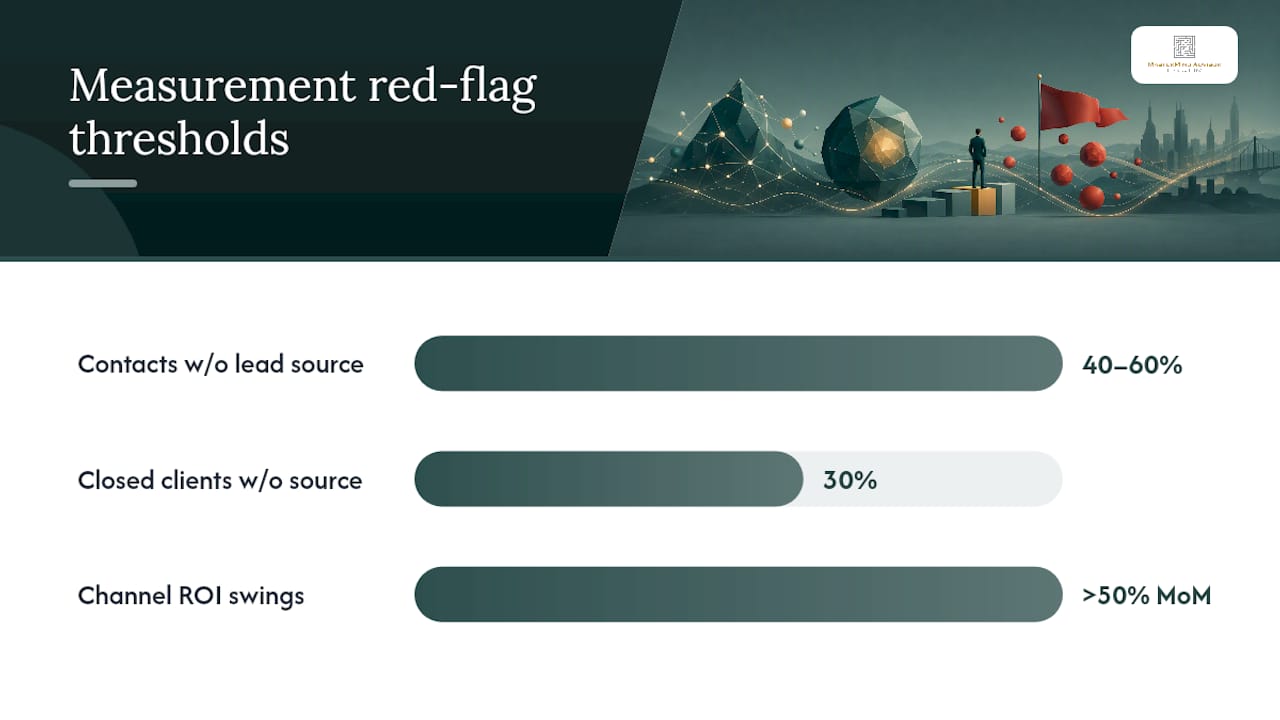
No UTM discipline. Campaigns go live without UTM parameters, so lead source is "direct" or "none" for 40–60% of contacts. Fix: create a UTM naming convention document and make it a campaign launch checklist item. Assign one person to audit UTMs weekly for the first 90 days.
-
Advisor time excluded from CAC. The CAC calculation uses only hard-dollar spend, making acquisition look cheaper than it is. Fix: calculate advisor hourly cost (annual compensation ÷ 2,000 hours) and log time spent on marketing and sales activities weekly. Add this to the CAC formula. Per Kitces' KPI framework, omitting time cost is one of the most common errors in advisor CAC calculations.
-
Fragmented CRMs. Some advisors use one CRM, others use spreadsheets, and the marketing team uses a third system. Revenue never reconciles. Fix: consolidate to a single CRM before the pilot starts. If that is not feasible in 30 days, at minimum create a manual reconciliation process for the pilot cohort.
-
Inconsistent lead definitions. Marketing counts a webinar registrant as a lead; the advisor counts only someone who booked a discovery call. The funnel math never adds up. Fix: this is the Step 0 alignment conversation from the framework section. Do it before instrumentation, not after.
-
Last-click attribution. The CRM credits the last touchpoint before close, which almost always means "direct" or "email." Every other channel looks like it contributes nothing. Fix: switch to data-driven attribution in GA4 and configure Windsor.ai to distribute credit across the full journey.
Red flags that your measurement system is unreliable:
- More than 30% of closed clients have no lead source in the CRM.
- Channel-level ROI swings by more than 50% month-over-month with no corresponding change in spend or creative.
- You cannot reconcile the number of closed clients in the CRM to the revenue figure in your accounting system.
When you see any of these, stop adding channels and fix the data foundation first.
A 60–90 day pilot that proved marketing ROI: what one advisory firm did
A mid-sized RIA with three advisors and a part-time marketing coordinator ran a 90-day pilot focused on two channels: webinars and paid search. Before the pilot, the firm had no UTM structure, lead source was blank on 58% of CRM contacts, and CAC was calculated as ad spend only.
Pilot scope and hypothesis: Test whether webinars or paid search produced a lower true CAC (including advisor time) and a higher meeting-to-client conversion rate.
Instrumentation completed in the first 30 days:
- UTM parameters deployed across all campaign URLs.
- Lead source field made mandatory in HubSpot on new contact creation.
- GA4 configured with form submission and webinar registration events.
- Advisor time logging added to weekly ops: 15 minutes per week to log prospect meeting time.
- Windsor.ai connected to HubSpot, Google Ads, and GA4.
Before and after metrics (90-day pilot cohort):
| Metric | Before pilot | After pilot (90-day cohort) |
|---|---|---|
| Lead source captured | 42% of contacts | 91% of contacts |
| CAC (ad spend only) | Not calculated | $2,800 (webinar) / $4,100 (paid search) |
| CAC (including advisor time) | Not calculated | $5,400 (webinar) / $6,900 (paid search) |
| Meeting-to-client rate | Unknown | 38% (webinar) / 22% (paid search) |
| New client revenue (pilot cohort) | Baseline: $0 attributed | $94,000 first-year AUM fees |
After the pilot, the firm shifted 60% of its paid media budget to webinar production and promotion, added a governance cadence (monthly leadership readout), and engaged Mastermindadvisormarketing to handle ongoing webinar production, CRM automation, and compliance-safe content. The infrastructure built during the pilot became the foundation for a full marketing funnel rollout in months four through six.
Key Takeaways
Defensible marketing ROI for an advisory firm requires a short pilot that connects CRM close data to campaign spend, tracks CAC with advisor time included, and uses cohort-based attribution rather than monthly revenue totals.
| Point | Details |
|---|---|
| Start with definitions | Align partners on lead, MQL, SQL, and client criteria before touching any tool or dashboard. |
| Include advisor time in CAC | Omitting time cost understates true CAC; use annual comp ÷ 2,000 hours to calculate hourly cost. |
| Use cohort attribution | Attribute revenue to the cohort whose first touch falls within the campaign window, not to whatever closed this month. |
| Run a 60–90 day pilot | A focused pilot on 1–2 channels produces defensible numbers faster than a full-stack rollout. |
| Mastermindadvisormarketing | Offers a turnkey pilot covering CRM setup, UTM architecture, compliance-safe content, and dashboarding for advisory firms. |
The tradeoff most advisory firms get wrong
The conventional wisdom says you need a complete marketing stack before you can measure ROI. Build the CRM, configure the attribution, set up the dashboards, train the team, then measure. That sequence is backwards, and it is why most advisory firms are still guessing at their marketing ROI two years after deciding to fix it.
The firms that get clean numbers fastest do the opposite: they pick the smallest defensible scope, instrument just enough to track it, and produce a real number within 90 days. That number, even if it covers only one channel and one cohort, is worth more than six months of stack-building with nothing to show leadership.
The DIY vs. turnkey question is not really about cost. It is about what your team's time is actually worth. If your marketing coordinator is spending 20 hours a week on UTM audits, CRM field mapping, and dashboard maintenance, that is time not spent on campaigns that generate leads. For most advisory firms under 15 advisors, the math on a turnkey partner is straightforward: the time savings alone justify the retainer, before you count the faster time-to-clean-data.
Where I see firms make the wrong call is in assuming their CRM admin can handle the attribution layer. CRM configuration and multi-touch attribution are genuinely different skill sets. Conflating them is how you end up with a technically functional CRM that produces attribution data no one trusts.
The firms that build durable measurement systems share one trait: they treated the pilot as a governance exercise, not a technology project. The tools are secondary. The definitions, the cadence, and the closed-loop discipline are what make the numbers defensible.
Mastermindadvisormarketing's turnkey pilot for advisory firms
Advisory firms that want clean ROI data without spending three months on infrastructure have a direct path: Mastermindadvisormarketing's turnkey pilot program is built specifically for independent financial advisors and RIAs who need a measurement system that works within compliance constraints and produces leadership-ready numbers within 90 days.

The pilot includes CRM integration and lead source configuration, UTM architecture and GA4 event setup, a compliance-safe content library and webinar production, automated email sequences, and a CAC/LTV dashboard your partners can read in five minutes. Every component is built for the regulatory environment advisors operate in, not adapted from a generic marketing template.
Firms that have run the pilot report a clear picture of which channels produce qualified prospects and which produce noise, giving them the data to reallocate budget with confidence rather than intuition.
To get started, book a discovery call with the Mastermindadvisormarketing team. The intake process takes 30 minutes and produces a pilot scope document you can review with your partners before committing to anything.
Useful sources and templates for your pilot
These resources give your team the methodology references and templates to run the pilot without building everything from scratch.
| Resource | What you get | Best used for |
|---|---|---|
| Kitces advisor KPI tracker | KPI definitions, CAC templates, and activity tracking framework for advisors | Building your pilot KPI baseline and CAC calculation |
| Windsor.ai ROI tracking guide | Nine practical methods for linking campaigns to revenue via UTMs and CRM | UTM strategy and closed-loop CRM setup |
| Deloitte hybrid measurement guidance | Framework for combining MTA and MMM for complex channel mixes | Attribution model selection for mixed-channel campaigns |
| Improvado ROI calculation guide | Step-by-step ROI calculation methods and multi-channel attribution best practices | Building the pilot report and cohort attribution methodology |
| ClicData ROI tracking guide | Standard ROI formula and cohort-based attribution methodology | Anchoring your ROI formula and presenting results to leadership |
| SmartAsset financial services marketing benchmarks | ROI benchmarks by tactic for financial advisors, including webinars and listings | Setting realistic CAC and ROI expectations before the pilot |
| Analytics and ROI improvement research | Evidence for analytics investment improving ROI outcomes | Justifying the BI and analytics stack to leadership |
This article provides general marketing guidance for advisory firms. Specific compliance, regulatory, and financial decisions should be confirmed with a qualified professional and your firm's compliance officer.