
Mastermind advisor marketing is the deliberate use of peer advisory groups combined with compliant, targeted marketing assets to generate qualified leads and deepen client engagement for financial advisors. Known in the industry as peer advisory marketing, this approach turns recurring group sessions into a repeatable engine for authority and trust. Unlike generic digital marketing, it builds credibility through structured collaboration, real client scenarios, and SEC-compliant content. This guide covers the core structure of mastermind groups, how the SEC Adviser Marketing Rule shapes your content, and how to turn every session into a lead-generating asset. Mastermindadvisormarketing has helped independent advisors do exactly this.
What is mastermind advisor marketing and how does it work?
Mastermind advisor marketing combines peer advisory group sessions with a deliberate content and lead generation strategy. The group format creates recurring, structured touchpoints that build authority far more reliably than ad hoc networking or one-off webinars. Each session produces real insights from real client situations, and those insights become the raw material for compliant marketing content.
The Trusted Advisor Mastermind model is one of the clearest examples of this structure in practice. It runs twelve 90-minute sessions over six months, meeting every other week. Each session uses a hot seat format, where one advisor presents a live client challenge and peers offer structured feedback. Confidentiality agreements protect all participants, which encourages honest, high-value discussion.

This format works as a marketing tool because it generates content you cannot manufacture in a conference room. The challenges discussed in hot seats reflect what your actual prospects are facing. When you anonymize those scenarios and turn them into webinar topics, email sequences, or blog posts, your content speaks directly to your market.
Structured repeatable sessions reduce the variance of ad hoc networking and reliably build authority. That consistency is what separates mastermind marketing from most other advisor marketing tactics. You show up every two weeks, produce insights, and convert those insights into assets.
Pro Tip: Record a brief audio summary after each hot seat session. That raw material becomes podcast episodes, email subject lines, and FAQ content with minimal editing.
The business mastermind coaching model also creates a natural referral network. Peers who watch you solve complex client problems in a group setting become your most credible advocates. That word-of-mouth effect compounds over time in ways that paid advertising cannot replicate.
How does SEC compliance affect your mastermind marketing?
The SEC Adviser Marketing Rule, effective November 4, 2022, governs all lead generation content financial advisors produce. Websites, emails, social media posts, podcasts, webinars, and third-party reviews all fall under its scope. Mastermind marketing assets are not exempt.
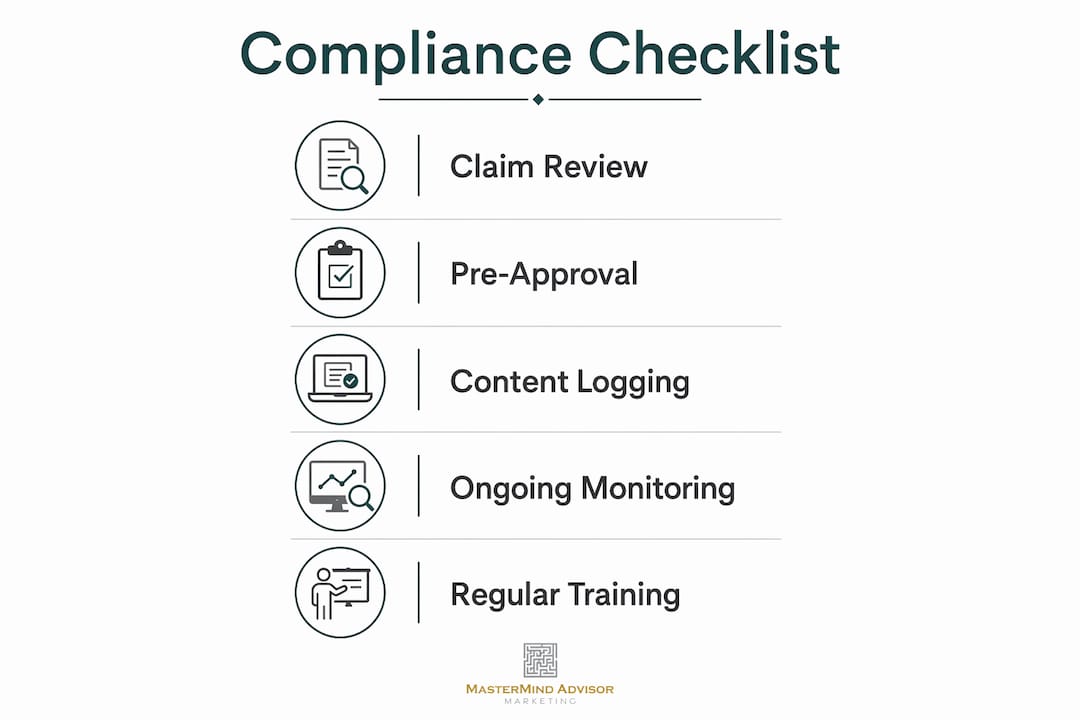
The rule requires three things from every piece of promotional content: substantiation, supervisory review, and archiving. Substantiation means every factual claim must be supported by documented evidence. Supervisory review means a qualified principal must approve content before it goes live. Archiving means you keep records of what was published, when, and who approved it.
Mastermind content creates specific compliance challenges you need to plan for:
- Factual claims from hot seat sessions must be verified before you publish them as case studies or educational content.
- Approval workflows must cover not just the primary content but also follow-up email sequences tied to webinars or seminars.
- Recordkeeping must capture the full content lifecycle, from draft to approval to distribution.
- Performance claims in any mastermind-related promotional material require documented substantiation before approval.
Claims must be substantiated and approved in advance to mitigate regulatory risk in mastermind marketing assets. This is not optional. Advisors who treat compliance as an afterthought face examination risk and potential enforcement action.
Pro Tip: Build a simple compliance checklist into your content calendar. Before any mastermind-derived asset goes live, confirm it has a substantiation document, a principal approval signature, and an archive entry.
SEC compliance is not just legal risk management. It shapes how you present content, which claims you make, and how you time your calls to action. Advisors who integrate compliance early in their content process produce better marketing, not just safer marketing. The role of ADV in advisor marketing is one area where compliance and marketing strategy intersect directly.
What content strategies turn mastermind sessions into marketing assets?
The most effective advisor marketing repurposes mastermind discussions into compliant, multi-channel content. The raw material is already there. Your job is to extract it, anonymize it, and distribute it across the right channels.
Here is a proven four-step process for turning hot seat sessions into marketing assets:
- Capture the core challenge. After each session, document the client scenario in general terms. Strip all identifying details. What remains is an educational narrative that mirrors what your prospects face.
- Build the primary asset. Turn the narrative into a webinar topic, a blog post, or a podcast episode. This is your top-of-funnel content. A retirement podcast case study reported 120,000+ downloads and $130,000 in new client revenue off an $11,000 marketing spend. That return is achievable when content addresses real client concerns.
- Create the follow-up sequence. Build a 14-day email sequence tied to the primary asset. Teams must pre-approve all promotional materials and follow-up communications within this window to meet SEC supervisory expectations. Get compliance approval before the sequence launches.
- Repurpose into micro-content. Pull direct quotes, statistics, and key questions from the primary asset. Distribute these as social posts, FAQ blocks, and newsletter snippets.
The table below maps each mastermind content type to its marketing channel and compliance requirement:
| Content Type | Primary Channel | Compliance Requirement |
|---|---|---|
| Anonymized case study | Blog, webinar | Substantiation document, principal approval |
| Hot seat narrative | Podcast, email | Archiving, factual claim review |
| FAQ block | Website, social | Pre-publication supervisory review |
| Follow-up email sequence | Email CRM | 14-day pre-approval window |
Answer Engine Optimization (AEO) adds a forward-looking layer to this strategy. AEO structures your content so AI-driven answer engines like ChatGPT and Perplexity can directly cite it. Short definitions, entity linking, and FAQ blocks are the core tactics. When your mastermind content answers specific questions in a direct, citable format, your brand appears in AI responses that your prospects are already reading. This is one of the fastest-growing visibility channels for financial advisors in 2026.
Mastermind sessions generate marketing assets by anonymizing client challenges into educational narratives, scripts, and FAQs that can be repackaged across compliant marketing channels. The key is building this repurposing process into your session workflow from day one, not as an afterthought.
How do you implement and scale mastermind advisor marketing?
Scaling effective advisor marketing through mastermind groups requires three parallel tracks: group formation, funnel integration, and compliance monitoring. Each track has distinct steps and metrics.
Forming your mastermind group
Select six to ten peers who serve similar but non-competing client segments. Advisors who work with the same demographic but in different geographic markets make ideal peers. Set a fixed meeting cadence, every other week for six months, and assign a facilitator for each session. Use a written confidentiality agreement before the first meeting.
Integrating into your marketing funnel
Your mastermind group feeds three funnel stages. At the top, hot seat narratives become lead generation landing pages and podcast episodes that attract new prospects. In the middle, webinars and email sequences build trust with warm leads. At the bottom, direct calls to action in follow-up sequences convert engaged prospects into consultations.
Building trust online is the connective tissue across all three stages. Mastermind content works because it demonstrates expertise through real scenarios, not manufactured case studies. Prospects recognize the difference.
Compliance monitoring and metrics
Track these four metrics to measure your mastermind marketing performance:
- Content approval cycle time: How long from draft to published asset? Shorter cycles mean your compliance workflow is functioning well.
- Lead conversion rate by asset type: Which content format (podcast, webinar, email) produces the most consultation bookings?
- Email sequence open and click rates: These signal whether your follow-up messaging resonates with your audience.
- Referral rate from mastermind peers: Track how many introductions come directly from group members each quarter.
Pro Tip: Use a CRM with automated tagging to track which mastermind-derived asset each new lead first engaged with. That data tells you exactly which session topics are generating the most qualified interest.
Digital leads for financial advisors in 2026 increasingly come from content that answers specific questions in AI-readable formats. Advisors who combine mastermind content with AEO tactics will have a measurable visibility advantage over those relying on traditional SEO alone. Lead nurturing strategies that align with mastermind content cycles also produce higher conversion rates because the messaging stays consistent from first touch to consultation.
Key takeaways
Mastermind advisor marketing works because it converts real peer advisory sessions into compliant, repeatable content that builds authority and generates qualified leads across multiple channels.
| Point | Details |
|---|---|
| Structure drives results | Twelve biweekly sessions with hot seat formats produce consistent, high-value marketing material. |
| Compliance is non-negotiable | Every mastermind asset requires substantiation, supervisory approval, and archiving under the SEC Marketing Rule. |
| Repurposing multiplies ROI | One hot seat scenario can produce a webinar, podcast episode, email sequence, and FAQ block. |
| AEO expands visibility | Structuring content with direct definitions and FAQ blocks gets your brand cited by AI answer engines. |
| Metrics prove growth | Track approval cycle time, lead conversion by asset, and peer referral rate to measure program health. |
Why most advisors underestimate this strategy
I have worked with enough independent advisors to know that most of them treat mastermind groups as a professional development activity, not a marketing engine. That framing costs them real revenue.
The advisors I have seen get the most from this approach are the ones who treat every session like a content production meeting. They walk in with a recorder, a note-taker, and a content calendar. They walk out with three to five marketing assets in draft form. The compliance review happens the following week, and the content goes live within 30 days of the session.
The compliance piece is where most advisors stumble. They produce great content from a session, then let it sit in a review queue for six weeks because they did not build the approval workflow before they started. By the time the content publishes, the moment has passed. Build the workflow first. Get your compliance principal aligned on turnaround times before you run your first session.
The future of this strategy runs through AI visibility. Advisors who structure their mastermind content with direct definitions, named entities, and FAQ blocks will get cited by ChatGPT and Perplexity when prospects ask financial planning questions. That is free, high-credibility visibility that no paid ad can replicate. The advisors who figure this out in 2026 will have a significant head start.
Mastermind marketing is not a shortcut. It is a system. Build it right and it compounds.
— Josh
Build your mastermind marketing system with Mastermindadvisormarketing
Independent advisors who want to turn peer advisory sessions into a real lead generation engine need more than a good idea. They need a system built for their specific compliance environment and client base.
Mastermindadvisormarketing offers a turnkey marketing system designed exclusively for financial advisors. The platform provides customized webinars, seminars, and automated email follow-up sequences that meet SEC compliance standards from day one. Advisors get a custom CRM, pre-approved content frameworks, and a structured program for hosting effective seminars that convert prospects into clients. If you are ready to stop guessing and start building a repeatable marketing system, explore the full platform and see what Mastermindadvisormarketing has built for advisors like you.
FAQ
What is mastermind advisor marketing?
Mastermind advisor marketing is a peer advisory group strategy where financial advisors use structured sessions to generate compliant marketing content and qualified leads. It combines business mastermind coaching with deliberate content repurposing across webinars, podcasts, and email sequences.
How does the SEC marketing rule apply to mastermind content?
The SEC Adviser Marketing Rule, effective November 4, 2022, requires all advisor marketing content, including mastermind-derived assets, to be substantiated, reviewed by a supervisor, and archived. Webinar follow-up sequences must also receive pre-approval within a designated compliance window.
How do i turn a hot seat session into a marketing asset?
Anonymize the client scenario from the session, build a primary content asset such as a blog post or podcast episode, then create a pre-approved 14-day email follow-up sequence. Each step requires compliance review before distribution.
What is answer engine optimization for advisors?
Answer Engine Optimization structures your content so AI tools like ChatGPT and Perplexity can directly cite it. Short definitions, FAQ blocks, and named entity references improve the likelihood your mastermind content appears in AI-generated responses to financial planning questions.
How many advisors should be in a mastermind group?
Six to ten advisors is the standard range for effective mastermind groups. Smaller groups allow deeper hot seat engagement, while larger groups introduce more diverse perspectives without overwhelming the facilitator or the session agenda.