
The most effective way to onboard new advisory clients is a compliance-first, automated, repeatable six-step workflow: collect KYC and suitability data upfront, deliver required disclosures before any account opens, fund accounts through custodian integration, and schedule structured 30/60/90-day touchpoints. That sequence, done consistently, is what separates practices that retain clients from those that lose them to confusion and slow starts.
Your six-step onboarding checklist:
- Step 1 — Kickoff meeting: Confirm goals, risk tolerance, and timeline; set expectations for the process.
- Step 2 — Collect KYC and suitability data: Send a secure, mobile-friendly intake link immediately after the meeting.
- Step 3 — Deliver disclosures and agreements: Provide Form ADV Part 2A or Form CRS, engagement letter, and privacy notice before account opening.
- Step 4 — Open and fund accounts: Submit custodian paperwork, initiate transfers, and confirm funding status.
- Step 5 — Implement the plan: Execute the investment strategy once accounts are funded and verified.
- Step 6 — First 90-day touchpoints: Schedule a 30-day check-in, 60-day operational review, and 90-day relationship assessment.
Do this today: Send every new client a personalized welcome email with a secure intake link and a one-page onboarding roadmap. That single action starts the data-collection clock and signals professionalism before your first formal meeting.
Table of Contents
- How do you build a step-by-step onboarding workflow that actually works?
- What compliance and KYC steps are required when onboarding U.S. advisory clients?
- Which tools should you use to speed up and automate client onboarding?
- What should your client communication plan include during onboarding?
- What should the first 90 days look like for a new advisory client?
- What are the most common onboarding problems and how do you fix them?
- Which KPIs should you track to measure onboarding performance?
- What do FINRA and SEC guidance actually require during onboarding?
- Key Takeaways
- How would I actually run onboarding at a small RIA?
- Better-fit leads make onboarding faster and easier
- Authoritative sources and further reading
How do you build a step-by-step onboarding workflow that actually works?
A repeatable onboarding workflow is the single biggest operational lever for both compliance and client satisfaction. The goal is a system where every task has an owner, every step has an acceptance criterion, and no client slips through a gap between advisor, paraplanner, and operations.
The ordered playbook
1. Signed agreement received (entry trigger) Owner: Advisor. The signed engagement letter or investment advisory agreement triggers the workflow. Nothing opens in the CRM until this document is confirmed.
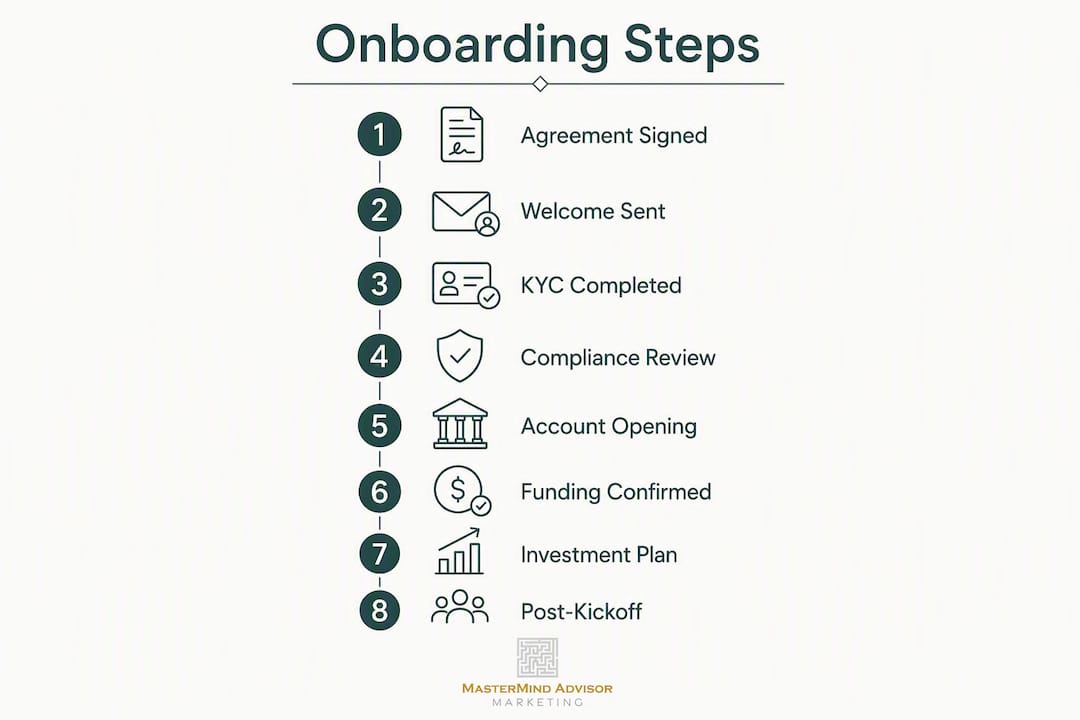
2. Welcome communication sent (within 24 hours) Owner: Advisor or CSA. Send the welcome email with the secure intake link, one-page roadmap, and portal login instructions. This is not optional — it sets the tone and starts the data clock.

3. KYC and suitability intake completed Owner: CSA/paraplanner. The client completes the guided intake form. The system flags incomplete fields and sends automated reminders until submission is confirmed. Acceptance criterion: all required fields populated and identity documents uploaded.
4. Compliance review and disclosure delivery Owner: Paraplanner or compliance lead. Verify identity documents, run AML screening, confirm Form ADV Part 2A or Form CRS was delivered and acknowledged. Log delivery date and method. Acceptance criterion: all disclosures acknowledged, AML clear, suitability documented.
5. Account opening and custodian submission Owner: Operations. Submit new account paperwork to the custodian. Initiate ACAT or direct transfer if applicable. Acceptance criterion: account number confirmed and transfer initiated.
6. Funding confirmed Owner: Operations. Verify that assets have settled or cash has posted. Acceptance criterion: account shows funded status in the custodian portal and CRM is updated.
7. Investment plan implemented Owner: Advisor. Execute the agreed strategy. Document the rationale in the client file.
8. Post-kickoff recap sent (within 48 hours of kickoff meeting) Owner: Advisor. A short, personalized recap covering what was discussed, next steps, and who owns each action. This one step materially reduces follow-up clarification requests.
Role and responsibility table
| Task | Advisor | CSA/Paraplanner | Operations |
|---|---|---|---|
| Send welcome email + intake link | ✓ | Backup | |
| Collect and review KYC intake | ✓ | ||
| AML screening and ID verification | ✓ | ||
| Deliver and log disclosures | ✓ | ||
| Submit custodian paperwork | ✓ | ||
| Confirm funding status | ✓ | ||
| Implement investment plan | ✓ | ||
| Send post-kickoff recap | ✓ | ||
| Schedule 30/60/90 touchpoints | ✓ | Backup |
Kickoff meeting agenda (60 minutes)
- 0–5 min: Welcome and agenda overview
- 5–20 min: Client goals, priorities, and concerns (open-ended questions)
- 20–35 min: Review financial picture: income, assets, liabilities, insurance, estate documents
- 35–45 min: Risk tolerance discussion and investment philosophy alignment
- 45–55 min: Explain the onboarding process, timeline, and what the client needs to provide
- 55–60 min: Confirm next steps, who does what, and when
Intake form fields to capture upfront: full legal name, date of birth, Social Security number, government-issued ID, contact information, employment status, income, net worth, investment objectives, time horizon, risk tolerance, beneficiary designations, existing account numbers for transfer, and any special handling instructions.
What compliance and KYC steps are required when onboarding U.S. advisory clients?
FINRA Rule 2090 requires every member to use reasonable diligence to know and retain the essential facts about every customer, including the authority of each person acting on behalf of that customer. The practical implication: KYC is not a checkbox at the end of onboarding. Per FINRA Regulatory Notice 11-02, these obligations arise at the beginning of the advisory relationship, before any recommendation is made.
Design your workflow so the system cannot advance a client to "account opened" until required verifications pass. That single design decision prevents the most common compliance failure: chasing missing documents after the account has already been opened.
Required documents and disclosures
- Form ADV Part 2A or Form CRS: Deliver to every retail client before or at the time of entering the advisory agreement. The SEC's Form CRS rules require RIAs and broker-dealers to file and deliver a relationship summary that describes services, fees, conflicts of interest, and the applicable standard of conduct.
- Engagement letter / investment advisory agreement: Signed before any account is opened or assets are managed.
- Privacy notice (Regulation S-P): Required at the start of the relationship and annually thereafter.
- Suitability documentation: Record the basis for your investment recommendations, including the client's investment profile, risk tolerance, and time horizon.
KYC verification checklist
- Collect government-issued photo ID (driver's license or passport) and verify against the name on account documents.
- Confirm Social Security number or Tax Identification Number.
- Document source of funds for initial investment.
- Screen against OFAC and relevant AML watchlists.
- For entity accounts: collect beneficial ownership information (name, date of birth, address, and SSN for each individual owning 25% or more).
- Log the date, method, and outcome of each verification step.
Recordkeeping best practices
Store signed disclosures, delivery logs, and identity verification records in a secure, access-controlled document management system. Retention requirements under SEC Rule 204-2 generally require RIAs to keep books and records for at least five years, with the first two years in an easily accessible location. Never rely on email alone — use a dedicated compliance folder in your CRM or document management platform.
FINRA Regulatory Notice 21-18 on account security: Firms should educate customers on account security during onboarding, provide updated security information, and offer alerts for account activity via email or SMS. Incorporating cybersecurity materials into your welcome packet and enabling activity alerts at account opening satisfies this guidance and reduces the risk of unauthorized account access. Source: FINRA Regulatory Notice 21-18
Pro Tip: Build a compliance gate directly into your CRM workflow: no task can move to "account opening" status until the KYC checklist is marked complete and the disclosure delivery log is attached. This prevents the most common audit finding — missing delivery evidence.
Which tools should you use to speed up and automate client onboarding?
Digital portals and e-signatures accelerate the process and reduce friction compared with paper routing, especially when integrated with CRM and custodian systems. The key is not picking the most feature-rich platform — it is connecting the right tools so data flows automatically from intake through to account opening without manual re-entry.

Tool categories to prioritize
1. Secure client portal The front door of your onboarding experience. Clients upload documents, sign forms, and check status here. Look for SOC 2 Type II certification, two-factor authentication, and mobile-friendly design. Examples in the RIA space include Orion, Redtail's portal features, and dedicated onboarding platforms.
2. E-signature DocuSign and Adobe Acrobat Sign are the two dominant options with broad custodian acceptance. Both carry audit trails that satisfy SEC recordkeeping requirements.
3. CRM Redtail Technology and Wealthbox are purpose-built for advisory practices and include workflow automation, task assignment, and compliance tracking. Salesforce Financial Services Cloud fits larger teams with more complex integrations.
4. Document generation Tools like Laser App or Docupace generate pre-populated custodian forms from CRM data, eliminating manual re-entry and the errors that come with it.
5. Custodian integration Schwab Advisor Services, Fidelity Institutional, and Pershing all offer API or file-based integrations with major CRM and portfolio management platforms. Prioritize this connection early — it is where most funding delays originate.
6. Identity and AML screening Platforms like Jumio or Socure handle automated ID verification and OFAC screening. For smaller RIAs, some custodians include basic AML screening in their onboarding workflow.
7. Payment and funding For fee billing, tools like Orion Billing or Tamarac integrate with custodians to automate fee deduction authorization during account setup.
Integration priority sequence
- CRM → document generation (so intake data pre-populates custodian forms)
- CRM → e-signature (so signed documents attach automatically to the client record)
- CRM → custodian feeds (so account status and funding confirmation update without manual entry)
- CRM → calendar and task management (so 30/60/90 touchpoints are scheduled automatically at account opening)
Automation recipes that work
- Intake trigger: Signed agreement received → CRM creates client record → automated email sends secure intake link with 48-hour reminder if not completed.
- Compliance gate: KYC checklist complete → system generates disclosure package → e-signature request sent → delivery logged automatically on completion.
- Funding alert: Custodian feed confirms funded status → CRM updates stage → advisor receives task to implement plan → 30-day check-in scheduled.
For a step-by-step marketing automation checklist that maps well to these onboarding recipes, the SMB framework translates directly to small advisory practices.
Vendor security checklist
Before signing any contract, confirm: SOC 2 Type II report available, data encrypted at rest and in transit (AES-256 minimum), data residency within the U.S., role-based access controls, and a signed Business Associate Agreement if PHI is involved. Request the vendor's most recent penetration test summary.
Adoption sequence by firm size
1–3 person RIA: Start with CRM + e-signature + secure portal. Add document generation in month two. Custodian integration is the third priority once the first two are stable.
4+ person team: Add identity/AML screening and automated task routing from day one. Dedicated onboarding software (Orion, Docupace) pays for itself quickly at higher client volume.
What should your client communication plan include during onboarding?
Clear, timely communication is what prevents the most common client complaint: "I don't know what's happening." A structured communication plan with copy-ready templates removes that uncertainty and reduces the back-and-forth that slows every onboarding.
Welcome packet checklist
- One-page visual onboarding roadmap (timeline with labeled milestones)
- List of documents the client needs to provide and how to submit them
- Portal login instructions with a direct link
- Contact card: advisor name, CSA name, phone, email, and response time commitment
- Brief FAQ sheet (see below)
- Cybersecurity tips and how to set up account activity alerts
Three email templates
Email 1 — Welcome + secure intake link Subject: Welcome to [Firm Name] — your next step is here "Hi [First Name], we're glad you're here. To get your accounts set up quickly, please complete your secure intake form using the link below — it takes about 10 minutes. [SECURE INTAKE LINK] If you have questions at any point, reply to this email or call [CSA Name] at [phone]."
Email 2 — Follow-up reminder (send at 48 hours if intake incomplete) Subject: Quick reminder: your intake form is waiting "Hi [First Name], your intake form is still open. Completing it now keeps your account on schedule. [SECURE INTAKE LINK] Takes about 10 minutes — let us know if anything is unclear."
Email 3 — Post-kickoff recap (send within 24–48 hours of kickoff meeting) Subject: Your onboarding recap from today's meeting "Hi [First Name], here's a quick summary of what we covered today: [bullet list of key decisions and next steps]. Your next milestone is [specific date/action]. We'll reach out on [date] for your 30-day check-in. Questions? Reply here or call us directly."
Why the 24–48 hour recap matters: Sending a personalized written recap within 24–48 hours of the first meeting reduces client anxiety, prevents misunderstandings, and materially lowers the number of follow-up clarification calls your team handles. Clients who receive a clear recap know exactly what happens next — and they trust you more for it. Source: Jump Advisor Trends
Kickoff meeting agenda template
| Time | Topic | Owner |
|---|---|---|
| 0–5 min | Welcome and agenda overview | Advisor |
| 5–20 min | Client goals, concerns, and priorities | Advisor (open questions) |
| 20–35 min | Financial picture review | Advisor + client |
| 35–45 min | Risk tolerance and investment philosophy | Advisor |
| 45–55 min | Onboarding process, timeline, and client tasks | CSA |
| 55–60 min | Confirm next steps and owners | Advisor |
Mini client FAQ sheet (include in welcome packet)
- How long does onboarding take? Most accounts are open and funded within a few weeks, depending on transfer complexity.
- What documents do I need to provide? Government-issued ID, recent account statements for any accounts being transferred, and your Social Security number.
- When will my money be invested? Once your account is funded and we confirm the transfer, we implement your plan within one business day.
- How do I access my portal? You'll receive a login link by email. Use the same email address you gave us, and set up two-factor authentication when prompted.
- Who do I call if I have a question? Contact [CSA Name] at [phone/email] for account questions. For investment questions, reach [Advisor Name] directly.
- When will I hear from you next? You'll receive a recap within 48 hours of today's meeting, and we'll schedule a 30-day check-in before you leave today.
What should the first 90 days look like for a new advisory client?
A structured 30/60/90-day plan improves retention and referral outcomes by giving clients visible proof that the relationship is progressing. The goal at each milestone is different — operational at 30 days, confirmatory at 60, relational at 90.
30/60/90 touchpoint plan
Day 1–30: Operational completion
- Confirm all accounts are open and funded.
- Verify investment plan is implemented as agreed.
- Send 30-day check-in email or call: confirm the client can access the portal, has no outstanding document requests, and understands the next steps.
- Address any transfer delays or missing documents immediately.
Day 31–60: Operational review
- Review account performance and confirm allocations match the agreed plan.
- Confirm all transfers have settled; follow up on any pending items.
- Send a brief progress update: what's been completed, what's still in motion.
- Ask one open-ended question: "Is there anything about the process so far that we could have made easier for you?"
Day 61–90: Relationship assessment
- Schedule the first formal review meeting.
- Send a short satisfaction survey (3–5 questions, NPS or simple rating).
- Discuss any life changes that may affect the plan.
- Confirm the ongoing meeting cadence (quarterly, semi-annual).
- Ask for a referral only after the client has expressed satisfaction — typically at or after the 90-day mark.
One-page onboarding roadmap for clients
Present this as a simple horizontal timeline in the welcome packet. Label five milestones: Welcome & Intake → Compliance Review → Account Opening → Funded & Invested → First Review. Under each label, add the expected timeframe (e.g., "Days 1–3," "Days 4–7," "Days 8–14," "Days 15–21," "Day 30"). Clients respond far better to a visual timeline than to a paragraph of explanation.
Escalation checklist for stalled accounts
If an account has not progressed within the expected window, follow this sequence:
- Day 3 past deadline: CSA sends a reminder email with the specific missing item named.
- Day 5 past deadline: Advisor calls the client directly; documents the call in the CRM.
- Day 7 past deadline: Operations reviews the custodian queue for technical holds; advisor notifies the client of any custodian-side delays.
- Day 10 past deadline: Escalate to firm principal or compliance lead; consider whether a new account application is needed.
What are the most common onboarding problems and how do you fix them?
Most onboarding failures trace back to three root causes: missing information, unclear ownership, and slow funding. Each has a direct operational fix.
Problem and remedy table
| Problem | Root cause | Remedy |
|---|---|---|
| Incomplete intake form | Client doesn't understand what's needed | Send a guided, mobile-friendly intake link with field-level instructions; add automated 48-hour reminder |
| Missing identity documents | No clear upload path | Include a document checklist in the welcome email with a direct portal upload link |
| Slow ACAT transfer | Client hasn't signed transfer paperwork | CSA calls within 24 hours of missing deadline; confirm the client has the correct account number from the delivering firm |
| Unclear expectations | No written process shared | Deliver the one-page roadmap at kickoff; recap next steps in writing within 48 hours |
| Handoff gaps between advisor and operations | No defined owner per task | Use the role matrix (see workflow section); assign every task in the CRM with a due date |
| Client disengagement mid-process | Process feels slow or opaque | Send progress nudges at each completed milestone; give the client a visible status tracker in the portal |
| Disclosures not acknowledged | Sent but not tracked | Use e-signature with read receipts; log delivery date and method in the compliance folder |
Scripts for re-engagement
Phone script (Day 5 past deadline): "Hi [First Name], this is [Advisor Name]. I wanted to check in because we're waiting on [specific item] to move your account forward. I know this can feel like a lot of paperwork — can I help you get that submitted today? It should take about five minutes."
Email re-engagement (Day 3 past deadline): Subject: One item is holding up your account "Hi [First Name], we're ready to move forward — we just need [specific document/signature]. Here's the direct link: [LINK]. If you have questions, reply here or call [CSA Name] at [phone]."
Reducing abandonment
- Use mobile-friendly forms with progress bars so clients see how close they are to completion.
- Break the intake into two short sessions if the full form is long: personal information first, financial details second.
- Confirm receipt of every document immediately with an automated "Got it" message.
- Schedule the 30-day check-in before the client leaves the kickoff meeting — a booked appointment is a commitment.
Which KPIs should you track to measure onboarding performance?
Tracking the right metrics turns onboarding from a gut-feel process into one you can actually improve. Five KPIs cover the full picture.
Core KPI list
- Time-to-complete KYC: Days from signed agreement to verified KYC checklist complete. Target: 3–5 business days.
- Time-to-fund: Days from signed agreement to funded account. Target: 10–15 business days for most account types; longer for complex ACAT transfers.
- Abandonment rate: Percentage of clients who start onboarding but do not complete it within 30 days. Track monthly.
- % documents missing at first submission: How often the initial intake form comes back incomplete. High rates signal a form design or communication problem.
- Client satisfaction (NPS or survey): Send a 3–5 question survey at the 30-day and 90-day marks. A simple 1–10 rating plus one open-ended question is enough.
Sample weekly ops dashboard
| Metric | This week | Target | Status |
|---|---|---|---|
| New clients in onboarding | — | — | Track count |
| Avg. days to KYC complete | — | 3–5 days | Green/Yellow/Red |
| Avg. days to funded | — | 10–15 days | Green/Yellow/Red |
| Intake forms incomplete at submission | — | Under 20% | Green/Yellow/Red |
| Accounts stalled 7+ days | — | 0 | Flag immediately |
| 30-day NPS responses received | — | — | Track |
Monthly retrospective checklist
- Review all accounts that took longer than the target time-to-fund. What caused the delay?
- Count the number of re-engagement calls made. If it's more than 20% of new clients, the intake form or communication plan needs revision.
- Review client survey responses. Identify the one most common complaint and assign a fix for next month.
- Update templates and automation triggers based on what the data shows — not what feels right.
Dashboards that show which clients are missing items, pending signatures, or awaiting funding create the operational visibility that makes these retrospectives useful. Without that visibility, you're reacting to problems instead of preventing them.
What do FINRA and SEC guidance actually require during onboarding?
Two regulatory frameworks govern most of what happens during advisory client onboarding in the U.S.: FINRA's KYC and suitability rules (for broker-dealer registered reps) and the SEC's Form CRS and Form ADV requirements (for RIAs). Understanding which applies to your registration type determines your specific obligations.
Key regulatory callouts
- FINRA Rule 2090 (Know Your Customer): — Requires reasonable diligence to know and retain essential facts about every customer, including authority of persons acting on the account. This applies at account opening and throughout the relationship.
- FINRA Regulatory Notice 11-02: — Clarifies that KYC obligations arise at the beginning of the relationship, not only when a recommendation is made. Collect and document suitability information before the first transaction.
- FINRA Regulatory Notice 11-25: Provides additional guidance on the implementation of KYC and suitability rules, including the July 9, 2012 implementation date for consolidated FINRA rulebook rules and practical answers to industry questions on documentation and timing.
- SEC Form CRS: RIAs and broker-dealers must deliver the relationship summary to retail investors at the start of the relationship. The SEC's final rule requires this document to describe services, fees, conflicts of interest, and the applicable standard of conduct in plain language.
- Proposed CIP rules for RIAs (2024): The SEC and FinCEN have proposed requiring RIAs to implement formal Customer Identification Programs (CIP) similar to those already required for broker-dealers. While not yet final, advisors should review the proposed rule and begin aligning their identity verification practices now.
FINRA Notice 21-18 — practical implementation: During onboarding, provide clients with written guidance on how to protect their accounts: how to set up two-factor authentication, how to recognize phishing attempts, and how to enroll in email or SMS alerts for account activity. Document that this education was delivered and keep a copy in the client file. This is not optional guidance — it is a recommended practice that regulators expect to see in your onboarding records. Source: FINRA Regulatory Notice 21-18
Industry best practices that align with regulatory expectations
- Bake compliance document collection into the first step of onboarding, not the last. Including compliance review as an early, mandatory step avoids the common pitfall of chasing missing documents after account opening has stalled.
- Use a compliance gate in your CRM: the workflow cannot advance to "account opened" until KYC is verified and disclosures are logged.
- Keep a delivery log for every required document: date sent, method, and date acknowledged. This is your first line of defense in any regulatory examination.
- For Form ADV obligations and how they intersect with your marketing and client communications, review your disclosure delivery process annually.
This article provides general information about U.S. regulatory requirements and is not legal or compliance advice. Confirm current rules with FINRA, the SEC, or a qualified compliance professional.
Key Takeaways
A compliance-first, automated onboarding workflow, with KYC collected upfront, disclosures delivered before account opening, and structured 30/60/90 touchpoints, is the most reliable way to retain new advisory clients and satisfy regulatory requirements.
| Point | Details |
|---|---|
| Start with compliance gates | Design your CRM so no account advances to "opened" until KYC is verified and disclosures are logged. |
| Send the recap within 48 hours | A personalized post-kickoff recap reduces misunderstandings and cuts follow-up clarification calls. |
| Track five core KPIs | Monitor time-to-KYC, time-to-fund, abandonment rate, incomplete submissions, and client NPS from day one. |
| Use the 30/60/90 framework | Schedule check-ins at 30, 60, and 90 days to confirm completion, review operations, and assess the relationship. |
| Mastermindadvisormarketing reduces onboarding friction | Better-fit leads from a turnkey marketing system arrive with clearer goals and fewer surprises, shortening onboarding time. |
How would I actually run onboarding at a small RIA?
At a one-to-three person firm, the biggest risk is the advisor doing everything. That is the fastest path to dropped tasks, missed compliance steps, and clients who feel like they're chasing you.
The split that works: the advisor owns the relationship touchpoints (kickoff meeting, post-kickoff recap, 30/60/90 calls), and a part-time CSA or paraplanner owns the operational tasks (intake follow-up, document collection, custodian submission, compliance logging). If you don't have a CSA yet, automate the operational tasks before you hire — it's cheaper and it forces you to document the process.
For tech, start with three tools: a CRM with workflow automation (Redtail or Wealthbox), an e-signature platform (DocuSign), and a secure client portal. That stack handles 80% of the friction points. Add document generation and custodian integration in the second quarter once you've run 10–15 clients through the base workflow and know where the gaps are.
Where to keep the personal touch: the kickoff meeting, the post-kickoff recap, and every 30/60/90 call. These are the moments clients remember. Automate the reminders and the document requests; never automate the conversations. A client who gets a warm, specific recap from their advisor within 24 hours of the first meeting will forgive a slow ACAT transfer. One who gets a generic automated message will not.
For launching and structuring an independent advisory practice with these operational foundations in place from day one, the investment in process design upfront pays back in every client you onboard after the first.
Better-fit leads make onboarding faster and easier
The hardest onboarding situations share a common origin: a client who arrived with unclear goals, mismatched expectations, or a financial situation that wasn't qualified before the first meeting. No workflow fixes that after the fact.

Mastermindadvisormarketing is built specifically for independent financial advisors who want leads that are already educated, pre-qualified, and aligned with the advisor's niche before the first conversation. The turnkey system, which includes customized webinars, compliance-friendly content, automated email sequences, and CRM integration, means prospects arrive knowing what to expect from the advisory relationship. That clarity cuts onboarding time, reduces the number of re-engagement calls your team makes, and lowers the rate of incomplete intake submissions.
The questions worth asking any marketing partner: What are your lead qualification criteria? How do you handle compliance review of content? Does your system integrate with my CRM? Mastermindadvisormarketing answers all three by design.
If you want leads who are ready to onboard, not just ready to talk, see how the system works and book a strategy call to see how it fits your practice.
Authoritative sources and further reading
- FINRA Rule 2090: Know Your Customer — The primary rule governing KYC obligations for FINRA member firms.
- FINRA Regulatory Notice 11-02 — Guidance on when KYC obligations arise and how to document suitability.
- FINRA Regulatory Notice 11-25 — Additional implementation guidance on KYC and suitability rules, including documentation requirements.
- FINRA Regulatory Notice 21-18 — Account security guidance: customer education, alerts, and cybersecurity steps to incorporate at onboarding.
- SEC Form CRS Final Rule (34-86032) — The SEC's final rule requiring RIAs and broker-dealers to deliver a relationship summary to retail investors.
- SEC Form CRS Filing Instructions — Practical filing and delivery requirements for investment advisers and broker-dealers.
- Proposed CIP Rule for RIAs (SEC/FinCEN, 2024) — Proposed Customer Identification Program requirements for registered investment advisers.
- Client Onboarding Checklist for Financial Advisors — Operational checklist and templates for advisory client onboarding.