

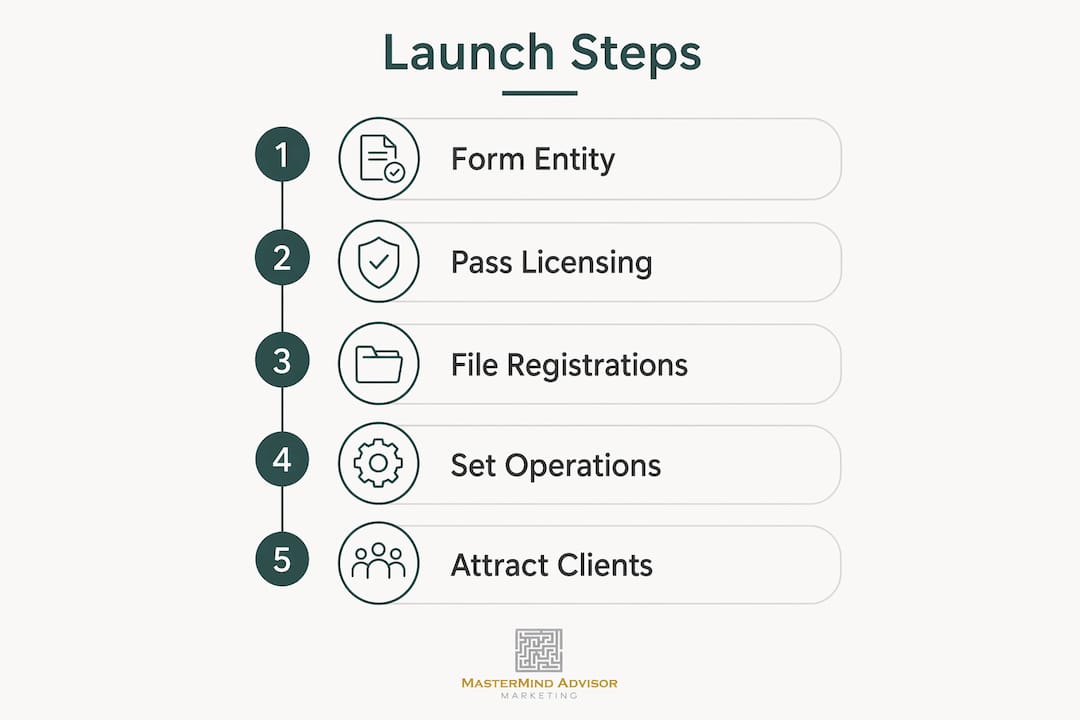
Launching an independent advisory practice means establishing your own Registered Investment Advisor (RIA) firm with proper licensing, compliant operations, and a client acquisition plan that generates revenue from day one. The process requires passing the Series 65 exam, registering with either the SEC or your state regulator, forming a legal business entity, and building the operational infrastructure to serve clients. Financial professionals who follow a structured approach avoid the most common registration failures and position their firms for sustainable growth. This guide covers every critical step, from regulatory baseline to your first signed client agreement.
What are the mandatory licenses and registrations required to launch an independent advisory practice?
The Series 65 exam is the primary licensing requirement for investment adviser representatives (IARs). It consists of 130 questions over three hours, and most advisors need 4–6 weeks of study to pass on their first attempt. Holding a CFP or CFA designation can substitute for the Series 65 in many states, but you must confirm your state's specific equivalency rules before skipping the exam.
Registration thresholds determine whether you file with the SEC or your state regulator. Firms managing $110 million or more in assets under management (AUM) register with the SEC. Firms below that threshold register at the state level, and most new RIAs fall into this category.
The filing process runs through the IARD system, which is the Investment Adviser Registration Depository maintained by FINRA. The SEC processes initial RIA registrations within a mandatory 45-day window. State regulators typically take 4–8 weeks, depending on the jurisdiction. That timeline means you should plan your launch date at least two months after your filing date.
Key registration steps:
- Complete Form ADV Parts 1 and 2, which describe your firm's services, fees, and conflicts of interest
- Register the firm separately from your individual IAR registration
- Fund your IARD account before submitting any filings, because unfunded accounts cause immediate electronic rejection
- Pay state filing fees, which generally range from $100 to $400 per initial filing
Pro Tip: Wire your IARD funds at least five business days before your planned filing date. Banks and FINRA processing times can add unexpected delays, and a rejected filing resets your entire timeline.
How to structure and legally form your advisory firm before registration
Your legal entity must exist before you file Form ADV. The entity name on your state registration, your Form ADV, and your client agreements must match exactly. Any discrepancy creates compliance problems that regulators flag during review.
Most independent advisors choose an LLC or S-Corporation as their business structure. Both protect personal assets from business liabilities. The LLC offers simpler administration, while the S-Corp provides potential payroll tax savings for advisors who generate significant revenue. Sole proprietorships offer no liability protection and are not recommended for RIA owners.
Formation steps before filing:
- Register your LLC or S-Corp with your state's Secretary of State office
- Obtain an Employer Identification Number (EIN) from the IRS, which takes minutes online
- Apply for any required local business licenses in your city or county
- Open a dedicated business checking account to separate personal and business finances
- Confirm your entity name is available and matches your intended DBA or firm name
Pro Tip: Choose your firm name carefully before formation. Changing it after registration requires amended filings with both the state and IARD, which costs time and money.
What operational and technology considerations must be in place before launching?
A new RIA needs a qualified custodian before it can hold or manage client assets. Custodians like Schwab, Fidelity, and Altruist are preferred by new RIAs because they offer strong technology platforms and dedicated support for smaller firms. Apply to your chosen custodian early, because approval can take several weeks and some custodians have minimum AUM requirements.

Compliance infrastructure is not optional. Regulators require a written compliance manual, a cybersecurity policy, and a code of ethics before your registration becomes effective. These documents must reflect your actual business practices. Generic, copy-pasted templates are a leading cause of registration delays and rejections. Working with a compliance consultant to build custom documents is worth the cost.
Your client management system matters from day one. A CRM built for financial advisors tracks prospect conversations, automates follow-up, and documents client interactions for compliance purposes. Mastermindadvisormarketing offers custom CRM tools and automated email follow-up systems designed specifically for independent advisors, which reduces the administrative load during the critical early months.
Additional operational requirements:
- Errors and omissions (E&O) insurance, which most custodians require before account opening
- A document management platform for storing signed agreements and client records
- A secure client portal for sharing reports and receiving sensitive information
- A dedicated business phone number and professional email domain
Pro Tip: Set up your compliance calendar before you open your first account. Annual ADV amendments, state renewal deadlines, and required client disclosures have fixed due dates. Missing them triggers regulatory action.
How to attract and onboard your first clients as a new independent advisor
Niche specialization drives referrals and higher client conversion rates for solo advisors starting out. A new firm competing for every type of client wins none of them. Advisors who focus on a specific segment, such as physicians, business owners, or pre-retirees in a specific industry, generate word-of-mouth referrals faster and build a recognizable reputation. Read the financial advisor niche selection guide to identify the segment that fits your background and market.
Building relationships with centers of influence is the fastest path to early clients. CPAs, estate attorneys, and mortgage brokers already serve your ideal clients. A single strong referral relationship with a CPA can generate multiple qualified introductions per year. Reach out with a clear value proposition, not a generic pitch.
Your digital presence must be ready before you launch. A professional website, a completed LinkedIn profile, and a content plan give prospects a way to evaluate you before they call. Content marketing for advisors builds credibility over time and supports search visibility. Mastermindadvisormarketing provides content marketing strategies and webinar programs tailored to newly launched firms, which accelerates the trust-building process.
Client onboarding steps for a new RIA:
- Conduct a discovery meeting to understand the prospect's goals, concerns, and current situation
- Present your services, fee structure, and what the client relationship will look like in practice
- Deliver the Form ADV Part 2 and any required state disclosures before signing agreements
- Execute the investment advisory agreement and account opening documents
- Initiate asset transfers or funding and set expectations for the first 90 days of service
Pro Tip: Send a welcome package after onboarding that outlines your service calendar for the year. Clients who know what to expect stay longer and refer more often.
Maintaining high-touch service in the first year builds the retention and referral base that sustains the firm long-term. The independent advisor service model you establish now becomes your competitive advantage. Advisors who define their service rhythm early, including scheduled reviews, proactive outreach, and clear communication protocols, retain clients at significantly higher rates than those who operate reactively.
Common pitfalls and regulatory compliance challenges during and after launch
The most frequent registration failure is a Form ADV that does not accurately describe the firm's actual operations. Copy-pasted compliance templates that do not reflect your specific fee structure, client types, and services cause regulators to issue deficiency letters. Each deficiency letter restarts a portion of your review timeline.
Regulators evaluate operational integrity beyond the forms themselves. They request follow-up clarifications, and slow responses delay approvals. Treat every regulator communication as urgent. A two-week delay in responding can push your effective date back by a month or more.
Advisors transitioning from a wirehouse or broker-dealer face additional legal steps. Analyzing your Form U5 and resolving any outstanding promissory notes or deferred compensation agreements before resigning is critical. Leaving without addressing these obligations can result in legal disputes that distract from your launch.
Avoid providing advisory services to clients before your registration is effective. Doing so constitutes operating as an unregistered investment advisor, which carries significant regulatory penalties. Use the waiting period to finalize your technology setup, build your marketing presence, and prepare client onboarding documents.
Ongoing compliance obligations begin the moment your registration is effective:
- File annual ADV amendments within 90 days of your fiscal year end
- Update your ADV promptly when material changes occur, such as new services or fee changes
- Maintain required records for the period specified by your state or the SEC
- Complete continuing education requirements if your state mandates them for IARs
Key Takeaways
Launching an independent advisory practice requires completing licensing, forming a legal entity, filing accurate registration documents, and building operational systems before serving a single client.
| Point | Details |
|---|---|
| Pass the Series 65 first | Most advisors need 4–6 weeks of study; confirm state equivalency rules if you hold a CFP or CFA. |
| Fund IARD before filing | An unfunded IARD account causes immediate rejection and resets your registration timeline. |
| Form your legal entity early | Your LLC or S-Corp must exist before you file Form ADV, and names must match across all documents. |
| Customize compliance documents | Generic templates cause deficiency letters; tailor every document to your actual fee structure and services. |
| Niche down to grow faster | Advisors who specialize in a specific client segment generate referrals and convert prospects at higher rates. |
What I have learned from watching advisors launch their own firms
The advisors who struggle most after launch are not the ones who failed the Series 65 or missed a filing deadline. They are the ones who treated the paperwork as the finish line. Registration is a starting point, not an achievement.
The firms that grow quickly share one trait: they defined their client experience before they opened their doors. They knew what their annual service calendar looked like, how they would communicate during market volatility, and what their onboarding process felt like from the client's perspective. That preparation is invisible to regulators but visible to every client you serve.
Technology is the other dividing line. Advisors who set up their CRM, document management, and client portal before launch spend their first year serving clients. Advisors who delay those decisions spend their first year managing chaos. The tools exist to handle the administrative side of the business. Use them from day one.
The last thing I would tell any advisor preparing to launch: your first 20 clients will define your firm's reputation for years. Serve them exceptionally well, communicate proactively, and ask for introductions when the relationship is strong. Referrals from satisfied clients cost nothing and convert at a rate no marketing campaign can match. Build the firm you would want to be a client of, and the growth follows.
— Josh
How Mastermindadvisormarketing supports new advisory firms
Building a compliant firm is one challenge. Building a firm that attracts clients consistently is another. Mastermindadvisormarketing provides a turnkey marketing system built exclusively for independent financial advisors, covering niche selection, advisor brand identity, content marketing, and automated client follow-up.

The platform includes custom CRM tools, webinar and seminar programs, and email automation designed to keep your pipeline full without pulling you away from client work. Advisors who use Mastermindadvisormarketing report stronger lead flow and faster practice growth compared to those relying on referrals alone. Visit Mastermind Advisor to see how the system works for firms at every stage, from pre-launch to established practice. Financial services marketing specialists at Omnivance Media also offer complementary support for advisors building their digital presence.
FAQ
What exam do I need to launch an independent advisory practice?
The Series 65 is the primary licensing exam for investment adviser representatives. Holding a CFP, CFA, or certain other designations may substitute for the Series 65 in some states.
How long does RIA registration take?
The SEC has a mandatory 45-day processing window for initial RIA registrations. State regulators typically take 4–8 weeks, so plan your launch date at least two months after filing.
What business entity should I use for my advisory firm?
Most independent advisors form an LLC or S-Corporation to protect personal assets and gain tax flexibility. Sole proprietorships are not recommended due to unlimited personal liability.
Can I advise clients while my registration is pending?
No. Providing investment advisory services before your registration is effective constitutes operating as an unregistered advisor and carries significant regulatory penalties.
How do I get my first clients as a new RIA?
Niche specialization and relationships with centers of influence, such as CPAs and estate attorneys, are the fastest paths to early client acquisition. A clear digital presence and consistent content marketing support those efforts over time.