
Retirement seminars still work, but only under specific conditions: focused, empathy-led education paired with a disciplined follow-up system. Run without that discipline, seminars become an expensive one-off event with a lumpy, unpredictable return. About 25% of financial advisors already use seminar marketing to grow their practices, and the ones who succeed treat the event as the front door to a pipeline, not the whole strategy.
If your firm can commit to repeat events and a real follow-up process, seminars remain viable. If not, a continuous system built on LinkedIn outreach and webinars, the approach behind tools like Mastermind Advisor Marketing, often produces steadier results with less financial exposure.
- Seminars work best for advisors with a local niche, repeat-event capacity, and staff to handle follow-up.
- Firms without a follow-up process or budget for multiple events should pivot toward an always-on pipeline.
- Your next move: audit your last seminar's follow-up sequence before you book another venue.
Key Takeaways
Retirement seminar marketing works best as a hybrid: use seminars for local, high-trust capture and a continuous LinkedIn and webinar pipeline for predictable, ongoing lead flow.
| Point | Details |
|---|---|
| Seminars still work conditionally | They succeed when paired with repeat events, empathy-led content, and a disciplined follow-up sequence. |
| Know your CAC before booking | Use CAC = event cost ÷ new clients, and compare it against expected client lifetime revenue before committing budget. |
| Follow-up beats attendance | A three-day personal note combined with automated value-add touches converts better than generic appointment requests. |
| Segment before you invite | Layer age, assets, and life events to build an invitation list that outperforms a generic mailing. |
| Consider a turnkey system | Mastermind Advisor Marketing builds produced seminars, webinars, and automated CRM follow-up specifically for independent advisory practices. |
Table of Contents
- Why Retirement Seminar Marketing Changed and Who Should Still Run Events
- Seminar Funnels vs. Continuous Pipeline Systems: Which Fits Your Practice?
- How Do You Fill a Retirement Seminar in 2026?
- What Seminar Content and Format Actually Convert Attendees?
- Turning Attendees Into Clients: Follow-Up and CRM Systems That Work
- What Does a Retirement Seminar Cost, and What's the Real ROI?
- How Mastermind Advisor Marketing Approaches Retirement Seminars
- Target Audience Segmentation and Profiling for Retirement Seminars
- Optimal Timing and Frequency for Hosting Retirement Seminars
- Strategies for Collaboration and Partnerships to Increase Seminar Reach
- Measuring and Analyzing Attendee Engagement During and After Seminars
- The Modernize-or-Replace Verdict on Seminar Marketing
- A Turnkey Path From Seminar Chaos to a Measurable Pipeline
- Frequently Asked Questions About Retirement Seminar Marketing
- Sources
Why Retirement Seminar Marketing Changed and Who Should Still Run Events
Three forces reshaped this channel over the past decade. Venue and dinner costs climbed, prospects moved their attention online, and compliance scrutiny made splashy "free dinner" invitations look increasingly dated to a public that has grown skeptical of them. None of that means seminars stopped working. It means they stopped working as a standalone tactic for advisors who can't sustain the operational load behind them.
Some firms are still well suited to seminars. The signals are fairly consistent:
- You serve a defined local audience. Advisors targeting a specific ZIP code, employer alumni group, or retirement community still get strong turnout because the invitation feels relevant, not generic.
- You can run events repeatedly. A single seminar rarely moves the needle. Firms that treat it as a quarterly program, refining the invitation list and topic each time, see compounding returns.
- You have staff or a system for follow-up. A seminar without a documented follow-up sequence is just an expensive dinner. The advisors who convert attendees have someone (or some automation) accountable for every name on the sign-in sheet.
Pivot away from seminars if you lack the budget for repeat events, don't have a follow-up process in place, or your ideal client is mobile-first and unlikely to respond to a mailed invitation in the first place. For that segment, LinkedIn and webinar-driven pipelines usually outperform a seminar built around an in-person dinner.
Seminar Funnels vs. Continuous Pipeline Systems: Which Fits Your Practice?
A seminar funnel and a continuous pipeline solve the same problem in structurally different ways. The seminar model concentrates effort into a single date: you build a list, mail or email an invitation, host the event, then work the room of attendees who showed up. A pipeline model, built on LinkedIn outreach and a recurring webinar cadence, spreads that same effort across the calendar so prospects enter the funnel every week instead of four times a year.
The operational demands differ sharply:
- Frequency: Seminars typically run in batches, around four per year per advisor according to SmartAsset's benchmarking. Webinar pipelines can run weekly or biweekly with far less venue overhead.
- Staffing: Seminars need event logistics, catering coordination, and a follow-up team working in short bursts after each event. Pipeline systems need a smaller team working continuously.
- Vendor costs: Seminars carry venue, catering, and printing costs per event. Pipeline systems shift spend toward ad platforms, webinar software, and CRM tools that scale more predictably.
- Tracking: Seminars generate a clear attendee list to measure against, but only a few data points per year. Pipelines generate continuous data, letting you A/B test messaging in real time instead of waiting for the next dinner.
If your firm depends on a small number of high-value client relationships and can absorb occasional budget volatility, seminars can still deliver strong lifetime value per acquisition. If you need predictable, month-over-month lead flow with less exposure to a single event underperforming, the pipeline model is the better structural fit. Many advisors run both: seminars for high-touch local capture, LinkedIn and webinars for everything else.
How Do You Fill a Retirement Seminar in 2026?
Filling seats requires layering channels rather than betting on one. Here's what actually moves registration numbers.
Direct mail isn't dead, but it needs testing discipline. Targeted direct-mail pilots can produce positive ROI when the list is narrow (income and age filtered, not a blanket ZIP code blast) and the creative leads with a specific problem, like Social Security timing, rather than a generic "free dinner" pitch. Start with a pilot of 500 to 1,000 pieces before committing to a full mailing budget.
Email sequences should follow a three-touch architecture: an invitation with a clear value proposition, a reminder five to seven days out, and a last-call email 24 to 48 hours before the event. Automation platforms can time these without manual work, and subject lines that name a specific concern outperform generic event announcements.
LinkedIn and social deserve more budget than most advisors give them. With social platforms reaching a large share of the adult population, per Pew Research, a well-run LinkedIn outreach cadence can replace the need for a single seminar entirely by keeping conversations going year-round instead of compressing them into one night.
Paid ads and local partnerships work best geo-targeted to your seminar radius, with a modest test budget before scaling spend.
- Capture registration source, referral channel, and RSVP status at signup.
- Track show rate, appointment requests, and booked meetings post-event.
Pro Tip: Run your direct mail and LinkedIn outreach in the same two-week window. Prospects who see your name twice, once in the mailbox and once in their feed, register at noticeably higher rates than those who see either channel alone.
What Seminar Content and Format Actually Convert Attendees?
The topic matters less than the narrowness of the topic. A seminar promising to cover "retirement planning" broadly draws a vague, low-intent crowd. A seminar promising to answer one specific question, like when to claim Social Security or how to build a tax-efficient withdrawal sequence, draws people who already have that exact problem.
- Pick one narrow problem per seminar. Social Security timing, safe withdrawal rates, and tax-efficient retirement income are the three topics that consistently draw qualified attendees.
- Open with a short, concrete concept, not a firm overview. Attendees decide within the first five minutes whether the room is worth their time.
- Teach through stories and examples, and keep self-promotion to a minimum. Experts advise empathy over hard selling, and attendees who feel taught rather than sold to are far more likely to book a follow-up meeting.
- Choose your format deliberately. Dinner seminars still draw the highest show rates but cost the most per attendee. Luncheons cost less and skew toward retirees with flexible daytime schedules. Webinars and hybrid formats cost the least but see lower show rates unless the invitation list is already warm.
- Close with a value-first ask. Instead of "schedule a consultation," offer something specific: a personalized Social Security analysis or a retirement income checklist, with the meeting framed as how they'll receive it.
Turning Attendees Into Clients: Follow-Up and CRM Systems That Work
The seminar itself rarely closes the client. The follow-up sequence does. Panel experts consistently point to content-first follow-up, not generic appointment requests, as the difference between a seminar that pays for itself and one that doesn't.
A sequence that holds up in practice looks like this:
- Same-day thank-you with a link to the resource promised during the presentation.
- Resource delivery within 24 hours, the checklist or analysis referenced in your closing CTA.
- A personalized note within three days. Practitioner data shows this window matters: outreach that mixes automation with a timely personal touch outperforms sequences that stay fully automated.
- Two value-add follow-ups spaced a week apart, each answering a question raised during the Q&A.
- A direct appointment request, framed around the specific problem the attendee came in with.
- Calendar nudges for anyone who engaged but hasn't booked within two weeks.
Your CRM needs to track registration source, attendance status, topic tags from the Q&A, and a named follow-up owner for every record. Without an owner field, leads quietly stall.
Staffing this in-house works if you have a dedicated coordinator; outsourcing it works if your team can't sustain the cadence without losing personalization. Track appointments booked per seminar and the conversion rate from appointment to client. That ratio, more than attendee count, tells you whether the seminar is actually working.
Pro Tip: Assign one team member to own the three-day personal note for every single attendee, no exceptions. That one touchpoint, done consistently, often outperforms the entire automated sequence combined.
What Does a Retirement Seminar Cost, and What's the Real ROI?
Run the math before you book the venue. SmartAsset's benchmarking data, sourced from Kitces research, puts average attendance around 20 people per seminar, with advisors typically running about four seminars a year and facing a meaningfully high cost per acquired client offset by strong average revenue per new client.
The formula that matters: Expected new clients = attendees × show rate × appointment rate × close rate. Client acquisition cost (CAC) = total event cost ÷ new clients acquired.
A seminar is viable when CAC stays below your expected client lifetime revenue, even using conservative close rate assumptions. Run this formula against your own numbers before your next event: a $3,000 seminar that closes one client from 20 attendees only pays off if that client's lifetime revenue clears the CAC by a comfortable margin. If it doesn't, redirect the budget toward a webinar pipeline instead.
How Mastermind Advisor Marketing Approaches Retirement Seminars
Mastermind Advisor Marketing runs a turnkey system built specifically for this problem: produced seminars and webinars, a compliance-friendly content library, and CRM integration that handles the follow-up sequence automatically instead of leaving it to memory.
- The Advisor Seminars That Win Clients and Fill Pipelines guide breaks down messaging templates and common follow-up mistakes.
- The Advisor Webinars for Financial Professionals: 2026 Guide covers webinar promotion and measurement for firms shifting toward a pipeline model.
- Both resources reflect the same follow-up discipline outlined above, applied at scale for independent advisory practices.
Target Audience Segmentation and Profiling for Retirement Seminars
The invitation list determines your show rate more than any creative decision you make. Advisors who segment broadly by age alone tend to draw a mixed room with wildly different needs, which weakens both the presentation and the follow-up.
Effective segmentation usually layers three filters: age band (typically 55 to 70), estimated investable assets (often pulled from list vendors or existing client referral data), and a specific life event, like an upcoming retirement date, a recent inheritance, or proximity to a major employer's pension buyout window.
Profile your ideal attendee before you write the invitation. A seminar targeting recently retired public employees needs different messaging than one targeting business owners planning an exit. The former cares about pension maximization and Medicare timing. The latter cares about business valuation and tax-deferred rollover strategies. Trying to serve both audiences in one room dilutes the presentation and confuses the follow-up conversation.
Segment your existing client base too. Advisors who mine referral patterns, noting which client profiles tend to bring friends or family to seminars, can build a lookalike invitation list that outperforms a purchased mailing list. This is also where LinkedIn segmentation earns its keep: filtering by job title, industry, and location lets you build an audience for a webinar that mirrors your best in-person seminar attendees, without the mailing cost.
Optimal Timing and Frequency for Hosting Retirement Seminars
Timing affects both turnout and topic relevance. Seminars scheduled in January and February tend to draw strong interest tied to New Year's financial resolutions and tax season anxiety. October and November work well for Medicare open enrollment and year-end tax planning topics. Summer months generally see softer attendance, particularly for evening dinner seminars, since vacation schedules compete for attention.
Weeknight timing matters more than most advisors assume. Tuesday, Wednesday, and Thursday evenings consistently outperform Monday and Friday, which compete with either weekend recovery or early weekend plans. Daytime luncheons on weekdays work well for fully retired audiences without work schedule constraints.
On frequency, the SmartAsset benchmark of roughly four seminars per year reflects what most solo and small-team advisors can sustainably staff without burning out the follow-up process. Running more than that without adding follow-up capacity usually means attendees fall through the cracks. If you're building toward a continuous pipeline instead, webinars can run monthly or biweekly since the production and follow-up load per session is lower than a catered in-person event.
The mistake to avoid is treating seminar scheduling as a calendar-filling exercise. Space events far enough apart that your team can fully execute the follow-up sequence from the last seminar before the next one adds a new batch of names to track.
Strategies for Collaboration and Partnerships to Increase Seminar Reach
Co-hosting extends your reach without extending your marketing budget at the same rate. CPAs, estate attorneys, and Medicare insurance brokers all serve the same retirement-age audience without competing for the same wallet share, which makes them natural partners for a joint seminar.

A CPA who mentions your seminar to clients during tax season, for instance, delivers a warmer lead than any mailing list you could buy. In return, you can refer clients back for tax preparation or estate document reviews, creating a two-way referral loop rather than a one-time favor.
Community organizations offer another underused channel. Senior centers, employer alumni associations, and local chambers of commerce often have built-in audiences and, in some cases, will co-promote an educational event that carries no product pitch. The key is keeping these seminars strictly educational; compliance concerns multiply quickly when a co-host expects product recommendations inside the room.
Faith communities and niche affinity groups can also be a strong fit for advisors willing to tailor content to that audience's specific values and concerns. If retirement planning content resonates more when framed around a shared worldview, faith-based retirement planning approaches offer a useful model for adapting topic selection and presentation tone without changing the underlying financial content.
Track partnership-sourced leads separately in your CRM. A referral partner who sends five attendees a quarter is worth nurturing differently than a cold direct-mail list, and blending the two data sources hides which relationships are actually paying off.
Measuring and Analyzing Attendee Engagement During and After Seminars
Attendance is the easiest number to track and the least useful one on its own. What happens during and after the event tells you whether the content and follow-up sequence are actually working.
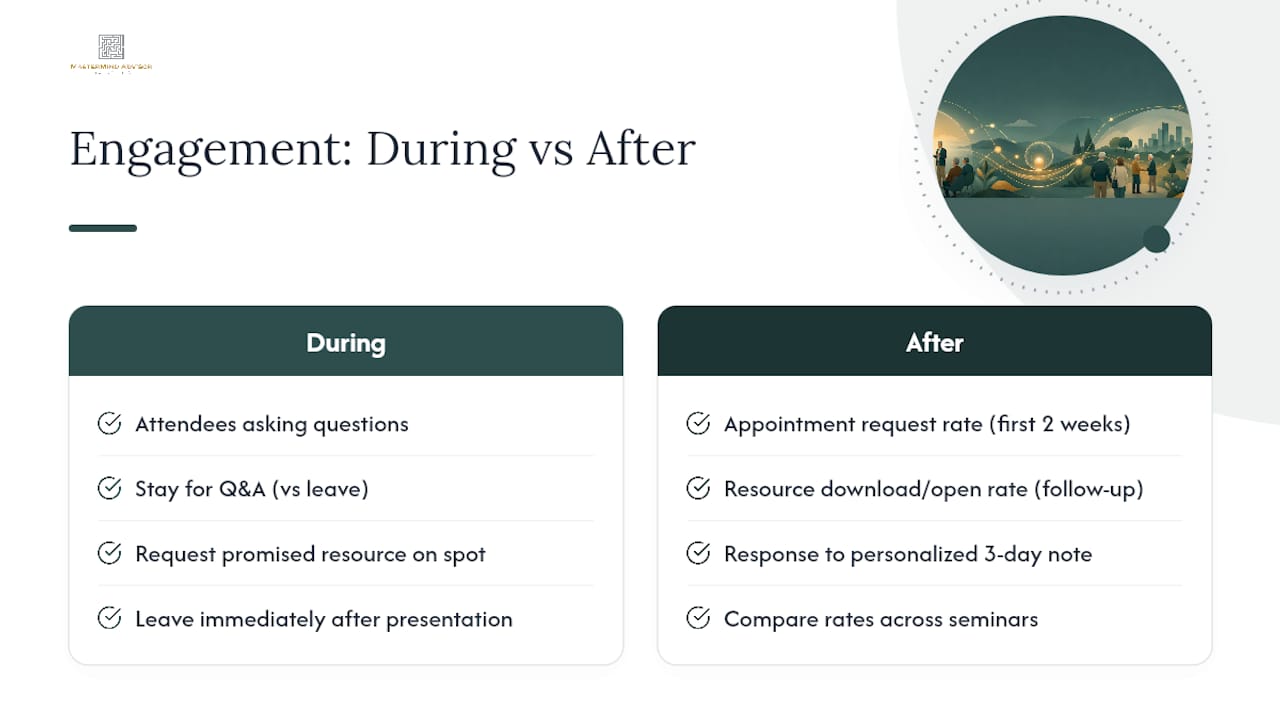
During the seminar, watch engagement signals your presenter can observe directly: how many attendees ask questions, how many stay for the Q&A rather than leaving early, and how many request the promised resource on the spot rather than waiting for the follow-up email. A room that leaves the moment the formal presentation ends is signaling that the content didn't land, regardless of how many people showed up.
After the event, the metrics that matter most are the appointment request rate (attendees who ask for a meeting within the first two weeks), the resource download or open rate from your follow-up emails, and how many attendees respond to the personalized three-day note versus ignoring it. A low response rate to that personal touch usually means the presentation didn't build enough trust to warrant a one-on-one conversation.
Compare engagement data across seminars over time, not just within a single event. If your Social Security seminar consistently outperforms your general retirement planning seminar on appointment requests, that's a signal to run the narrower topic more often. Most CRM platforms built for advisors can tag these outcomes automatically, letting you see which topics, formats, and follow-up touches actually move attendees toward booked meetings instead of guessing based on gut feel.
The Modernize-or-Replace Verdict on Seminar Marketing
The conventional advice on this topic hasn't caught up with what the numbers actually show. Most guidance still treats the seminar as the whole strategy: rent the room, mail the invitations, hope for a full house. That framing worked when seminars were novel. It doesn't hold up against a 25% adoption rate and rising costs per attendee.
What the research actually supports is narrower and more useful: keep the parts of seminar marketing that build trust, the empathy-led teaching, the narrow topic focus, the in-person credibility, and replace the parts that are unpredictable, the reliance on a single event's turnout, with a rules-based follow-up engine and a continuous outreach system.
Most advisors overinvest in the event and underinvest in the three days after it. That's backwards. The seminar is a trust-building moment. The follow-up sequence is where the client relationship actually gets built. If you only have the budget to fix one thing this year, fix your follow-up process before you fix your invitation list.
A Turnkey Path From Seminar Chaos to a Measurable Pipeline
Mastermind Advisor Marketing exists for advisors who want the trust-building power of seminars and webinars without building the follow-up machinery from scratch. Unlike piecing together a mailing house, a webinar platform, and a generic CRM separately, you get produced events, compliance-friendly content, and automated follow-up sequences built specifically for the long buying cycles typical of financial services.
That matters most for the exact gap this article covers: most advisors lose clients not at the seminar, but in the three days after it, when follow-up gets inconsistent or forgotten entirely. Mastermind Advisor Marketing's CRM integration and automated email drips handle that sequence by default, so the personalized three-day note and the value-add touches happen whether or not your team remembers to send them.
If you're deciding between rebuilding your seminar program or shifting toward a continuous pipeline, start by reviewing what a full turnkey system looks like for a practice your size, then book a strategy call to map your existing seminar or webinar funnel against it.
Frequently Asked Questions About Retirement Seminar Marketing
Is retirement seminar marketing still effective in 2026?
Yes, for advisors who run repeat events with a narrow topic focus and a documented follow-up sequence. Without that discipline, seminars tend to underperform a continuous LinkedIn and webinar pipeline.
What's a realistic cost per client from a seminar?
It varies by market and topic, but the formula to run yourself is CAC = total event cost ÷ new clients acquired, compared against your expected client lifetime revenue using conservative close rate assumptions.
How many people typically attend a financial advisor seminar?
Industry benchmarking from SmartAsset puts average attendance around 20 people per event, though this varies with list quality and topic specificity.
Should I use direct mail or digital channels to promote a seminar?
Test both. Targeted direct mail pilots can produce positive ROI when the list is narrow, while email and LinkedIn outreach extend reach at lower cost and support ongoing pipeline building between events.
What should happen immediately after someone attends a seminar?
A same-day thank-you and resource delivery, followed by a personalized note within three days. That timing window consistently outperforms fully automated, generic follow-up sequences.
Sources
- Seminar Marketing For Financial Advisors — SmartAsset
- How to do effective financial advisor seminars — Financial Planning
- Generating A Marketing ROI With Direct Mail Seminar Events — Kitces