
Awards are worth pursuing for most financial advisors, but only when you choose the right programs, use them correctly, and document everything for SEC exam readiness. The two strongest reasons: credible third-party rankings give prospects an independent reason to trust you before the first meeting, and they generate PR and networking value that paid ads simply cannot replicate. The compliance ceiling is real, but it is manageable.
Three things you can do this week:
- Add an awards disclosure page to your website listing every active recognition, its date, scope, and a link to the methodology.
- Shortlist one credible program (Forbes/SHOOK, Barron's, or a niche industry award) and request the full methodology document before applying.
- Schedule a 30-minute internal compliance review to confirm your current award references meet the SEC Marketing Rule's disclosure requirements.
Pro Tip: Within 30 days, draft a one-page "awards decision memo" for each recognition you plan to claim. Note the methodology, independence statement, fees paid, and how you verified the criteria. That document is your first line of defense in an SEC exam.
Key Takeaways
Awards are worth pursuing when the program is independent, the methodology is public, and you deploy the recognition consistently across your marketing with proper SEC disclosures.
| Point | Details |
|---|---|
| Choose credible programs | Forbes/SHOOK, Barron's, and SHOOK Research publish methodologies and do not sell placement. |
| Disclose every award correctly | Include the date, scope, criteria, and a methodology link in every advertisement that references a rating. |
| Document for SEC readiness | Keep a dated awards file with methodology PDFs, fee records, and compliance sign-offs for every active recognition. |
| Apply the ROI test | Estimate incremental meetings, multiply by close rate and client value, and compare to total cost before applying. |
| Mastermindadvisormarketing | Provides turnkey award amplification, compliance-reviewed messaging, and landing pages to convert recognition into prospect meetings. |
Table of Contents
- What role do awards and recognition play in advisor marketing?
- Major award programs every financial advisor should know
- What does an award actually signal to a prospective client?
- How to evaluate an award's credibility before you enter or claim it
- How to deploy awards in your marketing without overclaiming
- What does the SEC Marketing Rule require when you use awards?
- Is the cost of pursuing an award worth it for your practice?
- What advisors actually learn about awards after a few years
- Mastermindadvisormarketing turns your awards into a client acquisition system
- Primary sources and references
- Sources
What role do awards and recognition play in advisor marketing?
The role of awards recognition in advisor marketing is more specific than most advisors assume. A well-chosen ranking does not just decorate your bio. It gives a skeptical prospect a third-party signal that someone other than you has vetted your practice. That matters because financial advisor selection is reputation-driven: the Bureau of Labor Statistics notes that personal financial advisors work in a client-facing, reputation-sensitive environment where trust signals heavily influence hiring decisions.
The catch is that "awards" covers a wide spectrum. A Forbes/SHOOK ranking and a pay-to-play "Top Advisor" badge from an obscure publisher are not the same thing, and prospects who do their homework will notice the difference. The programs that actually move the needle share three traits: a published methodology, an independence statement, and enough media reach to put your name in front of people who were not already looking for you.
Awards also create internal momentum. Recognition gives your team a concrete milestone to rally around, and the PR assets (logos, profile pages, press reprints) give your marketing calendar a natural content hook. Industry commentary from Financial Promoter confirms that awards can differentiate advisors in a crowded market and generate networking opportunities, but only when the award's visibility actually reaches your target geography or niche.

Major award programs every financial advisor should know
Not every program deserves your time. The shortlist below covers the rankings with the widest reach, the most transparent methodologies, and the most useful marketing assets for U.S.-based advisors.
| Program | Methodology summary | Pay-to-play risk | Marketing assets provided |
|---|---|---|---|
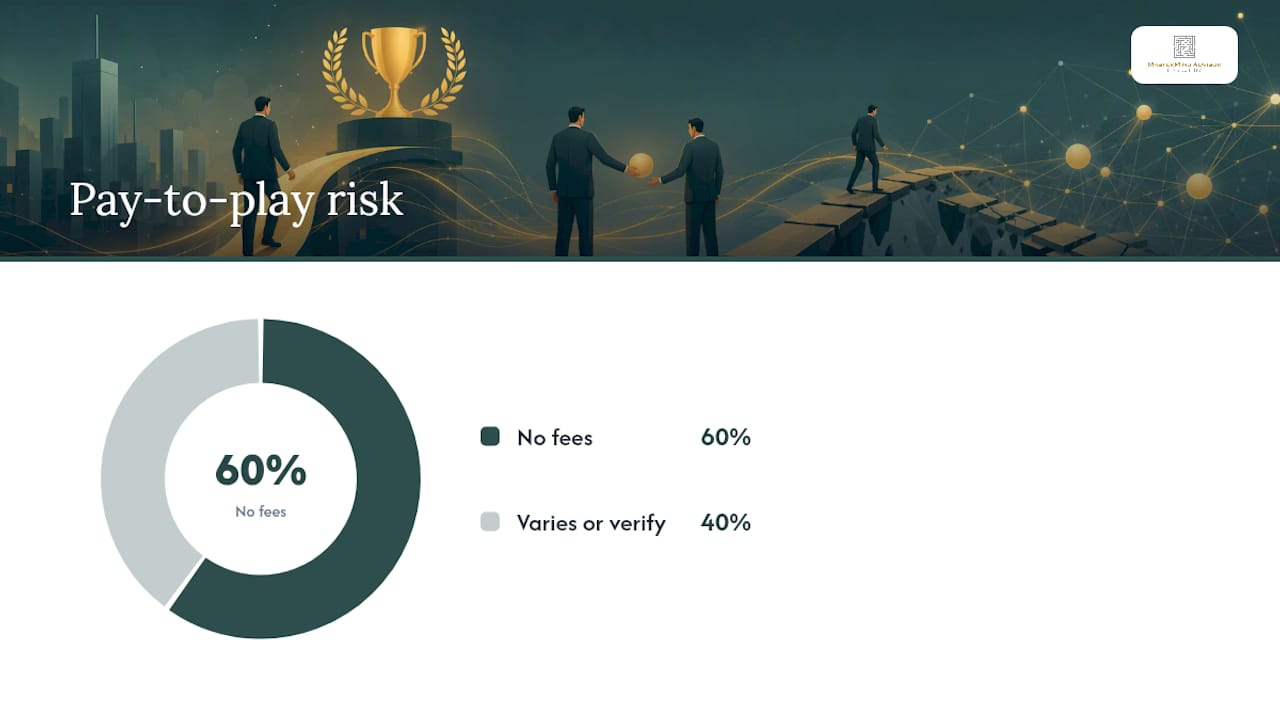
| Forbes / SHOOK Research (Best-in-State, Top Wealth Advisors) | Qualitative due diligence interviews plus quantitative metrics (revenue trends, AUM); portfolio performance is explicitly not a criterion | No fees for placement | Logos, profile pages, editorial reprints, press kit |
| Barron's Top Financial Advisors | Quantitative scoring: AUM, revenue, regulatory record, quality of practice | No fees for placement | Ranked list inclusion, reprints, digital badge |
| SHOOK Research (standalone) | Nominations, deep due diligence interviews, "would we recommend this advisor to a family member" standard; states it does not accept fees for placement | No fees for placement | Profile page, methodology documentation |
| Investopedia Top Financial Advisors | Editorial review of advisors and firms; content-driven visibility through Investopedia's audience | Varies by program tier | Profile page, editorial feature |
| USA Today Top Financial Advisory Firms | Algorithmic scoring of firm-level data; geographic and size segmentation | Verify before applying | List inclusion, digital badge |
| Wealthtender | Aggregator and industry guide; advisors can claim profiles and collect verified reviews | Subscription fee for enhanced profiles | Profile page, review aggregation, badge |
A few things worth noting about this list:
- Forbes/SHOOK's published methodology explicitly states that portfolio performance is not a criterion, which is critical for how you describe the recognition to prospects and regulators.
- SHOOK Research's process emphasizes qualitative vetting and independence from fees, which gives it strong credibility as a third-party signal.
- Wealthtender operates more as an aggregator than a traditional award body. Its value is in review visibility, not peer recognition, so treat it differently in your marketing copy.
Pro Tip: Being shortlisted or nominated is a legitimate marketing claim, even if you did not win. "Named a finalist for the Barron's Top Financial Advisors list" is accurate, verifiable, and carries credibility. Just make sure the disclosure includes the year, the selection criteria, and a link to the methodology.
What does an award actually signal to a prospective client?
An award signals that a third party applied some defined criteria to your practice and found it worth recognizing. That is the honest version. What it does not signal is often more important to get right.
Awards can credibly convey:
- Peer or editorial recognition of practice quality, client service approach, or professional standing
- That your practice met a defined threshold (AUM, regulatory record, tenure, interview performance)
- That a media brand with editorial standards found your work worth featuring
- Demonstrated process: you submitted to scrutiny and passed
Awards do not reliably signal:
- Superior investment returns or portfolio performance (Forbes/SHOOK explicitly excludes this)
- Fiduciary behavior beyond what the award's criteria actually measured
- That you are the right fit for any specific client's situation
- Future performance of any kind
The gap between what an award measures and what a prospect might infer is where compliance problems start. A prospect who sees "Top Wealth Advisor" might assume it means your returns beat the market. If your marketing copy does nothing to correct that inference, you have a problem under the SEC Marketing Rule.
Correct vs. incorrect claim using the same award:
| Scenario | Incorrect claim | Correct claim |
|---|---|---|
| Forbes/SHOOK ranking | "Named a Top Wealth Advisor for delivering superior investment returns" | "Named to Forbes' Top Wealth Advisors list, which evaluates advisors on practice quality, client service, and AUM — not portfolio performance. [Link to methodology]" |
| Barron's list | "Ranked #1 by Barron's for best investment advice" | "Ranked among Barron's Top Financial Advisors based on AUM, revenue, regulatory record, and quality of practice" |
The correct version names the criteria. That one change keeps the claim accurate and keeps you compliant.
How to evaluate an award's credibility before you enter or claim it
Run every award through this checklist before you apply, pay, or publish anything.
Credibility checklist:
- Published methodology: Can you find a detailed, public explanation of how winners are selected?
- Independence statement: Does the organizer explicitly state that placement cannot be purchased?
- Nomination process: Is it peer-nominated, self-nominated, or editorially selected? Peer and editorial nominations carry more weight.
- Fees and paid placement: Are application fees reasonable and clearly separated from any promotional packages? A fee to apply is different from a fee to be listed.
- Sample size and geographic scope: How many advisors were considered? Is the pool national, regional, or local?
- Frequency and recency: Is the award annual? Is the current year's list clearly dated?
- Disclosure availability: Does the organizer provide a disclosure document or methodology page you can link to?
- Third-party audit: Is there any independent verification of the scoring process?
Red flags that should stop you:
- The organizer cannot produce a written methodology when you ask for one.
- Winning or being listed requires purchasing a promotional package (paid placement).
- The award has no stated date, scope, or selection criteria on its public page.
- The organizer bundles "winner" status with advertising buys.
- The award is less than two years old with no track record.
How to document your decision for SEC exam readiness:
- Save the methodology page as a PDF with the date you accessed it.
- Note whether you paid any fee and what it covered.
- Record the selection criteria and the date of the award.
- Store this in a dedicated "awards file" alongside your marketing materials.
- Update the file each time you renew or claim the recognition.
Pro Tip: Email the award organizer directly and ask: "Can you provide your full methodology document and confirm that placement is not available for purchase?" Save their written response. That exchange is documentation an SEC examiner can review.
How to deploy awards in your marketing without overclaiming
Awards generate the most value when they appear consistently across multiple touchpoints, not just in a one-time press release. Here is where to place them and how to write the copy.
Primary placement opportunities:
- Website homepage and bio: Display the award logo with a one-line description of what it measured and a link to the methodology. Never let a logo stand alone without context.
- Email signature: "Named to [Award], [Year] | [Link to methodology]" is clean, compliant, and visible in every outbound message.
- Proposals and pitchbooks: Include a dedicated "Recognition" section that lists each award, its criteria, and its date. This is often the first place a prospect fact-checks you.
- Social media: Share the announcement with a post that explains what the award measured. Avoid superlatives. "Honored to be named to [list] for [criteria]" outperforms "Proud to be the best."
- PR and press releases: A legitimate ranking from Forbes or Barron's is genuinely newsworthy. Send a release to local business media and your professional associations.
Content assets worth building:
- A dedicated awards landing page on your website that lists all active recognitions with dates, criteria, and methodology links.
- A short video or blog post explaining what a specific ranking measures and why it matters to clients.
- A webinar segment where you reference the recognition as context for your practice philosophy, not as a performance claim.
- An A/B test: run two versions of your homepage hero section, one with the award badge and one without, and track meeting requests over 60 days.
Measuring award-driven impact:
Track UTM parameters on any link you place in award-related content. If you add a Forbes badge to your homepage, tag the methodology link so you can see how many visitors click through. For meeting attribution, ask new prospects during intake: "How did you first hear about us?" and record the answer. Over time, you will see whether award mentions appear in that data.
Industry commentary confirms that third-party recognition amplifies brand trust in ways self-promotion cannot, particularly when the recognition comes from a source the prospect already respects.
What does the SEC Marketing Rule require when you use awards?
The short answer: awards and third-party ratings are permissible, but they require clear and prominent disclosures, written agreements in many cases, due diligence on the rating methodology, and recordkeeping. The SEC's Marketing Rule makes clear that awards, prizes, and non-cash items can count as compensation, which triggers the rule's testimonial and endorsement provisions when those recognitions appear in your advertising.
The final adopting release replaced the prior advertising and solicitation rules with a single, technology-neutral framework that broadened the definition of "advertisement" and set specific conditions for testimonials, endorsements, and third-party ratings. The compliance date was November 4, 2022.
Compliance checklist for using awards in marketing:
- Disclosure: Every use of a third-party rating or award in an advertisement must include a clear and prominent disclosure of the date of the rating, the period of time it covers, and the identity of the third party that created it.
- Written agreements: If you compensate a promoter (including paying for a promotional package tied to an award), a written agreement is required unless the de minimis exception applies under 17 CFR § 275.206(4)-1-1).
- Disqualification rules: Confirm that neither you nor the promoter is subject to a disqualification event under the rule before publishing any testimonial or endorsement.
- Due diligence on methodology: You must review the rating methodology before using a third-party rating in advertising. Document what you reviewed and when.
- Recordkeeping: Retain all advertisements (including social posts, emails, and website content), the questionnaires or criteria used by the rating body, and proof of your methodology review.
- No performance implication: Never use award language in a way that implies superior investment returns unless the award explicitly measured returns and you have substantiation.
Common exam pitfalls the SEC has observed:
The Division of Examinations risk alert identified these recurring failures after the November 2022 compliance date: missing or non-prominent disclosures, inadequate due diligence on third-party rating methodologies, and weak policies and procedures for substantiating factual claims. SEC exam staff have also observed advisers using testimonials, endorsements, and third-party ratings without the required disclosures or adequate methodology review.
Practical compliance is mostly about documentation and prominence, not just content. A disclosure buried in a footnote or accessible only through a hyperlink that requires two clicks is not "clear and prominent" in the SEC's view.
Pro Tip: Create a pre-approval workflow for every new award reference before it goes live. The workflow should include: methodology review, disclosure draft, compliance officer sign-off, and file date. A one-page checklist takes 20 minutes to complete and is the difference between a clean exam and a deficiency letter.
For a broader compliance framework, the independent advisor compliance marketing checklist covers the full range of marketing rule obligations beyond awards alone.
Is the cost of pursuing an award worth it for your practice?
Cost components vary more than most advisors expect. Application fees for major rankings like Forbes/SHOOK and Barron's are zero. The real costs are staff time for the application and interview preparation, PR amplification (a press release distribution service, a copywriter, or both), travel if the award includes an in-person event, and any promotional packages the organizer offers separately.
A simple ROI framework:
- Estimate the incremental meetings the award is likely to generate over 12 months. Be conservative: a small number of additional prospect meetings per year can be a realistic baseline for a regional advisor using a Forbes or Barron's recognition.
- Multiply by your average close rate and average first-year client revenue.
- Compare that figure to the total cost (staff time at your hourly rate plus any fees).
- If the payback period is under 18 months, the award is likely worth pursuing.
What you could spend the same budget on:
- A targeted webinar campaign reaching 50 to 100 qualified prospects in your niche
- Three months of scheduled social media content with compliance review
- A referral program that incentivizes existing clients to introduce peers
- Paid search ads targeting high-intent keywords in your local market
Awards tend to outperform paid ads on one specific dimension: they generate trust with prospects who are actively researching you, not just browsing. Someone who Googles your name and finds a Forbes profile page is already further along in their decision than someone who saw a display ad. For niche-focused advisors, an industry-specific award that reaches exactly your target audience often delivers better ROI than a national ranking with diffuse reach.
Decision rules:
- Apply when the program has a published methodology, no pay-to-play, and meaningful reach in your geography or niche.
- Pay for a promotional package only when the package includes specific, measurable assets (a profile page with SEO value, a press reprint with distribution) and you have reviewed the compliance implications.
- Skip when the award requires purchasing visibility, lacks a public methodology, or reaches an audience that does not overlap with your ideal client profile.
What advisors actually learn about awards after a few years
Most advisors who pursue awards seriously go through a predictable arc. The first recognition generates genuine excitement and a flurry of marketing activity. The second or third teaches them something more useful: the awards that generate actual meetings are almost always the ones where the prospect already knew the publication before they knew the advisor.
That is the practical test worth applying before you invest time in any program. Ask yourself: would my ideal prospect recognize this publication or ranking body without me explaining it? If the answer is no, the award's primary value is internal (team morale, credibility with existing clients) rather than external (new prospect acquisition). Both are legitimate, but they require different marketing strategies.
The other lesson advisors learn slowly is that a single award mention is almost never enough. The advisors who see the most traction treat recognition as a content system: the Forbes listing becomes a blog post explaining what the ranking measures, which becomes a webinar segment, which becomes a social series, which becomes a talking point in every prospect meeting for the next 12 months. The award is the seed. The content is the crop.
Integrating awards into a broader brand and reputation strategy, rather than treating each one as a standalone event, is what separates advisors who build durable credibility from those who collect logos.
Mastermindadvisormarketing turns your awards into a client acquisition system
Independent advisors who earn a Forbes or Barron's recognition often have the hardest part done. The recognition exists. What most practices lack is the operational infrastructure to turn that recognition into a consistent stream of prospect meetings.
Mastermindadvisormarketing builds that infrastructure. The system covers award discovery and application support, compliance-reviewed messaging for every placement (website, email, proposals, social), press reprint production, and award-specific landing pages built to convert. For advisors who have been shortlisted or recognized, the team can deploy a full amplification campaign within weeks, including webinar tie-ins that use the recognition as a credibility anchor rather than a footnote.
The engagement starts with an audit of your current award references and marketing materials, flags any compliance gaps, and produces a documentation package built for SEC exam readiness. Every asset goes through a compliance review before it goes live. To see how the system works for practices like yours, visit Mastermindadvisormarketing and request a strategy session.
Primary sources and references
The sources below are the primary references for the compliance and methodology claims in this article. Each one is worth bookmarking.
| Source | What to look for |
|---|---|
| SEC Marketing Rule compliance guide | Testimonial/endorsement rules, compensation definitions, disclosure requirements, recordkeeping |
| SEC Final Rule: Investment Adviser Marketing (IA-5653) | Rule structure, definition of advertisement, rationale for third-party rating conditions |
| SEC Division of Examinations Risk Alert: Marketing Rule | Common exam focus areas post-November 2022: policies, substantiation, performance advertising, recordkeeping |
| Forbes/SHOOK Methodology (April 2025) | Qualitative interview process, quantitative factors, explicit exclusion of portfolio performance |
| SHOOK Research methodology | Independence statement, due diligence interview process, no-fee-for-placement policy |
| SEC exams risk alert: testimonials, endorsements, third-party ratings | Observed compliance failures: missing disclosures, inadequate methodology due diligence |
This article provides general information about SEC Marketing Rule requirements and award programs for educational purposes. It is not legal or compliance advice. Confirm current requirements with the SEC's published guidance or a qualified compliance professional before making changes to your marketing materials.
This article is general information, not a substitute for advice from a qualified financial advisor. Consult a qualified financial professional about your own circumstances before acting on anything here.
Sources
- Sec
- Final Rule: Investment Adviser Marketing
- Division of Examinations Risk Alert: Marketing Rule (SEC)
- Methodology: Forbes America’s Top Wealth Advisors 2025