
Educational workshops are the single most effective tool independent financial advisors have for turning strangers into clients. Not cold calls. Not LinkedIn posts. Workshops, because they let you demonstrate expertise in real time, answer real questions, and build the kind of trust that a brochure never can.
Table of Contents
- What is the role of educational workshops for advisors?
- How to plan and execute a workshop that actually works
- How do you promote a workshop to attract the right prospects?
- Using workshops to build thought leadership and win clients
- What compliance rules apply to financial advisor workshops?
- Key Takeaways
- Why independent advisors should invest in workshops right now
- A sharper take on why most advisor workshops fail
What is the role of educational workshops for advisors?
The role of educational workshops for advisors goes well beyond filling a room. They function as a lead generation engine, a credibility builder, and a relationship starter, all in one event. Approximately 25% of advisors use seminar marketing as part of their growth strategy, and the ones doing it well are not pitching products. They are educating.
Workshops work because they flip the dynamic. Instead of chasing prospects, you invite them into a conversation about their own financial concerns. Retirement income, estate planning, Social Security timing — these are topics people genuinely want to understand. When you are the one explaining them clearly, you become the obvious person to call.
- They establish credibility without a single credential listed on a slide.
- They create authentic human connection that passive marketing cannot replicate.
- They qualify leads naturally: people who show up already care about the topic.
- They differentiate you from advisors who rely solely on referrals.
- Mastermindadvisormarketing's turnkey marketing system is built specifically around this model, giving independent advisors the infrastructure to run workshops and follow up without having to build everything from scratch.
Pro Tip: Frame every workshop around a specific financial anxiety your ideal client has, not around your services. "How to avoid running out of money in retirement" fills seats. "Introduction to our wealth management process" does not.
How to plan and execute a workshop that actually works
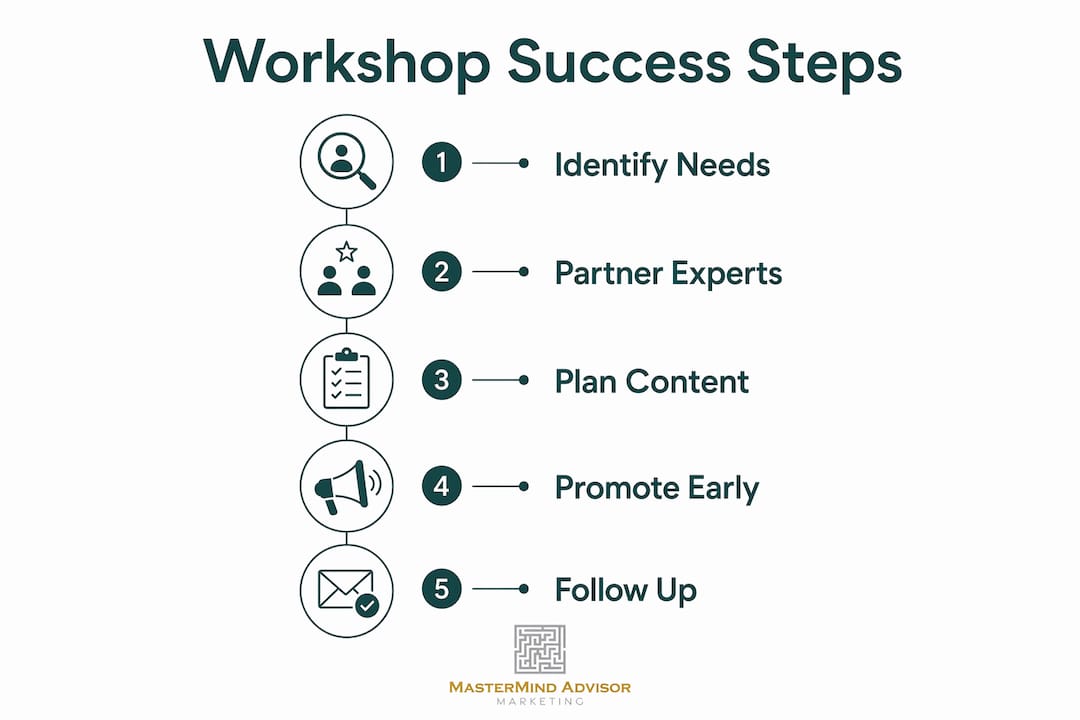
Good execution starts three weeks out, minimum. Multi-channel promotion combined with a clear event goal is what separates a full room from an awkward dinner with four people.
Planning checklist:
- Define your ideal attendee before you book the venue. A workshop for pre-retirees looks different from one for small-business owners.
- Choose a topic tied to a real financial anxiety: required minimum distributions, estate planning under current legislation, or Social Security optimization.
- Select a venue that fits your expected group size. A hotel conference room works for 30 people; your office conference room works for 8.
- Send email invitations at least three weeks in advance, with weekly reminders and a morning-of reminder on event day.
- Call every RSVP personally the day before. This one step alone lifts attendance rates and starts the relationship before you shake hands.
- Design your presentation around client concerns, not your biography. Attendees respond far better to empathy and practical guidance than to credential-heavy slides.
- Build in a Q&A session. Questions reveal what prospects are actually worried about, which is more useful than any survey.
- End with a clear call to action: a free consultation, a follow-up call, or a second event invitation.
Partnering with a complementary professional, such as an estate attorney or CPA, multiplies your reach and adds depth to the content without extra preparation on your end.
How do you promote a workshop to attract the right prospects?

Promotion is where most advisors underinvest. A great workshop with poor promotion is just a well-prepared talk to an empty room.
Start at least three weeks out across every channel you have: email, social media, your website, and direct mail. The best-performing invitation language uses phrases like "Know anyone who is worried about..." rather than generic event announcements. That framing activates your existing clients as referral sources without asking them directly to sell for you.
- Use your CRM to segment your list by age, life stage, or financial concern so invitations feel personal.
- Post event pages on LinkedIn and Facebook with clear registration links.
- Send a reminder email each week leading up to the event, plus one the morning of.
- Make a personal phone call to every confirmed RSVP the day before.
- If budget allows, run targeted digital ads to reach prospects outside your current network. Understanding audience needs before promoting helps you write copy that converts.
- Use Mastermindadvisormarketing's automated follow-up tools to handle registration confirmations and reminder sequences without manual effort.
Pro Tip: Ask your best clients to bring one person they think would benefit. A warm introduction from a trusted friend converts at a far higher rate than a cold registration.
Using workshops to build thought leadership and win clients
"Trust goes hand-in-hand with your ability to educate the client. If you are educating the client, then they are subconsciously building trust towards you." — Richard Corral, founding president of Retirement Systems
That quote captures exactly why the role of facilitators in workshops matters so much. The advisor who leads the room is not just presenting information. They are demonstrating judgment, patience, and genuine interest in the audience's financial lives.
Topics like Social Security optimization, RMDs, and estate planning under current law give you the chance to show mastery without ever saying "hire me." When you answer a question in the room that someone has been afraid to ask their current advisor, you have already won that relationship. Workshops focused on practical, client-relevant topics generate measurably higher trust and engagement than general financial overviews.
Post-workshop, the work continues. Effective follow-up requires multiple meaningful contacts before most prospects convert. A thank-you email with a summary of key points is the right first move. After that, each follow-up should add something new: a relevant article, a note referencing a specific question they asked, or an invitation to a second event. Generic "just checking in" messages do not move people forward. Specific, value-added outreach does. Mastermindadvisormarketing's advisor seminar resources walk through exactly how to structure this follow-up sequence.
What compliance rules apply to financial advisor workshops?
Running educational workshops as a registered investment advisor or broker-dealer representative comes with real regulatory obligations. The SEC and FINRA both require that any marketing materials, including event invitations and presentation slides, be fair, balanced, and not misleading. If you make performance claims or discuss specific investment products, those materials typically require principal review and approval before distribution.
State-level regulations add another layer. Some states require specific disclosures when soliciting clients through public events. Check with your compliance officer or broker-dealer before finalizing any promotional copy or presentation content. Recording a virtual workshop introduces additional considerations around consent and data storage. The safest approach is to treat every slide deck and invitation as a marketing document subject to your firm's standard review process, because regulators do.
Key Takeaways
Educational workshops are the most direct path from prospect to client for independent financial advisors, combining trust-building, lead qualification, and thought leadership in a single event.
| Point | Details |
|---|---|
| Start promotion early | Launch multi-channel outreach at least three weeks before the event. |
| Focus on client concerns | Address specific financial anxieties like RMDs and Social Security, not your credentials. |
| Follow up consistently | Plan 8–12 meaningful contacts after the workshop to convert attendees into clients. |
| Partner for reach | Collaborate with CPAs or estate attorneys to expand your audience and content depth. |
| Use a proven system | Mastermindadvisormarketing provides turnkey tools for workshop marketing and automated follow-up. |
Why independent advisors should invest in workshops right now
The advisors pulling away from the pack in 2026 are not the ones with the best brochures. They are the ones in the room, answering questions, building trust face to face. Digital noise has made authentic in-person and hybrid educational events more valuable, not less. When everyone else is sending automated emails, showing up in person is a differentiator by itself.
Workshops also compound. The first event is the hardest. By the third or fourth, you have a refined presentation, a growing attendee list, and a follow-up system that runs with minimal effort. Mastermindadvisormarketing's platform is designed to accelerate that compounding effect, with custom CRM integration and automated email sequences that keep your practice visible between events.
The advisors who build this habit now will have a durable pipeline that does not depend on algorithm changes or referral luck. That is the real case for investing in educational workshops today.
Ready to build a workshop marketing system that actually fills your pipeline? Mastermind Advisor gives independent advisors the tools, templates, and follow-up automation to turn every seminar into a client acquisition engine.
A sharper take on why most advisor workshops fail
Most advisor workshops fail before the first slide loads. The advisor walks in with a deck full of charts, a list of credentials, and a plan to explain their investment philosophy. The audience sits there waiting for something useful. By the time the Q&A arrives, half the room has mentally checked out.
The fix is not a better slide design. It is a fundamental shift in whose problem the workshop is solving. The best workshop facilitators I have seen treat the event like a consultation, not a presentation. They open with a question the audience is already asking themselves. They spend the first twenty minutes making people feel understood before they explain anything. The credential slide, if it appears at all, comes last.
There is also a follow-up problem that advisors consistently underestimate. Sending one thank-you email and waiting for the phone to ring is not a strategy. The 8–12 contact threshold cited by practitioners is not a sales trick. It reflects how long it actually takes for a person to trust someone enough to hand over their financial life. Each follow-up needs to add something the prospect did not have before: a relevant insight, a specific callback to their question, a reason to keep the conversation going.
The advisors who treat workshops as a one-time event rarely see strong returns. The ones who treat them as the opening move in a longer relationship-building process, backed by a structured follow-up system like the one Mastermindadvisormarketing provides, are the ones filling their pipelines year after year.