
Tax management services are a packaged, year-round advisor offering that combines tax-aware investment workflows, proactive intra-year monitoring, and coordinated CPA referrals to capture client-facing tax opportunities and generate qualified leads. To deliver and market them successfully, you need five things in place: a defined service scope, documented workflows, compliant client messaging, a CPA coordination protocol, and a lead-generation engine that converts tax-curious prospects into paying clients.
The bottom line: Advisors who integrate tax planning into their core offering gain a measurable differentiation advantage. A substantial share of affluent investors—about 70%—prefer working with an advisor who actively helps reduce their tax burden, yet many advisory firms currently do not offer structured tax planning.
Your 30-second checklist:
- Define your service scope and compliant messaging before you market anything
- Build a repeatable intake workflow using the prior-year 1040 as your starting dataset
- Pair every campaign with a CPA coordination protocol so you stay on the right side of the legal line
Table of Contents
- What should your tax management services package include?
- What can advisors legally provide, and when do you refer out?
- How do you build a scalable workflow inside your RIA?
- How should you package and price these services?
- Which marketing tactics generate the best tax-service leads?
- How do you measure whether tax management services are working?
- How a turnkey marketing system accelerates tax-service growth
- Key Takeaways
- Why tax management is the growth lever most advisors underuse
- Mastermind Advisor's turnkey system puts qualified tax leads in your calendar
- Authoritative sources and further reading
What should your tax management services package include?
The capabilities clients expect from a structured tax management offering go well beyond year-end loss harvesting. Effective tax management requires tax-loss harvesting, tax-efficient withdrawal sequencing, tax-managed rebalancing, and ongoing intra-year monitoring as core components, not optional add-ons.
Build your package around these six capabilities:
- Tax-loss harvesting: Systematic identification and execution of loss offsets throughout the year, not just in December
- Tax-efficient withdrawal sequencing: Ordering distributions from taxable, tax-deferred, and tax-free accounts to minimize lifetime tax drag
- Tax-managed portfolio rebalancing: Rebalancing that accounts for embedded gains, lot selection, and wash-sale rules
- Roth conversion modeling: Scenario analysis identifying optimal conversion amounts given current and projected tax brackets
- Charitable bunching: Aggregating deductions across years to clear the standard deduction threshold
- Intra-year monitoring: Quarterly reviews plus trigger-driven checks when markets move, income changes, or a life event occurs
On the client deliverables side, the package should produce a multi-year tax roadmap, scenario illustrations the client can actually read, and a CPA coordination summary after each planning cycle. Those three documents are what separate a premium offering from a vague "we think about taxes" pitch.
Pro Tip: In initial sales conversations, Roth conversion modeling consistently outperforms other capabilities as a conversation starter. It's concrete, personal, and almost always reveals an opportunity the prospect hasn't seen before.
What can advisors legally provide, and when do you refer out?
Financial planners can legally provide tax guidance when they frame it as planning and optimization rather than return preparation or definitive tax interpretation. The line is clearer than most advisors think.
What stays in your lane:
- Scenario modeling (Roth conversions, withdrawal sequencing, bracket management)
- Educational explanations of tax concepts and strategies
- Coordinating with a client's CPA and sharing planning assumptions
- Recommending tax-aware investment actions within a managed account
When to refer to a CPA or tax attorney:
- Preparing or reviewing a tax return
- Representing a client before the IRS
- Issuing a definitive tax opinion or written tax advice
- Advising on entity structuring, estate tax elections, or state nexus questions
The common compliance failure is blurring planning and counsel. Successful advisors preserve the boundary by framing every discussion as scenario modeling, documenting their assumptions, and routing definitive tax positions to CPAs or attorneys. For supervised firms, that means a principal review gate before any written tax-related communication goes to a client.
Pro Tip: Replace outcome promises with strategy-focused language in all client-facing materials. Say "help you understand and optimize your tax strategy" rather than "we will reduce your tax bill." That single phrasing shift, recommended by compliance-aware advisors, keeps your marketing compliant and your E&O insurer comfortable.
How do you build a scalable workflow inside your RIA?
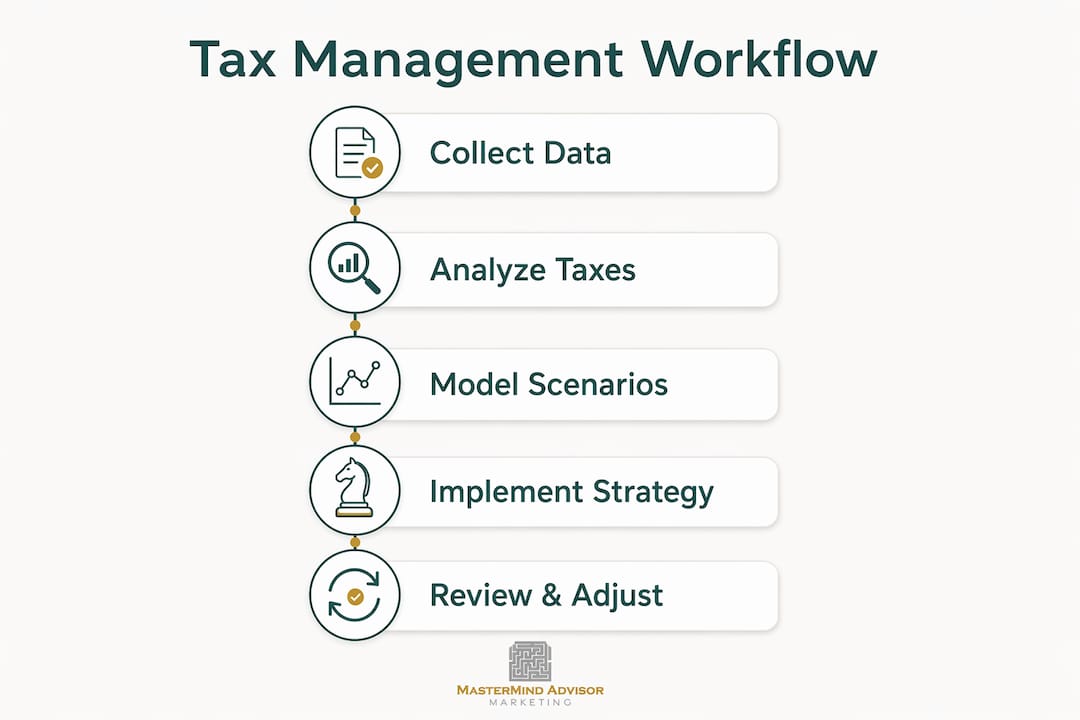
The recommended workflow runs in this order: ingest the prior-year tax return, build a baseline model, run scenarios, conduct a client review meeting, sync with the CPA, then execute and monitor. Top practitioners treat the prior-year return as the foundational dataset, uploading it into modeling software to build a proactive roadmap rather than waiting until December.
Operational steps to document or automate:
- Collect prior-year 1040, Schedule K-1s, account statements, payroll summaries, and entity documents at onboarding
- Upload return data into tax modeling software to establish baseline income, bracket position, and carryforward losses
- Run scenario models (Roth conversion, charitable bunching, withdrawal sequencing) and flag the top two or three opportunities
- Present findings in a client-facing summary; confirm priorities and document decisions
- Send a CPA coordination note summarizing planning assumptions and recommended actions
- Execute tax-aware trades or account changes within the investment management workflow
- Monitor quarterly and after trigger events (market drawdowns, income changes, life events)
Required data fields to collect at intake:
| Document | Why You Need It |
|---|---|
| Prior-year Form 1040 | Baseline income, bracket, carryforward losses |
| Schedule K-1s | Pass-through income and basis tracking |
| Account statements | Embedded gains, lot-level cost basis |
| Payroll / W-2 | Withholding accuracy, deferred comp elections |
| Entity documents | Business structure, S-corp distributions |
Consider partnering with a CPA or integrating a tax professional into your workflow from day one. It reduces liability, speeds execution, and gives clients a complete team rather than a referral handoff. Scalable tax planning requires documented, reviewable workflows with clear assumptions and pre-set coordination protocols so the service is repeatable, not advisor-dependent.

How should you package and price these services?
Three pricing models work for tax management, and the right one depends on how you position the service relative to your existing offering.
| Tier | Model | What's Included | Best Fit |
|---|---|---|---|
| Entry | Fixed-fee add-on — | Annual tax roadmap, one Roth conversion model, CPA coordination note | Clients new to proactive tax planning |
| Core | Retainer — | Quarterly monitoring, two scenario runs, withdrawal sequencing, CPA sync | Established clients with taxable accounts |
| Premium | AUM-based add-on — | Daily monitoring, full scenario library, priority CPA coordination, client portal access | High-net-worth clients with complex situations |
A few positioning notes worth keeping:
- Bundle tax management with financial planning for existing clients; price it as a standalone for prospects who come in through tax-specific campaigns
- Avoid pricing by the hour. It commoditizes the service and invites scope creep.
- Lead with outcomes in your value statements: "We model your tax picture across multiple years so you're never surprised by a bracket jump or a missed Roth window"
For niche-specific packaging, adjust the deliverables to match the client segment. Business owners need entity-level coordination; retirees need withdrawal sequencing and Medicare surcharge modeling.
Which marketing tactics generate the best tax-service leads?
The highest-ROI lead generators for tax management are webinars, in-person seminars, Tax Alpha upload funnels, and segmented email sequences. Each one works because it leads with a specific, demonstrable problem the prospect already knows they have.
Campaign execution steps:
- Webinar funnel: Host a 45-minute "Tax Alpha" webinar on a specific topic (Roth conversion windows, year-end harvesting). Gate registration with a short intake form. Follow up with a personalized email sequence and a calendar link.
- Seminar-to-appointment flow: Run a dinner or lunch seminar targeting pre-retirees. Present two or three tax scenarios relevant to that audience. Close with a complimentary "Tax Alpha Review" offer.
- Tax return upload funnel: Drive paid or organic traffic to a landing page offering a free tax review. Ask the prospect to upload their most recent return. A Tax Alpha review using an uploaded return serves as a high-intent lead magnet that converts cold traffic into qualified prospects.
- Segmented email sequence: Trigger a four-email sequence when a contact opens a tax-related email. Sequence: tax alert → scenario teaser → case illustration → strategy call invitation.
Content ideas to fuel outreach:
- Quarterly tax alerts tied to IRS deadlines and market events
- Short blog posts on bracket management, Roth windows, and RMD planning
- Client portal summaries showing year-to-date tax-saving activity
- Segmented landing pages by life stage (pre-retiree, business owner, recent widow)
For seasonal campaign timing, align your heaviest outreach with January (tax season anxiety), April (post-filing regret), and October (year-end planning urgency). Pair your content calendar with a marketing automation checklist to make sure every lead gets a timely, personalized follow-up without manual effort.
How do you measure whether tax management services are working?
Track these primary KPIs from the moment you launch:
- Qualified leads from tax campaigns: Number of prospects who engage with a tax-specific offer (webinar registration, Tax Alpha upload, seminar attendance)
- Conversion rate to paid service: Percentage of tax-campaign leads who become paying clients
- AUM sourced from tax engagements: New assets under management attributed to a tax-management conversation
- Revenue per tax client: Annual fee or AUM-based revenue divided by the number of tax-service clients
- Client retention uplift: Year-over-year retention rate for clients enrolled in tax management vs. those who are not
Secondary dashboard items worth monitoring: time-to-first-meeting from lead capture, CPA referral rate (how often your CPA partners send clients your way), and the number of modeled scenarios delivered per client per year.
Statistic to watch: Approximately 47% of advisory firms now offer tax planning, while about 70% of affluent investors prefer an advisor who helps reduce their tax burden. That gap is your market. That gap is your market.
Present KPI results to prospects as proof of process, not promises. A slide showing "clients in our tax management program received an average of three modeled scenarios last year" is compliant, credible, and compelling.
How a turnkey marketing system accelerates tax-service growth
The fastest path from "we offer tax management" to a full pipeline is a system that handles lead capture, nurture, and conversion without requiring the advisor to build it from scratch.
The core insight: Advisors who pair a documented tax-management workflow with a structured marketing system convert tax-curious prospects into booked strategy calls at a measurably higher rate than those relying on referrals alone. The marketing system is what makes the workflow visible to prospects who don't already know you.
A typical campaign pathway looks like this:
- A prospect sees a targeted ad or email promoting a "Tax Alpha Review"
- They register for a webinar or upload their prior-year return via a gated landing page
- The advisor reviews the return, identifies two or three planning opportunities, and books a strategy call
- The strategy call introduces the tax management service and the CPA coordination protocol
- The prospect converts to a paid engagement; the return data moves directly into the operational intake workflow
Proof points and client outcomes:
Prosperity Capital Advisors demonstrates this model in practice, using midyear tax planning content and return-upload workflows to position advisors as proactive tax partners rather than reactive investment managers.
Key Takeaways
Tax management services generate qualified leads and improve retention when advisors pair a documented workflow with a structured marketing system.
| Point | Details |
|---|---|
| Core capabilities | Build your package around tax-loss harvesting, withdrawal sequencing, Roth modeling, and intra-year monitoring. |
| Legal boundary | Frame all work as scenario modeling and planning; route return prep and definitive tax opinions to a CPA or attorney. |
| Workflow foundation | Use the prior-year 1040 as your starting dataset; document every step from intake to CPA sync to execution. |
| Marketing engine | Tax Alpha upload funnels, webinars, and segmented email sequences are the highest-ROI lead generators for tax services. |
| Mastermindadvisormarketing | Provides the turnkey webinar, seminar, and automation system advisors need to convert tax-management interest into booked strategy calls. |
Why tax management is the growth lever most advisors underuse
Most advisors treat tax management as a service enhancement. The smarter frame is to treat it as a lead-generation category. The Tax Alpha funnel, specifically asking a prospect to upload their return in exchange for a free review, is one of the few marketing tactics in financial services that generates high-intent leads AND delivers immediate planning value. The prospect self-qualifies by handing you their financial picture. You walk into the strategy call already knowing where the opportunities are.
The compliance anxiety is real but manageable. The planning-versus-advice boundary is well-defined once you read the primary guidance. The bigger risk most advisors face isn't crossing a legal line. It's leaving a differentiated, in-demand service on the shelf because the operational setup felt complicated.
Build the workflow first. Then build the marketing. In that order, the service scales. In the reverse order, you get leads you can't service well.
Mastermind Advisor's turnkey system puts qualified tax leads in your calendar
Advisors who want to sell tax management services face a specific problem: the marketing has to be compliant, the content has to be credible, and the follow-up has to be fast. Mastermindadvisormarketing is built for exactly that combination.

The system delivers customized Tax Alpha webinars, fully produced in-person and virtual seminars, a compliance-friendly content library, and automated email sequences that move tax-curious prospects from first touch to booked strategy call without manual follow-up. Every piece of content is built around the regulatory boundaries advisors operate within, so you're never choosing between effective marketing and compliant messaging.
Core deliverables included in the system:
- Customized lead-generation webinars and seminars on tax planning topics
- Automated email drip campaigns segmented by prospect type and life stage
- Scheduled social media content and a compliant content library
- High-converting advisor website and CRM integration
- Ongoing strategy support and campaign performance reporting
Book a strategy session with Mastermindadvisormarketing to see how the system maps to your tax management offering and get a campaign plan built for your practice. For a practical starting point on the seminar side, the seminar hosting guide walks through the exact format that converts tax-topic attendees into appointments.
Authoritative sources and further reading
The claims and recommendations in this article draw from the following sources:
| Source | What It Supports |
|---|---|
| Accounting Today | Legal boundary between tax planning and tax advice |
| Prosperity Capital Advisors | Prior-year return as baseline dataset; Tax Alpha funnel; intra-year monitoring |
| Wealth.com (compliance) | Scalable workflow design; documentation and CPA coordination protocols |
| Wealth.com (marketing) | Market demand statistics; compliant messaging frameworks |
| Altruist | CPA partnership and integration advice for RIAs launching tax planning |
This article is general information for educational purposes. It is not legal, tax, or compliance advice. Confirm current rules and regulatory requirements with a qualified compliance professional or attorney for your specific situation.