
A unique selling proposition for a financial advisor is a single, specific sentence that tells a prospect exactly who you serve, what you do differently, and why that difference matters to them. Proofcamp defines a USP as a concise statement of distinctive value that explains why a prospect should choose your firm over every alternative, and it must be expressible in one sentence. If it takes a paragraph, it is not a USP yet.
Two quick examples to make this concrete:
- RIA niche: "I help tech employees at pre-IPO companies turn equity compensation into a tax-efficient retirement plan before their lock-up expires."
- Insurance agent niche: "I help small business owners protect their key employees with disability income coverage structured around their buy-sell agreement."
Before you write yours, run this three-question check:
- Who: Can you name a single living person who fits your ideal client?
- How: Do you have a repeatable method or named process, not just a vague promise?
- Why it matters: Does your line name a specific outcome the client cares about, not a feature you like?
If any answer is "not really," the sections below will fix that.
Key Takeaways
A financial advisor's USP is a single sentence naming a specific client, a named method, and a concrete outcome — and it must be tested before it is treated as final.
| Point | Details |
|---|---|
| Define before you write | Name one real client type and one specific outcome before drafting any USP language. |
| Name the method | A repeatable, named process ("three-step deferred-comp review") is more credible than a vague promise. |
| Test within one week | Use email subject lines or a homepage headline A/B to validate the USP before committing to it. |
| Avoid industry clichés | Words like "holistic" and "personalized" no longer differentiate; replace them with specific methods and outcomes. |
| Mastermindadvisormarketing | The turnkey system helps advisors embed, test, and promote their USP across website, email, and social channels. |
Table of Contents
- Why a clear USP is the highest-leverage move for your practice
- How to build your USP in a 60-minute workshop
- The four elements every strong advisor USP must include
- Ready-to-use USP examples and fill-in templates
- Where to put your USP and how to know if it is working
- Common mistakes advisors make when crafting a USP
- Why the advisors who do this work win over the long run
- Mastermindadvisormarketing helps you test and promote your USP faster
- Sources
Why a clear USP is the highest-leverage move for your practice
Most advisors compete on trust, credentials, and service quality. So does everyone else. When every firm on the block claims to be "client-centered" and "fiduciary," those words stop doing any work. InvestmentNews calls this a "cliché crisis" in advisory messaging, noting that industry-standard terms like "holistic" and "personalized" are now so common they fail to differentiate firms. The practical consequence: when your language sounds like everyone else's, prospects make decisions based on price or whoever they happened to meet first.
A tight USP changes that dynamic in three measurable ways. First, it attracts right-fit clients who self-select before the first call, which cuts wasted discovery meetings. Second, it reduces price pressure because a specific promise is harder to comparison-shop than a generic one. Third, it drives referrals: a client who can repeat your USP in one sentence becomes a word-of-mouth engine. Clients who cannot articulate what you do differently rarely refer.
Morningstar's research on values-led propositions shows that advisors who center client values in their proposition build deeper relationships and increase plan adherence, because values are relatively stable even when markets are not. Structured approaches like the PERMA+V framework help advisors surface those values and make them actionable in planning conversations.
Pro Tip: Ask your three best clients to describe what you do in one sentence. Their words will almost always be more specific and more compelling than your current bio.
How to build your USP in a 60-minute workshop
You do not need a branding agency. You need 60 minutes, a blank document, and four honest questions. Work through these steps in order.
Step 1: Scan the competitive landscape
Pull the websites and LinkedIn headlines of ten advisors in your market. Then check public disclosure brochures on Adviserinfo to see how peer firms describe themselves in regulatory filings. Write down every phrase that appears more than twice. Those phrases are your "do not use" list. The gaps, the things nobody is saying, are your opportunity.
Step 2: Define one real client
Not a demographic. A person. Give them a name, a job, a specific financial problem, and a fear they have not said out loud. "Sarah, 52, a hospital CFO who has maxed her 403(b) for 15 years and has no idea whether she can retire at 60 without touching her deferred comp" is a target client. "High-net-worth professionals" is not. Your USP will only be as specific as your client picture.

Step 3: Name the benefit and the method
Fill in this prompt: "I help [specific client] achieve [specific outcome] through [named process or method]." The named process is what most advisors skip. "I help hospital executives retire on schedule through our three-step deferred-comp sequencing review" is a USP. "I help executives with retirement planning" is a job description.
Workshop prompts to run solo or with your team:
- What do clients thank you for that they never expected?
- What do you do in every client engagement that your competitors probably skip?
- What would your best client lose if they moved to a different advisor tomorrow?
Step 4: Write the line and test it fast
Draft three versions of your USP. Put each one as the subject line of a prospecting email to a cold list, or as the headline on a landing page. Track open rates and click-through rates over one week. The version that outperforms is your working USP. Treat it as a hypothesis, not a final answer.
Pro Tip: Run your draft USP past someone who has never heard of your firm. If they cannot tell you who you serve and what you do differently after one read, rewrite before you test.
The four elements every strong advisor USP must include
SSGA's framework for sharpening a value proposition identifies four pillars that separate a memorable USP from a generic tagline: ideal client, distinct approach, planning and portfolio integration, and client experience. Mapped to a USP audit, those pillars translate into four testable elements.
-
Client benefit: What specific outcome does the client get? Not "peace of mind" (everyone claims that) but "a written retirement income plan that accounts for your pension, Social Security timing, and deferred comp drawdown sequence."
-
Firm attribute: What do you do, or how are you structured, that makes the benefit possible? Fee-only structure, a named proprietary process, a specific credential, or a team model that no generalist can replicate.
-
Rational proof: Can you point to a method, a track record, or a framework that a skeptic could examine? A named process ("our three-meeting legacy alignment review") is more credible than a claim ("we go deep").
-
Emotional hook: What fear does your USP quietly address, or what aspiration does it speak to? The best USPs do this in the same sentence as the rational claim, not in a separate tagline.
| Element | What it answers | Example phrasing |
|---|---|---|
| Client benefit | "What do I get?" | "Retire by 60 without touching deferred comp" |
| Firm attribute | "Why can you deliver this?" | "Fee-only RIA with a dedicated equity-comp specialist" |
| Rational proof | "How do I know it works?" | "Three-step deferred-comp sequencing review" |
| Emotional hook | "Why does this matter to me?" | "So you stop wondering whether you saved enough" |
Audit questions to run on any draft USP:
- Can a prospect repeat it after hearing it once?
- Does it name a specific client type, not a broad category?
- Is the method or process named and testable?
- Does it address something the client actually worries about?
If any answer is no, the corresponding element is missing.
Ready-to-use USP examples and fill-in templates
The fastest way to write a USP is to see what a good one looks like in your niche, then adapt. Pershing's practitioner-facing mapping exercises show how to convert value-pillar language into client-facing lines. Here are six short examples across common advisor niches:
- Fee-only RIA, retirees: "I help federal employees within five years of retirement build a FERS income plan that replaces their paycheck on day one."
- RIA, tech employees: "I help software engineers at public companies exercise stock options without triggering an AMT surprise."
- Insurance agent, business owners: "I help family business owners fund their buy-sell agreement with disability income coverage their CPA helped design."
- Fiduciary advisor, physicians: "I help attending physicians in their first decade of practice eliminate six-figure student debt while building a tax-sheltered investment base."
- Hybrid advisor, women in transition: "I help recently divorced women rebuild a financial plan that reflects their new income, new goals, and their timeline, not their ex-spouse's."
- Insurance agent, small nonprofits: "I help nonprofit executive directors protect their key staff with group disability coverage that fits a budget under $50,000 a year."
Two fill-in templates
Belief-led (lead with what you believe): "We believe [client type] deserve [specific outcome]. That is why we built [named process], so you can [emotional payoff] without [common fear or frustration]."
Feature-led (lead with what you do): "We help [specific client] [achieve specific outcome] through [named method or process], so you [emotional payoff]."
Dos and don'ts:
- Do name the client type in the first clause.
- Do name a process or method, not just a promise.
- Don't use "holistic," "personalized," "comprehensive," or "client-centered" without a specific modifier.
- Don't write for everyone. A USP that fits every prospect fits none of them well.
- Don't lead with your credentials. Lead with the client's outcome.
Pro Tip: For a belief-led approach to copy that sorts for fit rather than trying to please everyone, write the belief sentence first, then build the rest of the USP around it. Advisors who lead with belief attract clients who share it.
Where to put your USP and how to know if it is working
A USP that lives only in your head is not a USP. It is a thought. Pershing's implementation guidance is direct: place the USP where selection happens. For advisors, that means five primary touchpoints.
- Homepage headline: The first sentence a visitor reads. Not your firm name. Not "Welcome." Your USP or a close variant.
- LinkedIn headline: 220 characters that show up in search results and connection requests.
- Email subject lines: A/B test your USP as a subject line in prospecting sequences.
- Proposal opener: The first paragraph of every prospect proposal, before credentials or fee schedules.
- Networking pitch: A 15-second spoken version you can deliver without thinking.
A simple one-week test plan
| Day | Action | What to measure |
|---|---|---|
| Day 1 | Update homepage headline to USP version A | Baseline click-through rate on primary CTA |
| Day 3 | Send email with USP as subject line | Open rate vs. your last three campaigns |
| Day 5 | Use USP as LinkedIn headline | Profile views and connection requests |
| — | Review and compare all three signals | Which version drove the most qualified inbound? |
Track three metrics over 30 days: homepage CTA click-through rate, inbound lead quality (did prospects self-identify as your target client?), and conversion from first contact to a scheduled meeting. If none of those move, the USP needs another iteration.
Compliance note: Any specific claim in your USP, particularly performance-related language or references to credentials, must align with your firm's regulatory disclosures. Review your ADV Part 2 language and run new copy past your compliance officer before publishing. The independent advisor compliance checklist is a practical starting point for aligning marketing claims with regulatory requirements.
Common mistakes advisors make when crafting a USP
Most first drafts fail for the same handful of reasons. Here is what to watch for and how to fix each one.
-
Vague buzzwords with no method behind them. "We provide holistic, personalized financial planning" tells a prospect nothing they cannot read on 200 other websites. Fix: replace the adjective with a named process. "We run a three-meeting values-to-goals review before we touch a single investment" is specific and repeatable.
-
Trying to serve everyone. A USP written for "anyone who wants financial advice" will resonate with no one. Fix: pick your best three current clients, find the common thread, and write for that thread. You will lose some prospects and gain far better ones.
-
Copying competitor language. If you pulled ten advisor websites in Step 1 of the workshop and then wrote a USP that sounds like the average of those ten, you have done the opposite of differentiating. Fix: go back to your "do not use" list and build from the gaps.
-
No test plan. Writing a USP and putting it on your website without measuring anything is guesswork. Fix: commit to one A/B test in the first week, even if it is just two email subject lines.
-
Over-customizing for one client. Some advisors write a USP so specific to their single best client that it alienates everyone else. Fix: the USP should describe a type of client and a type of problem, not a single individual. It needs to be repeatable by your staff, not just by you.
-
Burying the client benefit. Many advisors lead with their credentials or their firm's history. Prospects do not care about your history until they believe you can solve their problem. Fix: put the client outcome in the first clause, always.
A content strategy built around your USP makes these mistakes easier to catch early, because every piece of content becomes a test of whether the core message lands.
Why the advisors who do this work win over the long run
Here is what I keep seeing: advisors who invest 60 minutes in a real USP workshop, then actually test it, consistently outperform peers who rely on credentials and reputation alone. The reason is not mysterious. A specific USP acts as a filter at every stage of the client relationship, from the first Google search to the referral conversation five years later.
The advisors who resist this work usually give one of two reasons. Either they believe their work speaks for itself, or they worry that narrowing their message will shrink their market. Both instincts are understandable and both are wrong in practice. A tight USP does not shrink your market. It concentrates your best prospects and makes every marketing dollar more efficient.
The 60-minute workshop in this article is not a branding exercise. It is a client-selection tool. Run it, test one version within 30 days, and measure three signals. That is the whole ask. Advisors who do this and then build a positioning strategy around the result tend to stop competing on price within a year.
Mastermindadvisormarketing helps you test and promote your USP faster
Most advisors who complete the workshop above have a solid draft USP within a week. The harder part is getting it in front of the right prospects consistently, across a website, email sequences, and social content, without spending hours on execution every month.
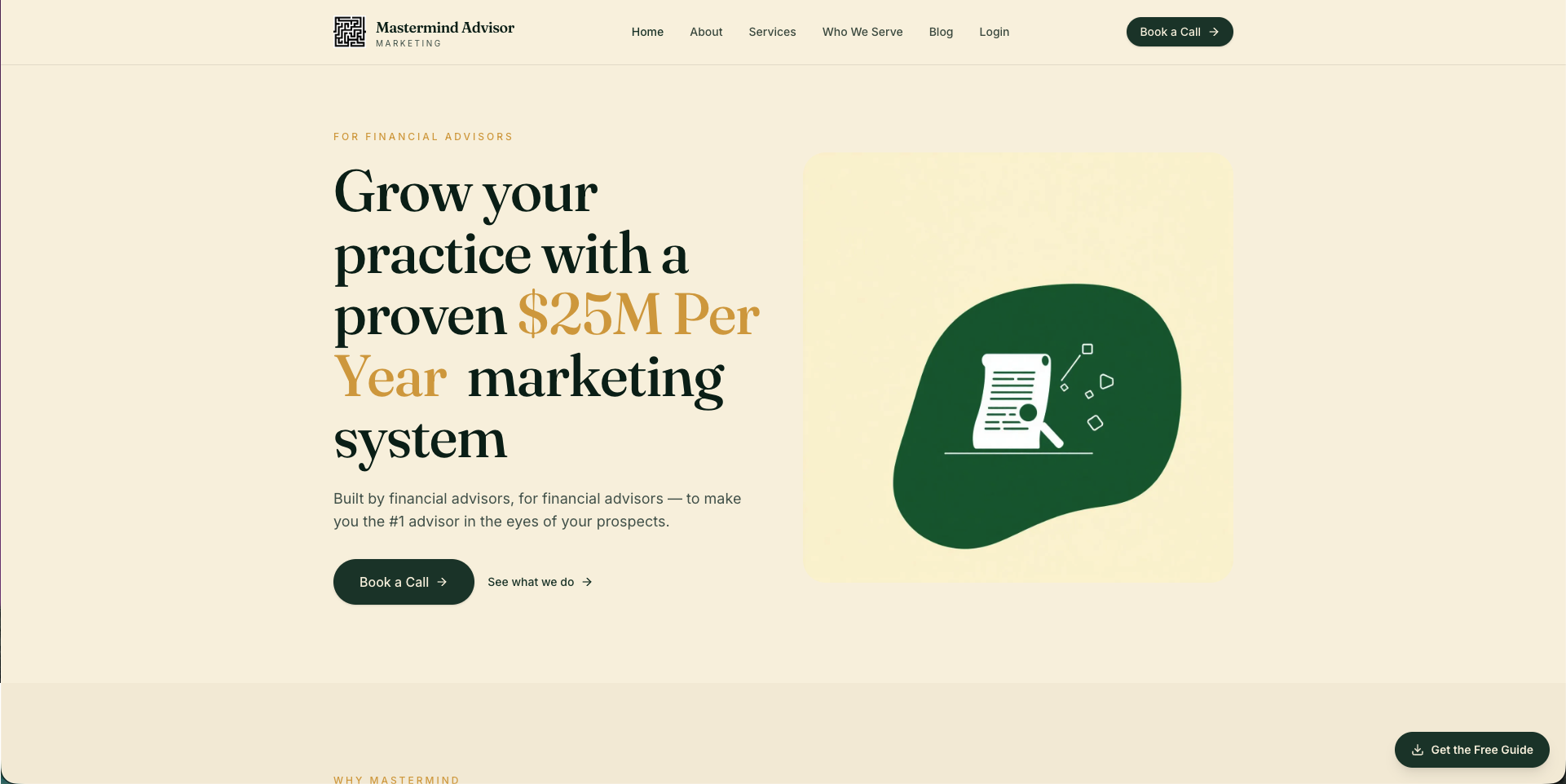
Mastermindadvisormarketing is built specifically for that gap. The turnkey system includes a high-converting advisor website where your USP becomes the homepage headline from day one, compliance-friendly email drip campaigns that carry your message through a full nurture sequence, and scheduled social content that reinforces your positioning without requiring you to write a post every week. The CRM integration tracks which version of your message is driving booked meetings, so iteration is based on data, not gut feel.
The pilot is straightforward: a short engagement to draft your homepage headline, run two email A/B tests, and measure results within 30 days. To see how it works for your practice, visit Mastermind Advisor and request a pilot conversation.
Sources
The sources below are worth bookmarking as you build and refine your USP.
- Is the RIA world suffering from a 'cliche crisis'? - InvestmentNews
- Financial Advisors: Where Are Values in Your Value Proposition? | Morningstar