
Inbound marketing advisors are specialists who build content-driven systems that help financial advisors attract, qualify, and convert prospects without cold calls or interruptive outreach. Instead of chasing leads, you earn them by publishing content that answers the questions your ideal clients are already searching for. Inbound marketing helps advisors get found and generate qualified leads when published content meets prospects during their research process.
Hiring an inbound specialist makes the most sense when you have limited internal time, need content that holds up under FINRA or SEC review, or want a scalable lead engine that compounds over months rather than burning out after a single campaign. Platforms like Mastermindadvisormarketing are built specifically for this, integrating SEO, webinars, compliance-friendly content libraries, and CRM automation into one system designed for advisory firms.
Three quick signals that inbound is right for you now:
- Your referral pipeline is inconsistent and you need a second, predictable channel.
- You want prospects who already trust your expertise before the first call.
- You lack the internal bandwidth to manage content, compliance review, and follow-up separately.
Key Takeaways
| Point | Details |
|---|---|
| Inbound vs. outbound timing | Outbound fills pipeline in months 1–12; inbound compounds from month 6 onward and keeps generating leads after publication. |
| Compliance is non-negotiable | Every blog post, email, webinar, and lead magnet is an advertisement under FINRA Rule 2210 and the SEC Marketing Rule; build a pre-approval workflow before publishing. |
| Five core tactics | SEO pillar content, quarterly webinars, high-value lead magnets, email nurture sequences, and intent-targeted paid amplification form a reliable inbound program for advisors. |
| Build vs. hire decision | If you lack 10+ hours per week, compliance-aware copywriting experience, or a 12-month commitment to consistent execution, hiring an inbound specialist is more efficient. |
| Mastermindadvisormarketing | Delivers a turnkey inbound system for independent advisors, including webinars, compliance-friendly content, CRM integration, and automated nurture, purpose-built for advisory firms. |
Table of Contents
- What does inbound marketing actually include for advisors?
- 5 inbound strategies that reliably work for financial advisors
- Inbound vs. outbound for advisors: when does each one win?
- How inbound maps to the advisor client journey
- Timeline, costs, and ROI expectations for advisor inbound
- Should you build inbound in-house or hire a specialist?
- Common myths advisors believe about inbound marketing
- Legal and compliance considerations for advisor inbound campaigns
- Why a compliance-first inbound system is the right foundation
- Mastermindadvisormarketing gives advisors a ready-built inbound system
- Sources
What does inbound marketing actually include for advisors?
Inbound is not one tactic. It is a coordinated set of channels that work together to move a stranger from "I found this article" to "I booked a call." Here is what a qualified inbound marketing consultant should plan and execute for your firm.
Blog and SEO. A well-structured blog targeting search queries like "how to reduce taxes in retirement" or "when should I hire a financial advisor" pulls in prospects at the exact moment they are researching. Building a financial planning blog that ranks requires keyword research, internal linking, and consistent publishing, not just good writing.
Gated guides and lead magnets. A downloadable checklist, retirement readiness quiz, or estate planning guide gives visitors a reason to share their email. This is where anonymous traffic becomes a named lead.
Webinars and seminars. A live or recorded webinar on estate tax planning for business owners, for example, positions you as the expert and generates a registration list you can nurture. Treating webinars as gated lead funnels with pre-event promotion, live delivery, automated replay, and a multi-step nurture track converts attendees to discovery calls within 30–90 days.
Email nurture sequences. After someone downloads your guide or attends your webinar, a five-to-seven email sequence keeps your name in front of them until they are ready to act. Each email should deliver a specific piece of value, not just a reminder that you exist.
Podcasts and video. These build the kind of familiarity that written content alone cannot. A short video explaining Roth conversion strategy does more for trust than a white paper on the same topic.
Social distribution. LinkedIn is the primary channel for most advisors. Distributing your content there extends reach without requiring new content creation.
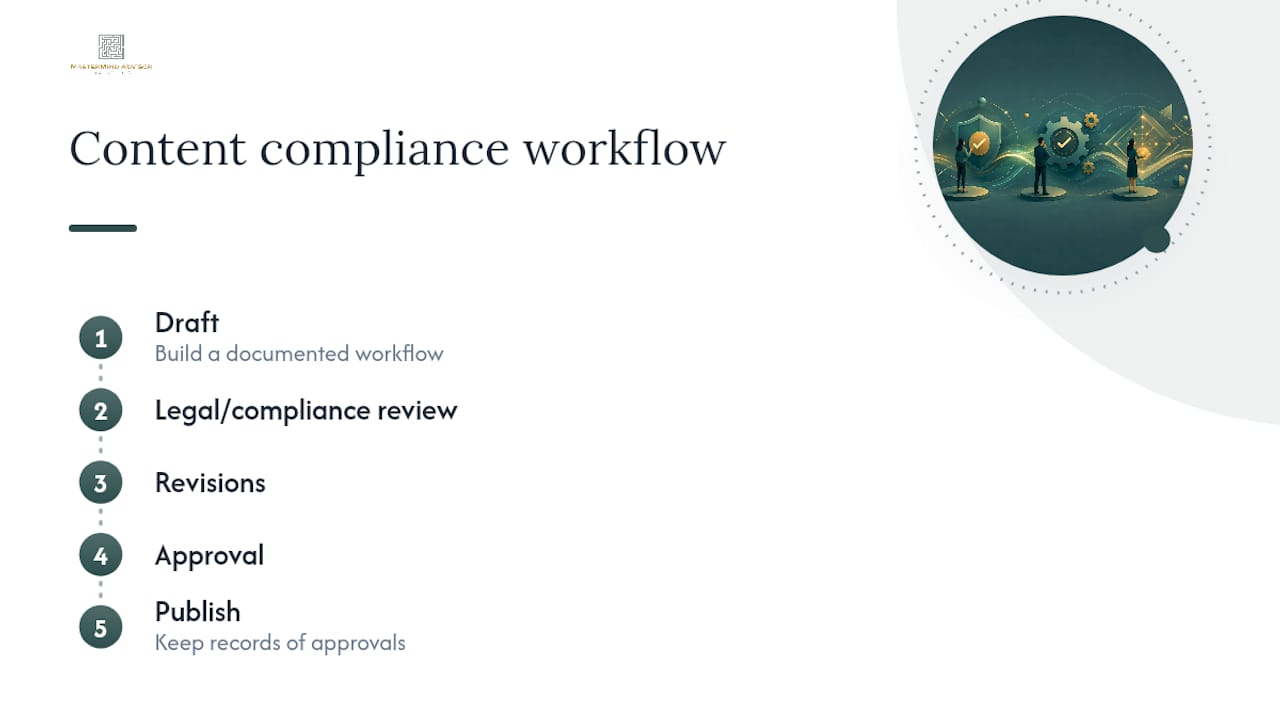
Pro Tip: Every piece of content you publish must go through a compliance review before it goes live. Build a documented workflow: draft, legal/compliance review, revisions, approval, publish. Keep records of approvals in a format your broker-dealer or RIA compliance officer can audit. This is not optional, and a good inbound advisor will have this process built in from day one.
5 inbound strategies that reliably work for financial advisors
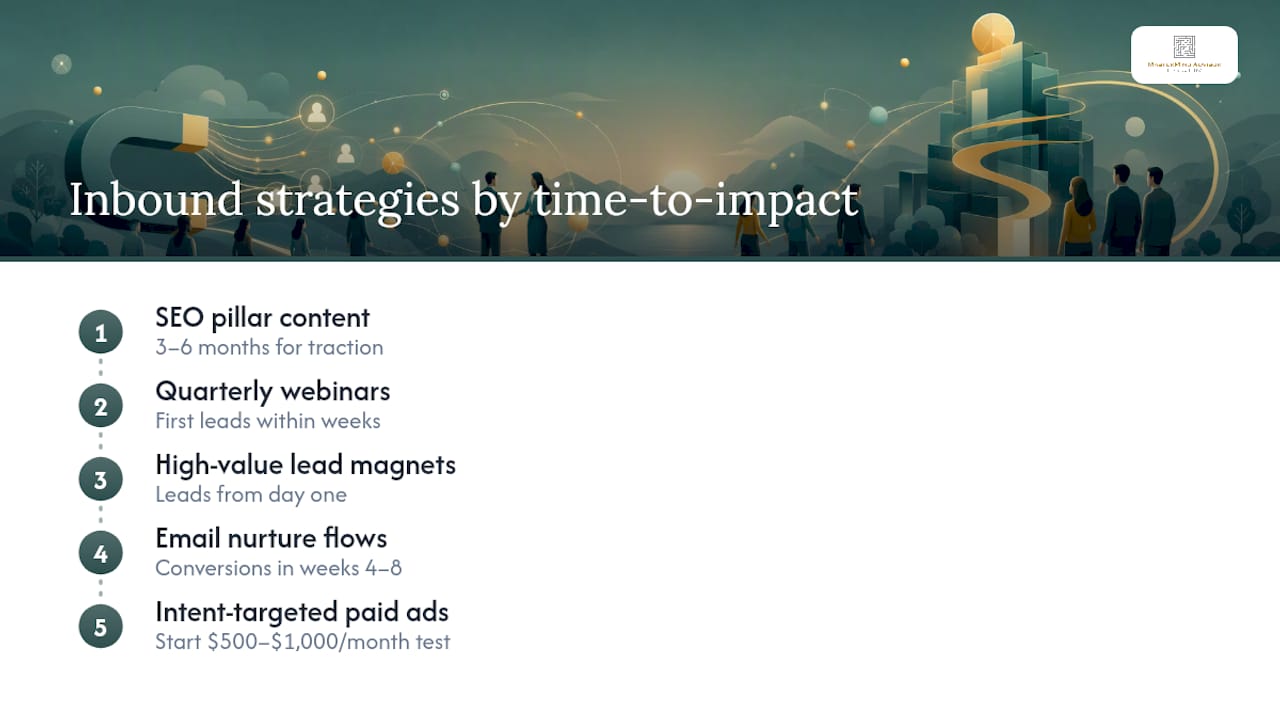
These are ranked by reliability and time-to-impact, not complexity. Start at the top and add layers as your system matures.
1. SEO-driven pillar content and service pages
Why it works: SEO-driven leads convert at roughly 14.6% versus 1.7% for outbound in tracked samples. A prospect who finds you by searching "fee-only financial advisor in Denver" is already in buying mode.
How to start: Identify five to eight core service topics (retirement planning, tax strategy, estate planning, etc.). Write one authoritative 1,500-word page for each. Link them together. Add a local SEO layer with your city and niche. Expect meaningful organic traction in three to six months.
2. Quarterly webinars with gated registration
Why it works: Webinars generate a warm, named audience who opted in specifically because your topic matched their situation. That is a higher-quality lead than almost any paid channel.
How to start: Pick one topic per quarter that maps to a seasonal planning trigger (year-end tax moves, Social Security timing, market volatility). Promote via email, LinkedIn, and paid social. Collect registrations through a simple form that captures name, email, and one qualifying question. Time-to-impact: first leads within weeks of your first event.
3. High-value lead magnets
"Retirement Readiness Checklist for Business Owners" outperforms "Free Financial Guide" every time.
How to start: Define your ideal client profile first, then build the lead magnet around the single biggest question that profile has before they hire an advisor. Gate it behind a short form. Time-to-impact: leads from day one of promotion.
4. Email nurture flows
Why it works: Most prospects are not ready to hire when they first find you. A structured nurture sequence keeps you relevant across the weeks or months until they are. Firms with documented content strategies and measurable KPIs consistently outperform those that publish without a plan.
How to start: Build a five-email sequence triggered by each lead magnet download. Email 1: deliver the asset. Emails 2–4: related insights and case examples. Email 5: soft invitation to schedule a call. Time-to-impact: conversions typically begin appearing in weeks four through eight.
5. Intent-targeted paid amplification
Why it works: Paid social and search ads work best when they amplify existing inbound assets rather than replace them. Promoting a webinar or guide to a targeted LinkedIn audience of business owners aged 45–60 in your metro area is far more efficient than running a generic brand awareness campaign.
How to start: Start with a $500–$1,000 monthly test budget on LinkedIn. Target by job title, geography, and age. Send traffic to your webinar registration page or lead magnet landing page, not your homepage. Time-to-impact: measurable lead volume within two to four weeks.
A practical three-step framework for advisors starting from scratch: define your ideal client, map content to each stage of their decision journey, then build a promotion and nurture workflow around that content.
Inbound vs. outbound for advisors: when does each one win?
Inbound earns attention by publishing content that prospects find on their own terms. Outbound creates attention by reaching out directly, through cold calls, direct mail, paid prospecting lists, or seminar invitations sent to rented lists.
Neither is universally better. The right mix depends on where your firm is right now.
New advisor (under $50M AUM): Outbound fills the immediate pipeline while inbound builds. You cannot wait six months for SEO to compound when you need clients this quarter. Run targeted outbound (LinkedIn outreach, referral campaigns, local seminars) while publishing two to four pieces of inbound content per month. The inbound assets you build now pay dividends in year two and three.
Established RIA ($100M–$500M AUM): Inbound becomes the primary engine. Your brand has enough credibility that content marketing accelerates trust. Outbound shifts to account-based tactics, targeting specific high-net-worth segments with personalized messaging that references your published thought leadership.
Scale-phase firm ($500M+ AUM): Both channels run in parallel with clear attribution. RIA firms using intent signals can reduce acquisition costs by up to 60% while improving lead quality by 200–400%. At this stage, intent data (identifying which companies or individuals are actively researching financial planning topics) lets you prioritize outbound outreach toward the prospects most likely to convert.
Integration tactic worth using now: Send webinar invitations to your outbound prospecting list, but make the webinar itself an inbound asset with a public registration page. This means your outbound effort drives traffic to a compounding inbound asset rather than a one-time event. The fastest-growing financial services firms run inbound and outbound together; the balance shifts by stage, but combining both accelerates pipeline while inbound builds long-term authority.
Timeline reality: Outbound drives immediate pipeline in weeks one through twelve. Inbound compounds over months six through eighteen and beyond. Blog posts, guides, and webinar replays continue generating leads long after publication. A cold call does not.
How inbound maps to the advisor client journey
Understanding the funnel stages helps you match the right content to the right moment, so you are not sending a "schedule a call" email to someone who just discovered you thirty seconds ago.
Discover: The prospect searches a question, finds your blog post or video, and learns your name for the first time. Content that works here: SEO articles, LinkedIn posts, podcast episodes, YouTube videos. Goal: get found and make a strong first impression.
Engage: They read more, download a guide, or register for a webinar. Content that works here: lead magnets, webinar registrations, email newsletter sign-ups. Goal: capture contact information and begin a relationship. A well-structured marketing funnel maps each of these stages to specific content types and conversion points.
Evaluate: They are comparing you to other advisors. Content that works here: case studies, testimonials, detailed service pages, comparison guides, FAQ content. Goal: reduce hesitation and build confidence.
Convert: They are ready to talk. Content that works here: a clear scheduling page, a discovery call offer, a free consultation. Goal: remove friction and make booking easy.
Lead capture mechanics that move prospects through these stages:
- Gated assets with short forms (name, email, one qualifying question).
- Webinar registration pages that collect firm size, assets, or planning concern.
- Calendar scheduling tools (Calendly or similar) embedded on service pages.
- Progressive profiling: ask one additional question each time a prospect downloads a new asset, building a richer profile over time.
Lead scoring signals that indicate meeting readiness:
- Attended a live webinar (not just registered).
- Downloaded two or more assets.
- Visited your pricing or "work with me" page.
- Opened five or more emails in a nurture sequence.
- Returned to your site multiple times within a two-week window.
A brief compliance note: under SEC and FINRA rules, all marketing materials, including gated content and email sequences, must be retained as advertising records. Your CRM and email platform should be configured to log and archive every communication automatically.
Timeline, costs, and ROI expectations for advisor inbound
Set realistic expectations before you commit budget. Inbound is not a quick fix, but it is one of the most cost-efficient lead channels available to advisors when executed with discipline.
What to expect at each phase
KPIs worth tracking
Organic traffic growth, qualified leads per month, cost per lead, conversion rate from lead to initial meeting, cost per acquired client, and lifetime value to client acquisition cost ratio (LTV:CAC). Measuring SEO performance gives you the attribution data to know which content is actually driving pipeline, not just traffic.
Budget shapes
A solo advisor running a lean inbound program (one blog post per month, one quarterly webinar, basic email automation) can expect to spend $1,500–$3,000 per month on tools, content production, and part-time support. A mid-sized RIA running a full inbound program with weekly content, monthly webinars, paid amplification, and CRM integration typically invests $4,000–$8,000 per month, whether through an agency retainer or a combination of internal staff and tools.
Firms with documented acquisition strategies acquire significantly more new clients than those operating without one. The efficiency gap between structured inbound and ad-hoc marketing widens considerably over an 18-month horizon.
Should you build inbound in-house or hire a specialist?
Most advisors underestimate how many distinct skills a functioning inbound program requires. Here is what a complete team looks like:
- Content strategist: defines topics, maps content to buyer stages, manages the editorial calendar.
- SEO specialist: handles keyword research, on-page optimization, and SEO for financial advisors.
- Compliance-aware copywriter: produces content that passes regulatory review without losing its persuasive edge.
- Event/webinar producer: manages registration, promotion, live delivery, and replay distribution.
- Marketing operations owner: runs the CRM, email automation, lead scoring, and attribution reporting.
That is five distinct roles. Most solo advisors and small RIAs cannot staff all five internally, which is exactly why inbound marketing consultants exist.
Three diagnostic questions to decide build vs. hire:
- Do you have 10+ hours per week to dedicate to content creation, promotion, and follow-up? If not, outsourcing is almost always more efficient.
- Does your internal team have compliance-aware marketing experience? Generic copywriters routinely produce content that fails FINRA review, costing time and creating liability.
- Can you commit to 12+ months of consistent execution? Inbound fails when it is treated as a short-term project. If internal priorities will compete for that time, a retainer relationship with a specialist holds the program accountable.
Tool categories you need regardless of who runs them: a CRM (to track every lead and touchpoint), email automation (for nurture sequences), a webinar platform (Zoom Webinars, Demio, or similar), SEO tools (Semrush or Ahrefs for keyword research and rank tracking), and analytics (Google Analytics 4 plus a call-tracking layer). A marketing automation checklist helps you configure these tools correctly from the start, so leads do not fall through the gaps between platforms.
Firms with documented content strategies, clear audience definitions, and measurable KPIs consistently outperform those that publish without a plan. That discipline is easier to maintain when someone owns it full-time.
Common myths advisors believe about inbound marketing
Getting these wrong costs time, money, and momentum.
Myth: Inbound is essentially free. Reality: Inbound requires professional execution to become a reliable lead engine. Content production, SEO, compliance review, webinar production, and CRM management all carry real costs. The Financial Planning Association notes that advisors who treat inbound as a free substitute for proactive business development consistently underinvest and see weak results.
Myth: Publishing more content produces more leads. Reality: Volume without strategy produces traffic without conversion. A documented content strategy with clear audience definitions and KPIs is what separates firms that see ROI from those that publish sporadically and wonder why nothing is working.
Myth: Inbound replaces outbound. Reality: Inbound and outbound serve different parts of the pipeline. Inbound builds authority and captures prospects who are already searching. Outbound reaches prospects who are not yet searching but fit your ideal client profile. Running both together, with inbound assets amplifying outbound outreach, produces better results than either channel alone.
Myth: Results come within 60 days. Reality: SEO takes three to six months to show meaningful traction. Email nurture sequences take four to eight weeks to produce conversions. Webinar pipelines build over multiple events. Advisors who quit at month two never see the compounding returns that begin at month six.
Pro Tip: Before you hire any inbound marketing advisor, ask to see a documented content strategy they built for another advisory firm, including the keyword map, editorial calendar, and KPI dashboard. If they cannot produce one, they are selling tactics, not a system.
Three things to do differently starting this week: audit your existing content assets (blog posts, guides, old webinar recordings) to identify what can be repurposed or updated; define your ideal client profile in writing using a buyer persona framework; and set one 90-day goal with a measurable outcome (e.g., 50 new email subscribers from a lead magnet).
Legal and compliance considerations for advisor inbound campaigns
Financial advisors operate under a stricter marketing framework than almost any other professional services category. Getting this wrong does not just hurt your brand; it can trigger regulatory action.
FINRA Rule 2210 and SEC Marketing Rule (Rule 206(4)-1). All marketing communications, including blog posts, social media content, webinars, email campaigns, and lead magnets, are considered advertisements under these rules. They must be fair, balanced, and not misleading. Testimonials and endorsements are permitted under the updated SEC Marketing Rule (effective November 2022), but they require specific disclosures and cannot be cherry-picked to create a misleading impression.
Record-keeping requirements. SEC-registered advisors must retain all marketing materials and related communications for at least five years under Rule 204-2. FINRA member firms have parallel requirements under Rule 4511. Your CRM, email platform, and webinar system should be configured to archive every outbound communication automatically.
Pre-approval workflows. Many broker-dealers require principal pre-approval of all advertising materials before publication. Even RIAs without a broker-dealer relationship should build an internal review step into their content workflow. Document who reviewed each piece, when, and what changes were required.
Specific content risks to watch:
- Performance claims require appropriate context and disclosures. "Our clients average X% returns" is almost always a compliance problem.
- Hypothetical illustrations must be clearly labeled as such.
- Third-party rankings and awards (e.g., "Top Advisor" lists) require specific disclosures about the criteria and any compensation involved.
- Social media posts that include investment recommendations or specific securities are subject to the same rules as formal advertising.
Practical step: Build a two-column compliance checklist into your content approval workflow. Column one lists the content element (headline, performance claim, testimonial, call to action). Column two confirms the required disclosure or review step for each. Any inbound marketing advisor you hire should arrive with this process already built.
Why a compliance-first inbound system is the right foundation
Most inbound marketing advice is written for SaaS companies or e-commerce brands. The tactics translate, but the compliance layer does not exist in those playbooks. That gap is exactly where advisors get into trouble.
The advisors who build durable inbound programs do not start with tactics. They start with positioning: who is the ideal client, what question does that person have before they hire an advisor, and what content answers that question in a way that also passes regulatory review. Get those three things right and the tactical execution becomes straightforward.
Content pillars come first because they determine everything downstream. A pillar on "retirement income planning for business owners" generates blog posts, webinar topics, lead magnet ideas, email sequences, and LinkedIn content for months. Without that pillar structure, you end up with a collection of disconnected posts that never build authority on any topic.
Webinar programs deserve more credit than most advisors give them. A quarterly webinar series, run consistently for 12 months, builds a warm audience of several hundred qualified prospects who have self-selected based on topic relevance. That list is more valuable than most paid lead sources, and it compounds with each event.
CRM integration is where most advisor inbound programs break down. Leads come in, get logged somewhere, and then fall through the cracks because no one owns the follow-up. Automated nurture sequences tied to specific lead sources, with clear handoff rules to the advisor when a lead hits a scoring threshold, are what turn a content program into a revenue engine.
Mastermindadvisormarketing gives advisors a ready-built inbound system
Independent advisors who try to assemble an inbound program from scratch typically spend six to twelve months and significant budget before they have a functioning system. Mastermindadvisormarketing shortens that timeline considerably by delivering a turnkey system built specifically for advisory firms.
The platform includes customized lead-generation webinars and fully produced seminars (in-person and virtual), a compliance-friendly content library, automated email drip campaigns, scheduled social media content, high-converting advisor websites, and integration with custom CRM and email automation tools. Every component is designed for the regulatory environment advisors operate in, so compliance review is built into the workflow rather than bolted on afterward.
Advisors using the system gain qualified leads from content that works while they are meeting with existing clients, not just when they are actively prospecting. The CRM integration means no lead falls through the cracks, and the automated nurture sequences keep prospects engaged across the weeks or months before they are ready to schedule a call.
Schedule a discovery call with Mastermindadvisormarketing to see how the system maps to your firm's specific goals and client profile.
Sources
These sources give you the evidence, templates, and tactical depth to follow up on any section of this article.
- RIA Client Acquisition Playbook for Digital AUM Growth | Defiance Analytics
- Contentmarketinginstitute
- Blog
- Inbound Marketing Can Help Advisors Grow