
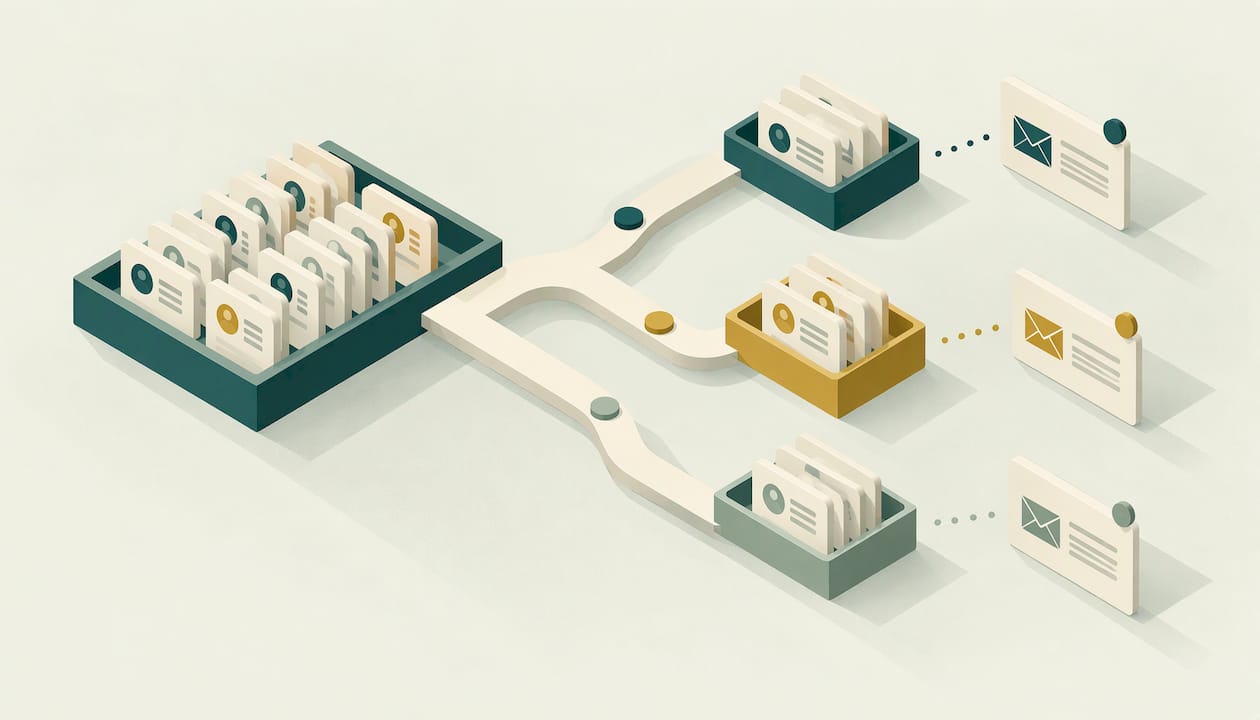
Advisor list segmentation means splitting your contacts into smaller groups, such as clients, prospects, centers of influence and event attendees, so each group gets messages that fit its situation. Start with three to five segments, built on client status first and one behavior or life-stage lens second. Then write one tailored follow-up per segment and track what happens. That beats a monthly newsletter sent to everyone.
This guide shows how to choose segments, which data to collect, what to send each group, how to keep the process compliant in the U.S., and how to judge whether it works.
TL;DR
- Segment by who the contact is to your practice (client, prospect, center of influence, past event attendee) before anything else.
- Keep it small: three to five core segments, then add a second lens such as life stage, interest or engagement.
- Do not rely on assets under management (AUM) alone. Behavior, complexity and life stage often say more about what a contact needs.
- Every segment needs a defined message and a defined next step, or the segment is only a spreadsheet column.
- Segmented email is still commercial email. Keep opt-outs, sender identification and your firm's review process in place for every send.
Table of Contents
- What list segmentation means for an advisory practice
- Start with the relationship, not the portfolio
- Add a second lens: the traits worth tracking
- How many segments is enough?
- Build the segments in your CRM
- What to send each segment
- Keep segmented email compliant
- Measure whether segmentation is working
- Perspective
- How we help advisors put this into practice
- FAQ
- Sources
What list segmentation means for an advisory practice
Most advisors have one big list built over years: client emails, a few hundred webinar registrants, people who met you at a seminar, a CPA or attorney or two, and old leads nobody followed up with. Sending the same email to all of them guarantees that most readers see something irrelevant.
Segmentation fixes that by grouping contacts on shared traits or behaviors. A retiree two years from Social Security decisions and a 38-year-old tech employee with stock options are both "leads," but they are asking different questions. The same is true of a client who has been with you for ten years and a prospect who downloaded one checklist last week.
The work is not complicated, but it does need a plan. You pick the traits that matter, record them consistently in your CRM, and write for each group. We cover the broader audience question in our guide to audience targeting for financial advisors. This article stays on the list itself.
Start with the relationship, not the portfolio
The first cut should be the simplest: what is this person to your firm? A practical starting set looks like this:
- Current clients, ideally split further into new or onboarding clients and established clients.
- Prospects, meaning people who have raised their hand through a webinar, a consultation request or a download.
- Centers of influence, such as CPAs, estate attorneys and other professionals who may refer clients.
- Topic-interest audiences, such as people who asked about retirement income or business exit planning.
Capital Group's practice-management article on email for advisors describes this same kind of grouping, with subsets for existing clients, new clients, prospects, centers of influence and topic-interest audiences, and notes that CRM software can make segmenting and personalizing straightforward.
This first layer matters because it controls tone and purpose. A client email can assume trust and a shared history. A prospect email has to earn attention. A center-of-influence email should be short, professional and about how you work with their clients, not about market commentary.
Add a second lens: the traits worth tracking
Once relationship status is clean, add one more lens. Common dimensions advisors use include life stage, assets or net worth, service interest, location and referral source. Behavioral signals include engagement level and what content the person downloaded or clicked.
MassMutual Ascend's client segmentation guide sorts these into three types:
| Segmentation type | Example dimensions | What it tells you |
|---|---|---|
| Demographic | Age or generation, career stage, relationship status | Which planning topics are likely relevant |
| Psychographic | Risk tolerance, investment preferences | How to frame the message |
| Behavioral | Engagement, communication preferences | When and how to reach them |
Pick the lens that connects to something you can actually say. "Pre-retiree, within five years" gives you a clear content track. "Lives in the Midwest" usually does not, unless you run regional events.
Why AUM alone is a weak sorting tool
Many practices default to tiers by assets. State Street's client segmentation framework says revenue and assets are useful inputs, but that defaulting to AUM alone rarely tells the full story. Its example: a client with $500K in investable assets who regularly refers new business may deserve more attention than a $1.5M client who engages little and never refers.
SEI's Growth Lab makes a related point. It cautions that A, B, C or Gold, Silver, Platinum tiers often reflect what matters to the advisor rather than the client, and it suggests asking who you enjoy working with, who sees the most value and whether a segment is sustainable. For email, that translates into a simple rule: sort by what a person needs and how they engage, then use assets as one input among several.
How many segments is enough?
Fewer than you think. State Street recommends piloting with one team or advisor, choosing one lens to start with, and aiming for three to five core segments so the model stays manageable. A practice-points PDF on segmenting clients gives the same advice: begin with three to five drivers and expand only if needed, since too many criteria can stall the effort.
In email terms, a workable first build for a solo or small RIA might be:
- Established clients
- New clients in their first year
- Warm prospects (attended an event or requested a conversation)
- Cold or older leads
- Centers of influence
That is enough to send five different kinds of email. You can add life-stage tags inside each group later without adding new lists.
If your niche is still fuzzy, segmentation gets harder, because you do not know which topics matter most. Our niche selection guide and the independent advisor target market guide help with that decision. For a broader view on defining who you are writing to, this walkthrough on how to identify your target audience is a helpful companion.
Build the segments in your CRM
Segments are only as good as the data behind them. A few habits make the difference.
Use tags or fields, not memory. Whatever CRM or email tool you use, record status, interest and source as structured fields. TaxDome's help center, for example, recommends filtering by tags such as service, type (small business owner), status (prospect, new client, returning client) or priority (VIP), so you can target a precise group instead of the whole list.
Capture the signal at the source. A registration form for a retirement-income webinar already tells you the topic of interest. Tag every registrant at the moment they sign up, rather than hoping to reconstruct it later. Add one optional question to forms, such as "What best describes your situation?", and use the answers as tags.
Separate what you know from what you guess. A tag for "age 55 to 65" should come from the contact, not from a hunch. Wrong assumptions in a personal email cost more trust than a generic greeting.
Clean on a schedule. Once a quarter, merge duplicates, remove bounced addresses and retire stale tags. Move inactive prospects into a re-engagement group so they stop diluting your results.
If you are still setting up the underlying system, our email campaign setup guide covers the tools and sequence.

What to send each segment
Segmentation pays off only when each group receives something different. Here are practical pairings that match the structure above. They are starting points, not tested benchmarks.
| Segment | Purpose of the email | Example follow-up |
|---|---|---|
| Established clients | Deepen the relationship, prompt reviews, invite referrals | Annual review reminder; plain-language explainer on a law change that affects them |
| New clients | Confirm they made a good decision and set expectations | Welcome series covering what happens in the first 90 days |
| Warm prospects | Move toward a first meeting | Recap of the webinar or seminar with one clear invitation to book a call |
| Older or cold leads | Re-open the conversation | Short check-in with one useful resource and an easy opt-out |
| Centers of influence | Build referral relationships | Brief note on who you serve and how you coordinate with their clients' other professionals |
TaxDome's help center lists similar triggers in its tag-based examples: sending quarterly planning notes to clients with a given service tag, promoting a package to high-net-worth clients, notifying clients affected by a specific tax law change, introducing services to prospects who have not signed a proposal, and following up with inactive prospects.
Event follow-up is the easiest first win
If you host webinars or seminars, split attendees from no-shows within a day. Attendees get a recap and a next step. No-shows get the replay and a lighter ask. Both groups are already interested in the topic, so this requires no guesswork about relevance. Speed matters here too, and this breakdown of lead nurturing sequences for advisors shows how to plan the first responses.
Write the message after the segment, not before
MassMutual Ascend's guidance is to create tailored messages for each segment after segmenting and to use client data to guide messaging and track outcomes. In practice: for each segment, write down who they are, what they are worried about, what you want them to do next, and the one email that moves them toward it. If you cannot fill in all four, the segment is not ready.
Keep segmented email compliant
Segmenting does not change your obligations; it can increase them, because more distinct messages means more content to review. Three points matter for U.S. advisors.
Commercial email rules apply. Federal CAN-SPAM requirements cover commercial email, including honest sender information, truthful subject lines, a physical address and a working opt-out. When someone unsubscribes, suppress them across every segment, not only the one that sent the message.
If you are an investment adviser, the SEC Marketing Rule governs advertising. The SEC's final rule on investment adviser marketing, effective May 4, 2021, sets general prohibitions for all advertisements, allows testimonials and endorsements with required disclosures and oversight, and requires net performance whenever gross performance is shown. It also excludes most one-on-one communications from the definition of an advertisement, with exceptions. A segmented mass email is not one-on-one, so assume the rule applies to it and confirm edge cases with your compliance professional.
If you are a broker-dealer representative, FINRA Rule 2210 applies. As described in FINRA Regulatory Notice 26-14, a retail communication is a written communication to more than 25 retail customers within 30 days, while correspondence goes to 25 or fewer. Retail communications need approval by a qualified registered principal before use. The notice also describes a proposal to modernize that approval standard, so check the current rule text with your compliance team.
Two practical consequences: segments change which category a message falls into, since a message to 20 people may be treated differently from one to 200, and your approval process should cover every segment template, not just the newsletter. Our guide to audit-ready email compliance for RIAs lays out pre-send controls you can adopt.

Measure whether segmentation is working
You do not need industry benchmarks to evaluate your own lists. Compare each segment against its own past performance and against the unsegmented sends you did before.
- Record a baseline. For your last three to five general sends, note open rate, click rate, unsubscribes and replies.
- Track actions, not just opens. Opens are an unreliable signal because email apps can preload messages. Clicks, replies, booked calls and referral introductions tell you more.
- Compare within a segment over time. Is the warm-prospect group booking more calls after you changed the follow-up? Is the established-client group replying to review reminders?
- Watch unsubscribes and complaints by segment. A spike in one group usually means the message does not match the group.
- Review quarterly. Merge segments that behave identically. Split one only when you have a distinct message for each half.
Avoid claiming a specific lift in your own marketing unless you have the data and your compliance reviewer agrees. Keep the numbers internal, use them to decide what to send next, and let client results show up as meetings and referrals.
Perspective
Most advisors we talk to do not have a list problem. They have a sorting problem. The names are there: clients, event attendees, referral partners, leads from two years ago. What is missing is a system that tells each person something that fits.
We built our marketing work around practicing advisors' experience, and one lesson repeats: the buying cycle in financial services is long. People attend a webinar, think for months, talk to a spouse, then call. Segmentation is how you stay present through that stretch without becoming noise. A prospect who attended a seminar needs a different next message than a client's CPA.
That is why we pair segmented content with CRM and email automation, so tagging, follow-up timing and reminders run without adding to your week. Done well, it lets the advisor be the first name that comes to mind when the person is ready.
Josh
How we help advisors put this into practice
If you would rather not build segments, templates and automations on your own, our turnkey system covers the pieces this article describes: webinars and seminars that generate tagged leads, a compliance-friendly content library, automated email drip campaigns, custom CRM and email automation, social content and advisor websites. We work only with independent financial advisors, so the system is shaped around regulatory needs and long buying cycles.
See what is included in our services, or start with a growth strategy conversation to map your segments and the follow-ups behind them. For more on why email carries so much weight for advisors, read why email marketing converts advisors.
FAQ
What is the first segment an advisor should create?
Separate clients from prospects. They need different messages, different tone and, often, different compliance review. Once that split is clean, add centers of influence and a group for people who attended your events.
How many segments should a small RIA use?
Three to five core segments is a sound starting range, a figure both State Street and a practice-points guide on segmenting clients recommend. Add tags inside those groups as you learn what matters, rather than creating many separate lists.
Is segmenting by AUM a bad idea?
Assets are a legitimate input, but they should not be the only one. Layering in behavior, life stage and complexity gives a more accurate picture of what a client needs and how they like to communicate.
Does segmentation affect compliance?
It can. Each segment's messages are still commercial email, and depending on your registration, SEC or FINRA rules may apply to the content and the approval process. Run each segment's templates through your compliance review, and honor unsubscribes across all lists.
How do I know if my segments are working?
Compare each segment with its own earlier results: clicks, replies, booked calls, referrals and unsubscribes. Judge changes over a few sends rather than one, and keep the figures for internal decisions.
Sources
- Client segmentation: A framework for growth, State Street
- Things to consider: ideal client personas, SEI Growth Lab
- Client Segmentation, MassMutual Ascend
- Seven reasons to segment
- Easy and engaging email marketing for financial advisors, Capital Group
- Personalize interactions for specific client groups, TaxDome Help Center
- Final Rule: Investment Adviser Marketing, SEC
- Regulatory Notice 26-14, FINRA