
Email marketing is the most effective channel for financial advisors to convert prospects because it delivers direct, personalized communication that builds trust over time. Known in the industry as permission-based direct marketing, email gives advisors full control over their message, their audience, and their timing. Email marketing returns $36–$44 for every $1 spent, making it the highest-ROI channel available to independent advisors. Mastermindadvisormarketing has built its entire client acquisition system around this channel for exactly that reason. Understanding why email marketing converts advisors starts with one fact: clients choose advisors they trust, and email is the best tool for building that trust at scale.
Why email marketing converts advisors better than any other channel
Email is the only marketing channel advisors fully own. Social media reach depends on algorithms. Paid ads require ongoing spend. Email lists belong to the advisor, with zero marginal cost for each additional send. That ownership matters enormously in financial services, where client relationships take months or years to develop.
61% of financial services clients prefer email as their primary communication channel with advisors. That number tells you where your prospects want to hear from you. Meeting clients on their preferred channel removes friction from the relationship before it even starts.

Email also works across the entire client lifecycle. It generates leads, nurtures prospects, converts clients, and drives referrals. No other single channel does all four. That breadth is why email marketing success for financial services firms consistently outperforms social, direct mail, and paid search in long-term ROI.
How does segmentation increase email conversion rates?
Segmentation is the practice of dividing your email list into smaller groups based on shared characteristics. For advisors, useful segments include life stage (pre-retirement vs. retired), financial goals (wealth accumulation vs. income planning), and prospect status (new lead vs. long-term client). Sending the same message to all of these groups wastes the opportunity email gives you.
Segmented campaigns generate up to 760% more revenue than non-segmented blasts. That gap exists because relevance drives action. A 55-year-old nearing retirement responds to a Social Security timing guide. A 35-year-old building wealth responds to a tax-efficient investing checklist. The same generic newsletter serves neither well.
The engagement data backs this up. Strong segmentation nearly doubles open rates, moving average opens from 9.95% to 16.17%. Higher open rates mean more prospects reading your message, which directly feeds conversion.
- Segment by life stage: pre-retirement, retirement, wealth-building
- Segment by source: webinar attendee, referral, cold opt-in
- Segment by engagement: active openers vs. dormant subscribers
- Segment by financial concern: income planning, estate, tax strategy
Pro Tip: Start with just two segments: prospects and current clients. Send prospects educational content that builds credibility. Send clients service updates and referral requests. That single split will improve your results immediately.
How does email automation scale advisor outreach?
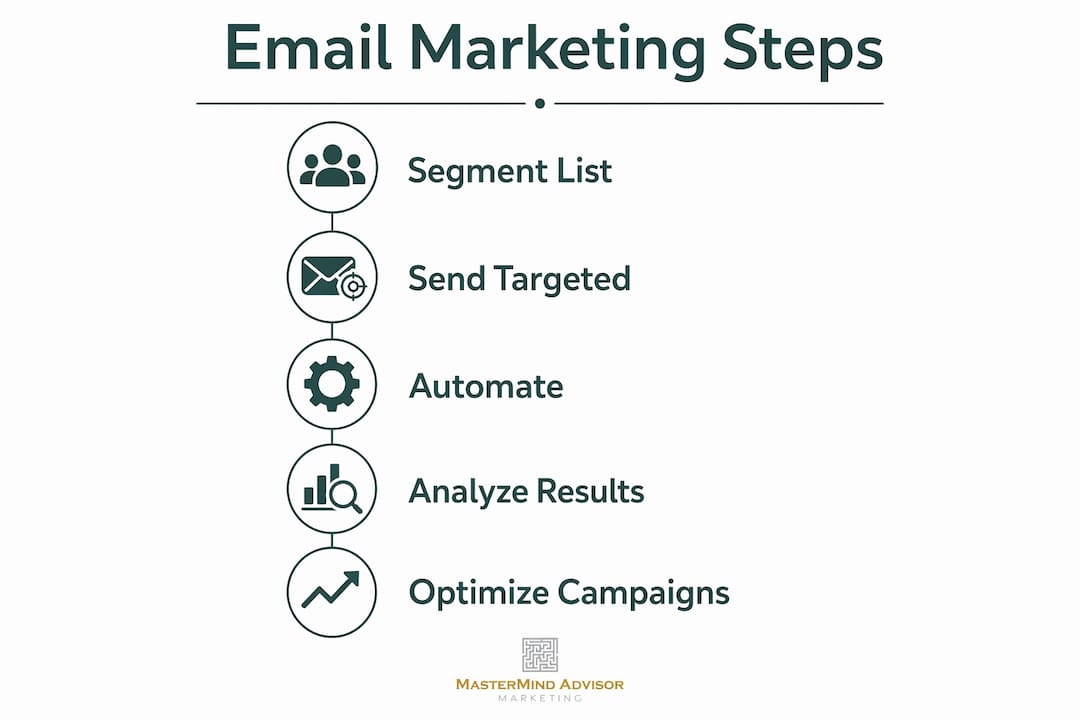
Email automation is the use of pre-built sequences that send based on time delays or subscriber behavior, without manual effort each time. For advisors, the most common automated workflows include welcome sequences, post-webinar follow-ups, and annual review reminders. These workflows run in the background while you focus on client meetings.
The performance gap between automated and manual email is striking. Automated workflows account for 37% of all email-generated sales despite making up only 2% of total sends. That ratio shows how much more effective a well-timed triggered message is compared to a generic broadcast. Automation reaches prospects at high-intent moments, which is when they are most likely to act.
Automated flows generate revenue per recipient nearly 18 times higher than broadcast campaigns. For a solo advisor managing 200 contacts, that difference is the gap between a marketing system that grows your practice and one that just keeps the lights on.
Common automated workflows for advisors:
- Welcome sequence: 3–5 emails over two weeks introducing your philosophy and services
- Post-event follow-up: triggered after a webinar or seminar attendance
- Behavior-triggered: sent when a prospect clicks a specific link or visits a key page
- Annual review reminder: timed to client anniversary dates
Pro Tip: Build your welcome sequence first. It is the highest-leverage automation you can create. A five-email sequence that runs automatically after every opt-in compounds in value every time a new prospect joins your list. Learn more about setting up email campaigns from the ground up.
Why does email work for slow, trust-based advisory sales?
Financial advisory sales cycles last six to eighteen months on average. That timeline is not a problem to solve. It is a reality to work with. Email is the only channel built for that kind of long-term nurturing without burning through a budget.
"Financial advisors sell trust before services. Email's consistent communication cultivates this trust effectively over time." — Email Marketing for Financial Advisors: The Complete Strategy Guide (2026)
During a long decision cycle, prospects need to see you consistently without feeling pressured. A monthly market commentary email keeps you visible. A quarterly educational piece on tax planning builds your credibility. Neither asks for anything. Both remind the prospect that you are the expert they should call when they are ready.
Content types that build trust over time:
- Monthly market commentary with your interpretation, not just data
- Educational guides on retirement income, Social Security, or Medicare
- Client success stories (with permission) that illustrate real outcomes
- Timely responses to news events affecting your clients' portfolios
The key distinction is that email functions as a relationship-building system, not a broadcast tool. Advisors who treat it like a newsletter blast miss the point. The ones who use it to have an ongoing, one-sided conversation with prospects until those prospects are ready to talk are the ones who convert.
How to integrate email into your full advisor marketing strategy
Email does not work in isolation. It needs a steady flow of new contacts to remain effective. Lead generation landing pages are the primary entry point for new subscribers, and without them, your list stagnates. Seminars, webinars, and content downloads all feed the list.
Once contacts are in your system, email becomes the connective tissue of your advisor marketing funnel. It moves prospects from awareness to consideration to conversion through consistent, relevant communication. Weak calls to action or irregular sending breaks that chain.
Here is a practical framework for integrating email across the client lifecycle:
- List building: Use webinars, seminars, and lead magnets to add qualified contacts monthly.
- Prospect nurturing: Send educational content on a consistent schedule, at least twice per month.
- Conversion triggers: Include low-pressure calls to action, such as scheduling a call or downloading a guide, in every third or fourth email.
- Client retention: Send service updates, review reminders, and appreciation notes to existing clients.
- Referral generation: Use behavior-triggered emails at client milestones to request introductions. Referrals generated this way show a 37% higher retention rate than clients acquired through traditional methods.
Pro Tip: Cadence matters more than volume. Two well-crafted emails per month outperform eight rushed ones. Set a schedule you can maintain for 12 months and stick to it. Consistency is what builds the familiarity that converts prospects into clients. Review the full picture of marketing automation for advisors to see how email fits into a broader system.
Key Takeaways
Email marketing converts financial advisors' prospects into clients because it combines channel ownership, segmentation, automation, and consistent trust-building into one system that outperforms every other marketing channel on long-term ROI.
| Point | Details |
|---|---|
| Highest ROI channel | Email returns $36–$44 per $1 spent, more than any other advisor marketing channel. |
| Segmentation multiplies revenue | Segmented campaigns generate up to 760% more revenue than generic email blasts. |
| Automation drives disproportionate sales | Automated workflows make up 2% of sends but produce 37% of email-generated sales. |
| Email fits long sales cycles | The 6–18 month advisor sales cycle requires consistent, low-pressure nurturing that email delivers. |
| Referrals convert better via email | Behavior-triggered referral emails produce clients with 37% higher retention than traditional acquisition. |
What I have learned about email that most advisors ignore
Most advisors I have worked with treat email like a social media post. They send when they feel like it, write whatever is on their mind, and wonder why nothing converts. That approach misses the entire point of the channel.
Email works because it is a system, not a series of one-off messages. The advisors who see real results build sequences, track what gets opened, and iterate based on data. They do not start with 20 automations. They start with one welcome sequence, run it for 90 days, and improve it before adding anything else.
The other mistake I see constantly is confusing activity with progress. Sending three emails a week feels productive. But if those emails have no clear next step for the reader, they train your list to ignore you. Every email needs one purpose and one call to action, even if that action is just reading a related article.
The advisors who win with email in 2026 are not the ones with the biggest lists. They are the ones with the most consistent, relevant, and patient communication. That patience is what the six to eighteen month sales cycle demands. Email is the only channel that rewards it.
— Josh
How Mastermindadvisormarketing supports advisor email marketing
Mastermindadvisormarketing builds turnkey email marketing systems specifically for independent financial advisors. The platform combines custom CRM integration, automated follow-up sequences, and content marketing tools designed around the trust-based sales cycles that define financial services.
Advisors who work with Mastermindadvisormarketing get a complete system: list-building strategies through seminars and webinars, automated nurture sequences, and proven email frameworks that move prospects from first contact to scheduled meeting. The platform is built for solo and small-team advisors who need results without a full marketing department. Visit Mastermindadvisormarketing to see how the system works and what it can do for your practice.
FAQ
Why does email marketing outperform social media for advisors?
Email is a channel advisors own outright, with no algorithm controlling reach or paid spend required. Social media platforms limit organic visibility, while email delivers your message directly to every subscriber.
How often should financial advisors send marketing emails?
Two to four emails per month is the standard cadence for advisor email marketing. Consistency matters more than frequency. A predictable schedule builds familiarity without overwhelming your list.
What is the ROI of email marketing for financial advisors?
Email marketing returns approximately $36–$44 for every $1 spent in financial services. That makes it the highest-ROI marketing channel available to most independent advisors.
How does segmentation improve email conversion rates for advisors?
Segmented campaigns generate up to 760% more revenue than non-segmented sends. Dividing your list by life stage, financial goal, or prospect status makes each email more relevant, which drives higher open rates and more conversions.
What automated email sequences should advisors set up first?
Start with a welcome sequence of three to five emails sent over the first two weeks after a new subscriber joins your list. This sequence introduces your philosophy, builds credibility, and sets expectations for future communication.